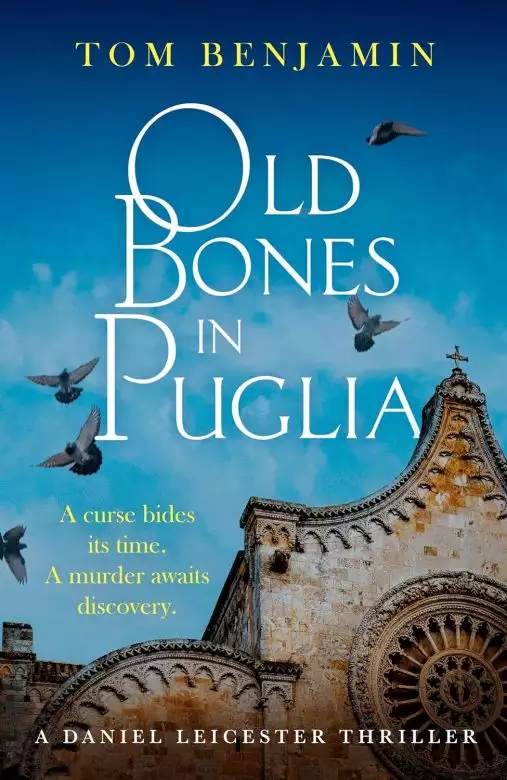
The wildest corner of Puglia is home to mafia clans, catacombs and sinister ceremonies, and when Daniel arrives for a family visit, old grudges resurface and life is breathed into ancient superstitions.
Daniel is drawn into a search for long-lost precious artefacts, but when a contact is gruesomely murdered by Italian mobsters of the most formidable kind, he is faced with an impossible choice. Does he flee for good? Or fight to bring the fearsome perpetrators to justice?
Discover beautiful, bewitching Puglia in the seventh Daniel Leicester thriller, the most propulsive yet.
----------
Praise for Book 6 in the Daniel Leicester series, The Bologna Vendetta:
'A galloping and topical read' - The Florentine
'Evocative, easy to read, and immersive... Old and new mysteries come together in a satisfying, and moving finale. Highly recommended.' - Amazon reviewer, ⭐⭐⭐⭐⭐
'There's plenty of Bologna, lots of mystery and conspiracy, and even some heartbreak via Daniel's past. Highly recommended!' - Amazon reviewer, ⭐⭐⭐⭐⭐
'I have read all this series and loved every single one... I really didn't want to put it down and read it in only a couple of days' - Amazon reviewer, ⭐⭐⭐⭐⭐
'A real treat. One of the few series that I've read throughout and this is the best of the lot. Beautifully drawn characters, a wonderful evocation of Bologna, a twisty plot and a genuinely moving and clever callback to an earlier event. Oozes class.' - Trevor Wood, author of the DCI Jack Parker series
'This brilliant series is consistently unmissable and The Bologna Vendetta is no exception; intriguing, intelligent and thoroughly compelling, it's the best yet!' - Karen Cole, Hair Past Freckle book review blog
Release date:
May 14, 2026
Publisher:
Little, Brown Book Group
Print pages:
80000
* BingeBooks earns revenue from qualifying purchases as an Amazon Associate as well as from other retail partners.
As we sped along the autostrada beside the sparkling sea, I had no inkling of what awaited us in that northernmost part of Puglia. In time, I would come to consider it a kind of malevolent spirit that had fled the rationalising, industrialising forces of modern Italy to skulk among the nation’s wildest crevices, waiting to kill, or be killed. In the meantime, I was supposed to be on holiday.
At least that was what I kept telling myself. Certainly, my daughter Rose and colleague Dolores, who had hitched a lift in our car to go camping in the Gargano, the rude spur into the Adriatic dividing the calf and ankle of Italy’s slender designer boot, were in vacation mode, as was my boss and father-in-law, known even to his kids as the Comandante, sitting beside me in the passenger seat dozing off behind absurd black wraparound sunglasses.
Faidate Investigations would have a skeleton staff this Easter. The Comandante had requested this trip, ostensibly to visit the sister of his late wife who was in hospital in San Giovanni Rotondo, but I suspected the real reason was to make a pilgrimage to the shrine of Saint Pio in the same town to whom the staunchly Catholic Giovanni Faidate had become ‘devoted’ as a young police officer in these parts, and whose likeness – in statue, effigy, poster, calendar or cigarette card – was ubiquitous throughout the south.
We may have been heading to Puglia, but a little like our hometown of Bologna, which could be overlooked by tourists speeding between Florence and Venice, our Puglia hid in plain sight, a wild place characterised by suspicion and superstition and a cacophony of local languages the Italian state labelled ‘dialects’. Hardly anyone came here unless they had to: it was over five hours down the Autostrada Adriatica from Bologna, or a couple either way from the airports in Pescara or Bari. British holidaymakers tended to head south from Bari to Salento and the ‘Sunday supplement’ sights, or north from Pescara to the rustic, yet in their own way equally cultivated, countryside and fortified towns of tourist-friendly Marche and Abruzzo.
But I felt a certain fondness (if not relief, after the drive) as I noted the maroon-rusted sign to Pietrina bent around a pole beside the lonely traffic light at the junction, and turned to take the heavily potholed road towards table-top hills hunched from a distance like slag heaps, but which were actually piles of quarried stone.
Ramparts of cacti, interspersed by reeds, wild palm and yucca, bordered the road. Beyond, a shepherd herded his flock amidst a field of poppies.
We neared the quarries and the road turned white with dust, the smooth outline of those hills becoming ragged, the area’s characteristic yellow limestone piled – massive cube upon cube – like the pyramids.
Rounding the corner, Pietrina spread like a pueblo in the valley around the blue cross glowing from a white church tower. Even though we were just five hundred kilometres from home, the contrast between Emilia’s rich soil and Puglia’s mean earth, those towering oaks and twisted olive trees, the red brick and vanilla marble, left the impression of arriving in another country, certainly another zone – south.
The town’s official title was ‘Pietrina del Gargano’ because it abutted the wooded hills of the vast Gargano national park that brooded across the horizon like a part-submerged alligator. We would visit San Giovanni and Padre Pio (and Giovanni’s sister-in-law) up there in due course, but we were staying here because the Comandante still owned the modest house he had bought with Maria, his late wife, after he had ‘rescued’ her (he liked to joke) from the even smaller – indeed, tiny – town of Congrega Garganico, also on the promontory.
The house was in the centre of town, but we got held up in the suburbs as a large procession of men, dressed casually but wearing white hoods and carrying railway sleepers between them, slow-marched in front of us to the beat of a drum. Rose leaned forward – I realised she had never actually seen this.
‘They’re practising for Holy Week,’ I explained. ‘Like in Bologna, when they bring the Madonna down from San Luca. That’s why they’ve got the beams for the weight, and they dress up for it – hence the hoods.’
‘Just hoods?’
‘Oh no,’ I said. ‘On the day, they go full Ku Klux Klan.’
‘Spooky.’
‘These are your people, Rose. You’re a quarter Pietrinese, remember.’ Although catching her reflection in the rear mirror – that auburn hair, rain-water complexion and blue eyes – she seemed far removed from these small, dark haired, olive-skinned people.
Giovanni’s house was not actually that modest by Pietrinese standards – many homes in the ‘historic’ centre were either shut up or occupied by very old ladies, constituting as they did just two or three rooms, one of which the large families might once have shared with a seasonal pig. It was a three-storey, shuttered townhouse built in the nineteenth century, probably to accommodate the local magistrate, doctor or pharmacist. A handsome building with picturesque balconies looking across to the similarly stately town hall.
Were our fortnighting tourists to take a wrong turn and end up in Pietrina, they might wander cream streets paved by marble off-cuts from the mines, photograph balconied lanes and bleached-yellow vistas, remark upon a ‘quintessential’ southern paese, but in the event they lingered long enough for the early evening passeggiata when the families with very young children trooped up and down Via Roma, they also might experience an unsettling sense of strangeness (appropriately, straniero is the Italian word for foreigner) – chiefly, their own.
They would likely be regarded with brazen, and not especially amiable, curiosity; after failing to find anything more than a few bars and a pizzeria, let alone anywhere to stay, they would depart for larger, more welcoming places. Lacking a tourist trade, the Pietrinese did not feign conviviality. Their work still derived from the countryside or quarries, and the people were cut from soil and stone. They were kind to kith and kin, but generally closed to outsiders. As such, Pietrina actually was the quintessential southern town, but di una volta, as we also say in Italy, of once upon a time.
The Comandante had engaged a local family to keep an eye on the place and there were fresh poppies and daisies set in a crystal vase upon the table in the hallway as we opened up. A scrawny white- and brown-patched typically Pietrinese cat, which thoroughly deserved the epithet moggy, was sat upright in the middle of the hall, observing us coolly with its one good eye (the other was marble-white).
‘Oh!’ exclaimed Rose, who was a sucker for anything animal. She crouched to greet it.
‘Careful,’ I said. A favourite pastime of the brats in these parts was stuffing firecrackers up cats’ bottoms, which had created a breed both extremely wary of humans and inclined to come at them claws first.
But this one appeared to be the exception – I had the impression she was an old lady cat – and permitted Rose to scratch the ruff of her neck.
‘How did she get in?’ I wondered (a subsequent inspection of the house would leave me none the wiser).
‘But this is great.’ Dolores dumped her rucksack. ‘Maybe we should just stay here.’
My daughter, at nineteen very much the junior partner on this expedition with my colleague, shot her a wary glance. To be honest, I was entirely unconvinced that Rose, a creature of clean sheets and hot water, would be able to sustain a week camping in the Gargano with Dolores, almost a decade her senior, who I had ‘discovered’ tending a cow on an urban farm in Bologna, prior to which she had been perfectly at home sleeping rough, but I was keeping out of it. Dolores was presumably teasing Rose, who had asked if she could accompany her. I had quietly asked Dee if she would prefer to go alone and she had shrugged: ‘It’s fine, Dan, but she had better understand – no concessions.’
‘Does she realise there isn’t a phone signal?’
‘She’ll find out soon enough.’
I always had mixed feelings coming here because my late wife, Lucia, had spent much of her time renovating, refurbishing and sourcing items, that vase included.
Walking through the ground floor reminded me what a fine job she had done. She had discovered frescoes beneath the ceilings and the remnants of an earlier, medieval building in exposed brickwork. She had uncovered a regally tiled floor, sourced period furniture, and enrolled my assistance to sand the floorboards in the bedrooms above. At the time, the Comandante had complained – ‘it looks like some kind of domestic museum’ – and undoubtedly most Pietrinese, for whom newness was a symbol of success, would have viewed it askance, but Giovanni had eventually come to appreciate the hotchpotch of styles, or at least stopped complaining. Perhaps, like me, he had simply decided to keep out of it.
He sat at the long kitchen table Lucia had commissioned which was topped by old blue, yellow and white church roof tiles (that he had once muttered was ‘sacrilegious’) and flicked through the post – mainly junk – until he stopped at one handwritten envelope. It appeared to contain another kind of remnant, a letter. Even rarer – one penned by hand in a careful, swirling blue-black ink shadowed through the page. As Giovanni read it, he thoughtfully rubbed his grey beard. I noted that the envelope was addressed to him, but there was no stamp or street name. Yet somehow, receiving a letter here did not seem as odd as it might in Bologna. This was a house that would still receive letters, and Pietrina a place where they might be sent, or at least furtively slotted into the box.
‘A little local difficulty?’ I asked.
‘From an old friend,’ he replied, setting down the two pages and flattening them as they attempted to close.
‘You don’t seem very happy to hear from him.’
‘Oh – a problem. An obligation.’
‘Need you feel obliged?’ A stupid question, but I felt it merited asking. He picked the first page of the letter up again and seemed to be asking himself the same question.
‘The letter was written by a man of the north.’ He laid it back down. ‘And it reads as if it is a problem of the north.’ He sighed. ‘But we are – the pair of us – in the south, and he must know how things are here.’
I knew enough not to ask how things were here. ‘So what do you want to do?’
‘Tomorrow,’ he said. ‘We will talk to him.’
The weather was certainly better in these parts. Bologna could sometimes feel a little like sharing a home with a depressive: after days of winter-grey and fog one might wake to a cloudless blue sky and you could fool yourself into believing it would remain, only for it to retreat behind a grey veil the following morning. In summer, that same blue could become an unblinking curse, heralding another day of relentless heat. But here it seemed always sunny, and somehow okay. I had never visited ‘the Holy Land’, but as a child my wife had accompanied her parents on a trip organised by the local church and had remarked upon the area’s similarities with its olive groves and fertile aridity, hardy shrubs and thorny flowers; serpents, history. Further across the Gargano outcrop was the town of Monte Sant’ Angelo that had once been the departure point for pilgrims setting off for Jerusalem and, having scrambled across the countryside, they must have felt as if they had almost arrived.
The sun shone Easter-bright, a breeze blown through pine, wild herbs and sea salt. Following the winding road up to Congrega, I could understand why the carabinieri – the military police to which Giovanni had once belonged, and which tended to rule the roost outside the big cities – had based themselves in Pietrina. You were on the flats and could swiftly call in reinforcements from San Severo or Foggia, especially if you needed to suppress the uppity communists for which Pietrina had been notorious. You wouldn’t want to be stationed in a place perched up on the cliffs between the winking indigo sea and interior. Congrega may have been little more than a dozen kilometres from Pietrina as the crow flew but there was just a single road up the hill that could be easily blocked. If you needed help, there was absolutely no guarantee it would arrive in time.
Equally, there was no shortcut to the wildest part of the wilderness Dolores had chosen to ‘get away from it all’, and as a consequence she and her intrepid travelling companion would be stuck with us as first we visited Congrega, and then San Giovanni, before finally dropping them in the back of beyond.
‘It was the main fortress for the area,’ the Comandante was saying.
‘Dad, can you slow down?’
‘It had an excellent view of both sea and overland routes.’
‘I’m sorry?’ I said.
‘Slow down,’ said Rose. ‘You’re making me feel sick.’
‘And you see,’ continued the Comandante, ‘how the homes appear to be stacked one upon the other? Another defensive strategy, against pirates.’
‘Better?’ I asked.
‘Just take it easy,’ Rose said queasily.
‘I can’t straighten the road, you know.’
‘But it goes back far longer than that – this is one of the longest continually occupied parts of Europe.’
‘Is that actually true?’ asked Dolores.
‘There’s a cave here where they found thousands of human artefacts dating back to prehistoric times, pottery, burials and paintings, too. That is precisely why there is a museum, and why we are coming this way.’
‘Dad, hurry up.’
‘I thought you told me to slow down!’
‘And, of course,’ the Comandante continued, ‘you come from here, Rose, or at least partly – through your grandmother.’
‘Look out!’ my daughter cried.
‘What?’
‘Oh my god, you just flattened a snake!’
‘I wouldn’t have if you hadn’t distracted me.’ I rounded a final bend and pulled up at the base of the old fortress.
‘Thank God!’ Rose almost fell out of the rear of the SUV and stumbled towards a bench where she slumped down, drawing deep breaths.
‘Seriously,’ I said to Dolores as we got out. ‘Is she all right?’
‘My bet is she can’t handle not being the one behind the wheel.’ She began to wander over to the rail that overlooked the floodplain fading into the interior.
‘Are you saying my daughter’s a control freak?’ I asked. Dolores looked at me askance.
‘Daniel!’ It was the Comandante, beginning to walk up to the museum. ‘Are you coming?’
‘So it begins. I don’t suppose you’d like to join us?’
‘I’m cool.’ Dolores pulled out her tobacco pouch. ‘I’m on holiday, remember?’
‘Yeah, me, too, apparently.’ After going over to check on Rose, who blamed it all on the driver, I followed the Comandante up to the Museo del Paleolitico.
The Paleolithic Museum was a modest modern building that had been constructed to showcase some of the discoveries in the cave and also provide a base for the teams of excavators who regularly visited the site. This was how Giovanni had come to know the professor, who had been working here as a young researcher in the nineteen seventies. Educated company was likely hard to come by back then and, even as a mere carabinieri sergeant, Giovanni presumably had the autodidactic tendencies the would-be professor would have shared.
Still, they greeted each other coolly, these two old friends who had not seen each other in perhaps forty years, with a definite air of reserve, even given that each was from the north (in Professor Roderico Malaparte’s case, Turin). They might have been a pair of old soldiers from opposing sides become converts to peace, although Giovanni’s reticence could in part have been prompted by the professor’s appearance – skin drawn tightly over his fine-boned face, he was as grey as a troglodyte and appeared weary with the effort of holding his skeleton upright. ‘I should explain,’ the professor half-whispered. ‘I have a certain pain throughout my body, a certain chronic pain which doctors believe to be arthritis or osteoporosis, they can’t decide, although heaven knows they have carried out enough tests, but nothing helps, although a strictly vegan diet does appear to alleviate the symptoms.’
‘I am very sorry to hear that,’ said the Comandante. ‘Have you had it long?’
The professor let out a wheeze-like chuckle that appeared to rattle throughout his frame. ‘About thirty years. I realise I appear to be at death’s door – and it certainly feels like that from time to time – but the old ticker seems to go on and on.’
‘That is something, at least,’ said Giovanni.
‘Yes, that is something.’
The professor was flanked by a woman in tan cargo shorts, a shapeless khaki T-shirt and scruffy boots beneath scabbed knees who looked as if she had just come back from a dig (which she well may have). The professor introduced her as his assistant.
‘Assistant professor,’ she added wryly, giving my hand a firm shake. She was handsome, with a prominent ‘Roman’ nose, tied-back jet-black hair and whimsical, chocolate-button eyes, that seemed so typically from these parts I had to ask. ‘That’s right,’ she confirmed. ‘I grew up in Congrega and have been fascinated by the caves since I was a girl. I even used to hang around the site doing errands when I was a kid.’
‘Persefone was my little helper,’ Professor Malaparte said, although she now stood half a foot taller than him. ‘She would skip barefoot across the rocks like a mountain goat.’ We laughed at this picture, although Malaparte seemed perplexed by our amusement. ‘It was Persefone who first noticed,’ he continued. ‘A few days after we arrived from Turin.’ Taking her arm to steady himself, he signalled to a side room. ‘Please.’
A wide bowl-like opening topped the traditionally shaped, bulbous body of an amphora decorated with black geometrical patterns on cream, with looped handles on either side. Similarly geometrical black lines spiralled down to the dark interior. The amphora leaned as if it had been created before the invention of the potter’s wheel and shaped by hand.
‘A funerary olla,’ said Persefone. ‘Around the fifth century, BCE.’
‘They were Greeks in these parts, right?’ I said.
‘Daunian,’ said the professor. ‘Which means “wolf people”. An Illyrian tribe,’ he added, as if this clarified the matter. I nodded solemnly like I understood.
‘Although you’re not entirely wide of the mark.’ Persefone smiled at me knowingly. ‘They came over from the Balkans, mainly what we now know as Albania, in the eleventh or tenth century BCE, but like many of the cultures of the time, they would certainly have been influenced by the Greeks. Judging by the design, this item would have probably been made a little beforehand. Actually.’ She pouted thoughtfully. ‘As well as referring to the cult of the wolf, Daunos is rooted in the word meaning “to strangle”, or literally, “strangler”.’ Her eyes widened. ‘I’ve often wondered what my ancestors got up to.’
‘Excuse us, gentlemen,’ Malaparte said peevishly. ‘Persefone likes to talk.’ I shot her an apologetic look and she rolled those huge eyes. ‘But I cannot fault her powers of observation.’ He nodded and she dug out a tiny torch from a pocket of her cargos. Despite its size, it had a tremendous, laser-like beam, which she directed at the upper ‘dish’. ‘You see this crack?’ There was a small fracture midway down the dish that ran like jagged steps up to the mouth. ‘Now, look at this.’ She laid the torch on the table and picked up an iPad, opening a photo of the same bowl on the table. She expanded it. ‘See?’
‘What precisely?’ I asked.
‘The crack only descends through two lines,’ said the Comandante.
‘That’s it,’ rasped the professor. ‘I never would have noticed. My eyes …’
‘But isn’t that always a possibility?’ I asked. ‘It’s very old – you moved it, placed it in a different atmosphere, and so on.’
‘I asked Persefone to check,’ Malaparte replied dryly.
‘We examined it in the lab,’ she said. ‘Inside the crack, diluted lime had been used to simulate natural encrustation that would have built up. I then tested the clay itself – it was modern.’
‘By “modern” you mean …’
‘Like it was bought last week! Through any regular supplier. Its base is red earthenware. It had been artificially aged using charcoal. Admittedly, it’s an excellent counterfeit …’
‘Except for the spreading crack.’
‘Probably a flaw in the firing process.’
‘So you’re saying the original has gone missing?’ said the Comandante. They nodded. ‘A bowl of this … nature,’ he continued. ‘The original, I mean. What would be its value?’
‘To us?’ said the professor. ‘Priceless. I’m sure any museum would feel likewise, but on the open market … I don’t know. Perhaps a few thousand euros.’
‘So little?’ I asked.
‘A more sophisticated piece by one of the schools …’
‘Which would be a couple of hundred years later,’ Persefone interrupted.
‘Could attract tens … perhaps hundreds of thousands. This, it is very old but age itself … it would depend upon demand.’
‘Collectors,’ I said.
‘Precisely.’
‘Have you tried eBay?’ They looked at me as if I was mad. ‘Why not? All right,’ I said defensively, ‘I can understand why not, given that this is not actually supposed to have gone missing. But it wouldn’t be the first time that stolen goods have been sold online. And not just bikes and old stamp collections, either – you can find all sorts.’
The Comandante ignored me: ‘You woul. . .
We hope you are enjoying the book so far. To continue reading...

 Please log in to recommend or discuss...
