'There are two major stars in this book, the laconic private eye Daniel Leicester and the city of Bologna itself. Tom Benjamin mixes these ingredients perfectly making Italian Rules a really great read.' Ian Moore, author of DEATH AND CROISSANTS
'Italian Rules is a fabulously sophisticated and classy mystery with an utterly gripping plot' Victoria Dowd
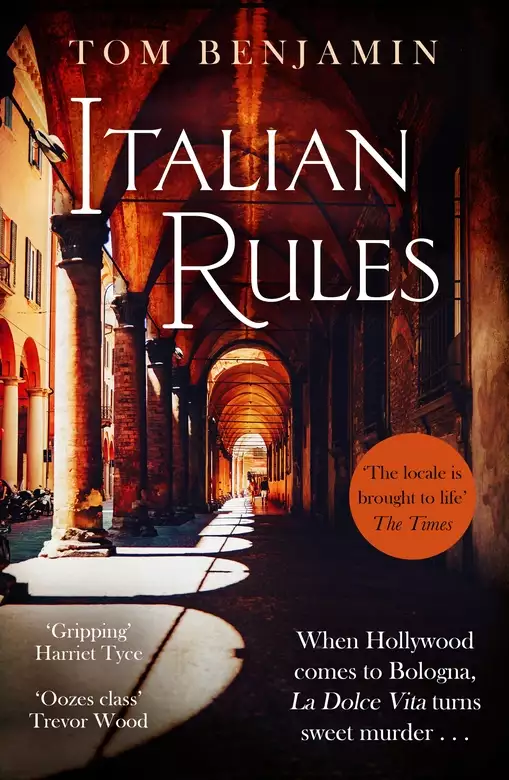
When Hollywood comes to Bologna, La Dolce Vita turns sweet murder...
A famous Hollywood director arrives in Bologna to remake a cult film and the city's renown cinema archive decides to mark the occasion with a screening of the original, only to discover it has disappeared. After English detective Daniel Leicester follows the trail of Love on a Razorblade to an apparent murder-suicide, he begins to suspect there may be more at stake than missing negatives - could the film contain a clue to one of the city's most enduring mysteries? Together with a star from the forthcoming remake, Daniel moves from the glamour of Venice Lido to the depths of Bologna's secret tunnel system as a sinister network closes in and he learns some people are ready to kill for the ultimate director's cut.
Praise for Italian Rules
' Benjamin skilfully combines a cracking crime novel with a love letter to Italian cinema . . . Italian Rules is an absolute treat' Trevor Wood
'Intelligent, kinetically sprung ' Irish Times
'Soul-moving' Peterborough Telegraph
Praise for Tom Benjamin
'The locale is brought to life . . . the plot keeps you guessing' The Times
'A slow-burning, tense and brooding thriller' The Herald Scotland
'Tom Benjamin's debut novel blows the lid off a political cauldron in which Leftist agitators, property moguls, the police and city elders struggle for survival and dominance' Daily Mail
'It's an immensely promising debut, which leaves the reader feeling they really know the city.' Morning Star 'Another great crime novel set in Bologna' Reader Review
'The mystery smolders away nicely and the wrap-up throws some curve balls. Another indulgent offering in this rewarding series.' Reader Review
Release date:
November 10, 2022
Publisher:
Little, Brown Book Group
Print pages:
80000
* BingeBooks earns revenue from qualifying purchases as an Amazon Associate as well as from other retail partners.
The finale, the final twist: the private snoop keeps pace with Ursula through the red city while fresh-faced company clerk Maurizio fusses over the lunch table set for two.
The camera tracks Ursula along the portico, that pulsing synthesiser accompaniment and her blond feathered hair very much dating the film to the mid-1980s.
A BACK SHOT down the seemingly endless portico of Bologna’s Via Saragozza, stretching ahead like a target. FRONT SHOT: in her low-cut blue dress and white heels, Ursula is swallowed by the shadows, bleached by shards of light.
CLOSE UP of the chopping knife Maurizio is using to slice the tomatoes.
It is the denouement of wrought (some critics say over-wrought) giallo-cum-melodrama Amore su una lama di rasoio, literally, Love on a Razorblade, which would be retitled Bad Blood for its English language release: austere, widowed factory boss Vittorio, played by American star Ron Manchester, dubbed in Italian, goes to pieces over his sexually voracious new wife, who in his jealousy he pushes into the arms of another man. But which man?
Maurizio starts at the sound of the buzzer, slicing his finger. As he goes to the door, the shot lingers on the track of blood along the knife edge.
Sucking his injured digit, the young man awkwardly opens the door with his left hand, and in steps …
Deborah, the boss’s young secretary.
‘What happened?’ She takes his hand away from his mouth.
‘Accident.’ Deborah, who until now has been depicted as a paragon of virtue and Catholic morality, takes Maurizio’s finger and – CLOSE UP – slides it into her mouth.
CUT to a shadow falling across an editing block. Franco, played by smouldering George Malouf, also dubbed in Italian, looks up, a strip of film in one hand, razorblade in the other. Ursula, Italian actress Vanessa Tramonte, begins to say something but Franco already has hold of her, is pressing his mouth against hers. He pushes her backwards, grips hold of her thighs, pulls her dress up to expose her lime panties, props her against the edge of a desk and wrenches her bare thighs apart.
Ursula shoves him away. He stumbles back, a hand – nice detail this, considering this is one of the twentieth-century’s great heartthrobs we’re talking about – still inside his unbuttoned flies.
‘It’s over,’ she says.
‘What are you talking about?’
‘That’s why I came – to tell you.’
‘Are you crazy?’
‘Yes, I’m crazy – and that’s why it has to end.’
‘You know you want me,’ says Franco. ‘You know this will never end.’
‘I mean it.’ But this time she doesn’t resist. Does she want him too much? Or is she thinking: one last time, then I’ll go. What hasn’t been explicit until this moment is what her unspoken interactions with her husband in the last third of the movie have amounted to: that even as Vittorio’s obsessive jealousy has secretly grown – to the extent that he has put a tail on his wife – Ursula has come to appreciate how much she loves him following an attempt on his life by communist terrorists. She has finally decided to commit herself to her husband.
Only her husband is standing at the open editing room door.
It is a powerful and excruciatingly uncomfortable scene because it does not end there. The lovers continue to make love. Ursula gasps, wrapping her arms, her long legs around Franco’s back.
WIDE SHOT framing a tableau of three, the camera moving leisurely forward across the gloomy editing suite with its pools of artificial light, passing the rutting couple, until it finally ZOOMS IN on Vittorio’s – Ron Manchester’s – weathered face, those bloodshot eyes. EXTREME CLOSE UP. The reflection of the couple, an ingenious effect, captured in his pupils.
The couple climax. Are frozen in their embrace in those black orbs.
The shot begins to withdraw as they do. Vittorio remains the motionless spectator while Ursula lowers her legs, releases Franco’s neck from her grasp. They begin to rearrange themselves, and only then do they see him, and see the revolver in Vittorio’s hand. And now Franco says it, the word that makes this betrayal far, far worse than with any vigorous office clerk:
‘Brother.’
It smelled of olden times, of past places and things – of those celluloid spools hung along metal racks, loose film curling downwards like monkey tails.
It was the dusty, vinegary odour of dangerous, potentially flammable substances that evoked memories of a pre-digital age when everyone smoked and had plenty of excuses for not knowing better. I felt nostalgic for about as long as it took it to trouble my sinuses, then I wanted out.
‘Can you show us precisely where the film should have been?’ I tried to keep the irritation from my voice, but Italians would insist on their lengthy preambles. I usually went along with them, but I usually wasn’t cooped up in an airless anteroom. Through a Perspex window running the length of the wall, I could guess where the next door led: a bright, sterile contrast with this gloomy past – a properly airtight lab peopled by workers kitted out in hooded white boiler suits as they painstakingly restored frame after precious movie frame on high-tech machines.
‘I was explaining how the Moviola machine worked …’ The chief archivist stood before a green metal beast with four legs, pedals, and between a pair of chunky, shoulder-like canisters, a viewfinder sprouting toward us.
I turned to Dolores: ‘I think we’ve got it, haven’t we?’
‘I was interested in what the signora was saying about sound. I’ve always wondered why our old movies appeared dubbed even when all the actors were Italian, and they were clearly speaking Italian …’
‘But I don’t see how that relates to the missing negatives,’ I said testily. ‘Unless you have any suggestions, signora?’
‘I couldn’t say – I mean, you’re the detectives.’ She fingered the chunky wooden beads of her necklace like a rosary. It had probably been picked up on holiday in Africa or South America with the kind of tour group that specialised in detail-hungry teacher and librarian types on a modest budget. She was wearing a similarly bazaar-bought, densely patterned silk shawl above a loose-fitting, dark cotton dress, along with sandals made out of recycled materials. Her grey hair was tied back with a burnt orange elephant-print band.
‘It’s the atmosphere in here,’ I said. ‘Would you mind if we stepped outside?’
‘That would be the cellulose nitrate,’ she said loftily. She nodded to her assistant, a skinny young woman dressed head to foot in black with matching oversize glasses. ‘We’re currently restoring a print of Buster Keaton’s The Electric House, a full length feature from 1923. We were sent it by Yale Film Labs …’
We followed the assistant through a side exit onto a platform overlooking a brick walled former factory space, now the CineBo library, Signora Varese rattling on about the technical challenges that had defeated even the Americans.
CineBo was the pre-eminent film lab in Italy and one of the best in the world, holding tens of thousands of films in its archive in a former tobacco factory situated only five minutes across the road from our office in Via Marconi. It was a huge presence in Bologna – a ‘film city’ inside the walls, comprising not only of the archive and restoration wing but also, across the scrappy Parco Settembre 11, a cinema complex on the site of a former slaughterhouse, plus a giant screen every summer in the main square, Piazza Maggiore, which featured a range of films, from recent restorations to popular movies and classics, often accompanied by a live orchestra, free to the public. Projected against the backdrop of those Renaissance arcades and the looming, copper green dome of Santa Maria della Vita, it was Cinema Paradiso on steroids.
So in a sense, and certainly in a very Italian sense where municipal trumped national pride, we all had a stake in keeping news about the missing movie quiet, especially with the pending arrival of legendary American director Indigo Adler to film a remake of Amore su una lama di rasoio – which he had decided to re-christen Love on a Razorblade – and the much heralded screening of a fresh print of the original at CineBo, which was scheduled to be introduced by the renowned director.
Only when the time had come to book the negatives out, they were nowhere to be found.
In contrast to the library, where through the arched windows the spring sky was painted an unmistakably Italian azure, the windowless archive could have been anywhere in the world. This was where those thousands of films were stored, neatly stacked in flat grey boxes on metal racks, their titles written in thick black felt-tip.
The entire history of Italian cinema was represented, beginning at the 1890s and encompassing early talkies, Fascist propaganda, prints by neorealist greats like De Sica and Rossellini, plus a comprehensive range of gialli – exploitation thrillers – and westerns, alongside additional bequests from non-Italian cinema greats like David Lean, Charlie Chaplin and Buster Keaton.
It was air-conditioning cool, presumably to preserve the film stock, and although a stale, dusty smell dominated, there remained that tang of acetate.
A crashing sound came from the far end, followed by the timpani of colliding metal canisters. They settled with a shiver upon the concrete floor.
We followed Signora Varese’s rapid progress along the outer lane, clearly about to give some benighted fool a bollocking, only to find CineBo’s director, dottore Rocco Domori, sitting with a curly haired young woman, the pair of them surrounded by open boxes. Seemingly random spools of film topped precarious-looking towers of metal canisters.
‘Dottore.’
The director held up his hands. ‘Forgive me, Donatella, but, well, you see, I had this idea … I couldn’t resist …’
‘I told you, dottore, I went through the entire rack personally, very thoroughly. Very thoroughly, indeed.’
‘I know, it was just …’ The director pulled himself up by one of the shelves. I noticed the chief archivist wince. ‘I didn’t think it would do any harm.’
‘Director,’ she said, ‘I don’t know how they did things in London, but here we have different standards. The spools! They shouldn’t be exposed like this. Gloria,’ she meant her assistant, ‘help Valeria sort this out.’
The director, now on his feet, could clearly see this was not a battle worth fighting. He turned to us.
Despite having been sitting cross-legged on the floor, dottore Rocco Domori was dapper in a natty navy-blue suit with a silver silk tie. With his square-cut grey goatee and what was left of matching hair shorn neatly around the sides, he looked as if he only lacked a carnation for his wedding. I was pleased I’d made the effort to wear a suit, and asked Dolores to dress accordingly, albeit she had gone with her habitual ‘vintage’ look: in this case a black seventies trouser suit, although beneath those bell bottoms I knew lurked a pair of trainers.
‘Daniel? A pleasure to finally meet you.’ He held out a manicured hand. A few years ago I might have taken umbrage at being addressed in English – as a sign, perhaps, that I hadn’t yet mastered Italian – but now I took it for what it usually was, an opportunity for my interlocutor to practise, or show off, their language skills. ‘The Comandante mentioned you at one of our burraco evenings: Bologna’s very own English detective! It sounds like the plot to a film – you haven’t thought of writing a script, I presume?’
‘I haven’t had the time.’
‘I expect Giovanni keeps you busy!’
I found it hard to imagine my father-in-law, and boss, the Comandante, chatting airily about me at his weekly card sessions, but then I found it equally difficult to picture the slick direttore here, participating in them.
Rocco Domori had been an assistant director at the British Film Institute, and previously at Munich’s cinema museum before being recruited to head up CineBo. I had always considered those weekly burraco nights held at the exclusive members-only club Cisalpina exclusively for old folk, but apparently they were a hot ticket.
‘I guess you’re now satisfied these negatives aren’t where they’re supposed to be,’ I said in Italian. I took in the vastness of the room. ‘And you say you’ve checked the rest of the archive?’
‘Thoroughly,’ said the chief archivist. She glanced at her new boss. ‘We have an extremely strict policy in place, maintained by our qualified professionals, to ensure this kind of thing does not happen. This is not a public lending library.’ Signora Varese seemed part offended, part relieved by our presence – only something that merited the involvement of private investigators could begin to explain this phenomenon.
‘And who has access?’
‘Exclusively members of the archive department.’
‘You. Gloria, here,’ I looked at the woman on the floor. ‘Valeria, I think you said?’
‘Oh no, Valeria is the director’s secretary.’
‘I have the access code,’ said the director. ‘I asked Valeria to help me.’
‘But obviously you, direttore …’
‘Please, Daniel – Rocco.’
‘Rocco. But you’ve never actually put anything here.’
‘Oh no.’ Another gesture of surrender to Signora Varese.
‘And the film was donated by … ?’
‘The estate of Toni Fausto,’ said the director. ‘It had been held in a vault together with his papers. The masters to Amore su una lama di rasoio were bequeathed to us, but we had to bid for the papers, a joint bid, in fact, along with the National Museum of Cinema in Turin. However, these were purchased by signor Adler.’
‘The American director,’ I said. ‘He must be a real fan.’
‘You could say that,’ he nodded. ‘Look,’ he took me aside. ‘The Comandante said you might be able to … turbo charge our investigation here because, well, time is pressing, and the reputational damage of this loss being discovered …’
Behind him, I noticed Valeria pass some kind of over-sized video cassette to Gloria but in doing so brush against one of those stacks. It began to sway as if in slow motion. Gloria yelped and Valeria turned to grab it, but too late: it exploded, scattering another stack of films across the floor.
In the accompanying hullabaloo, Dolores and I took the opportunity to take our leave.
‘What are you thinking, Dan?’ she asked as we headed back up the outer lane.
‘Whatever the chief archivist might say about her highly trained professionals, it’s possible someone simply screwed up. Maybe one of the young ones lent them out and forgot to book it into the system and now it’s set off this shit show they’re too terrified to fess up. See if you can get pally with the assistant archivist, maybe she’ll let her guard down.’
We walked the lanes, Dolores starting at one end, me the other. I crouched, peering beneath the shelves for a tell-tale sliver of film, but apart from dust, a ballpoint pen and some loose change, found nothing.
I met Dolores mid-way. ‘Anything?’
She shook her head. ‘Well …’
‘What?’
Between the tips of her fingers she produced an empty condom wrapper. ‘It was underneath.’
‘And what does that tell us?’ She looked at me like I was mad.
‘That people are having sex?’
‘Somewhere they’re not meant to. Unless Signora Varese is more liberal than we thought.’
‘No CCTV in here,’ said Dolores.
‘A condom – young folk.’
‘Why do you say that?’
‘They’re more careful, and more reckless. In here? Either they can’t keep their hands off each other or they live with their parents. And I can’t exactly see Donatella at it with Rocco.’ Dolores pulled a face.
‘It also tells us that the chief’s rules exist solely for her,’ I continued. ‘Her staff definitely break them. Shame the used condom’s not inside, we could have run a DNA check.’ Dolores’s look of disgust became total. ‘But I guess there’s CCTV on the outside … and only one way in and one way out …’
‘There’s an emergency exit at the far end of “XYZ”,’ said Dolores. ‘But it’s alarmed.’
We went to take a look. The standard double doors with a pair of push bars, above them – lurid yellow warnings that the exit was, indeed, alarmed.
‘Judging by where it’s situated,’ I said, ‘I’d guess this leads onto the park.’
‘We could check outside.’
‘Or we could …’ I placed my hands on the bars.
‘Dan!’
I pushed, readying myself for bells or sirens. Nothing.
‘Maybe it’s a silent alarm?’ said Dolores.
We stepped onto a concrete stoop which sloped onto one of the sandy paths cutting through Parco Settembre 11. I looked up. There was no CCTV above the exit. No CCTV back here at all.
‘There’s that, though.’ Dolores pointed to the set of cameras crowning a lamppost by the children’s play area.
Beyond them, the flat park ended at another set of old industrial buildings constituting more of CineBo, plus a university hall of residence and the communications faculty.
‘I can’t hear the fire brigade, yet,’ I said.
‘Perhaps they’ve got silent sirens,’ said Dolores.
We stepped back inside. ‘Is the alarm broken, switched off, or simply a fake? Check that.’
I began to close the doors, but noticed a sliver of card wedged just beneath a bottom hinge. I pulled it out: a torn piece of a CineBo programme. Shaped like a ragged archipelago it fit into the palm of my hand. Still, I could clearly make out part of what appeared to be a name in capitals AWA, a slippered foot, and few words like an especially obscure haiku.
the for
ronin come
villagers hop
defeat for us, but a
‘You picked up a programme earlier, didn’t you?’ I said. Dolores pulled it out.
‘Look for Kurosawa’s The Seven Samurai.’
‘How do you know that?’
‘Isn’t it obvious, dottoressa “I studied Latin and Ancient Greek”? Remember when you took the mickey out of my degree “watching films all day”?’
Dolores opened the programme but couldn’t find anything that resembled our piece of card. ‘All right,’ I said. ‘Let’s find out when they last screened The Seven Samurai, and if we can match the entry to a specific programme. That should enable us to date it back to when the door was opened – and kept ajar. What?’
‘You look like the cat that got the cream,’ said Dolores.
‘I admit,’ I smiled, ‘I never considered it a particularly practical degree, but neither was your Latin and Greek, and that’s not done us any harm.’
‘Eia igitur, age, et portas clauderent.’
‘Oh, and what peculiar morsel of Roman wisdom is that?’
‘Close the doors and get a move on – it’s lunchtime.’
CLOSE UP of the revolver, the length of its barrel, the lead-grey domes of the bullets in the chamber.
CLOSE UP of Franco’s face, George Malouf looking at once defiant and resigned. It is a quarter of a century since the Franco-Lebanese actor made his Hollywood debut, but the actor still brims with the sensual power that his ‘brother’ Vittorio, the then seventy-four-year-old Ron Manchester playing a man perhaps ten years younger, plainly lacks. But what Vittorio misses in potency, he makes up for with power, and isn’t this the theme of the film? The tension between the powerful and powerless, young and old – in this case during ‘boom years’ Italy, whether it is the communist students attempting to assassinate stolid factory owner Vittorio, or his little brother sleeping with his wife. In this context Ursula might be seen to represent Italy herself, given what transpires next.
With a shouted ‘No!’ she steps in front of Franco to shield him from her husband at the very moment Vittorio pulls the trigger.
The bullet hits her square in the chest, the violence of the act portrayed with brutal realism, the force slamming her against her lover, who stumbles back, reaching out to grab hold of her but failing as she falls through his arms.
He looks down, horrified.
The closing shot from above as bright red blood spills from the corner of Ursula’s mouth.
CREDITS.
‘So, what do you think?’
‘It’s fun watching films at work,’ said Jacopo. ‘Even old ones. I can see why you did it for your degree.’
‘I always hated that ending,’ said Dolores. ‘Such an Italian cliché. The men do the dirty and the woman pays the price.’
‘Well,’ I said. ‘It was of its time and, as I was explaining, it’s symbolic.’
‘If you believe any of that,’ said the Comandante.
‘Et tu, Giovanni? Cut me some slack.’ The Comandante, who was two years older than Ron Manchester when he shot Amore su una lama di rasoio, shrugged.
We were in the boardroom of Faidate Investigations: myself and Dolores, who had recently been promoted from trainee to fully-fledged ‘Investigator’, Jacopo – Giovanni’s son and our tech guy – the Comandante himself, fresh from his weekly trip to the barber’s to have his grey beard trimmed, a manicure and a few air snips around his thinning hair, and Alba, his niece and our company administrator, who was heavily pregnant and perfectly asleep, sitting at the far end of the polished oak table, snoring lightly.
I had enjoyed learning more about director Toni Fausto, who began his career in neorealist cinema before helming innumerable giall. . .
We hope you are enjoying the book so far. To continue reading...

 Please log in to recommend or discuss...
