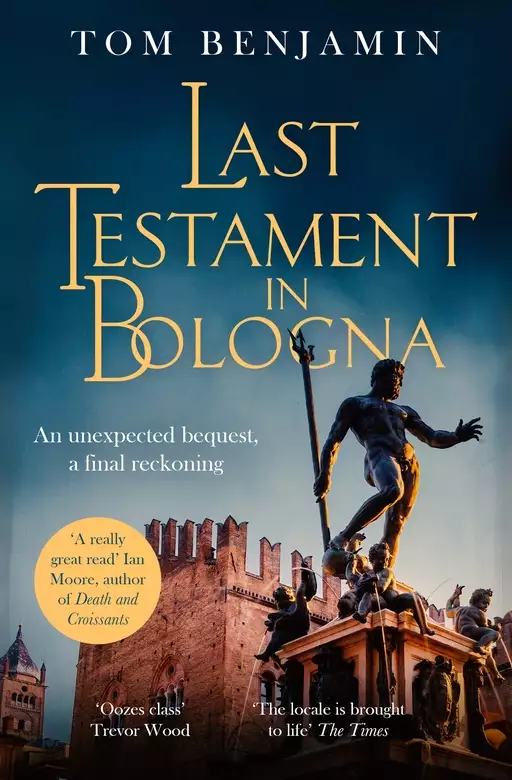
'Benjamin's latest captivating mystery will keep the reader hooked to the very last page while also bringing the city of Bologna to fascinating life. Bravo!' Camilla Trinchieri, author of Murder in Chianti 'Excellent! This time, English detective Daniel Leicester takes us on a hairpin ride through the glamorous, perilous world of Formula One. An absorbing portrayal of what happens when wealth, rivalry and corruption collide, this is a compelling read from a writer who knows Italy inside out and is at the top of his game.' Eleni Kyriacou, author of The Unspeakable Acts of Zina Pavlou, selected for BBC 2 Between the Covers Book Club 2023 'Raced through this latest in the fab crime series featuring English 'tec Dan Leicester. Set in the murky world of Formula 1, this souped-up thriller should ensure that Tom Benjamin takes his rightful place at the front of the crime-writing grid' Trevor Wood
'High-octane, fierce rivalry, ever-present sense of danger and carnage is one of the many reasons why this is my favourite of his novels so far.' Judith Cranswick, Mystery People
When an old man makes a bequest to investigate the mysterious death of his son, English detective Daniel Leicester follows a trail leading to one of Bologna's wealthiest families - makers of some of the world's most coveted supercars. He soon discovers that beneath the glitz and glamour of the Formula One circuit lurk certain people, with sinister interests, who may just be prepared to kill to keep their secrets. Time and tide wait for no man - or woman - and while biology obliges one of Faidate Investigations' team to finally undergo a long-delayed operation, history catches up with another. Shadowing a suspect along one of Bologna's blood-red porticoes or mixing with the glitterati in the paddock at Imola, the English detective comes to learn in Italy the past not only has a long tail, but its sting can be deadly.
Praise for Italian Rules 'There are two major stars in this book, the laconic private eye Daniel Leicester and the city of Bologna itself. Tom Benjamin mixes these ingredients perfectly making Italian Rules a really great read.' Ian Moore, author of DEATH AND CROISSANTS
' Benjamin skilfully combines a cracking crime novel with a love letter to Italian cinema . . . Italian Rules is an absolute treat' Trevor Wood
Praise for Tom Benjamin "Tom Benjamin does it again! Last Testament in Bologna is another brilliantly-immersive crime mystery, seeped in the culture and scenery of Italy, that leads you through a compellingly-twisty plot balanced with authentic and heartfelt characterisation, and unspools to a perfectly satisfying conclusion." Philippa East
'The locale is brought to life . . . the plot keeps you guessing' The Times
'A slow-burning, tense and brooding thriller' The Herald Scotland
'Tom Benjamin's debut novel blows the lid off a political cauldron in which Leftist agitators, property moguls, the police and city elders struggle for survival and dominance' Daily Mail
'It's an immensely promising debut, which leaves the reader feeling they really know the city.' Morning Star 'Another great crime novel set in Bologna' Reader Review
'The mystery smolders away nicely and the wrap-up throws some curve balls. Another indulgent offering in this rewarding series.' Reader Review
Release date:
November 9, 2023
Publisher:
Little, Brown Book Group
Print pages:
80000
* BingeBooks earns revenue from qualifying purchases as an Amazon Associate as well as from other retail partners.
Once they had realised why we were there, the brother and sister looked dismayed, and who could blame them? A stranger is about as welcome at the reading of a will as a former spouse at a wedding, perhaps less so – there is money involved.
The Comandante and I had received the call from the notary herself, but she could not provide us with any further details, ‘according to the law’. Only that the deceased – Giorgio Chiesa – had requested our firm’s presence as an ‘interested party’ at the reading at her office in Osteria Grande, which was on the Via Emilia between Bologna and Imola. We had checked our database, along with the memory of the Comandante, which often proved more reliable than the company’s pre-digital files, but Chiesa did not appear to have been a client of Faidate Investigations.
‘Maybe you once did him a favour and he never forgot,’ I said. ‘You’ll get a nice cheque, or inherit some property.’
The Comandante gave me a pitying look.
‘Favours are easily forgotten,’ he said. ‘It is grudges that persevere.’
Osteria Grande – the town’s name always made me smile. Literally, Big Pub, albeit that ‘osteria’ had long-since become synonymous with restaurant in Italy, at least at the reasonable end of the spectrum.
There were no large restaurants in Osteria Grande, let alone pubs, but there was a half-decent, medium-sized place along the main road where we lunched before walking the thirty or so metres to the notary’s office in a low-rise, salmon-coloured block.
Across the road, a field of wheat was stirred by the cleansing April breeze, while the few puffy clouds above moved hurriedly along as if they were expected elsewhere – England, perhaps. We were deep in the Pianura Padana – the granary of Italy – and the town had spent much of its history as a farming hamlet before expanding in the late twentieth century to accommodate overspill from Bologna. This may have explained the venue for the reading – houses were cheaper the further out you moved and so, presumably, were notaries.
Because of the Comandante’s hip (he was due for a partial replacement soon), we took the small lift up a single storey to the notary’s office. She answered the door herself. Her assistant could have been away, more likely she didn’t have one. The notary was a small, bone-thin woman in her mid-thirties whose lime-green framed glasses lent some levity to an otherwise dissatisfied mien, as if she had once come across a particularly egregious clause in a conveyancing contract and never quite gotten over it.
The family had yet to arrive, she explained, and asked us to wait in the hallway.
Despite the modern building with its low, fluorescent-lit panelled ceiling, tinted windows and cream marble floors, the buzz of the cars and lorries whizzing along Via Emilia, the notary’s entrance was as sombre as any venerable Bologna palazzo. Heavy, dark wood benches were set on both sides, while yellowed certificates and age-dimmed paintings lined the walls. An ancient grandfather clock ticked imperiously away. Behind the notaio’s closed ‘studio’ door, she might have been labouring beneath the scowls of frescoed deities.
The front door buzzed. The clack of the notary’s heels as she emerged from her sanctum and passed without acknowledging us. She opened the door and greeted the couple in low tones before ushering them through to her office. The man appeared to be in his thirties, the woman perhaps a decade older. It was clear they were siblings, albeit the man was puffy faced and unshaven in a dark blue V-necked tunic and matching, loose-fitting cotton trousers beneath a dark grey Ferrari-embossed fleece, while the woman was smartly dressed in a black suit with a white blouse. But they shared the stocky build of provincial Bolognese and a familial aquiline nose. The pair nodded cordially at us before the notary closed the door behind them. I exchanged a glance with the Comandante – I doubted they had as yet been told we would be joining them.
It didn’t take long – neither the thin walls or the rumble of trucks managed to muffle the booming lamentations of the man. It took his sister to finally shut him up with a shrill: ‘Basta, Francesco’ before we heard those heels again and the door swung open.
It was our turn to nod a greeting. The brother, Francesco, looked stonily ahead, his thick, hairy fists clamped atop the dark oak table. Veins bulged from his smooth skull. He might have seemed threatening if his flushed, over-fed face hadn’t given the impression he was on the verge of a stroke, while his sister sat beside him as white as a sheet. She crossed her arms and met my smile with an expression of unabashed anxiety.
Taking her chair at the head of the table, the notary opened the maroon folder. I was vaguely surprised to see it contained just two pages of double-spaced, typed text. I had never attended the reading of a will before – my late wife had not left one, and the subsequent legalities had been handled by her father, the Comandante, as neither my then linguistic or emotional state was up to it – but I had yet to see any official Italian document that could be described as brief or to the point, and certainly no public functionary who would miss an opportunity to cite lengthy legal statutes at even the most joyous occasion. I leaned a little to the side to check if the notary had perhaps a further, bulky file set on the floor beside her.
Apparently not.
She peered at the date. ‘Yes,’ she said as if in response to a question we had not been privy to. ‘This was filed just over four years ago.’ She pulled herself up straight and cleared her throat. ‘Before myself, Dottoressa Chiara Mignotti, Notary of Osteria Grande, and in the presence of witnesses: Giovanni Buonpresenza . . .’
‘Buonpresenza!’ said the brother. ‘That piece of shit, I’ll—’
‘Francesco.’
The notary read on: ‘Date of birth, third of September, 1947, resident in Bologna, Via Regnoli 17, and Vladimir . . .’
‘Of course, of course,’ Francesco muttered.
‘Bonnacini, date of birth seventh of March, 1952, resident in Via delle Pecore 38, Dozza, and in the presence of Giorgio Chiesa, date of birth, nineteenth of September, 1942, resident at Via Paolo Fabbri 4B.
‘The said signor, Giorgio Chiesa, whose identity has been confirmed by the notary, wishes upon the cessation of his life to have his testimony made public in the presence of his surviving children, and Comandante Giovanni Faidate and/or a representative of Faidate Investigations.’ She acknowledged me.
‘Signor Chiesa states: “The law requires me to leave two thirds of my estate, which consists of my house in Via Fabbri, to my surviving children, so I express my formal wish to do so in my testament to avoid any additional expenses, along with whatever meagre balance is contained in my bank account, and do so with pleasure – I am only sorry I cannot leave you the substantial inheritance you so richly deserve. I also leave you any heirlooms or furniture contained therein, to be divided between yourselves as you see fit.
‘However, I pray you will also understand why I want to commit the discretionary third of my estate that, in truth, I would have left to be divided between yourselves and your late brother, to Comandante Faidate, or his successors in the firm Faidate Investigations. Comandante – you don’t know me, but I know your reputation as an honest man. I therefore bequest the legacy that I legally control to you or your heirs in trust – I trust you to find whoever was responsible for the death of my youngest,’ Francesco hissed like a fast-puncturing tyre, ‘son, Fabrizio, drawing upon the equity as you see fit. Once you have fulfilled this commission to your satisfaction, I respectfully request that you reimburse the outstanding balance to my surviving children.”’
‘Signed, Giorgio Chiesa.’
‘I finally understand,’ Francesco said to his sister. ‘I wondered why he’d shut up about it.’
His sister shook her head. ‘He never “shut up” about it, Fran. He just knew better than to mention it in your presence on the few occasions you could be bothered to visit.’
Francesco looked at the Comandante. ‘Did you know about this?’
‘As your father stated, Signor Chiesa, we were not acquainted. This comes as much as a surprise to us as it does to you.’
‘You’re private eyes, the signora says.’ His phone, which was set upon the table, began to buzz. ‘Excuse me.’ He picked it up. ‘That’s right,’ he said. ‘Run her through the pre-op. The bloodwork was fine, but there’s a family history of malignant hyperthermia, and the anaesthetist has recommended a low dose of Propofol. Okay. Yes, that should be fine.’ He put the phone down, transformed in those blue coveralls from seemingly a manual worker, to some kind of surgeon. ‘There’s nothing in there that actually obliges you to take the job,’ he continued. ‘And who are you, anyway? Dad had clearly heard of you, but I’m afraid your fame has passed me by.’
I looked at the Comandante with curiosity. In all our years together, I had never witnessed him introduce himself further than a curt: Faidate.
Giovanni gave the son a fatherly – or perhaps, grandfatherly – smile.
‘Comandante Faidate,’ cut in the notary, ‘was head of the Carabinieri’s Special Operations Directorate in Bologna, dottore. His agency is the most respected in the city, if not the state.’
The doctor’s mouth drew appraisingly downwards. ‘In any case,’ he said, ‘the best connected, no doubt.’ He sat back, the status of a former chief of police apparently qualifying Giovanni Faidate for his attention.
The Comandante turned to the notary.
‘Dottoressa, did Signor Chiesa furnish any further information about the death of Fabrizio?’
‘I’m afraid not, Comandante.’
That equanimous smile again. ‘Signori?’
‘Fabri died in an accident seven years ago,’ said Dr Francesco Chiesa. ‘Dad never accepted it. The old man was convinced he had been murdered.’
‘Was it investigated by the authorities?’
‘Of course! They confirmed it was just a terrible accident, but he wouldn’t let it go.’
‘And the accident itself?’
He looked at us if it was obvious. ‘Car crash.’
‘Was anyone travelling in the car with him?’
He shook his head. ‘He was alone in the hills . . .’ He paused as his sister reached around the chair for her handbag. She pulled out a pack of tissues and blew her nose.
‘He had popped in to see me,’ she said. ‘He was going home.’ The brother placed a comforting arm around her shoulders.
‘But that’s not half of it,’ he said. ‘Not three quarters. Four fifths.’ He delved into the top of his tunic for an unselfconscious, grizzly-like scratch. ‘Look – our youngest brother, the apple of our father’s eye, was a racing driver. And not just any boy racer – a test driver for Molinari. He was being groomed for their F1 squad.
‘Our Fabri . . .’ His voice grew gruff. ‘Well, the boy was a wizard behind the wheel. Dad couldn’t accept he’d just driven off a cliff.’
A silence settled around the table. We might have been standing around the drop, looking respectfully down.
I asked finally: ‘And who did he suspect, your father?’ Francesco frowned.
‘You’re not Italian,’ he said.
‘English.’ He shrugged, apparently unsurprised.
‘Molinari. Of course.’
‘The company?’
He slapped the table. ‘The man! Fucking Massimiliano Molinari! The owner!’
The sister squeezed his hand and he withdrew like a stung bear. ‘Daddy blamed him for everything,’ she said. ‘Ever since he stole his fuel injection system – back when we were kids.’
‘Or so he claimed,’ mumbled Francesco. ‘We were raised on it like our mother’s milk, but he couldn’t prove a thing.’
‘He took him to court,’ said the sister. ‘Our childhood was dominated by cases. But it was just him against the might of Molinari Automobili SpA.’
The brother looked unconvinced. ‘In any case, Dad never got over it – from then on, everything was Molinari’s fault. If a bolt of lightning had struck the Holy Father himself, you could guarantee that bastard Massimiliano Molinari would have had something to do with it.’
‘And yet,’ I said. ‘His son went to work for him, or at least the company.’
Francesco smiled. ‘He did indeed, indeed he did, Englishman. Darling Fabrizio, Dad’s favourite, inculcated even more than the rest of us on the myth, ended up working for Dad’s nemesis – who took him on, incidentally, despite my father basically having stalked him for a quarter of a century.
‘So you see, signori, you’re on a fool’s errand – Giorgio Chiesa has managed to sustain his ruinous obsession beyond the grave, while our poor brother continues to have his rest disturbed.’
‘Thank you, dottore,’ said the Comandante. ‘This is all most helpful.’ He turned to the notary. ‘However, in the circumstances, I do feel obliged to follow Signor Chiesa’s instructions.’
‘We will look into the matter as requested,’ he turned back to the siblings, ‘with the hope of remitting as much of the legacy to your family as possible.’
Francesco raised his hands in mock surrender. ‘For myself,’ said the brother. ‘I couldn’t care less about a house in Cirenaica.’ He turned to his sister. ‘Although I guess you could do with the cash?’
‘It was what Dad wanted,’ she said glumly. ‘We should respect that.’
Francesco turned to us. ‘By all means, Comandante. Give Ingegnere Chiesa the respect he’s due. But let’s not exaggerate, eh?’
There were some further details to go through with the family, so the notary excused us. We walked back to the Comandante’s old but still immaculate black Lancia limo in the restaurant car park. I was about to set the navigator to home when Giovanni said: ‘Dozza, if you please, Daniel, Via delle Pecore, 38.’
‘Oh?’
‘The address of Vladimir Bonnacini,’ he said. ‘One of Signor Chiesa’s witnesses, who was a client of mine, in a manner of speaking.’
‘A manner of speaking?’
‘Yes,’ said the Comandante. ‘I arrested him.’
They call Dozza ‘the City of Art’, and it is pretty enough, a walled town (it’s certainly no city) crowning a hill a little further along the Via Emilia, famous for the paintings that line its walls. It’s the sort of place you go for Sunday lunch when you fancy a change from Bologna and a short drive. Having said that, as we pulled into the visitor’s car park on the fringe of the town, I realised I hadn’t been here since Lucia had been alive and we had got up to those kind of family things, inevitably with my father-in-law in tow. Back then, in the absence of her friends, he had cheerfully filled the role of my daughter Rose’s chief playmate.
‘I can go alone,’ I said, eyeing the cobbled slope running up through the blue painted gatehouse.
‘I will grit my teeth,’ said the Comandante, opening the car door. I walked around to help him out.
‘You know, you probably shouldn’t aggravate it.’ I avoided mentioning the surgery, which I suspected he was dreading.
‘Better still, don’t aggravate me.’ He linked his arm in mine and, leaning surprisingly heavily against me, we made slow but steady progress up the slope.
It was a quiet Tuesday afternoon and Dozza was dozing. There were more cats in the street than people. It really was a pleasant place – venerable buildings clustered around a typical fifteenth-century rocca, or fortress, which remained largely intact. Had we been in Tuscany, it might have been thick with tourists and trinket stores, but it was far enough away from Bologna, which fell outside the main tourist circuit, to still have a pulse. Sure, there were a few wine shops (closed) but also the kind people needed to survive – a butcher, ironmonger, Co-op supermarket. When the burghers of Dozza began inviting artists to decorate their walls in the 1960s, it had been to beautify their living space rather than cash in, and out.
The auto repair shop was down a side street, beneath a wide, red brick archway which might once have been the entrance to a tannery or some other large-scale medieval enterprise. The presence of a garage in the heart of the walled city did seem rather anomalous, given that non-residents were banned from entering in their cars, but I didn’t let that trouble me – I had been in Italy long enough to know it rhymed, most of all, with anomaly.
The big old wooden doors into the courtyard were open, but a gate with prison-like bars blocked further progress. Above, I noted a CCTV camera and winking alarm box. For good measure, there was also a Beware of the Dog sign. I looked hopefully through the bars – I liked dogs.
The courtyard reminded me of our own – hadn’t the Faidate Residence once been its own hive of medieval activity? – but Carrozzeria Bonnacini was on an altogether larger and shabbier scale. While La Residenza had become precisely that – somewhere to reside – this place still had dirt beneath its fingernails.
The whiff of rubber and metallic paint. A pair of mechanics dressed in black shorts and T-shirts bent under a car on a ramp. The shapes of three more automobiles beneath black covers sheltered by a corrugated iron awning. A radio set to Nettuno Bologna Uno – some kind of interminable football chat.
‘His daughter,’ said the Comandante. A stringy blonde in her forties emerged from the office carrying a clipboard. She lolloped towards us in excessively high heels.
‘Can I help?’
‘Faidate, dear, for your father.’ She blinked, then took a pair of unsteady steps back.
‘I’m sorry?’
‘Faidate,’ he repeated. ‘He might know me as “the Comandante”.’
‘Then it is you.’ She pressed her clipboard to her chest. ‘He’s not done anything wrong.’
‘It has nothing to do with the law. It concerns another matter. He is probably expecting me.’
She stood staring at him. ‘You. You stole ten years of my life.’
‘Your father will be expecting me,’ he repeated gently but firmly.
‘You . . .’ Still clasping the clipboard to her chest, she swivelled around and wobbled back to the office.
‘It was six, actually,’ said the Comandante. ‘He was convicted for eight but released after six, although I suppose to a child it must have seemed like . . . a childhood. He was almost certainly involved in a couple of jobs after he got out – which is where I suppose this place comes from – but I couldn’t pin anything on him.’ The Comandante stroked his neatly clipped beard as if still contemplating those missing leads. ‘Ah, here he is.’ A man came towards us, stick thin like the woman, with a grey, closely cropped widow’s peak so severe it might have spelt V for Vladimir.
‘What was he?’ I asked.
‘Getaway driver.’
Vladimir Bonnacini, in black cargo shorts and a T-shirt like his mechanics, stood as his daughter had, two steps back from the bars.
‘Comandante,’ he said. ‘Not the first time we’ve met like this.’
‘But this time you have the key, Speedy.’
‘Or at least, the magic button.’ He raised his hand and pressed a fob. There was a mechanical whir as the bolts withdrew and the gates opened inwards.
‘An impressive set-up,’ said the Comandante.
‘Speedy’ grinned with teeth as yellow as his nicotinestained fingers. ‘We’re both independent businessmen now, Comandante. Like you, I’m putting my know-how to good use.’
‘If I’m not mistaken, isn’t that a Fiat 124 on the ramp?’
‘Bravo, Comandante! You’re not mistaken – a 124 Special, 1970.’
‘I had one myself, a wonderful vehicle.’
‘Franco,’ Speedy called to one of the mechanics. ‘Come here un attimo.’ Wiping his hands on his T-shirt, the younger of the two men approached. ‘This is an old friend of mine.’ The mechanic nodded respectfully. Speedy chuckled. ‘Oh yes, me and Comandante Faidate of Comando Speciale dei Carabinieri go way back.’ He relished the look on the young man’s face. ‘Don’t worry, he’s in the private sector now. Let’s show the Comandante what we’re hiding.’
We followed the two men to the awning. Together, they drew back the cover of the first car. It was a sleek, bronze two-seater Alfa Romeo sports car with a detachable tan roof. It was unarguably a thing of beauty.
‘Spider Junior,’ sniffed Speedy. ‘1981. One-point-six litre.’ He ran his hand lovingly along the curved ridge that ended with the missile-like headlights. ‘Pininfarina did the coachwork. We’re polishing the heads.’ He moved onto the next one.
They pulled back the covers to reveal some kind of silver sports car, not so different to the Alfa, only with a solid, bulbous roof and softer lines.
‘My goodness,’ said the Comandante. ‘A Zagato.’
‘Bravo, Comandante. Is there anything else you can tell us?’
‘A partnership between Abarth an. . .
We hope you are enjoying the book so far. To continue reading...

 Please log in to recommend or discuss...
