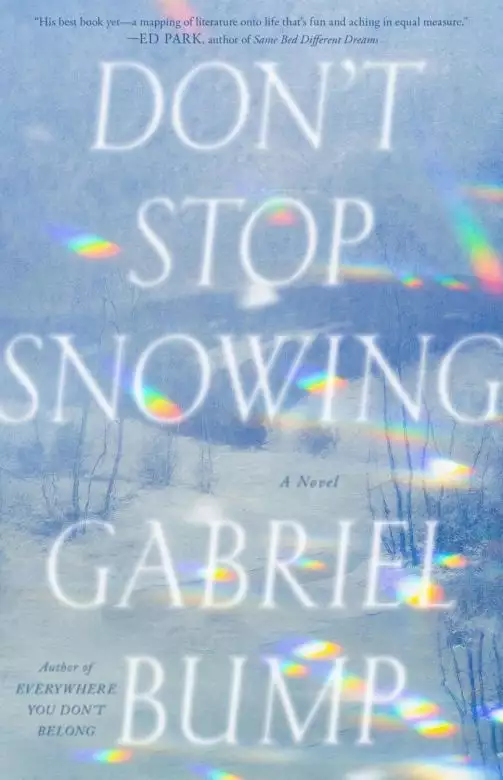
How do you outrun the family curse? What if you can't?
Fresh out of grad school in Michigan, on the brink of despair, directionless, David worries his parents. They don't know what to do for him, they don't know how to heal him. His doctor suggests that he needs to gain some perspective, get to know himself. And possibly a relocation would help. Maybe there is such a thing as a geographical cure?
And so he takes off for snowy, grey Buffalo. It's not the first place that comes to mind when you think of a curative place, but there, he'll stay with his cousin Flip. Maybe time with Flip will give him some distance from his parents who hardly speak to each other. Maybe it will help him to forget his own troubled past. But as it turns out, Flip's life and state of mind is even unsteadier than his own. Suddenly enlisted to take care of his cousin and to even fill in for him at his job, David falls into a new life and a new way of seeing the world. A world where, come to think of it, he doesn't mind the snow.
Don't Stop Snowing is a fresh and honest--and funny--story of the struggles we all face as we realize that we don't just inherit eye, hair, and skin color, but also the complicated psyches of our parents.
Release date:
November 10, 2026
Publisher:
Little, Brown and Company
Print pages:
272
* BingeBooks earns revenue from qualifying purchases as an Amazon Associate as well as from other retail partners.
from our front window, we watched the kids car-sledding. Or I watched, and Antonia hid behind the curtain, asked me to put my phone away, stop recording, let the kids have their dangerous fun.
It hardly ever snowed here, maybe four times a year. Class was newly in session, the first week over. Martin Luther King Day tomorrow.
We had just moved into a real house, were still moving in. More than half of our clothes were in boxes and bags in the closet. Our curtains were temporary. As in we had plans for better curtains, in a few years, when some projects in the works would come to fruition, when I got some paychecks. There was a lot of money stuff. We were a new couple. We were still figuring each other out, revealing our embarrassments at a careful pace. Yet we were comfortable, too old to romanticize each other. I was fifty. Antonia was fifty-three.
“Come on,” Antonia said. “Come back.”
“Wait,” I said.
A white Jeep stopped. There was an empty sled attached to it. Two young women got out of the back. The driver rolled down her window, looked at her friends, waited until they were seated in the plastic sled, arms wrapped around each other, the taller one, strangely, seated in front of the smaller one. The driver gave a thumbs-up; the sledders reciprocated. And they pulled off slowly.
“See,” I said. “It’s not that dangerous.”
“Come here,” Antonia said.
She was away from the curtain, standing in the center of the room, on our temporary rug, the rug from my old place, the rug she hated, my biggest rug, my Target rug, white, blue, and stained. Did I get it in Buffalo, all those decades ago?
“Come here,” Antonia said again, opened her arms.
I left the window. I heard kids screaming, noticed Antonia’s smile, our shared happiness, our relief.
We were already late for the reading.
one of our friends, an economist, was celebrating the release of his fifth book, a treatise on emerging markets and fascism, or something. I hadn’t read his books. He hadn’t, I assume, read mine. We weren’t really friends; we had friends in common. And as a writer and a bookstore owner, I invited him to readings, even offered to host the release of his latest book at my bookstore, Seven Eccles Street. My novels: You wouldn’t know them. Small-press stuff. Experimental. Not very good. Not lasting. Unlike my father, who shut himself in rooms and said he would write a novel and didn’t appear with anything—never published, never, I think, finished them—I said I would write novels and I did. So what if they weren’t particularly good?
If I were 20 percent happier, I wondered, would I shower and not rub my belly? Which, considering, was fine. Not the heaviest it had felt; not the lightest.
My life was fine.
I drank just one glass of whiskey every night, but if Antonia was out of town, I’d get drunk and watch whichever sport was in season. Baseball, football, basketball, even hockey. Four whiskeys would get me drunk, make me ruminate too much, trip me into memory. Not that long ago, five years, ten years ago, I could drink ten whiskeys some nights and feel horrible and alive for days after, not think too much about it, even feel like I had accomplished something. I would leave the bookstore, go to the bar near campus, drink near students, get home by foot, and feel like an adult, or the kind of adult that my father was.
I couldn’t do it more these days than once a month, at most.
Now, I don’t enjoy hangovers. I don’t enjoy making my chorizo-and-egg hash the morning after. Tiny potatoes cut into tinier pieces, spicy sausage pulled from the casing, farmers’ market eggs. A smoothie with bananas and blueberries. A beer at noon, if the hangover doesn’t leave. It’s all too much work.
Antonia is up every day at six, doing gentle yoga, reading, working on a monograph, touching me awake. Some combination of all these. She’s a better reader than I am. She’s a true boring academic. That, I assume, is why we work so well. Why everyone tells us how in love we look. How they can feel our love. And then they engage us in some minor group hug. And they invariably say how everyone is happy for us. Antonia doesn’t mind hugs. I do. Even with her, I could live without them.
Antonia wouldn’t let me go, kept her arms around me.
I don’t know how she pulls it off. How she says she’ll be ready in fifteen minutes and appears, beautiful, in seven, never out of breath. I try not to overdo it telling her she’s perfect and beautiful; I don’t want to sound hyperbolic, untruthful, a salesman trying to convince her this is the best life for her. She doesn’t believe me when I tell her, like I don’t believe her when she does the same. We can go back and forth for ten minutes. It’s horrible, saccharine stuff. It is earnest.
Stuck in Antonia’s arms, I think about Stephen, my twenty-year-old son, from my first marriage, how he has already fallen in love three times, as far as I know. First, a girlfriend during his junior year of high school, who was older than he was, a senior, who took him to prom, then left for college across the country, or in another country. He took it hard. I told him don’t, you’re young, I know what I’m talking about. Her father was some banker or highly specialized doctor. We once went to her parents’ house, and her father got drunk, said surprising and racist stuff. This guy looking at me, saying how the leftists are turning the cities into such unlivable places that all the smart and rich people are moving to our Southern college town and making everything more expensive, and how maybe, rightfully, the country is trending toward segregation again, which makes you think maybe we shouldn’t have gotten rid of segregation at all, and maybe the connecting factor between San Francisco, Chicago, New York City, and Los Angeles is the absence of Jim Crow, and maybe pretending like those Blacks and Mexicans and whatevers were equal to white men was a stupid idea, because you can’t virtue signal your way out of concrete facts, such as: This country, America, is the greatest idea in human history and was achieved through the righteous march of free white men, whether anyone wants to admit it or not; there is no denying the fact. He spoke with such conviction, looking straight at my face the whole time, that, well, the rant felt prepared, rehearsed. Maybe he’d prepared it for me? Was he angry when he saw me, angry at Stephen’s passing, his light skin, his Black grandmother hidden beneath the pale and curly hair? When the rant was over, before we’d finished our salads, I excused myself, went to the car, waited for Antonia and Stephen to join me, which they did right away. I didn’t want my son to see me kill a man. Although, strangely, the man, the asshole, didn’t fill me with only rage. I thought of my mother, how I missed her, how she would’ve given the proper, dignified, cutting response to the banker’s nonsense. His stupidity made me miss my mother, who was sick, getting old. She would’ve, maybe, humiliated him.
I didn’t tell Stephen to break up with her. I only told him to never invite me to their house again. I didn’t hear from the family. Antonia didn’t speak to me about it. We were getting old. Those people happen. What do you say? Still, hard for me to bounce back from that. My son, he’s good, a decent, pathetic man already. He broke up with her over text. I was proud.
He looks like Pidge, my first wife. I have pictures of her somewhere in my closet, in a box of accumulated junk. That box has tax information from my first book, old minor checks from speaking engagements and campus visits, a laptop I used for eight months to write a screenplay about an artist collective, pages of an unpublishable novel. Also a suicide note I never sent—a thought that lingered for about five years, from wedding to fourteen months postdivorce, stopped when I first moved to the South, to open this bookstore in North Carolina, needing the change of scenery, not far from my mother’s people.
I think about my son. I’m terrified for him. I try not to say it in front of him. I tell him he’s okay, like I told him when he fell in love for a second time, a year after the first time, during his senior year of high school. She moved to Southern California, and he stayed here. One of those boring teen movie plots. He didn’t get into the same university as her, cried about it, wrote her embarrassing letters, got over the whole thing in five months. I don’t bring up his crying. I will someday, when he’s older, in eight years about, when another emotional screw breaks loose and he starts careening. It’s genetic, certainly. Our minds. Our spirits.
Now he lives five minutes away, on the other side of campus. He’s dating a young woman from Wilmington. I’ve seen them walking up Franklin Street, holding hands, laughing. I don’t embarrass him. I don’t honk. I don’t cheer. There’s a quick angle where he looks just like me, for a moment. His head tilted a certain way.
Most days, my body doesn’t feel right, even with all I try. Run three miles. Walk between seven and eight miles if I don’t run. I’ve started going to church again, or more like a Quaker meeting house up the street. I’m reading the Bible.
Antonia doesn’t get it. Why I pack the Bible when I travel, this black pleather edition. Why I pray at takeoff and landing. She doesn’t know that once we’re in bed, lying there, I pray at night: for her, for my son, for most people I’ve known, the dead, the walking, the people on West Coast time just sitting down for dinner, a few friends in Ireland, already waking up. I’m there, next to Antonia, with my eyes closed. I’m still. I don’t want to sleep. There’s often a touch from her, a kick. On her side, her back pushed into my ribs. When I wake up feeling sick, around three in the morning, I thank God for Antonia. I listen to the students walking home.
antonia couldn’t believe the reading wasn’t canceled, what with the snow.
“How are we supposed to drive?” Antonia asked.
“We can walk,” I said.
“What if we couldn’t?”
“Everyone can walk. We’re all neighbors. He doesn’t have many friends.”
“Listen to yourself. Not everyone can walk.”
I had forgotten about our differently abled neighbors and the seniors with replaced hips and spines, bones one slip from dust.
“The roads aren’t that bad,” I said.
“The children,” Antonia said, “are all sliding around out there.”
“Sledding.”
“Fuck off.”
She left the bathroom. She waited in the kitchen, near the back door, fully dressed, ready.
walking to the reading, we heard the whole thing: Overconfident acceleration, braking at the stop sign, sliding through the intersection, tapping into a neighbor’s fence. A car, stuck, half a block away.
Antonia ran over to check on the driver. I didn’t know she could run so well on ice. She reminded me of the hockey players I knew in Michigan. When I did my twice-weekly runs, she would never join. I figured it was her knee. Look at her go, I thought. What was that about?
“Hurry,” Antonia yelled.
She was already at the driver’s door, trying to rip it open.
By the time I got there, Antonia and the driver, a youngish man, frazzled, were standing in the snow. Antonia checked the man’s vision, moved her fingers around his face, told him to follow.
“I’m fine,” the young man said.
“That’s the adrenaline,” Antonia said.
“I called the ambulance,” a person yelled. “And I called the cops.”
“The cops,” the young man yelled. He got back in the car, drove off, but slow enough for Antonia to run alongside him, bang on the window, yell at him stop, get help, let us help you. After half a block, Antonia gave up. It would nag me for months after, that young man driving away, so afraid of the cops. That niceish-looking college-age buttoned-up white kid. Why did he have to run? What did they have on him? Was that maybe how my father looked in college after an accident?
By the time Antonia got back, we could hear sirens. A larger crowd had gathered at the scene, the scratched white fence showing pale wood.
“Are you okay?” I asked Antonia.
“He kept saying sorry,” Antonia said. “He was crying.”
“Was he drunk?”
“He smelled like fried chicken.”
We were walking the wrong way. A full block.
I thought of chicken, sauces, my summer and winter spent in Buffalo over twenty years ago. It was a new thing, the slow tickle of mortality on my neck, under my feet, triggered by smells, by weather, whatever.
On our slow walk to Seven Eccles Street, the snow blew off the bare trees, down on us, as if it had started all over again.
I thought on the shadow of loneliness across most years of my life. And yet how I felt now, how the world felt to me, after all the times I had to run away. The shame. The desire to die. The will to die. The want. I can see it clear. The fear, in the moment, of the moment, from the moment, like a glowing thousand-pound ball, huge, hovering over the road, appearing out of nowhere, right there ahead of me and Antonia, a thousand feet, at least. Like an asteroid, staying there, waiting for me, pulling me closer.
What a miracle I was still alive.
Antonia told me to watch out, look down, be careful. Ice. She could tell I was losing it a bit, as I do sometimes. My head wasn’t in it.
I fell, bad.
“Did you hear a pop?” Antonia asked.
“I can’t hear anything,” I said.
A truck with massive tires and a bomb-like engine came around the corner, dragging a toboggan in its smoking wake, five coeds in a smoking wake, laughing, coughing, in coats too thin.
I couldn’t hear Antonia, above me, hair brilliant against a white-and-blue sky, a pine tree white with snow, tiny finches bouncing around, a cardinal. That woodpecker I always saw, above her head. Not making a sound.
There was Antonia in nature, the world.
Here is a good place to start.
the boat, i figured, had enough gas to take me a few lakes and towns over, maybe into Wisconsin. My parents were sleeping. I could see their window. I could not see my father, who was actually not sleeping, who had sat up in bed, wondering if I was brave enough to do it. I was eight.
After a few months of threats and tantrums, followed by my repeated promise that they would miss me when I was gone, I was about to be gone. They would regret not getting me Final Fantasy VII. We’ll get you a book, they’d said; we’ll take you to Jabberwocky, a short drive away, the big store in Eagle River, with books, video games, VHS rentals, and board games. I wanted the PlayStation game. I promised my threats were real. But I was only allowed one video game for every six books I read.
My father watched me get into the boat and turn on the engine before coming down to get me. He would not make promises behind my mother’s back but said he would talk to her about the game, he would make my case. Still, enough with these fantasies. I told him it wasn’t my fantasy, the game; it was a series, about good and evil, from Japan. You played as a guy with a large sword. And another guy with a machine gun for an arm.
I remember my father’s face in the dark as he carried me through the chill, the soft flurries.
When had it started to snow?
What about Harry Potter, he asked, that cool young wizard? Wasn’t a wand just as cool as a sword? There were broomsticks.
No, I said, of course a broomstick wasn’t as cool as a machine-gun arm. A magic wand, maybe. I doubted it.
The moon was full. I remember his face, frozen in time, like looking in a mirror, except his skin much lighter than mine. His confusion and worry: What the hell was I going on about? What was this game? Big swords and machine-gun arms: My mother would never go for it. It was testing his limits too. What was the appropriate amount of violence for an eight-year-old? How much should they let me see in order to remain truthful to the world? Late ’90s, these were conversations people had at dinner, on television talk shows. Columbine still a couple years away.
He was proud too. Of his strange son. Good for him, going on about this game surely not meant for someone this young, dismissing children’s literature. He encouraged my bravery, in ways big and small. Like on a cold spring morning, jumping into the lake after breakfast. Gutting fish myself. That type of thing. Reading me Ulysses, knowing I couldn’t understand, knowing James Joyce annoyed my mother.
I was lucky to have him.
Back inside, he tucked me in, kissed my forehead, told me cool it with the tantrums, don’t run away again. I would grow out of my temper, settle into brooding, just like he did.
I would have these freak-outs, scary in their unpredictability. Where would I have gone if he hadn’t come out to the water?
in the morning, my mother wanted me to explain myself.
“What can he say?” my father said, stepped between us.
My mother was at the door, putting her coat on, the chill coming in as she hesitated. I was still in my T-shirt and shorts from the night before. How did I last outside so long?
“I’m not talking to you,” my mother said to my father.
I could not see their faces.
“He was pranking us,” my father said.
“I am late for work,” my mother said. “He is late for school.”
“I will discuss this with my client.”
“Please. Don’t buy him the video game. Take him to school.”
“Our discussions are confidential,” my father said. . . .
We hope you are enjoying the book so far. To continue reading...

 Please log in to recommend or discuss...
