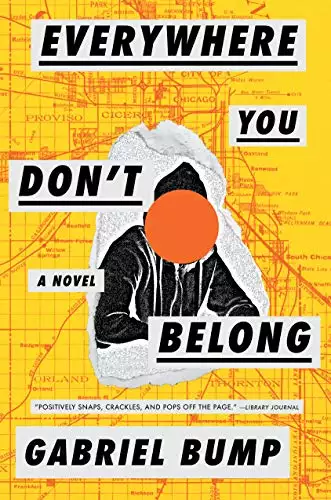
In this powerful, edgy, and funny debut novel about making right and wrong choices, Gabriel Bump gives us an unforgettable and lovable protagonist, Claude McKay Love. Claude is a young black man in search of a place where he can fit; born on the South Side of Chicago, he is raised by his civil rights-era grandmother, who tries to shape him into a principled actor for change. After a riot consumes his neighborhood, Claude decides to escape Chicago for another place, to go to college, to find a new life and identity. But as he discovers, there's no escaping the people and places that made him.
Written in a fierce and original voice attuned to the ironies inherent in our 21st-century landscape, Everywhere You Don't Belong marks the arrival of a brilliant young talent.
Publisher:
Algonquin Books
Print pages:
288
* BingeBooks earns revenue from qualifying purchases as an Amazon Associate as well as from other retail partners.
Dad’s friends hung out in places I couldn’t go, on the other side of the tracks, down Jeffrey Avenue, deeper into South Shore. That’s where Dad grew up, near the train stop to Indiana, across from the strip mall. That’s where Dad’s friends lived, still, in apartments clustered near mass transportation—people always coming and going and waiting and never leaving.
Mom was from the Highlands, a three-block chunk of South Shore reserved for black doctors, black politicians, black bankers, and black lawyers—all the rich people too dark-skinned for the suburbs, too poor to live downtown.
Dad’s friends didn’t come over often.
In the sixties, when they were teenagers, Coach and Dad had tipped buckets.
They snuck up and tipped buckets of fish in the harbor, hauling ass through the golf course before the guy in a Vienna Beef uniform could catch them. That was when South Shore was still Jewish and Irish, before expressways and White Flight and manicured suburbs.
When the guy in a Vienna Beef uniform caught Dad, he dangled Dad by his ankles over the harbor and promised to drown him. There was a moral to that story, but Dad was never sure what it was. Coach thought the moral was don’t fuck with anybody in a Vienna Beef uniform.
When they were growing up, Harold Washington was mayor. The Jews and Irish were almost gone. A few stubborn old men refused to leave, clung to their porches until death, didn’t care about the neighborhood’s changing color. Dad and Coach would recite poetry by the water. Dad, once, wanted to get a doctorate in high Renaissance art. Coach, once, wanted to play in Northern Italy, make a modest living around high culture.
When they were young, Dad and Coach rode their bikes through the Highlands.
When Dad started taking me to see Coach, Mom thought Dad was toughening me up by letting me witness a broken man break further. There wasn’t anything tough about Coach. His wife had left him with two babies and moved to Florida. Dad took me to see Coach because Dad thought Coach was capable of murder-suicide.
The first time Dad took me to Coach’s apartment, five of us sat in three plastic chairs on Coach’s shag rug. Dad bounced the babies on his knees.
The empty fireplace overflowed with dusty trophies. When Coach started crying, Dad made me go into the bedroom with the babies.
One Thanksgiving when I was five, Dad invited Coach over. Paul sat in the living room, watched Detroit struggle against Green Bay, and grunted when Coach pushed the double-wide pink stroller through the door.
“Paul,” Coach said. Paul was Grandma’s friend.
Coach handed the babies off to Mom and sat next to Paul on the couch.
The game was enough to get Coach and Paul drunk off excitement. Dad wanted to get drunk too. Mom and Grandma kept yelling from the kitchen.
Dad gave me a beer at dinner, which turned into a fight.
“What do you want my grandson to be?” Grandma said.
“What do you want our son to be?” Mom said.
“This is a party, and I don’t want him to feel left out,” Dad said.
“My grandson is not a follower,” Grandma said. “He is his own man.”
“My son will be a force in the world,” Mom said.
“A father can give his son a beer whenever he wants. I can give my son a beer whenever I want.” Dad slammed the table.
Nobody looked at me. While they argued, I chugged the beer as fast as possible. Grandma, Mom, and Dad looked at Coach, who was flinging mashed potatoes at a giggling Paul. He used his fork as a slingshot. Mom slammed the table. Paul wiped the potatoes from his face. Coach turned toward Mom, raised his weapon, and hit Mom on the neck so clumps fell down her blouse. Grandma gasped while laughing. Her bracelets jingled when she grabbed her chest. Dad went for another beer. Paul called Coach a bastard. I felt lightheaded and sick.
The babies’ crying marked the end of Thanksgiving. Mom held open the front door, held back her own tears. Dad told me to get my coat.
Jeffrey Avenue felt quiet. Cars dodged potholes with grace. Coach stood at the stoplight and didn’t say a word. We all smiled, waited for the light to change, looked at a bus struggle to a stop, and nodded at the faces in the window.
Outside Coach’s building, I knelt in front of the babies. Dad grabbed Coach behind his neck.
“Are you going to be okay?” Dad said.
“Can you come upstairs?” Coach asked. “Please.”
Dad carried the babies. I folded the stroller and lugged it up. Coach hummed like mad over his jangling keys.
Who said, “God hates me”? Who opened the bottle? Who sat there drinking all night and paced around the room with arms raised toward the ceiling and asked for forgiveness? Who forgot I was standing there? Who didn’t hear the babies crying?
Dad woke up the next day with a hangover.
Coach disappeared around Christmas.
The babies ended up in Kentucky, or Pennsylvania.
And my life went on like that: people coming and going, valuable things left in a hurry.
When Mom and Dad had their final fight, we were late to an all-black rendition of Fiddler on the Roof.
“Fuck Hakeem Olajuwon!” Dad screamed from the dark water.
Dad was out there without a boat, without pants or suit jacket, down to his underwear, past the buoy, rocking with the swells, pumping his arms up and down, jamming to the news—Jordan was coming back. No more baseball. Back to work. Back to the ’ship.
There was a storm coming up the horizon, up from Indiana. Lightning hit that junk barge, that barge always floating on Lake Michigan.
I was out there on the beach, in my nice shoes, stumbling, messing up my nice pants, yelling for my family to stabilize, relax, act normal.
I remember Mom with her dangling earrings. Her bracelets had rubies. Her necklace was sapphire and thick. I remember her near the shore, running, jangling, not caring about broken glass, kicking up sand, not caring about her hair, her shoes, her dress—the final straw.
“Claude,” Grandma called from the parking lot. “Fly your behind back over here.”
“Join me!” Dad yelled to all of us.
“You’ll die!” Mom yelled back.
“Fuck Olajuwon!” Dad yelled to heaven.
“We’ll miss the first act!” Mom yelled to a separate and more desperate heaven.
Grandma pulled me into the back seat between her and Paul.
“It’s just a game,” Paul said. Paul was a Knicks fan.
Grandma got my cheek between her thumb and middle finger. She squeezed and pulled our faces close. Her long false lashes brushed against my eyebrows. Her lipstick, from that close: clumped and peeling, cracked. She wasn’t scared; she was hard; she knew.
I don’t remember how she smelled; I don’t remember what she said. I remember looking past her moving lips. Out there: my father, still past the buoy, still waving his arms, still floating, still here.
The next day, Mom left us and Euclid Avenue and Sixty-Third Street beach. The day after that, Dad followed her. Neither left a note or kiss goodbye.
“That’s it,” Paul said, then, in the car, before pulling a sleeping mask from his breast pocket. “That’s enough culture for one day.”
We missed the first and second acts; we missed the play.
Ms. Bev asked if our parents loved us. She was crying again. We always said yes when she cried. When the divorce started she brought three lunches to class, eating them throughout the day.
“That’s good,” she said. “Love is good.”
She put her head on the table and bid us to leave. We were nine. We didn’t have anywhere to go. There was a foot of snow outside.
Bubbly leaned over and whispered to me. “I think she’s going to kill herself.”
“How do you kill yourself?” I asked. I loved Bubbly.
She stuck a finger up her nose and ate what she found.
“My parents think she’s going to kill herself,” she said.
Nugget smiled, showed us an eraser in his mouth.
“She’s just sad,” Nugget said over the eraser, spit coming down his chin. “Haven’t you guys ever been sad?”
Bubbly raised a fist at Nugget. Fear confused Nugget. Back then, he couldn’t tell fear from sadness. When he got older he found out. He jumped out of a plane. His parachute didn’t open. It was on the news.
He took the eraser out of his mouth and rolled it between his palms.
“Nugget,” Bubbly said, “you smell like bologna.”
“Thank you,” he said, and turned around. Nugget loved bologna.
“You’re nice,” I said to Bubbly.
I was going to ask Bubbly to marry me, but Principal Big Ass walked in. His real name was Gene Longley IV.
“Mrs. Beverley,” Principal Big Ass said. “May I speak with you in the hall?”
“It’s Ms. Bev,” Nugget said.
“What was that, Jeffrey?” Principal Big Ass asked.
“It’s Nugget,” Bubbly said.
“What, Tiffany?” he asked.
“It’s Bubbly,” I said.
“Claude?” His face turned purple.
“Yeah, that’s right,” Nugget said. Everybody laughed. Nugget put the eraser back in his mouth.
I didn’t want a nickname; Nugget and Bubbly didn’t like their normal selves. Once, earlier in the year, I spilled an apple juice carton on Ms. Bev’s rug, underneath the upside-down world map, with Africa and South America twice as large as America and Europe. After that, Nugget and Bubbly wanted to call me Nigerian Juiceman. That name was too long to catch on. And it wasn’t me.
Ms. Bev followed Principal Big Ass into the hall. She looked at us over her shoulder before closing the door.
“See, Nugget,” Bubbly said. “That’s fear.”
“I think I’m always afraid,” Nugget said.
“I know, Nugget.” Bubbly patted his back. “I know.”
Grandma thought Ms. Bev should go down the river.
“For a swim?” I asked.
“The river, Claude,” she said. “Listen.”
I was listening. She sat on the faded White Sox carpet next to my bed and rubbed my feet.
“You never listen, Claude,” she said again. I always listened. Paul leaned against my doorjamb, arms and legs crossed. I thought about pushing him over.
“He does listen,” Paul said.
“She really shouldn’t put you kids through her shit,” she said.
Grandma covered her mouth, apologized through her fingers. She wasn’t supposed to swear around me. Through her fingers, she swore again.
I called Bubbly my bitch one day at recess. Principal Big Ass heard and called Grandma. Grandma wanted to know what the context was. Principal Big Ass told her. She was ambivalent about it. He wasn’t. We had to change: no more swearing.
Paul told me to call Bubbly my sunshine.
“You kids aren’t learning anything.” She brought my foot up to her lips. Her lipstick felt like chalk. She had a date.
“Nugget loves bologna,” I said.
“Nugget is an idiot,” Paul said.
“Nugget’s my friend,” I said.
“And that Tiffany,” Grandma said, picking at my big toenail. “That Tiffany is fast.”
I shouldn’t have told Grandma that Bubbly and I kissed. She called Bubbly a skank.
“I’m going to marry her,” I said.
“Let’s pick out a ring tonight,” Paul said.
“Then you’re going to marry a fast woman that will break your heart,” she said. I pulled my knees to my chest.
“You’re fast,” I said.
Paul whistled and left. Grandma palmed my face. She left too. Her long purple dress got caught in my door. I heard a rip, her running down the steps, the front door slam. That was 8:00 p.m.
Later, Paul opened my door with an empty beer in hand.
“Let’s go get that ring,” he said.
Paul didn’t shovel our walk, even when the snow got deep. He carried me to the salted sidewalk by my armpits. Rainbow Bar was three blocks away. Wind tossed me around. Paul dragged me along. I slipped on ice. He said sorry. The Temptations were playing over the speaker when we arrived. We both nodded at the bartender and went to the backroom.
“I love babysitting,” Paul said.
Teeth was there, waiting, patient.
“I hear you want to fuck someone, Claude.” Teeth stood up and kissed Paul.
“We’re not swearing anymore,” Paul said, an arm around Teeth’s waist.
“Is that what Claude wants to do?” Teeth asked. “Do you want to fuck someone?”
“No,” I said. “I just want to marry her.”
“What are you going to do when you’re married?” Teeth asked me.
“Go on adventures,” I said.
“What are we going to do when we get married?” Teeth asked Paul.
“Go to the moon,” Paul said.
“Yeah,” I said. “I’d go to the moon with Bubbly.”
“Why does love always start with the moon?” Teeth asked.
“Bubbly is my sunshine,” I said.
Teeth crouched in front of me.
Paul didn’t speak about Teeth much at home. Grandma didn’t approve. She thought Teeth was a bad influence and a layabout. Grandma wanted Paul to date a nice man, for once; someone out and proud and successful. What I first knew about true love and happy relationships, I learned from Teeth and Paul in Rainbow Bar’s backroom.
“What will you do for your sunshine?” Teeth asked. “Will you protect your sunshine from this cruel world? Will you guide your sunshine through any perils? Will you pay the bills? Will you walk the dogs? Will you take out the trash? Will you hold your sunshine when there’s thunder outside? Will you rock the baby to sleep? Will you drive the kids to school? Will you bury your sunshine in the most expensive coffin?”
“Yes,” I said. “Of course.”
“Leave him alone,” Paul said to Teeth.
“Is that what you do for Paul?” I asked Teeth.
“For Paul,” Teeth said, “I do anything.”
Teeth’s sister was in our class also. She sat three rows behind Nugget. Teeth refused to understand the law. Paul and Teeth had dated for six months. It was our secret. Most people knew. Still—Teeth was twenty years younger than Paul. He used to play professional tennis. He was tall and had a spider tattooed on his cheek.
Teeth picked me up.
Teeth spent five years in Cook County for repeated and aggressive gun possession.
Teeth put me down. Paul pushed me toward a foldout chair facing a wall. I sat like I always did and pretended not to listen.
“If you love me, Timothy,” Paul said, “you’ll move away.”
“I can’t right now,” Teeth said.
“Then when?” Paul asked.
“Why do we have to leave?” Teeth asked.
“This place isn’t good for us,” Paul said.
“This place isn’t good for anybody,” Teeth said.
“Let’s go to Italy,” Paul said.
“I can’t,” Teeth said.
“Why not?” Paul asked.
“I just can’t,” Teeth said. “Do you understand? I just can’t leave this place. What am I going to do? What place would take me? There’s nothing I can do.”
“We can love each other,” Paul said.
“We can love each other anywhere,” Teeth said. “I’ll love you always.”
“We can love each other in Florida,” Paul said.
“I’ll love you between heaven and hell,” Teeth said. “I’ll love you into other dimensions, into other lives.”
They went on about love and leaving and staying and possibilities. Real love, I learned that night, is compromise. Teeth agreed to consider a life in Florida. Paul agreed to give Teeth some time to think about it. Teeth kissed Paul goodbye.
Teeth crouched in front of me.
“When you have your sunshine,” Teeth said, “don’t let your sunshine take you to Florida.”
Teeth stood up and kissed Paul one more time. We left him standing at the bar.
Snow started falling when we left Rainbow Bar.
Paul got a call in the morning. Teeth. Metra tracks. Flattened. A fatal accident. According to news reports, Teeth shot himself before falling down.
Paul sat at the edge of my bed until Grandma called for breakfast. He filled his glass with white wine and told me it was juice.
“Life isn’t like this,” Grandma . . .
We hope you are enjoying the book so far. To continue reading...

 Please log in to recommend or discuss...
