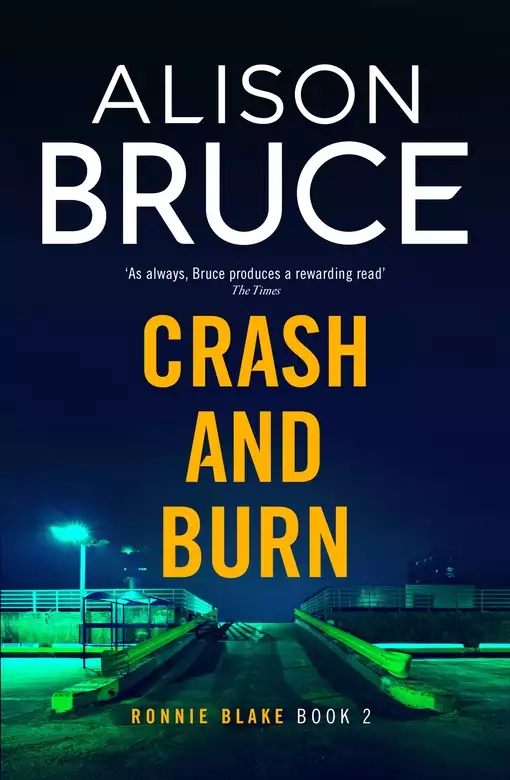
TWO BODIES. TWO DECADES APART. ONE DEADLY CONNECTION.
When an arson attack reveals a fresh corpse alongside remains from nearly twenty years ago, DS Ronnie Blake and Cambridge's special investigations unit, known as the DEAD team, must investigate both to find the connection. Their only lead is Mariel Greer, who, as a child, survived her mother's abduction and presumed murder.
Mariel remembers nothing, except a single, haunting phrase she repeated over and over. Now, as long-buried secrets resurface, the team must untangle a mystery long thought lost, before the killer strikes again.
Praise for Alison Bruce
'A powerful and absorbing story that stayed with me long after I'd finished reading. A writer at the top of her game' ELLY GRIFFITHS
'Admirers of Bruce's superb DC Goodhew series will seize on this . . . engrossing, and with plot twists that keep you guessing till the end, this is a brilliant start to what promises to be a terrific new series' CHRISTINA KONING
'Superb! Ronnie Blake will become a household name alongside crime fiction's top protagonists. Because You Looked Away is gripping, clever and utterly authentic' GRAHAM BARTLETT
'Because She Looked Away is fast paced, twisty, clever, and satisfying, an engaging start to a new series from an established author' EMILY WINSLOW
'One of our most interesting crime writers' Daily Mail
Release date:
November 20, 2025
Publisher:
Little, Brown Book Group
Print pages:
90000
* BingeBooks earns revenue from qualifying purchases as an Amazon Associate as well as from other retail partners.
She imagined that everything that had ever happened to her was stored in neat, traditionally bound volumes with unmarked covers and creased spines. In dense rows. With tissue-thin pages filled with tightly formed script. Some she carried with her, close to her chest. There were others she could no longer find, and some which had broken open, their pages scattered like old confetti. Trampled beyond recognition.
The lost books and tattered pages bothered her. She had no doubt of their existence. And with the right stimulus, no doubt that her brain could pluck them from nowhere, spread them out and read them as clearly as if the ink had only just dried. How could they seem permanently lost and then fully restored in a moment?
She didn’t understand. Not when it was all happening within her own head. Not when she should have command of the contents of her own mind.
All of this she had puzzled over many times. Her thoughts ran through the same familiar routine whenever an unexpected memory resurfaced. Usually they were innocuous, just snippets of conversation or forgotten purchases. It might be the sudden realisation that she’d met someone or visited somewhere years before. Or sometimes just a vague sense of déjà vu. Usually just the normal experiences that everybody encountered.
But not this time.
This time the trigger had been a photograph in the local paper: a tightly cropped image of fire crews outpaced by flames as they made a futile attempt to save a burning building. She’d seen it as she’d queued for coffee at Espresso Lane, the only café in Botolph Lane. She’d planned on a flat white to go; instead she took the paper from the rack and took her drink to one of the small, outside tables. The lane was one of Cambridge’s narrowest streets, dating back to the 1500s, most of one side occupied by painted terraced housing, this café and a bookshop, and most of the other side by the churchyard of St Botolph’s.
She placed her coffee on the table and repositioned her chair so that it faced the busy end of the street and allowed her to sit with her back to the window. She already knew that the image of the fire had triggered more than curiosity, and wanted to take her time to study it. But before she’d even taken a second glance, a memory bounced back at her. It was both vivid and opaque.
She froze, then sank slowly into the seat. She knew how the building had looked before the fire had begun. The image in her head was a wider shot. Much wider. It showed an unremarkable grey bungalow with dirt-layered windows, closed curtains and just a concrete apron for a front garden. There were no buildings either side, just an uneven single-track road leading in either direction to who knew where, and there was nothing else, no context. No sense of who or why or where or when. Just the single image and a painful visceral reaction that jolted through her.
She laid the newspaper on the table, smoothing out the section with the photo. There was twisting in her stomach and her heart began to pound. Her hands were clumsy, and she jogged her coffee, slopping it into its saucer. She barely noticed, her attention on nothing but the photo. She should have recoiled from the page but her hand was pressed against the photo as though it needed the connection. As though the flames had reached out and welded her to it. She didn’t know what the memory meant or who she could ask, but at that moment she also knew she didn’t trust herself to speak or stand.
She glanced quickly at those closest to her. The man at the next table. The woman walking towards her with the buggy. Mariel had no idea whether her reaction had been silent, or if she’d cried out or done anything that would have grabbed people’s attention. Instead she drew a slow breath to steady herself and began the quiet ritual she trusted when her thoughts spiralled and panic danced with her nerves.
Five things I can see. The coffee, the table, the sooted bricks of the church wall, the faded double yellow lines painted on the pitted tarmac of Botolph Lane and the traffic passing just a few yards away at the junction with Trumpington Street.
Four things I can hear. She closed her eyes. Footsteps on the pavement. The tick, tick, tick of a pushed bicycle. A child crying in the middle distance. And from inside the café, a short peal of laughter.
Three things I can touch. She kept her eyes closed. Her fingers lay against the photo and she told herself it was only paper. With her other hand she felt the edge of the table, the dark wood warm, even in the shade. And beneath her feet, the solid paving slabs laid on ground that people had walked for hundreds of years.
The exercise was working; it always had before and now she felt herself calm a little.
Two things I can smell. Goat’s cheese baguette. She guessed the aroma came from the next table, although she hadn’t noticed the man eating anything. And coffee, of course. It was why she visited Espresso Lane.
She opened her eyes, and took a fresh look at her surroundings. Rays from the lazy afternoon sun bounced from the wall of St Botolph’s Church, the man at the next table took the first bite of his baguette and, where the lane met Trumpington Street, she could see the constant flow of cars, bikes and pedestrians. Everything was normal.
One thing I can taste.
Coffee, of course. She reached for her half-drunk flat white.
She’d always thought of those books of memories as anthologies of images and story fragments, but her gaze fell once again on the newspaper photo and her relief vanished, souring and curdling in an instant. The flames were livid and all-consuming. She stared into them and suddenly she was powerless. Voiceless. And overcome by a hollow, bottomless pain. This, she knew instinctively, was a memory too. And it had been there all along. Hiding in her own fucking fragile brain.
One thing I can taste.
I can taste fear.
Ronnie Blake pulled up as close to the outer cordon as she was able. The scene was still active. A single fire crew remained on site with three police cars and an ambulance on their side of the cordon.
Ronnie’s gaze was drawn to the blackened wreck of a building, collapsed low to the ground. There were no flames now and barely any smoke, but ripples of heat haze still hovered just above it.
DI John Fenton’s attention must have been drawn in exactly the same way as her own because he voiced her thoughts almost precisely.
‘How have they pulled a body out of that?’
In pieces was Ronnie’s automatic answer, but thankfully she didn’t voice it.
‘I guess we’re about to find out,’ she replied.
The lane had been shut off to through-traffic. She left her vehicle tight to the grass verge, which would allow just enough space for a fire engine or ambulance to squeeze past if needed. They were only a few miles outside Cambridge and it was less than an hour since she’d been at home, eating breakfast with her nephew Noah, hearing how his day might look.
She’d expected her own to start with her usual walk into Parkside Police Station. Twenty-five uninterrupted minutes, falling into step with the sights and sounds of the city. It prepared her for the day going in and grounded her on the way back home.
But not this morning. Fenton had called and told her he was picking her up, that they had somewhere to be. When he’d arrived, he’d told her to drive and the satnav had directed her north out of Cambridge, towards a village called Stretham. Not for the first time, it struck her how quickly the affluent hub of the city was replaced by hardworking farmland. There was still wealth. Old money, country houses and expensive new builds, but among them it was easy to spot drab and weather-stained cottages, gardens that were junk yards and others clearly not abandoned, but looking too fragile to take another winter.
Fenton had spent much of the journey on the phone. They’d passed through Stretham, turning down a bumpy side road and then a track less than half a mile beyond.
A couple of farm buildings stood on the corner. They’d collapsed in on themselves, their corrugated iron roofs mostly rust and air, and beyond that, the scene had finally come into view.
Fenton finished his call. Ronnie had gleaned very little from his end of the conversation, and now he just looked ahead and muttered, ‘Well, this will be interesting.’
‘How so?’ she asked, and in reply, he nodded at the scene in front of them. She looked back at the confusion of activity and this time spotted the tall and grizzled figure of DCI Beetham.
‘That’s who was on the phone.’
She’d already guessed that much. ‘You said it’s going to be interesting. Why?’ But then she jumped straight into a second question before giving him space to answer the first. ‘I don’t even understand why we’re here. It’s too soon to know whether it’s arson and murder. It could be NFA’d by teatime. Why would it be given to the DEAD team? It’s not one for us. Not yet anyway.’
DCI Beetham spotted their car and began to walk towards them. Simultaneously, they opened their doors but Fenton paused before stepping out, so she did the same.
‘I didn’t understand why Beetham had called us in either, but they’ve found a second body, and, to answer your question, that’s what makes it interesting.’
Ronnie frowned. ‘Two people caught in a fire doesn’t make it any more of a DEAD team case than one. What else?’
‘The second was sealed in plastic and hidden under the floor.’
He left the car then and she followed suit. They spoke almost simultaneously to greet DCI Beetham, ‘Good morning, sir.’
‘I’d say interesting, rather than good,’ he replied. His Lancashire accent was still distinct, despite years of living in the south. ‘We can’t get over there yet. CSI is on the way, but they’re going to have to wait until it’s declared safe.’
Fenton shifted his weight from one foot to another, making a bad job of hiding his impatience. Ronnie knew he would be wondering why they’d been dragged out so early when there was nothing they could do. But DCI Beetham was also well acquainted with DI Fenton’s unsubtle body language.
‘Yours isn’t the only morning that’s been disrupted, John. We have a historic, suspicious death in an inaccessible location, revealed by collapsing debris from suspected arson and I called you first. You should be flattered.’
He paused, waiting for Fenton to respond.
‘Sorry, sir, and thank you,’ Fenton replied, with only the slightest trace of sarcasm.
Beetham held up his phone and a photo filled the screen.
‘It was snapped by one of the fire crew.’
Ronnie was the first to take it from him. She held it between her and Fenton. It took her a few seconds to understand the image.
At first glance, it was just a muddle of indistinguishable shapes, shadows and grubby tones. Smoke blackened lines of something resembling a shroud. But not fabric because, despite the soot and decay, there were no rotted fibres. Nothing frayed.
Near one edge, a smear of light reflected back at the camera. An angular and barely human form shaped the sheet into still folds.
A body, diminished and discarded in a heavy plastic sheet.
She looked from the image back to the wreck of the building. From what she could see of the ground around it, the plot had been untended and overgrown.
‘Do we know who owns the place?’ she asked.
Ronnie was still holding Beetham’s mobile. He plucked it from her hands.
‘Yes, we do, but I’ll come on to that in a minute. Given the state of decomposition, I believe we’re looking at a body that’s been there for a number of years. Even so, I’m reluctant to split this into two different investigations. We don’t have potential names for either victim and, once we do, we need to know whether there’s a link. I’m doubtful, but in case there is, I didn’t want this to go in two separate directions.’
Fenton’s dark expression hadn’t lifted. He was paying attention to Beetham, but his gaze darted at regular intervals to the site of the fire.
‘Do you expect this to be part of something bigger, sir?’
‘In what way, John?’
‘Firstly, I didn’t understand why you were calling us in for this one, but I can see that we have the right resources and the capacity to take this on. But I’m also wondering if you have a feeling about which way this one might go? I mean a body wrapped in plastic and hidden under the floorboards means offences have been committed . . .’ He stopped mid-sentence and shrugged but he didn’t need to finish. Ronnie understood the unspoken part of the question and she was certain that Beetham would too.
He waited for a second, letting Fenton have the space to add more, then gave a single nod.
‘Hardly your clearest communication, but astute none the less. We don’t know what we’re dealing with here. We won’t know the sex of either victim until the post-mortem has taken place, but yes, the case may be of special interest. There is a historical missing person’s case connected to the village.’
He tipped his head in the direction of Stretham.
Alfie Paton’s room was six foot by seven, with the kind of mid-sleeper bed that would have pleased a five-year-old. The floor space was eaten up by a small wardrobe and a chest of drawers, leaving a narrow strip between them and the bed.
Most of the carpet was hidden by piles of dirty laundry, and every surface was heaped with dirtier crockery, spent vapes and wrappers from the local Chinese. It was only a little less tidy than the rest of the house, but at least this mess was his own.
He’d made a swift trip to the kitchen and returned with a tube of Pringles under his arm plus half a loaf of bread, a jar of jam and a tub of butter, all balanced on a dinner plate.
He was awake in plenty of time for school, but he still hadn’t decided whether he was going.
There were always two other options: pick a mate and hang out all day, or spend it here. He knew from experience that if he shouted out ‘See you later’, slammed the front door and lay low till after nine, that he would have the house pretty much to himself for the day. His dad would have left already and wouldn’t come back until late. His mum might be around, or she might not. When she worked it was patchy, and when she was home she’d switch between daytime TV and brightly coloured three-in-a-row games on her phone. Her world would shrink to sofa and screens. He didn’t know whether she heard him in the house, or just zoned out.
Or there was school.
The last year is so important. The teachers bleated it. His dad tried it too, which was a bit rich coming from somebody who hadn’t been around for most of his life despite living under the same roof. Sometimes his mum hassled him, even though she spent the rest of the time proud of how well she had done with not much in the way of qualifications.
It was coming at him from all sides and just the sentiment made his hackles rise now. He just wanted to get to the end of school. He didn’t know what he wanted to do next but he’d have another two years in education whether he liked it or not.
He didn’t know what the options would be if he failed everything. He’d asked, but Ms Kellett hadn’t taken him seriously. She’d raised an eyebrow, given a tight-lipped smile and told him that it was a position he really didn’t want to get himself in. And at that moment he’d had the burning desire to fail every fucking exam just so he could see the look on her face and make her answer his bloody question.
Without even noticing he’d popped open the Pringles and had been pulling them out in pairs. He looked down and saw that he was a third of the way down the tub already. He replaced the lid and lobbed the tube to the other end of his bed.
No, it wasn’t a day for school, and it wasn’t a day for feeling smothered by staying indoors either.
Peachy, he decided, would have the answer. If Oskar Peach was up for staying off, the day would be sorted.
He leaned back on his pillows with his plate and phone balanced on his lap. He sent Peachy a message, then watched reels on Insta while he ate. He was halfway through a mouthful when Peachy called. Actually called, didn’t message first, just rang.
Weird.
He pressed to pick up and Peachy’s face filled the screen. His friend spoke immediately, his voice quicker and higher than normal. ‘The Palace burned down. Was it you? Did you do it?’
Alfie gulped a half-chewed mouthful. ‘What the fuck?’
‘What the fuck?’ Peachy’s eyes widened. ‘Did you?’
‘Why the fuck would I do that?’
‘Cos you’re the only person I know who likes setting fire to stuff.’
Alfie’s brain was stumbling towards catching up. ‘When?’ he asked.
‘Late last night. My dad saw it. I mean, he saw it on the local news. He wasn’t there, obviously. He wanted to know if I knew anything about it.’
Alfie shuffled straighter and leaned towards the phone. ‘Why would he even ask?’
Peachy looked pained. ‘Cos I left the fucking Find My Phone on didn’t I? He makes me keep it on as he pays the bill. He knew I went out there last time.’
‘Peachy . . .’
‘Yeah, I know, all right. I told him we were out that way at a house party, but then he saw the Palace on fire, checked on a map and put two and two together. But listen, Alf, if it’s arson and the police know you’ve been there they’re going to look at you, not me.’
‘Oh fuck,’ Alfie muttered. ‘How bad is the damage?’
Peachy’s reply was almost instantaneous, but in the tiny pause before he spoke, Alfie could already see what would happen to the tinder-dry frame and the dust-filled rooms, especially after so many weeks without any rain.
‘The Palace is gone, mate,’ Peachy told him. ‘There’s a film of it online, my dad showed me. It was being hosed down. You can see the roof, but it’s pancaked down on the rest of it. It took me a few minutes to even recognise what it was.’
Alfie pushed his plate away. Unease had begun to creep over him. ‘When did you see this?’
‘Like twenty minutes ago. My dad came in and woke me up. Pushed his phone in my face. He might as well have sniffed the air to see if I smelled of smoke. But it’s not my bag, is it? So my first thought was you. You didn’t, did you, Alf?’
‘No, of course I didn’t. Why would I? That was . . . I dunno, I liked it there.’
‘It was a shithole, Alf.’
‘Yeah, right,’ Alfie muttered. Then, ‘Later, later, mate,’ and he hung up, just as Peachy told him to cover his tracks.
Alfie slid from his bed and pressed his forehead against the window, looking down at the street and being met by the usual double-parked cars, churned grass verges and kids making the trudge to school. All mundane. Nothing seemed out of place and he illogically wanted it to be a sign that Peachy was mistaken, or pulling a poker-faced prank. But although his view of the wider village was mostly blocked by the nearby houses, in the distance there were smudges of smoke dispersing in the empty morning sky.
There was absolutely no reason for anyone to torch the Palace. The old bungalow had been a wreck but Alfie knew it had been a meet-up point for teenagers long before it had been his turn to visit. It was a constant.
Alfie glanced at his bedroom door. His dad wouldn’t be home, but his mum might be. He felt a ripple of connection; the Palace had been in their teenage lives too. They’d want to know for sure.
He sighed and headed downstairs, trying two or three opening lines in his head before pushing on the closed living-room door.
His mum was already in position on the sofa. Coffee and phone at her elbow, vape in one hand and the remote in the other. She’d embraced grey for the room, ramming home the names of the shades: whisper-grey walls, pewter throws and the TV standing against a charcoal ‘feature wall’. Everything she watched and played jumped out in blaring, backlit colours. The rest of the family lived in grey. ‘What?’ she asked, moving her head ten degrees in his direction but keeping her gaze trained on the TV breakfast sofa and its forgettable guests.
The ripple of connection vanished. It had been a stupid thing to feel.
Alfie glared at her. ‘I was gonna tell you something, but if you’re gonna be like that, I just won’t bother.’
Her voice softened slightly. ‘What is it, Alf?’ she said, but she still didn’t look at him.
‘The Palace burned down.’
She paused the screen and turned to him. ‘What?’ She looked confused, questioning, but the remote didn’t leave her hand.
‘It burned down,’ he repeated.
‘When?’
‘Peachy just phoned. Been burning all night,’ he said.
‘Have you been down there?’
Alfie narrowed his eyes, and the dark corners of the room grew dimmer. He hesitated, unsure whether she was asking whether he’d seen it with his own eyes, or been there when it started. ‘No, I haven’t.’ He hadn’t heard that anyone had planned to go before the weekend. But something or someone had set it alight. Maybe a local, pissed off with teenagers turning up in hot hatches with bass-heavy music pumping through the windows. Except there were no residents for a mile, that was why it worked.
His conversations with his father barely stretched beyond the practical but in one of the rare exceptions, he’d described hanging out at the Palace in his own teenage years, chuckling at the memory, as if visiting the place was a rite of passage. His dad was older than his mum, pretty ancient at almost fifty. If the locals hadn’t cared for all those years, why would they now?
His mum was staring at him, he realised. ‘What?’ he said.
‘You zoned out. I asked what happened. Was it an accident or did someone do it?’
He shrugged.
‘How do I know? But if there was no one there, there’s no one to drop a lit joint or cigarette. Buildings don’t set fire to themselves, do they?’
There was silence for a few seconds and Alfie registered how rare it was for his words to carry this much weight.
‘And there’s nothing left. It’s burned enough to collapse in on itself.’
He could imagine the thrill of seeing it ignite, watching the flames creep until they burst into full vigour. He’d started plenty of fires, small ones, rubbish bins mostly. He always carried a lighter in his pocket. He could adjust the gas flow until it produced a long, lazy, yellow flame. It gave reluctant paper enough time to ignite. It was efficient, but the ignition of a match won every time.
No matter how many times he saw it, the moment when a match ignited was beautiful. The crisp strike of the head against the rough side of the box, followed a fraction of a second later by the satisfied sigh of the flame. He liked the smell of sulphur dioxide as it was released in a small burst, but he liked the flame the best. It was small but powerful. Perfect but transient, and watching a perfectly cut matchstick twist and transform into a gnarled and blackened distortion of itself may as well have been alchemy.
‘Does Nathan smoke?’ Alfie asked suddenly and could tell by the look on his mum’s face that he’d clearly interrupted her thoughts.
‘Alf,’ she snapped at him, but he just frowned. As far as he knew, Nathan didn’t smoke, but maybe she knew something he didn’t.
‘He doesn’t, does he?’
Her frown stayed, but she relented enough to shrug. ‘Don’t know, don’t think so. If he did, he’d vape.’ She jiggled the vape in her hand. ‘That’s the thing now.’
She started to speak again, probably starting from where she’d left off, but Alfie slipped from the room, closing the door behind him as he left and glancing back in time to see his mum pick up her phone.
Beetham, Fenton and Ronnie remained at the scene for the next hour. Beetham had indicated that he wanted to speak further but then spent most of the time . . .
We hope you are enjoying the book so far. To continue reading...

 Please log in to recommend or discuss...
