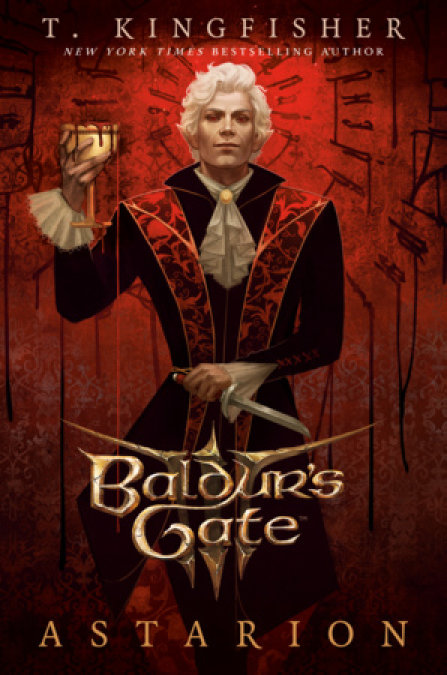
The roguish charlatan Astarion will free himself from a centuries-long fate of servitude or die (a second time) trying—in this decadently dark fantasy adventure by award-winning author T. Kingfisher.
You’re too pretty to die.
Astarion Ancunin was supposed to be a magistrate, not a vampire spawn. He was supposed to serve the law, not the vicious vampire lord Cazador Szarr. And he was supposed to drink fine wine, not rat blood. Alas—the city of Baldur’s Gate cares little for what’s supposed to happen.
Though he has been powerless to resist his master’s bidding, haunting the nighttime streets to fetch warm blood, Astarion has never surrendered his hope. One day, this nightmare must end. He just has to find out how.
When the vampire lord announces a twisted competition for his favor, an opportunity presents itself in the form of a rare prize . . . and an unlikely alliance. The blood of a dead god is buried deep beneath Baldur’s Gate, and, to get it, Astarion will need the help of a handsome Aasimar paladin named Hahn den Suriel.
There are just a few problems. Astarion is not supposed to trust his fellow spawn. He’s not supposed to go out into the city for his own ends rather than the vampire lord’s. And he’s certainly not supposed to strike a deal with a stranger whose golden eyes can snare even a blackened, undead heart.
But the city of Baldur’s Gate cares little for what’s supposed to happen.
Release date:
September 29, 2026
Publisher:
Random House Worlds
Print pages:
272
* BingeBooks earns revenue from qualifying purchases as an Amazon Associate as well as from other retail partners.
Blood, as various poets and murderers have observed, behaves very differently from water. It is thicker, obviously, and does not flow quite so smoothly. Raindrops falling into it leave tiny pools that float for a moment before dissolving.
On wet cobblestones, blood spreads out in a pool, with edges that soften as it melts into the rain. Should it happen to encounter something—in this case, a broken crate, a wine-colored sleeve, and what appeared to be half an elderly turnip—blood will soak into them, blackening the wood, deepening the red of the fabric, and staining the turnip a rather fetching shade of pink.
Astarion Ancunín was in a position to observe all this because he was lying in an alley with his right eye about six inches from the turnip in question. Also, it was his blood.
Good shade of pink, he thought absently. You wouldn’t want too much of it in an outfit, of course, but it would make a splendid accent. Perhaps as the hidden color in a set of slashed sleeves? Black fabric overall, and then flickers of color as the wearer moved . . . no, the pink would still be too much. Embroidery in a waistcoat, perhaps? Silver on black, and then a trace of pink here and there, just enough to provide a flicker of warmth . . . yes, that might work. He should probably write that down.
Astarion tried to reach for the narrow writing case at his belt. His right arm moved about half an inch before things began to grate together inside, bone against jagged bone, and pain like nothing he’d ever felt before ripped through him in a nauseating bolt.
He shrieked.
Tried to shriek.
His throat insisted he was screaming, but all his ears could pick up was a miserable whimper, like a dog dying in an alley.
Pain has a way of focusing the mind. Oh, right, Astarion thought, with remarkable clarity. I’ve been beaten senseless. That’s why I’m lying here.
He must have taken a blow to the head at the end of the beating for things to be so foggy. He couldn’t be sure, because now that the pain of his broken arm had receded, a number of other pains began fighting for his attention. His lower back was a solid mass of agony, and his left knee was throbbing with a sparkling, almost effervescent pain, as if someone were pouring champagne on the exposed nerve and then hitting it with a hammer.
He was also pretty sure he’d been kicked in the balls.
Right. I remember now.
He’d gone to the Helm & Cloak tavern for a drink after a miserable day on the magistrate’s bench. The main case had been three hunters brought up for poaching deer from a noble estate. It was an open-and-shut case. The poachers had freely admitted it, saying that there were plenty of deer, and the nobles obviously weren’t using them, so what was the harm? Their legal counsel had first tried frantically to shush them, then tried to argue that they were speaking in the abstract, then finally sat with her head in her hands, her shoulders slumped in despair.
The penalty for poaching was death. Specifically, hanging.
The men’s families had crowded the room, their faces set and expressionless as they waited for the verdict. Astarion knew the law backward and forward, knew that they were guilty, but you had to temper justice with mercy occasionally or you got a reputation for following the letter of the law. Then people stopped trying to bribe you, and what was the good of that? He’d done his best. He’d ruled that since it was a first offense, the three poachers would spend a year in prison instead of facing execution.
It was a light sentence! Light! What did they want me to do, pat them on the head and say, “Good job, here’s a copper, go buy some candy”?
The men had looked at him silently, and then they had all filed out of the courtroom and left Astarion alone with the bailiffs and a lawyer on the verge of tears.
He went over and put a hand on her shoulder. She looked up, startled, and said, “Your Honor?”
“Come on, my dear,” he said. “Let’s go get a drink.”
Astarion wasn’t going to seduce her. Sleeping with the defense was a dreadful breach of ethics, and while that might not have stopped him, it would certainly have stopped her. So he took her to the Helm & Cloak, which was extremely respectable, and let her pour out her sorrows, which were extremely dull. It wasn’t the ideal way to spend an evening, but it was an investment in the future. It was always good to have lawyers who liked you. With sufficient time and careful nurturing, they would transform like a caterpillar into a beautiful butterfly who owed you a favor.
He’d left her there after a few hours and began strolling home with the virtuous feeling of having done a difficult job as well as possible. Then he saw the men.
They were toughs, obviously, wearing the mismatched armor of street bravos. The sort who showed up in his court as boys for picking pockets, then later as men charged with beating someone to death in an alley. There was a little knot of them on the street corner, and they had the bored but expectant air of men waiting for something.
There were a great many street toughs in Baldur’s Gate, obviously, and it might not mean anything, but Astarion crossed the street anyway. Young magistrates did not get to be old magistrates by being stupid.
When he looked back, one had crossed the street and was sauntering in his general direction.
Astarion stopped and pretended to examine something in a shop window. The tough also stopped, apparently fascinated by the texture of the stone wall in front of him. When Astarion started moving again, so did he.
This isn’t good.
He quickened his pace. When he glanced over his shoulder, he saw the tough had been joined by another one. He turned a corner, and there was a third, and by now it was abundantly obvious he was being followed.
Astarion had turned sharply and cut down the nearest alley, hoping to escape. For a moment, he almost thought he had shaken them, but then two shapes materialized at the far end, black cutouts against the dull orange lantern light.
He spun around and saw the three men behind him. They were carrying clubs.
Were they after his coin purse? It was possible, but attacking a magistrate was a good way to suddenly get the Watch very, very interested, an interest that usually involved the attacker ending up in a crow cage. Ordinary street thugs wouldn’t risk it.
Families of those found guilty, though . . .
“It was a merciful ruling,” he said, not because he expected that to matter, but because it was merciful, dammit; he’d done the best he could. Did they want to be hanged?
One of the toughs spat on the ground. A voice behind him said, “Not real interested in your rulings, guv.”
“Oh,” Astarion said, then a club swung toward him, and he lifted his arm to defend himself, and . . .
Actually, there was no real point in dwelling on the bit after that. It was perhaps best described as an excruciating blur.
And now here he was.
It will be fine, Astarion told himself. Nothing a cleric can’t fix. Or a healing potion.
His right arm was clearly no good. He tried his left, watching the wine-colored sleeve shudder, then lift a trembling inch. The lace at the cuff was dyed a brilliant red.
Good color, he thought. Clashes with the wine, though. Might look good with dark purple. He looked at his hand, then wished he hadn’t. Two of his fingers were bent at a nauseating angle, but the arm itself seemed mostly intact.
It’s fine. Two healing potions will put everything to rights.
He got his hand to the side of his head. His hair was soaked with something. He wished he could believe it was rain. He ran his good fingers gingerly over his skull.
The bone moved, with a crunching noise that he did not exactly hear but that briefly filled up his entire world.
That is . . . not fine. That is very bad.
I will bathe in healing potions, and everything will go back to normal.
He stopped touching his head. He was fairly certain that there was nothing good to be learned by continuing.
I have to get to a cleric. Or any healer, really. This was not the time to be picky. He’d even let a paladin lay on hands; normally, he insisted on a few drinks first.
To get to a healer, he was going to have to crawl out of the alley.
“Right,” he whispered to himself, and tried to get to his knees.
Blinding agony erupted through his chest, and he collapsed back to the cobblestones. It was suddenly very hard to breathe. Or rather, he was breathing, but nothing seemed to be happening.
Oh, I’ve punctured a lung. I see. That’s bad.
It occurred to Astarion that he was dying.
So this is it. After all I’ve done, after everything, my life is worth less than a dead deer.
He’d never given much thought to his eventual death. Elves didn’t have to for at least the first two or three centuries. When you got to five or six hundred, really started getting up there, then you began to think about it. You prepared yourself for the inevitable, which usually meant making peace with your loved ones or doing a lot of research into how to become a lich.
He had never wanted to be a lich. Not one of them had decent hair, and as for their skin . . . oof.
We hope you are enjoying the book so far. To continue reading...

 Please log in to recommend or discuss...
