
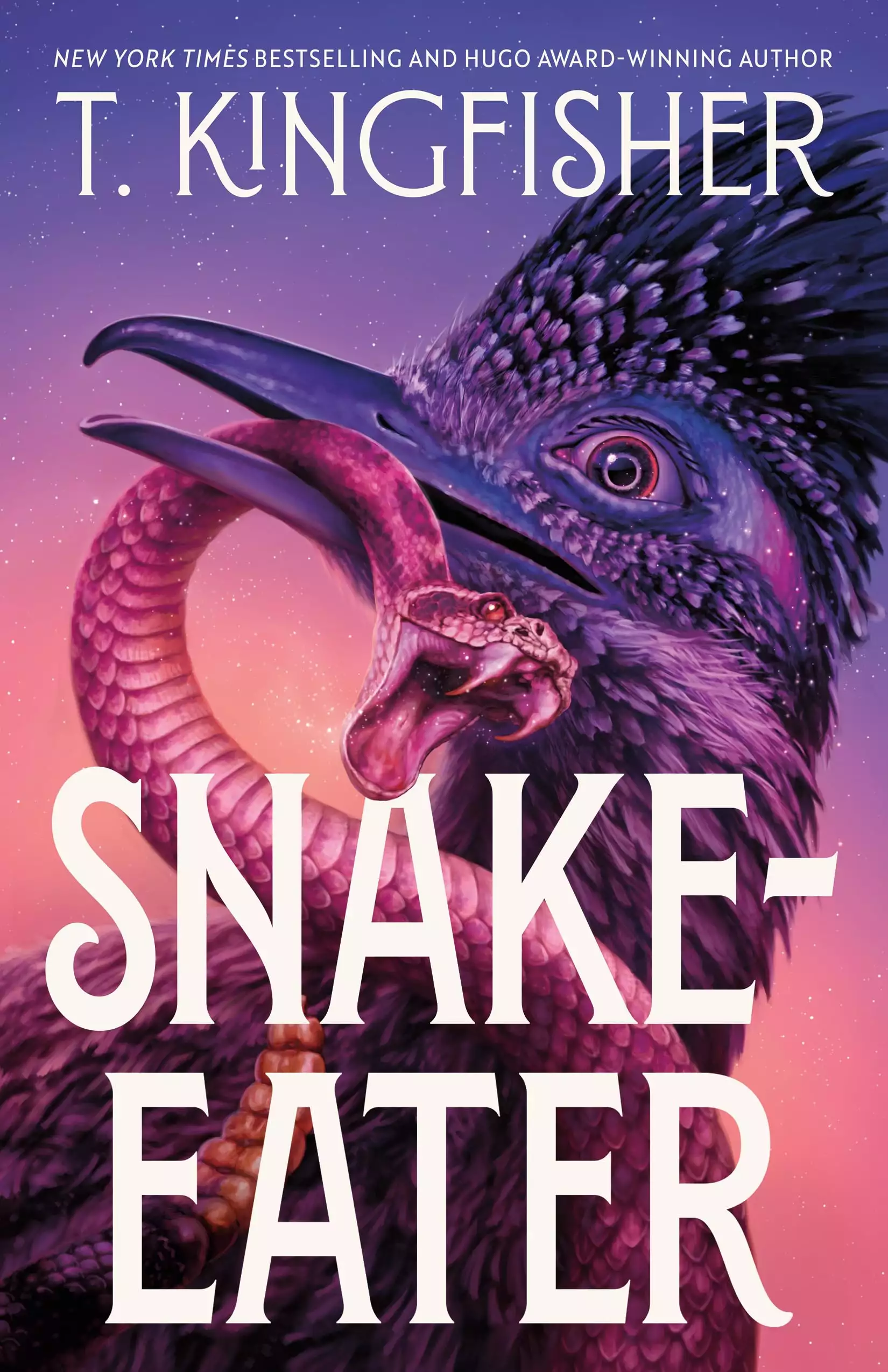
Snake-Eater
- eBook
- Paperback
- Audiobook
- Hardcover
- Book info
- Sample
- Media
- Author updates
- Lists
Synopsis
From New York Times bestselling and Hugo Award–winning author T. Kingfisher comes an enthralling contemporary fantasy seeped in horror about a woman trying to escape her past by moving to the remote US desert—only to find herself beholden to the wrath of a vengeful god.
With only a few dollars to her name and her beloved dog Copper by her side, Selena flees her past in the city to claim her late aunt's house in the desert town of Quartz Creek. The scorpions and spiders are better than what she left behind.
Because in Quartz Creek, there's a strange beauty to everything, from the landscape to new friends, and more blue sky than Selena's ever seen. But something lurks beneath the surface. Like the desert gods and spirits lingering outside Selena's house at night, keeping watch. Mostly benevolent, says her neighbor Grandma Billy. That doesn't ease the prickly sense that one of them watches too closely and wants something from Selena she can't begin to imagine. And when Selena's search for answers leads her to journal entries that her aunt left behind, she discovers a sinister truth about her new home: It's the haunting grounds of an ancient god known simply as “Snake-Eater,” who her late aunt made a promise to that remains unfulfilled.
Snake-Eater has taken a liking to Selena, an obsession of sorts that turns sinister. And now that Selena is the new owner of his home, he's hell-bent on collecting everything he's owed.
Release date: December 1, 2025
Publisher: 47North
Print pages: 267
* BingeBooks earns revenue from qualifying purchases as an Amazon Associate as well as from other retail partners.
Reader buzz
 Please log in to recommend or discuss...
Author updates
Snake-Eater
T. Kingfisher
Chapter 1
Selena picked her new home for no better reason than the dog laid down on the porch.
The dog was a middle-aged black Lab, though her Labrador-ness had been diluted by a fence-jumping father of questionable ancestry. Whatever he had been, his genes had helped temper the breed’s boundless energy. She still worshipped chasing tennis balls as the highest form of canine endeavor but wanted a long nap afterward, and ideally a long nap beforehand as well.
Selena named her Copper, which Walter said was a stupid name because there was nothing copper colored about her. Selena felt guilty when he pointed that out, but Copper had already learned her name by that point, so she put a collar on the dog with bright copper tags. Walter rolled his eyes, but Selena was pleased with herself for having set things right again.
The dog, it must be said, never seemed to mind either way.
Selena had ridden out on the train, two and a half days to get there, and she’d been afraid the whole time that somebody’d tell her she couldn’t have a dog on board. She didn’t know what she’d do. Fortunately Copper had excellent travel manners and mostly lay under her seat and let out the long sighs of an old dog at peace with the world. The rocking of the train seemed to agree with her. She squatted obediently at every stop and was extremely pleased to share the sandwiches that Selena passed down to her.
At the second-to-last stop, the conductor bent down and scratched Copper behind the ears, and Selena was so relieved that she nearly cried.
When they reached the final stop, Copper stood up and stretched. Her muzzle had begun to go white, but her eyes were clear. She glanced around the train platform and then up at Selena, as if expecting orders.
Quartz Creek was painted on the platform wall, in faded blue. The train platform was cinder block and adobe. It could have been ten years old or two hundred.
There were no gates or turnstiles, no ticket takers. Also no taxis. Selena knew that the area was a historic zone, which meant that you couldn’t put developments up all over the place and drones were banned, but she hadn’t expected a lack of taxis. Or maybe there just weren’t enough people around for taxis to make any money, which was a somewhat alarming thought.
“I guess we just go?” Selena asked empty air. She wrapped the leash around her right hand and gripped her suitcase handle in her left.
The station was nearly deserted. Two men in faded jeans unloaded several boxes from one of the cars into the back of a battered pickup truck. The conductor went over and had them sign a sheet of paper, then said something that made the others laugh.
Selena stole a glance to make sure that they weren’t laughing at her. They didn’t seem to be.
There was a drinking fountain against one wall. The water came out lukewarm and tasting of metal. She filled her water bottle and let Copper drink her fill from the little metal dish in her backpack.
There was hardly anything else to the station. Two little shelters with benches, the drinking fountain, and a list of timetables under glass. The stairs down from the platform ran directly to a rutted dirt road. Selena stared down the road in mild disbelief, then slowly lifted her eyes.
The town was visible a long way in the distance. There was a hill behind it, or maybe a mountain. Between town and station stood two or three miles of desert, full of scrubby little bushes and big gray-green saguaros, and dozens of plants that she didn’t know the names of. One long, serpentine thing might be ocotillo, but then again, it might not. Whatever it was, it had thorns. So did most of the other plants.
The dirt was bone white and the sky was hard blue. It was only midmorning, but heat was already making long squiggles in the air.
She’d expected the town to be closer, or for there to be taxis or buses or something. She hadn’t expected a hike from station to town. Aunt Amelia would probably have come out to meet her, except that Amelia didn’t know that she was coming. They corresponded by erratic postcards and neither had ever included a phone number.
Even if she’d known the number, she didn’t dare turn on her phone. The location tracker that had seemed like such a sensible precaution when Walter explained it would give her away, and she just wasn’t ready to deal with that yet. Which also meant that she couldn’t use a rideshare app, assuming there were any way out here.
Selena picked up her suitcase and let the dog lead the way.
Behind them, the train let out a long whistle and began to chug away.
The black dog kicked up little puffs of dust as she trotted along, occasionally reaching the end of the leash and pausing for her human to catch up. Selena studied the verge of the road. She had expected deserts to be full of sand, but the earth here looked more like talcum powder mixed with rocks. The shrubs along the road had gray bark and grew sideways, split, grew sideways again.
There was so much sky that it was hard to think. In the city, there were walls you could put your back against, doors to shut, places to hide. To hide out here, you’d have to crouch down and worm your way under one of the scrubby little bushes, and you’d probably get a faceful of spines for your trouble. Even the shadow of the Scottsdale arcology had faded away into the endless blue.
Selena wiped her forehead, where beads of sweat were already beginning to form. She was very tired. Unlike Copper, she hadn’t slept well on the train. Dragging her suitcase wasn’t helping. The wheels on the bottom were made for flat surfaces, not dusty roads with washboard ruts. The rattling went all the way up her arm and into her skull, setting her back teeth clattering against each other.
I shall invent an all-terrain suitcase and make a fortune. With giant wheels, and a handle that doesn’t try to twist out of your hand when you hit a rock.
She had dragged the suitcase perhaps a quarter of a mile when the battered pickup from the station rumbled up alongside them. It stopped by the side of the road.
“Need a ride in?” asked the driver. He was an older Latino man with a lean, angular face covered in narrow wrinkles. “It’s a short drive but a long walk.”
Selena’s first instinct was to refuse. You didn’t take rides from strange men—that was asking for Bad Things to happen. They could kidnap you and dump your body somewhere in the desert where you’d never be found.
Then she had to laugh at herself. There were no other people around and nowhere to hide. If they were planning on kidnapping her, it didn’t matter whether she climbed into the truck or not.
Besides, if I have to walk the whole way, my body may end up somewhere in the desert anyway.
“Thank you,” she said. Was that enough? Probably not. “I’d appreciate that a lot.” There, that should be good. Just enough, not too much.
“Hop in,” said the old man, jerking his thumb toward the back.
The other man was riding in the back alongside the crates from the train. He lowered the tailgate and Copper leapt up. “Hey girl,” he said to the dog, and she thumped her tail twice, then settled at Selena’s feet. “Ma’am,” he added, dipping his head to Selena, and helped her settle her suitcase.
It was too loud in the back of the truck to talk, for which Selena was grateful. She gave the man a quick smile and then looked away, at the desert. Copper was a reassuring weight against her shins.
She wondered if the men knew her aunt. She could ask. What little she could see of Quartz Creek looked too tiny for anyone to be a stranger. Aunt Amelia had always said it was a small town, but she hadn’t realized quite how small.
She practiced what to say to the driver in her head. Thank you for the ride. You were right, it would have been a long walk. That sounded pretty good. That was a normal thing somebody would say, right?
Thank you for the ride. You were right, it would have been a long walk.
She ran it through a couple of times, staring at the landscape bouncing over the side of the truck bed. The dust cloud that rose up behind them was four or five times the height of the truck and looked like a plume of ash.
Was the desert beautiful? It would be hard to tell. It was hard and dry, which Selena had expected, and intricate, which she hadn’t. She’d been picturing sand and stone and scouring winds. Not the little bushes fitted all together with strips of dust in between, not the stacked paddles of prickly pear. It looked like a complicated mosaic with white mortar, or one of those paintings made out of hundreds of dots. If she were far up in the hard-blue sky, would the desert resolve into a picture?
Thank you for the ride. You were right, it would have been a long walk.
Lord, I must be tired. She almost always had to repeat a script in her head, but not so many times, and not such a simple one. Most of her scripts had been memorized long ago. It was only lately, with the funeral and wrapping everything up—and now the train—that she’d had to make so many new ones, and maybe they were crowding out old ones, like how you thanked someone for giving you a ride.
The truck rattled and cracked down the dry road, the wheels fitted into the ruts like train tracks. A line of fat, gray bodies ran alongside for a moment. Selena blinked, surprised, at a flock of plump little birds with black topknots and stubby wings.
Are those quail? Real quail?
She supposed she knew that quail existed somewhere, but she’d never expected to see them. They were creatures out of children’s books, more like stuffed animals than real flesh and feather and bone. But here they were, plump and ridiculous and very much alive.
Selena realized that she was grinning foolishly. She darted a glance at the other passenger, and saw him smiling. He said something, but she couldn’t hear it over the roar of the engine. She shook her head.
He was middle-aged, probably the driver’s son. He wore a bandanna over his hair, and his skin was deeply tanned. There were thick silver rings on three of his fingers and black rings of grease under the nails.
When the truck slowed, entering Quartz Creek, and the wind died down, he leaned forward. “What brings you to town?” he asked.
Selena felt the little muscles along the back of her neck go wire tense. It’s a normal question. It’s perfectly normal. You know what to say. You practiced this.
She reached into her chest, and the words were there, just as she’d practiced them. “I’m looking for my aunt,” she said. “She lives out here. I’m just not sure what her address is.”
To her intense relief, he nodded, as if this wasn’t strange at all. “Go up to the post office,” he suggested. “It’s right across the street. If you’ve got people here, Miss Jenny will know where they’re at.”
“Thank you,” said Selena, although she had already planned to try the post office. “That’s a good idea.” Compliments were good, though not flattery. She thought she’d done it right. She had praised the idea, not him, and not extravagantly. She dropped her hand to Copper’s collar, and the dog thumped her tail.
The town wasn’t very large, a few dozen houses. They stood wide apart with ditches between them, and small roads arranged like the spokes of a wheel. The buildings were pale adobe with flat roofs, wide porches, and what looked like whole logs sticking out the sides. It was a very strange look, as if they’d built the rafters too long for the walls. One of the buildings was taller, an old Spanish Mission–style church, with double doors thrown wide.
Most of the houses had solar panels on the roof or the garage, the old, ugly kind—cheap and nearly indestructible. The sort that Selena associated with poverty one step up from corrugated-steel siding.
I’ve got twenty-seven dollars left to my name. I don’t get to talk to anybody about poverty, I guess.
Did one of the houses belong to her aunt? Was one of those scruffy, speckled chickens hers?
Somehow Selena had never thought of her aunt as poor. She has a house! People with houses aren’t poor.
At least . . . not in the city . . .
They passed an old garage, a temple to cars where mechanic-priests sat around in their overalls. There was a line of electric charging poles, but no stoplights. Chickens scattered along the road as the truck passed, and dogs lay panting in the shade. There were a couple of ragged pine trees, and some strange trees that Selena didn’t know—one that was all green, even the trunk, with fine slender needles, and one with slick red bark that peeled like a burn.
The truck stopped.
Her companion unhooked the tailgate and jumped out. He reached up a hand to her.
Do I take his hand / you’re not supposed to touch strangers / but he offered first and now it would be rude / no, it’s like a handshake, that’s okay, handshakes are okay—
She took it with, she hoped, no obvious hesitation. His fingers were dry and hard and had calluses like bits of gravel.
He helped her down from the truck and handed down her suitcase. “Thank you,” said Selena.
“No problem. Post office is right over there.”
Selena took a step toward it, then stopped. Don’t forget. She walked up to the cab of the truck and said, carefully, “Thank you for the ride. You were right, it would have been a long walk.”
“Anytime,” said the old man. He lifted a hand in half a wave, and Selena waved back.
She felt a bit giddy as she approached the post office. She’d done it right. She hadn’t practiced getting a ride, but she hadn’t said anything stupid. It was an unexpected victory.
The post office stood in the center of town. It was the same square adobe style as the rest of the buildings, but there was a metal sign over the door that said Post Office. Two of the strange green trees grew out in front, their leaves buzzing with cicadas.
Selena tied Copper’s leash to one of the porch posts and said, “Stay.” Copper fell over on her side with a drawn-out groan, the world’s most put-upon dog.
Next to the door was a little wooden sign with letters burned into it that said Burnt Branch House.
Selena paused with her hand on the knob. Was that the name of the building? She’d seen named buildings in the city, but mostly they were named for historical figures. Burnt Branch House. Hmm.
She pulled the door open.
Inside it was all tile: red clay on the floor, bright blue for the counter. A line of painted sunflower tiles circled the wall. Even in the dim light, the room glowed with color. Selena had never seen a post office that was anything but industrial gray, and the sight made her want to grin in the same way seeing the quail had.
A stout woman sat behind the counter. She looked up and raised her eyebrows as Selena came in.
“Can I help you?”
Say it. Say it just like you practiced. It’ll be okay.
“I’m sorry to bother you . . .” Selena reached into her backpack and pulled out the old postcard. The ink had blurred in a couple of places, and the stamp was half gone, but the name on the return was clear. Amelia Walker.
There was no street address, just the name of the town, which Selena had thought was odd until she came to Quartz Creek and saw how small it was.
“I’m looking for my aunt,” she said and slid the postcard across the tiles.
The woman behind the counter picked it up, flipped it to the back. A line formed between her eyes, and she looked up.
Her broad face was sympathetic, and even before she spoke, Selena knew.
No. No. She hasn’t said anything, you’re wrong, she hasn’t said anything so it isn’t real—
“Oh, honey,” said the woman. “I’m sorry. She passed away—only about a year ago. We didn’t know how to find her next of kin, or we would’ve tried to get out a letter.”
Selena was aware that she was staring straight ahead. Heat was rising up her face, to her eyes, and when it hit, she was going to burst into tears.
No, no, she can’t be—I came all this way—I can’t afford to go anywhere else—I can’t even afford a ticket back—
And then the old anxiety came back, and she realized she’d been standing there for much too long and the woman was looking at her.
“Thank you,” she said in a high, strangled voice. She might have said more, but she knew that it sounded like she was going to cry, and you did not cry in public, that was something you definitely did not do. Her mother had always been very clear on that. “You might as well wet your pants on the street corner!” she’d said.
Selena turned away and practically ran out the door.
Copper was waiting there. Copper, who was big and solid and made of fur and bone and muscle. Copper, who loved her even though she didn’t deserve it. Selena crouched down and put her face in the black Lab’s shoulder.
A year ago. A year ago. The phrase beat in her head like a pulse. A year ago.
Oh god, only a year. If she’d found her courage just a little bit sooner, if she’d gone only nine years instead of ten, she would have come out and found her aunt alive.
Whether her aunt wanted to see her—whether her aunt had any fond memories of the city or had sent the postcards purely out of loneliness and duty—those were hurdles she could have faced.
Now she couldn’t.
Now she was in the desert hundreds of miles away from home, and there was nothing but strangers and heat and dead white dust.
Copper licked her face and wagged her tail, concerned that her human was making upset noises. That was okay. She could wipe dog slobber off her face and nobody would know she was wiping off tears.
The door creaked behind her.
“Oh, honey,” said the post office woman. “I’m sorry.” She sat down on the porch next to Selena, not touching, but close by. “Guess you were hoping for better news.”
Selena had no scripts at all now, and only nodded.
Stupid, stupid, should have thought what you’d do if she was dead or even had moved, didn’t think, didn’t plan . . .
What she knew, down in her heart of hearts, was that she couldn’t have planned. This had been her last thrash toward self-preservation. She might as well go lie down in the desert now and let the sun bleach her bones.
“I’m sorry,” she croaked. Copper licked her chin again, worried.
“Nothing to be sorry about,” said the post office woman. “We all ought to have somebody to cry when we pass on.”
Guilt joined the lump in Selena’s throat, because she hadn’t been crying for her aunt at all, but for herself. Callous and stupid.
The woman held out her hand to Copper, who sniffed it and gave it a vague, meditative lick. Selena rested her cheek on the dog’s warm, furry back and tried to think of nothing at all.
“What’s her name?” asked the woman.
“Copper,” said Selena. Her voice was still shaky, but that was a safe question and a safe answer.
“Good name.” She scratched Copper behind the ears and was rewarded with an enthusiastic tail wag. Copper did not believe in disguising her emotions. “Black Lab?”
“Mostly.” Selena wiped her face. “The rescue wasn’t sure what the rest was. Some kind of hound, maybe.”
“You’re a pretty girl, aren’t you?” the woman asked Copper. Copper gazed at her soulfully and attempted to convey that she had never been petted, not once, but would like to experience it.
The familiar conversation grounded Selena a bit. Everything was terrible, but she still had to do the next thing and the next thing after that. She couldn’t just sit on the porch crying all over her dog.
“Is there . . .” She swallowed. Twenty-seven dollars. “Is there a motel or a hostel near here?”
“Can’t say there is, no.”
Selena hadn’t expected there would be. Quartz Creek didn’t look big enough to have a Dollar General, let alone a motel.
I’ll have to get back on the train. Somehow.
She could call Walter, of course. Turn on her phone and call him. He’d wire her the money and she could get a ticket and go home.
If she did that, he’d explain to her that her nerves had just been disordered from grief over her mother’s death. Or maybe she could say that she went to tell Aunt Amelia in person, and then he’d chide her for not having thought it through, but allow that it was perfectly understandable under the circumstances. Losing her mother had been a blow, and it was bound to dredge up lots of things. Anyone would act a little irrationally under the circumstances.
He’d be right, of course. And—Selena knew herself—she’d be grateful to him for being so understanding. She would. And then later he would refer to the time that she had hared off to the middle of nowhere without enough money to get home, and she would flush hot with shame at the memory.
It would become one more of the stories about How Selena Had Done Something Foolish and Walter Saved Her. The story might lie in wait for years, but then it would rear its head and strike. She’d never know when to expect it. During an argument. Or during a party, maybe, when Walter needed to top a coworker’s story about something silly their spouse had done. Or maybe just in a moment when Selena wasn’t sufficiently grateful for all the things he did for her.
The story would never go away. Walter forgave immediately, but he never, ever forgot, and so neither could Selena.
The thought was so exhausting that she felt like crying again. She drank some water to stave it off, swallowing down the lump in her throat.
The woman from the post office studied the postcard again. “Tell you what. The house is still there, you know. Amelia’s house.”
Selena looked at her blankly, one hand hooked under the dog’s collar.
“Nobody’s claimed it,” said the woman. “She’s got no kin around here, and it’s not a big house. And you look about done in, if you don’t mind me saying so. No reason you can’t stay there for the night. Or however long you need.”
Selena had to think for a minute, to put the words together. She tried them out in her head a few times, then said, “Is that allowed?”
“Sure,” said the post office woman. “I said it was fine, didn’t I?” She grinned. “I’m the mayor, you know. Also the postmaster, fire marshal, and the chief of police. My name’s Jenny.”
She stuck out a hand and Selena shook it. Shaking hands was polite, and if she was careful, she wouldn’t start to overthink whether she’d been shaking too long or not long enough.
She didn’t want to babble or dominate the conversation, but surely she could ask one more question. “You’re sure no one will mind if I stay there?”
“Nobody around to mind,” said Jenny. “Lotta places standing empty these days. Can’t keep people in ’em. You know how it is.”
Selena didn’t have the least idea how it was and didn’t know where to start asking, so she simply nodded and hoped that Jenny wouldn’t have any follow-up questions.
“You’re next door to Grandma Billy, out past the old well, and then there’s nothing for a mile on. You’ll have to check the old solars, but they should be working well enough to make tea, and you ain’t gonna need heat for a couple of months yet.” She leaned back on her hands. “Give it a look over. If you’re inclined to stay, just come by the post office and let me know. I’ll make you out an address form.”
An address form? For what? Is she suggesting I move in? I can’t do that. Houses are expensive. People with houses are always complaining about it. You can’t buy a house with twenty-seven dollars. Even if they gave it to me, I couldn’t keep it. The roof will fall off and the walls will fall down and I’ll have no money and they’ll hate me for not taking care of it. And it’s stupid to think anyway, because nobody gives away houses.
“I can’t stay,” said Selena. She had no money and apparently no family either. She’d have to leave, go back, deal with what she found in the city. With Walter. Running away hadn’t solved anything.
“Up to you,” said Jenny. “Train won’t be back till tomorrow, though, so you might as well walk over and take a look.” She pointed down one of the roads. “’Bout half a mile that way. Grandma Billy’s the one with the blue door, and you’re the one just past it.”
“Thank you,” whispered Selena, her store of words exhausted.
Jenny, the mayor and the postmistress and the fire marshal and the chief of police, smiled at her and said, “It’s called Jackrabbit Hole House. You can’t miss it.”
Excerpt from SNAKE-EATER by t. kingfisher Text copyright © 2025 by t. kingfisher, Published by 47north
We hope you are enjoying the book so far. To continue reading...
