On North Carolina’s Ocracoke Island, Maureen Nash sells exquisite seashells to locals and tourists—with Bonny the shop cat and the ghost of a Welsh pirate for company. And when needed, she steps in to help the police solve a murder…
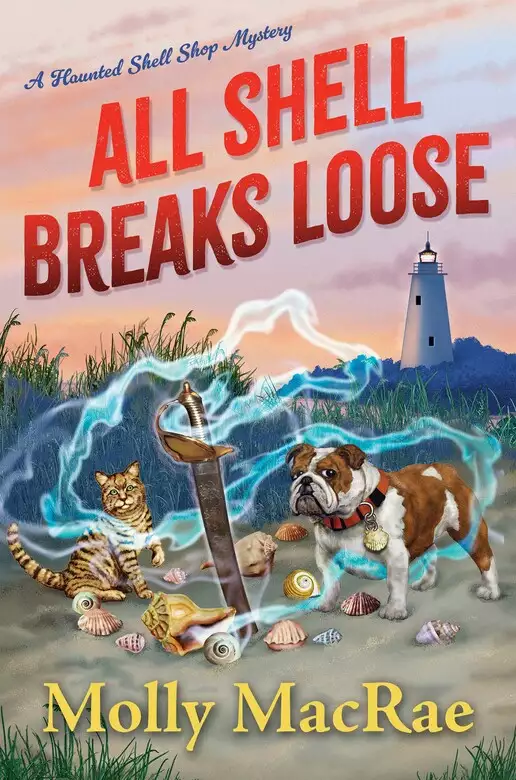
Dr. Irving Allred is boasting around town that he’s about to get his hands on an authentic haunted sword. But minutes after Maureen hears the story, a woman walks into the Moon Shell, sword in hand. She found it while walking her bulldog on the beach—and its blade is stained with what looks like blood. Looks like it’s time to call the sheriff’s department.
Allred is furious that his prize is now in police custody—and even more agitated that an unknown buyer was trying to outbid him. He’s convinced that the sword will lead him straight to the ghost he’s hunting. He’s not the only one on the Outer Banks who’s been searching for spirits, though. An odd visitor also showed up at Maureen’s shop claiming the ability sense them . . . though somehow she didn’t seem to notice Maureen’s spectral friend hanging about.
When a man who’d been camping nearby is found cut down along the shore, Maureen starts providing some unofficial assistance to Captain Rob Tate by digging into the island’s maritime history. But it’s not the only mystery she’s facing—because the shop’s resident ghost is seeing ghosts himself . . .
Release date:
June 30, 2026
Publisher:
Kensington Books
Print pages:
288
* BingeBooks earns revenue from qualifying purchases as an Amazon Associate as well as from other retail partners.
On an early November morning, with gulls crying over the harbor of seagirt Ocracoke, I stepped onto the deck of my bonny ship, the Moon Shell. That the “ship” was my shell shop and the “deck” my shop’s front porch didn’t matter. Emrys Lloyd, the pirate sitting on the porch railing, was real enough. Or as real as a ghost may be.
“Good day, mistress Nash,” Emrys called from his perch. “You look positively heroic with your broomcorn lance and watering can shield. With what enemy are you intending to do battle?”
The edge of my hand to my brow, I shielded my eyes, the better to scan the horizon for brigands or buccaneers. There was no one in sight on the sand and oyster shell lane called Howard Street, either to the left, or to the right, or directly across, where the good-hearted, slightly nosy Weavers lived. Interesting note—both their golf carts were gone. The only infiltrators in sight were the leaves mobbing the corners of the porch and a crow sitting on the railing beside Emrys. He had good rapport with crows.
The emptiness of Howard Street meant no one would overhear when I spoke to the ghost pirate whom they had no idea existed. “I’ve brought grog for the mums.” I lifted the watering can. “After which these leaves shall walk the plank.” Three leaves met a lethal side swipe from my broom.
“Very good. Carry on.” Emrys enjoyed strutting around the Moon Shell, acting the part of the merchant and seaman he’d been in life. It would have tickled him, no end, if I saluted before carrying on with my watering and sweeping. For two good reasons I didn’t.
First, a salute would go to his head, and a swell-headed pirate is a sight and earful to behold. I generally cut him slack. He couldn’t help it if his manners and mores were products of the early- to mid-eighteenth century. I cut him slack for the whole ghost thing, too. That wasn’t an ideal condition for anyone to deal with. But over the couple of months since we’d met and I’d become the owner of the Moon Shell, his preferred haunt, we’d spatted more than a few times. He claimed to be 311, having been born in 1713, so he felt entitled to seniority, if not superiority. That made sense. Or it would, if ghosts worked that way. But they don’t.
Ghosts don’t age after their deaths. So, just as Emrys would always wear his cutaway frock coat, knee breeches, stockings, buckle shoes, and tricorn hat, he would always be thirty-seven. Sure, he’d learned new songs over the 274 years since he’d died and sang them in his still-lovely tenor voice. He’d taken up reading Nero Wolfe mysteries and obituaries in The New York Times. He enjoyed learning current vocabulary and knew how to dink around on a computer (dink being one of his new words). But as a competent, breathing, fifty-two-year-old woman successfully navigating recent widowhood, who’d raised two self-sufficient sons, I felt I had an edge over the dead pirate. Most of the time we got along well, though, with our friendship sailing true on an even keel.
For instance, we easily agreed on the second reason I wouldn’t salute him—the danger of ghost hunters. I hadn’t believed in ghosts until I met Emrys, but I knew that plenty of people accepted their existence as part of life and death. Ghost hunters were another matter.
Not many people had seen or heard Emrys since his death. By some quirk, possibly a zap from an electrical short, I was one of the lucky few and currently the only one. He haunted the Moon Shell, the shop I’d recently inherited in Ocracoke Village, the one-time pirate haven on Ocracoke Island, off the coast of North Carolina. I felt lucky to know him and call him a friend. He’d been educated and well-read during his lifetime. He’d continued to take an interest in the world around him since his death. He wrote treacly poetry and loved spewing quotations. He’d collected seashells, and the shop was named for the magnificent shell on which he’d carved an intricate and beautiful seascape for the wife he’d loved and still mourned. For all that he was a pirate and a ghost, Emrys was a gentleman. And to be fair, he hadn’t been much of a pirate. As he swore with a hand on his once-beating heart, he’d only gone pirating once, and that by accident (almost), and it hadn’t ended well for him.
Our mutual worry was that an encounter with a ghost hunter might not end well for him, either. One ghost hunter in Ocracoke in particular. Dr. Irving Allred, the island’s doctor, yearned to see a ghost and practically slavered to catch one. Neither Emrys nor I knew how Allred could do that, and we didn’t want to find out. For that reason, I did my best not to talk to Emrys or interact with him around customers or other people. He didn’t always make that easy. Maybe no one else saw or heard him, but I did, and he found plenty to say and do.
“What ho,” he said now, as gravel crunched under the tires of a car turning into the small parking area in front of the shop. “Who is this coming alongside before you’ve made our decks shipshape?”
A dark green Subaru rolled to a stop. It looked a lot like the one Jeff, my late husband, drove for fifteen years. A faithful, sturdy car able to haul the many props, costumes, and bits of scenery a university theater director asked it to. This Subaru carried a woman a decade or so older and several inches shorter than me. She waved, and when she opened the back passenger door, we saw that the car also held an English bulldog.
“Good morning,” I called.
Emrys doffed his hat.
“Love the color of your chrysanthemums,” the woman said. “They’re all the colors of last night’s sunset. The crow on the porch railing is a nice touch, too. Looks real.”
The crow cawed and flapped away.
The woman’s eyebrows shot up and she laughed. “A real nice touch.”
“Thanks. I’ll be with you in two flaps of a crow’s wing.” Or fifteen minutes if I stuck to the posted hours, which I wouldn’t if she wanted to come in immediately and ogle the shells. I might be new to retail, but I knew better than to turn away a potential customer first thing in the morning.
“Take your time,” she said. “Ben wants a walk and I’ve been dying to get pictures of the lichen on the fences along this street. We’ll be back, though. Don’t worry about that.” She waved again, and she and Ben the bulldog ambled off down the street, Ben looking stolid and ministerial, like Winston Churchill, and the woman whistling a jaunty tune. As they disappeared around the bend, a little dust devil formed in the parking area and then it disappeared, too.
The crow, or another one, cawed from the live oak at the edge of the yard. It tipped its head looking as surprised as I was by the appearance and disappearance of the mini whirlwind. The crow slowly turned its head, its eyes like obsidian beads, intent as though tracking something moving across the yard toward the shop. Toward me at the top of the steps, I realized. Leaves on the steps swirled into the air, into my face, then scattered over the porch floor, and a chill ran over my scalp.
“A crazy leaf devil,” I said, laughing at the folly of sweeping on a windy day. Not much of a laugh, though. Except for those two tiny devils, the air was dead calm. “Did you see that?” I glanced toward Emrys only to find the porch railing now empty of ghosts. No crow in the live oak, either.
The chill left my scalp and crawled down my spine, and I decided the mums could wait until lunchtime for their water. And no need to sweep the leaves, either. Leaves would always be with us. And, right then, abandoning mums, leaves, and porch seemed like a fine idea.
Before I could retreat, a series of anemic beeps reached my ears. Beeps approaching from the left—moving in the wrong direction on narrow, one-way Howard Street. The bleating beeps of two golf carts jockeying for position, careening toward me (as much as electric golf carts racing at fifteen miles an hour could careen). They screeched to a halt beside the Subaru (the screechers being the drivers, Glady and Burt Weaver, and not the carts).
“Have you heard what Irv Allred’s done now?” Burt yelled.
“No.” I shook my head, too, in case he couldn’t hear over Glady.
“The old fool,” Glady shouted. “The utter and absolute fool!”
The octogenarian and nearly octogenarian siblings did their best to leap from the golf carts and dash up the porch steps, their faces bright with news (or flushed with the effort to move at anything like a leap or a dash).
I opened the door and held it for them. Burt wiped his brow, took a heaving breath, and gestured for Glady to go ahead of him. She hustled inside. Burt made as if to follow and then, with the triumphant gloat of a younger brother beating his sister to the punch, he turned in the door so that his broad back blocked her and blurted, “Irv Allred thinks he’s bought a haunted sword.”
“You whelp!” Glady shouted. “You no fair fathead!”
I took a few broom sweeps toward a chuckling Burt and followed him inside. With a crash, the door slammed behind me. A few seconds of startled silence followed. Then, in unison, Glady and Burt complained about my dangerous consarned closing of doors.
“They aren’t wrong,” Emrys said. “Bonny will tell you. She’s sure to have lost two of however many lives she has left thanks to your carelessness.”
Bonny, the usually calm shop cat, crouched low on the sales desk, eyes large, round, and staring at the door.
“Yikes! Sorry about that,” I said over their complaints. “That wasn’t me, though. It was the wind.” Emrys and I looked out the window. No branches swayed. No dust or leaf devil danced.
“Well, easy come, easy blow.” He gave me a toothy grin, knowing I wanted to groan.
“Really?” That worked as a response to him and to Glady and Burt’s news. I turned to them and added, “Allred and a haunted sword?”
Haunted or otherwise, swords and Irving Allred didn’t sound like a good combination. He himself was an odd combination of things. In his early- to mid-seventies, he’d been the island’s doctor for years. At the same time, he claimed to occasionally see “tokens of death” foretelling a patient’s imminent passing. That wouldn’t be entirely outlandish if he were a member of an old Ocracoke family. Stories handed down over the years told of people witnessing tokens of death—an unusual vision, image, or sound—before someone died. Allred reported the tokens only after someone died, though, so no one believed he saw or heard them. Why he co-opted the island stories was a question for another kind of doctor. The man had an intense interest in paranormal phenomena in general, besides his hunger to see or catch a ghost. Most people brushed his paranormal hobbies aside as eccentricities. Emrys and I weren’t most people. To us, Dr. Irving Allred was an odd-scary combination of doctor, buffoon, and our worst nightmare.
“Do I really want to hear about Allred with a sword?” I asked.
“If it’s haunted, yes,” Emrys said.
“We didn’t drag-race all the way here to not tell you,” Glady said. “He doesn’t have it yet.”
“According to Irv, though,” Burt said, “he’s soon to possess it.”
“Where did you hear this?” I asked.
“Just now,” Burt said. At the—”
“The Variety Store.” Glady snatched the rest of his words for herself.
“We heard it from his own ridiculous lips.”
I glanced out the window again. Still no breeze. “You didn’t just take one cart to the store?”
“Didn’t make sense,” Burt said. “I need to run by the library afterwards and Glad wanted to come on home.”
“Instead, he tried to run me off the road to get back here.” Glady leveled slitty eyes at Burt. “Which is directly across the street from home.”
“Sounds like the golf carts did all the work,” Emrys said. “Why were they so out of breath when they got here?”
“Mo doesn’t want to hear our petty squabbles,” Burt said.
“Mo?” That was new.
“Sure,” Burt said. “If she can be Glad, you can be Mo.”
“Ignore him. We’re talking about Irving,” Glady said. “He saw the thing advertised online and bought it sight unseen.”
“Not quite unseen. The ad had a picture,” Burt said.
“Artistic rendering or a photograph?” I asked.
“A photograph showing a wild-eyed older woman brandishing a sword.” Glady demonstrated the brandishing. “She should at least have brushed her hair. She looked more haunted than the sword.”
“That’s not saying much. She might be an actress,” Burt said. “Or the ghost.”
“Or A.I.?” I asked.
“I didn’t think of that,” Glady said. “But probably not. The woman only had two arms and two legs.”
“An A.I. picture would have been more in focus, too,” Burt said. “The picture Irv showed us was ridiculously poor quality. More ghost than photograph.”
“The picture’s probably more of a ghost than the supposed ghost haunting the sword,” Glady said.
Burt nodded. “Goes without saying.”
“Irving’s beside himself,” Glady said. “The seller is personally delivering the sword to him with papers proving its authenticity and detailing its provenance.”
“What does proving its authenticity mean?” I asked. “That it’s a real sword? That it’s genuinely old?”
“That it’s haunted by an authentic ghost and not an electronic gizmo hidden in the hilt?” Emrys threw in.
“Hoo boy.” I shook my head. “This a lot of—”
“It’s a lot of something,” Glady said, “but let’s not specify what and just agree that Irving’s stepped smack-dab in the middle of it.”
“Has he already paid for it?” I asked. “How does he know the papers are real?”
“Good questions,” Burt said. “We should have asked.”
“If we had, we wouldn’t have gotten satisfying answers,” said Glady.
“Where on the internet do you even find an ad for a haunted sword?” I asked,
“Another good question,” said Burt.
I wanted to pooh-pooh the whole idea of haunted swords, and three months ago I’d have scoffed with the best of them. Then I’d met Emrys, and a stable part of my life went cattywampus. He haunted the shop, but more specifically he haunted the magnificent shell—a helmet shell the size of an overinflated football, carved like a cameo—that gave the shop its name. That was the only haunted shell in the shop, though, and he was the only ghost. But whether one or a hundred haunted shells existed, didn’t that mean that a haunted sword might, too?
“Okay, you guys.” I looked at all three of them. “This is a real question and I want real answers.”
“I shall endeavor,” Emrys said. Glady and Burt gave cautious nods. Bonny, still on the sales desk, stopped washing the last of the aggressive door slam from her ears and listened, too.
“At the risk of sounding as nutty as Allred, do you believe there is such a thing as a haunted sword? Whatever you answer, no judgment.”
A growl low in Bonny’s throat caught our attention.
“What’s got her whiskers in a twist?” Glady asked.
Bonny growled again and sank into a crouch, staring at the door. The knob rattled, the door started to open—before it was open more than a crack, Bonny was a streak of whiskers, fur, and flattened ears heading for safety in the office.
The door opened fully and our early-morning customer stopped on the threshold. Ben the bulldog stopped by her side. She smiled and Ben’s nose sniffed thoughtfully, following the arc of Bonny’s flight toward the office. Carrying on with his Churchill impression, his sniffs had the air of a connoisseur trying to identify the components of a fine cigar’s aroma.
“Good morning again,” I said.
“Is it all right if Ben comes in?” she asked. “He’s well trained and doesn’t offer unsolicited licks.”
“You’re both welcome. He looks like a stand-up guy. Are you looking for anything in particular?”
“No. We’re happy browsing.”
Whistling her jaunty tune softly, either to herself or to Ben, she started at the central display table. She examined the blown glass crabs, starfish, sand dollars, and mermaids hanging from a small driftwood Christmas tree. Ben examined Mrs. Bundy, the stuffed seagull hanging from the ceiling above the table. Mrs. Bundy was a long way up for a stubby dog to look at for long and he switched to browsing our shoes.
“You’re welcome to lick Burt’s shoes, Ben,” Glady said. “He spilled muffin batter on them this morning.”
Ben obliged with a quick lollop of his tongue and moved on to Emrys’s shoes. I was a bit surprised by that, but only because I hadn’t seen any dogs near enough to Emrys to know if they were aware of him. Bonny obviously saw him, and crows did. Horses, too, so why not dogs?
“You’re a fine, discerning fellow,” Emrys told Ben, “however, I’m not sure Bonny would agree.”
“Bonny’s changed her mind. She seems to think Ben’s A-OK,” I said.
Bonny now sat in the office doorway, tail curled becomingly around her toes, fully composed as though nothing terrifying had happened only moments earlier.
Glady caught Burt’s attention and nodded him closer to me. Emrys followed. Glady pitched her voice low and said, “I don’t think we should leave until we’ve answered Maureen’s question about our belief in the existence of haunted swords. On a scale of naïve to nutty, the question’s well on its way to stark, raving Allred.”
“You’re right,” Burt said. “As wise friends and more experienced neighbors, we owe it to her.” He put a hand on my shoulder. “Please know that we will always help you keep your feet on the ground.”
“Bonny’s feet, though!” Glady’s voice rose. “Did you see that cat after Maureen asked the question? Bonny’s reaction to the idea of a haunted sword is obviously more visceral than mine, but still very much the same, and that reaction is easily summed up in one word.”
“Agreed,” Burt said.
“What word?” Emrys asked.
There was really no telling with Glady and Burt. “You’re in public,” I reminded them.
“Another word, then,” said Burt.
“The B word,” Glady said. “Bilgewater.”
“Precisely,” Burt and Emrys said.
“Excuse me, and sorry to interrupt,” Ben’s friend said, “but I couldn’t help overhearing you say something about swords. Unless I misheard?”
“Not just swords but haunted swords,” Glady said. “It’s nothing to worry about, though. Just the local doctor’s lunacy acting up again.”
“He’s an old acquaintance who gets fanciful from time to time,” said Burt. “Glady’s exaggerating the lunacy. Somewhat.”
“They’re both exaggerating.” I tried to sound soothing and hoped no one heard overtones of snark.
“I’m not up on haunted swords,” the woman said with a twinkle, “but by interesting coincidence, Ben and I found a sword this morning.” She looked from one to the other of us, the twinkle now burning bright. “We took a long beach walk and then found a path into a marshy area. Ben loves mud. I had the dickens of a time keeping him out of it. Partway along that path is where we found it. It looks old. Maybe even antique. Possibly a cutlass? Definitely a sword of some sort. It’s out in the car. In the trunk. I’m Martha Lee, by the way. Martha Lee Wyatt-Beckington. Double first name, double last. Twice the fun.”
“Maureen Nash,” I said, “and Glady and Burt Weaver.”
“And your cat is Bonny,” Martha Lee said, “and Ben is Benjamin Franklin when he’s being formal. Would you like to see the sword?”
I shrugged. “Sure.”
“Are you sure?” Emrys asked. “We don’t know this double-double woman. The tale she’s told us might be only so much spindrift. Can we trust she won’t wield her sword against us?”
Martha Lee, wearing mom jeans and a cardigan, looked as threatening as a dust bunny. She patted Ben on the head, handed the leash to Burt, and went out. Glady snapped a picture of Burt and Ben standing side by side. Burt looked thoughtful. Ben smiled. Martha Lee returned with a beach towel–wrapped, sword-length bundle.
“Bring it right over here.” Glady bustled to the sales desk. “Maureen, move this clutter for her, will you?”
Glady sounded bossy, but she was right. The desktop wasn’t big enough for a bundle that big and the “clutter.” The small baskets of shells meant to entice add-on sales went into a drawer and I propped the freebie guide to North Carolina seashells against the cash register. Martha Lee laid the bundle on the desk and, when she uncovered the sword, I nearly dropped the application cards for Mrs. Bundy’s Fan Club still in my hands.
The sword Martha Lee had swaddled in a Little Mermaid beach towel had to be almost three feet long. Most of that length was its wickedly curved blade. Whatever metal it was made from—steel? iron?—didn’t look as though it had ever reflected splinters of sunshine. This sword didn’t invite fancy flourishes in the air and cries of “en garde” from a foppish, fencing musketeer. This sword bared its single blackened tooth, weighed heavy in its wielder’s hand, and looked altogether lethal, yet still like the work of a master.
“A beast but still a beauty,” Burt said.
Emrys ran his thumb the length of the blade’s sharp edge and then touched the point at its tip. “It’s fortunate that I no longer bleed.”
“I think cutlass is the right name,” Martha Lee said.
“It is,” Emrys agreed. “She’s also correct that it’s quite old.”
As if drawn by a magnet, we all leaned closer to the sword.
“Is this engraving?” Squinting, Glady pointed at an area of the blade near the hilt. “It isn’t easy to make out. Are these stars?”
“Three stars and a moon,” Martha Lee said.
“The hilt guard isn’t just a cup,” Emrys said. “It’s a scallop s. . .
We hope you are enjoying the book so far. To continue reading...

 Please log in to recommend or discuss...
