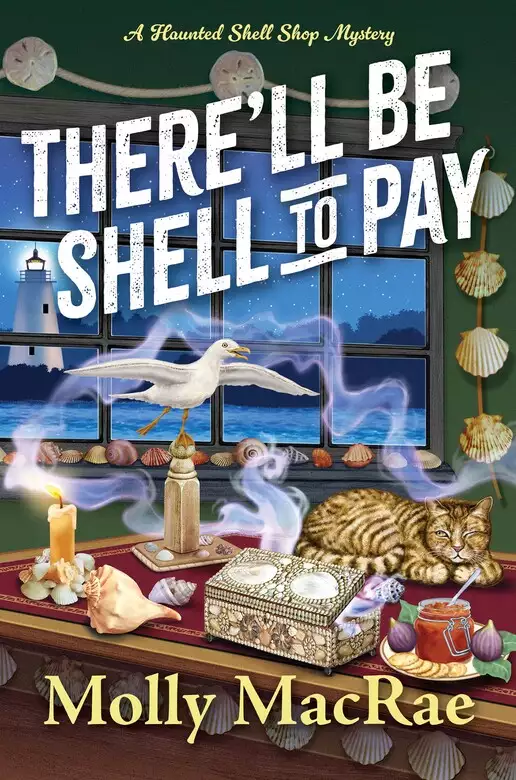
When she’s not selling seashells by the North Carolina seashore from her shell shop, Maureen Nash is a crime-solving sleuth with a ghost pirate for a supernatural sidekick . . .
Maureen is still getting used to life on Ocracoke Island, learning how to play the “shell game” of her business—and ghost whispering with the spirit of Emrys Lloyd, the eighteenth-century Welsh pirate who haunts her shop, The Moon Shell. The spectral buccaneer has unburied a treasure hidden in the shop’s attic that turns out to be antique shell art stolen from Maureen’s late husband’s family years ago.
Victor “Shelly” Sullivan and his wife Lenrose visit the shop and specifically inquire about these rare items. Not only is it suspicious that this shell collector should arrive around the time Maureen found the art, but Emrys insists that Sullivan’s wife is an imposter because Lenrose is dead. A woman’s corpse the police have been unable to identify was discovered by the Fig Ladies, a group who formed an online fig appreciation society. They’re meeting on Ocracoke for the first time in person and count Lenrose among their number, so the woman can’t possibly be dead.
But Lenrose’s behavior doesn’t quite match the person the Fig Ladies interacted with online. Now, Maureen and Emrys—with assistance from the Fig Ladies—must prove the real Lenrose is dead and unmask her mysterious pretender before a desperate murderer strikes again . . .
Release date:
June 24, 2025
Publisher:
Kensington Books
Print pages:
304
* BingeBooks earns revenue from qualifying purchases as an Amazon Associate as well as from other retail partners.
On a Monday morning near the end of October, I sailed toward new adventures. Waves, curling and unfurling, carried my ship steadily closer to its destination—legendary Ocracoke Island, one-time pirate haven off the coast of North Carolina. Like diamonds, droplets of salt spray glittered in my fellow passengers’ hair—also on the windshields of our cars because we were, in fact, aboard a ferryboat, the Croatan, plying its way from Hatteras to the landing at the north end of Ocracoke. Waves did curl, but out in the Atlantic, not on our sedate path in Pamlico Sound. Droplets and diamonds only glistened in my imagination, but new adventures did await.
As a storyteller—my late husband called me his fabulous fabulist—embellishments were my second language. It was no exaggeration, though, to say that I felt much better prepared for adventure on this trip than I had a month before when I’d arrived on Ocracoke at the tail end of a hurricane. That trip started with fears of sharks and foundering and ended with me waving goodbye to the ghost of a pirate. Again, not exaggerating. Quite a lot happened in between the fears and the farewell—getting zapped by an electrical short, being left for shark bait, and becoming the new owner of the Moon Shell, the island’s storied shell shop, for instance.
A circus of gulls followed the ferry, begging for someone, anyone, to toss popcorn, French fries, a sandwich, stale bread, anything into the air for them to snatch. “Don’t hold back!” they cried. “Throw something, you miserly meat bags!”
Try telling seagulls they shouldn’t eat what humans toss for them. They won’t listen. They have no time in their raucous, jeering schedules for nutritional advice. I hadn’t taken my own nutritional advice, stopping in Buxton, on Hatteras Island, for lunch. Maybe the gulls smelled the softshell crab sandwich and onion rings on my breath. They might even have been interested in the few groceries I’d picked up in Hatteras Village before boarding the boat. Cupboard- and fridge-filling shopping could wait for the Ocracoke Variety Store.
Before heading from the passenger deck down to the vehicle deck and my car, I saw someone fishing near the dock. With miles of shore on either side of the island available for fishing, dropping a hook so near the oil-slicked dock waters seemed an unlikely choice. But, as a non-fisherman, what did I know?
This short, stout person looked shorter and stouter because of a heron-like hunch of the shoulders. The round, large-brimmed hat made the person look like a toadstool. It also hid the person’s face, but I’d met someone of that general description a month ago—Doctor Irving Allred. Immediately and instinctively I shrank back from the railing. Allred, the island’s elderly, and only, physician, had several hobbies, none of which I wanted to get involved in. Hoping he hadn’t seen me, I returned to my car.
The deck vibrated as the ferry’s great engines slowed us for mooring. With the vibrations, the excitement I’d kept in check for the day and a half it took to drive here began to stir. The boat came to its bumping stop against the dock’s pylons. The excitement thumped against my rib cage and then burst out and took wing like a gull, begging me to race it to the village at the other end of the island. The gangplank lowered, clanged into place, and a crew member directed vehicles in a mannerly disembarkation. As soon as my tires touched land, I wanted to cheer. And I felt . . . a difference.
Jeff, my husband, used to say that wonderful places like Ocracoke only appear in reality as you approach them. He called it his Brigadoon hypothesis. (He’d seen the movie at an impressionable age and fell in love with tales of places, often under a spell or curse, that appeared and disappeared.) Was that what I felt? The frisson of a place too good to be true? Or was it the feeling of passing through a time warp to a place that harbors centuries-old stories and legends? I didn’t believe either of those options, so maybe I was warped? No. I didn’t believe that either.
I did believe that a month ago, when I’d landed on Ocracoke at the tail end of Hurricane Electra, I’d come close to drowning in assumptions. This time I hoped I wasn’t drowning in rosy expectations for the success of this move, this new life.
The feeling grew stronger as I drove the spindly highway down the spine of the island and intensified to a prickling down my own spine. Not exactly unpleasant, but not something I’d expected. Did it have anything to do with the superstitious codswallop about traveling on a Monday that Doctor Allred loved to spout? What was it he’d said? If you start a journey or vacation on a Monday, you drag bad luck along with you. Today was Monday, but I wasn’t here on vacation, and I’d set out on Sunday. Safe from Allred’s warped codswallop.
Another possibility fizzed back and forth across my scalp as I entered the village. Did the feeling have anything to do with Emrys Lloyd? With the odd fact that he was a ghost and haunted the Moon Shell? Or the odder fact that I and almost no one else saw him or knew he existed?
Tourists thronged the sidewalks in town—thronged the street on bikes, in golf carts, in every kind of vehicle. I joined them, passing the harbor—called Silver Lake—on the left. Sailboats and the big ferry from Cedar Island crowded the docks. Eateries, souvenir shops, and rental kiosks for bikes, golf carts, and kayaks lined the shore.
I made the turn onto one-way Howard Street. A pair of crows sitting on the street’s signpost cawed and flew off as I passed.
Howard Street dripped with atmosphere the way Spanish moss dripped from live oaks here and there on Ocracoke. It was believed to be the oldest street in the village, the small village dating back to at least the early 1700s. Short and made only of sand, oyster shell, and gravel, Howard was really more of a slow-paced lane. Trees, houses, and lichen-crusted fences lined both sides. Many of the houses belonged to descendants of the original settlers. Small family cemeteries nestled in the deep green shade of the trees, the graves resting so quietly that tourists in vehicles or on foot didn’t always notice them. Jeff and I used to visit Ocracoke with our sons when they were kids. Howard was our favorite street.
I slowed the car to a crawl as I came to the street’s slight leftward bend and looked first at Glady and Burt Weaver’s two-story house on the right. Either of the Weavers would be happy to correct me on the street’s name and then be happy to argue with each other over which of them had clued me in first. Old Ocracokers, like the eighty-one- and seventy-nine-year-old sister and brother, knew Howard Street’s official name—East Howard Street. Part of the street’s charm was in discovering that no West, South, or North Howard ever existed to cause confusion with East Howard. That, of course, confused a few. I smiled at all that and then looked at the smaller house opposite the Weaver’s.
Glady and Burt had grown up in this second house, a neat one-and-a-half-story bungalow with a less generous, but still pleasing, front porch. Glady and Burt still owned the bungalow but fifty years earlier had moved across the street into the bigger house built and previously owned by an uncle. For the fifty years since they’d migrated, their birthplace had been home to the Moon Shell, the business started by Dottie Withrow (also called Mrs. Seashell) and carried on by her son, Allen. Now, by a weird quirk of luck, the business belonged to me, and the apartment in the half-story above the shop was my new home. My mind still wrestled a bit when I tried to wrap it around that quirk.
A couple of children jumped down the shop’s four front steps, ran back up, and jumped down again. Even in the bright afternoon sun, the shop’s lights shone through the front window and looked welcoming. Three golf carts sat in the small parking area in front of the shop. Golf carts—when I’d arrived in the village the month before, they’d surprised me. I didn’t remember seeing a single one the last time Jeff and I visited. That only showed how long ago that visit had been and how little I paid attention to trends in vacation destination transportation. Golf carts made good sense, though. They were a quiet, efficient, friendly way for visitors and locals to get around. Along with the shell shop (and the rest of Allen’s worldly goods and properties), I’d inherited his golf cart. Before I knew it, I’d be tootling around the village with the best of them, provided the police weren’t still holding the golf cart as evidence. The quirk of luck hadn’t come without baggage.
I followed a drive, more grass than gravel, around the side of the house to a more obviously gravel apron in back and parked. Unpacking the car could wait. Right now it was time to test expectation number one—that I would walk into the Moon Shell’s front door, and there would be Emrys, Bonny the shop cat, and Glady to greet me. Emrys with a doff of his tricorn hat, Bonny with a purr and a twine around my ankles, and Glady with open arms.
I trotted around to the front, called hello to the crows in the live oak that dappled the yard with shade, greeted the children, and bounded up the stairs with one of them. Taking a deep breath, I opened the door and walked in.
“Perfect timing, Maureen,” Glady called, looking up from helping a customer. She went right back to peering over her glasses at the cash register, then at the customer, and back to the register: a busy businessperson’s greeting. Couldn’t fault her for that. If she’d sent a smile along with the greeting, though, I didn’t catch it. It probably got distracted wending its way past the displays of seashells. Or got spooked by the stuffed seagull—new to me—beady-eyed and wings fully extended, hanging over the central display table. Where had that come from? It looked ready to snatch the ornaments off the driftwood Christmas tree standing in the middle of the display table.
“What can I do to help?” I asked.
Glady raised a hand. “Not now.”
“Okay.”
Glady concentrated like a pro. She’d had a long career writing mysteries while sharing a house with her brother. True, he was a career librarian, but according to Glady, librarian doesn’t equate with quiet, organized, or willing to let other people be quiet and organized. The two of them took some getting used to, but I liked them.
She’d stuck a pencil behind each ear but picked up a pen to write up the sale on the receipt pad. The shop was still old-school in that regard, despite having an electronic cash register.
The other customers, two couples, seemed happy enough browsing on their own and not terribly serious about it. Picking up shells, putting them down, sticking their fingers into any shell with an opening meant for its original critter.
There were no signs of a ghost or a cat. Maybe the rampant seagull spooked them, too. Maybe they were napping.
I went looking. Not far and wide. There is no far or wide about the Moon Shell. The shop was in the house’s original living room—fifteen feet by twenty at the most. Also on this floor were a small office and a larger storeroom, neither one with an overload of nooks and crannies. Not that a ghost needed a hiding place. Even so, if Emrys or Bonny didn’t want to be found, they wouldn’t be. I opened the storeroom door, glanced around, and called softly. No luck. Same for the office. That left me with the apartment upstairs.
Her customer, a woman not much younger than Glady, murmured, “Two more, I think,” and swirled a finger through a basket of impulse-buy cowrie shells next to the cash register. She picked out one and went back to swirling.
Standing against the wall, between the doors to the office and the storeroom, was a tall glass display case. Emrys sometimes stood there, too, leaning one shoulder against the side of the case. With his tricorn hat, full-skirted knee-length coat, long waistcoat visible where the coat parted, knee breeches, stockings, and one well-shod foot cocked over the other ankle, he tended to look comfortable and the picture of pirate-casual. That he could lean against the glass and pass through it was a mystery to me. Sometimes he sat at the desk in the office, too, in the chair that was an ergonomic wonder no ghost should require. Anyway. (I didn’t like the way anyway got tacked onto conversations as a way of ending them, dismissing them, but considering this whole haunted situation, the anyway and the dismissal fit.)
I leaned my shoulder against the display case, feeling comfortable and every bit of newly anointed business owner-casual. Not disappearing, as per Glady’s directive, but I did let my mind wander. The case
It was a sturdy case and locked because the shells inside were the shop’s most valuable. Some of them weren’t for sale at all. One was as big as an over-inflated football and an incredible work of eighteenth-century shell carving—a cameo shell. Allen Withrow’s mother had called the shell the moon shell and named the shop after it. The shell belonged to Emrys. He was the artist who’d carved it. I didn’t hear him humming as I stood there, didn’t hear his clear tenor singing in English or Welsh. I got no sense he was nearby.
It turned out leaning against the case wasn’t all that comfortable. I felt conspicuous, too, and useless, so I ducked into the office and dropped my purse in the bottom drawer of the filing cabinet. As I did, the customer’s voice floated in behind me, thanking Glady.
“It’s been a pleasure,” Glady said, giving me a look when I reappeared.
“I have something for each of the grands when I get home,” the customer said. “I think.” She set the bag with her purchase on the counter and reached a finger toward the cowries again.
“Every last one of your grandchildren will be delighted.” Glady deftly waylaid the finger swirl for another shell by picking up the bag and putting it back in the woman’s hand. “Have a safe trip home and come see us next time you visit.”
The woman thanked her again and thanked me, too, when I opened the door for her. As I closed it behind her, one of the other customers stepped up to the sales desk.
“That’s a super whelk or something or other,” Glady said, “and Maureen will be with you in two ticks.” She grabbed her sweater from somewhere under the sales desk and practically ran toward me. “Glad you’re here,” she said, opening the door. “I’ve been run off my feet and I’m taking the rest of the day off.”
“Oh. Okay. But you said something about important news?”
She’d started through the door, stopped, and looked back over her shoulder. “Couple of things. Bonny’s at our house. I’ll send Burt over with her when I see him. There’s an envelope for Rob Tate on the desk in the office. He knows. He’ll come get it. Got to run now. Catch you later.” And, poof, she was gone.
Wondering how Glady had the energy to run if she’d already been run off her feet, I closed the door. But she’d been keeping the business going while I was gone, so how could I complain?
The customer with the lightning whelk waited patiently at the sales desk. The woman with him handed him two Scotch bonnets and said she’d go ride herd on the kids outside. I smiled at the customer, then at the cash register, hoping I remembered the incantations to make it run without freezing. If not, I’d rummage for the manual. That’s how Glady and I had learned to run the thing in the first place.
“You picked out a really nice lightning whelk,” I said, my fingers surprising me by landing on the right register keys. “Do you know the difference between a lightning whelk and a knobbed whelk?”
“That sounds like the beginning of a bad joke.”
I laughed. “It does. It’s not, but I have plenty of those, too.”
“Then tell me the difference, throw in a joke, and you’ve got a deal.”
“Deal. Information first. The opening, that is the aperture, of lightning whelks is on the left. Knobbed whelks open on the right.”
“Good to know,” the man said. “And the joke?”
I glanced around for joke material—got it. The stuffed gull. “Why do seagulls fly over the sea?” While he thought, I put his shells in a bag.
“Uh, to see the other side?”
“Not quite, but not bad.” I handed the bag to him. “They fly over the sea because if they flew over the bay we’d have to call them bagels.”
“We’d have to?” he asked.
“No choice. Rules of a bad joke.”
He waved, and as he went out the door, three more people came in. And that’s the way the afternoon went. Customers came in waves, washing in and out. Some browsed. Some bought. I tried a few more jokes because Emrys liked them and I thought he might come out from wherever. He didn’t but that was okay. All was good.
Except that my welcome-back expectations had been dashed to pieces. No doff of a tricorn, no purr with an ankle twine, no open arms. And no time—I’d expected to have an hour or two, preferably the whole afternoon and part of tomorrow—to ease into waiting on customers and running the shop. Time, at least, to get my bike off the back of the car and to haul the groceries I’d bought in Hatteras up the stairs. Good thing I hadn’t bought anything that would spoil.
I was being silly. Of course I could have taken the time to run a few things up to the apartment. The business of selling seashells by the seashore was hardly fraught. Or I could have closed for an hour or for the afternoon. I was the boss, after all. The captain of my own ship and every cliché I cared to use.
But I was happy to have the customers wandering in and out. As long as they kept me busy, the unusual feeling that had settled over me after landing on the island receded into the background. I was aware of it but it didn’t rattle me. It was just there like a softly tugging undercurrent, like an indistinct murmur, a Greek chorus of itty-bitty crickets. But during the few moments I was alone in the shop? Back that feeling came on the wings of a squawking seagull.
“Sorry,” I said to the seagull overhead. “We’ve hardly met, and I’m already saying rude things about you.”
The bird kept its beak shut. The door hadn’t opened for several minutes either. I retrieved my purse from the filing cabinet in the office and pulled out my keys on the way to the only section of shop wall without a display. It looked like every other part of the shop’s white beadboard paneling except for the keyhole. I unlocked this cleverly hidden door and ran quickly up the steep staircase to the apartment.
“Emrys?” I listened. No answer. No breath of air. The compact space smelled dusty, disused, and too warm. I opened the dormer that looked out on Howard Street, and a window in the bedroom, left my purse on the kitchen table, and went back down to the shop. Silence there, too.
“Emrys?” I tried in the storeroom and again in the office. Nothing. Like a cat, Emrys didn’t always come when he was called, but this felt different. I dumped myself in that lovely ergonomic desk chair, and would have settled in comfortably for a good grump, but the front door opened and several chatting, laughing people came in. No wonder Glady had to take the afternoon off. No rest for the grumpy and ghostless.
I slapped my hands on the desktop, telling myself this was the life of a shopkeeper and this was the life for me, and pushed myself to my feet. And there, in front of me on the desk, was the envelope with Rob Tate’s name on it that Glady mentioned on her way out the door. Rob Tate, Captain of the Ocracoke station of the Hyde County Sheriff’s Department. Stand-up guy. But why would anyone leave an envelope for him here instead of taking it to the station—all of, what, a half mile away? I looked closer at his name, at the handwriting. There was something familiar about it, and it made me uneasy.
Two forty-something men in cargo shorts, Hawaiian shirts, and loafers with no socks came into the shop. They did something I’d seen more than a few customers do that afternoon. Hands in pockets, they made a circuit of the room, glancing at the displays the way people do who aren’t seriously shopping. They made a second circuit looking at the walls. The shorter, balder of the two stopped to say “boop” and tap the seagull playfully on the tip of its beak. I made a mental note to take the bird down or hang it higher. Then they both stared at the ceiling for much longer than plain white plaster should have held anyone’s attention.
I caught the eye of the lankier, hairier guy. “Except for a few cobwebs, what are you looking for on the ceiling?”
“Nah, don’t mind me,” he said. His hands went deeper into his pockets and his shoulders did a little up and down move that said, “Aw, shucks, ma’am.”
His buddy, the beak booper, snickered and mimed a potshot at the seagull. “Got him. Rats with wings.”
This gull was now my friend and I would defend it to its dying . . . no. That ship had sailed. I would defend it to my dying day or see the dear thing retired from shop life with dignity. I might tell the gull that when we were alone, but it wasn’t worth explaining to these false customers. Emrys would call them varlets and louts. I missed him.
Then the louts, Aw Shucks and Beak Booper, both looking parboiled from unaccustomed time in the sun, went further than other browsing customers had. They didn’t just look at the walls, they studied them and zeroed in on the section with the concealed door. Aw Shucks sidled over and stood with his back to it. Beak Booper feigned interest in a pair of delicate, blown-glass Christmas ornaments—pretty little crabs. He took them from the driftwood Christmas tree and held them to the light. I proved to myself that I could run the cash register and keep an eye on two suspicious so-and-sos at the same time. Aw Shucks rocked on his heels and nonchalantly rapped on the wall with his knuckles. He gave a little nod and both of them looked at the ceiling again.
“No one’s home upstairs.” I smiled from Aw Shucks to Beak Booper. “In case you were wondering.”
Beak Booper twitched, making the crabs clink against each other. He hastily rehung them on the driftwood and put his hands back in his pockets.
Aw Shucks stepped closer to me. “Is it true? What I mean is—” His face morphed from avid curiosity to something . . . more serious? Worried? Concerned? His eyebrows couldn’t seem to make up their minds. Whatever the expression was, once the eyebrows settled, it didn’t play well with the riot of tropical flowers and parrots on his shirt. Or the whiff of beer on his breath. The pause he took after saying what I mean is went on long enough that I thought he’d forgotten he’d had a meaning. But then he spoke, pitching his voice low. It didn’t sound naturally low. It sounded like he’d decided a deeper voice complemented his newly arranged eyebrows.
“The old guy who ran the place,” he said. “We met him a time or two when we were on the island. We were sorry to hear he’d passed.”
I nodded. Tipped my. . .
We hope you are enjoying the book so far. To continue reading...

 Please log in to recommend or discuss...