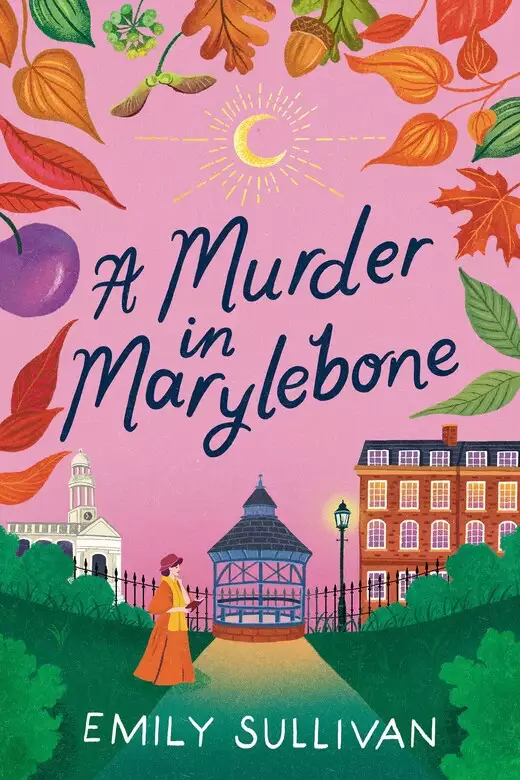
After over a decade away, widowed mother of two Minnie Harper has left sunny Greece and returned to her native England at the turn of the 20th century—just as a cloud of suspicion falls over her younger sister in this cozy historical mystery for fans of Jessica Fellowes, Tasha Alexander, Deanna Raybourn, Rhys Bowen, and the PBS series The Durrells in Corfu.
The world is changing at the dawn of the 20th century, but respectable English families still dread a public scandal. So Minnie agrees to accompany her reckless sister, Delia, for a night on the town with her Bohemian friends. The evening involves a raucous house party, a visit to a fortune-teller, and an encounter with a flirtatious baron, but none of that unsettles Minnie more than running into Stephen Dorian, her former employer in Corfu, who stirs in her a mix of resentment and attraction.
Soon after, Delia discovers the body of her rumored beau in his own home, and Minnie insists on playing by the rules and informing the police. After all, fleeing the scene could suggest Delia is guilty of more than an improper late-night rendezvous . . .
When the sisters return to the townhouse, their parents, dreading the threat of gossip, insist that Minnie help clear Delia’s name. Her discreet investigation will take her back into Delia’s decadent circle and have her crossing paths again with the baron—a collector of antiques—and the infuriating Stephen Dorian. But her new social life is soon overshadowed by dangerous intrigue that leads her to question even her own past . . .
Release date:
April 28, 2026
Publisher:
Kensington Books
Print pages:
338
* BingeBooks earns revenue from qualifying purchases as an Amazon Associate as well as from other retail partners.
It is often said, and usually with great sorrow, that one can never go home again. But then that presumes one would want to do such a thing. The admittedly unkind thought came to me as I stood before my parents’ pristine, white stucco town house in Portman Square.
“Mama, why have you stopped?”
I tore my gaze away from the imposing black front door and looked down at Tommy, my eight-year-old son, and forced a smile. “Sorry, darling. I was just thinking of something.”
More specifically, the last time I had been here. And, in truth, it was harder to remember than I’d like to admit. Had I really forgotten so much of my own life?
“Well, come along,” he said, mimicking the stringent tone I used when he was running late. “Grandmama and Grandpapa are waiting for us.”
I pursed my lips. Tommy, certainly. But I doubted my presence was much anticipated. For I was the errant daughter finally returning home after a scandalously long absence. And though my parents’ letters had been perfectly polite over the years while I was living in Greece, I truly wasn’t sure how I would be received.
However, I kept such thoughts to myself and allowed Tommy to lead me up the steps, his free arm swinging with purpose, and wished for a bit of his enthusiasm. We had been in London for nearly a month now, having moved here from the island of Corfu so that my daughter, Cleo, could attend school in Hampstead. My aunt Agatha had graciously offered the use of her home, as she was off galivanting around the Italian Riviera until Christmastime. But between helping Cleo adjust to her new school and settling into our temporary residence, I simply didn’t have the chance to arrange a proper visit.
Nor the desire.
But I had put it off for as long as possible. Tonight we were having dinner at my parents’ house, and the rest of my family would be in attendance. Or, rather, the family that lived in England. My brother Samuel, the sibling I was closest to by far, lived in Bombay. How I longed for his company this evening. Our eldest brother, Jack, was an ass of the highest order, and our sister Delia, the youngest, was an unknown quantity, given that she had been little more than a child the last time I saw her.
I had left England immediately after marrying my late husband, Oliver, and we had spent our entire married life abroad, first in Athens, where he worked for the British embassy, and then on Corfu. Oliver had died suddenly about five years ago, and I decided to remain on the island until Cleo confessed a desire to return to England for school. And because she had aspirations to attend Girton College at Cambridge, just as I had, it was in her best interest to leave the small English school in the town of Corfu for a more academically rigorous institution.
It was Aunt Agatha who had suggested the school in Hampstead run by Lady Artemis D’Arcy, a well-respected champion of female education with a flair for the dramatic. Understandably, Cleo was quite determined to make a go of things at her school, and new students were strongly discouraged from leaving the campus during their first term. But I wasn’t yet sure how long Tommy and I would remain in London. We were allowed to visit on Saturday afternoons, which had made the situation more bearable, at least for me, but I still couldn’t imagine going all the way back to Corfu without my daughter. And, in truth, my impression of the island had changed since last spring.
The front door opened just as we reached the top step, and we were greeted by my parents’ dour-faced butler, who looked even more ancient than I remembered.
“Hello, Morris.”
“Mrs. Harper,” he replied flatly before shifting his dark gaze lower. “And this is young Mr. Harper, I presume?”
“Hello,” my son said cheerily. “I’m Tommy.”
I gripped his shoulder and shot Morris an apologetic smile. Our life on Corfu had been much less formal than what was expected in London, and Tommy was still learning the different rules of etiquette here. That children should be seen and not heard was a particular sticking point. As was the treatment of the servant class.
Our housekeeper, Mrs. Kouris, was like a member of our family. But here in London, maintaining the hierarchy between servants and employers was of particular importance, especially to a man like Morris, whose entire existence was built around following the most archaic rules.
He arched a brow. “Yes. Quite.” Then he stepped back from the doorway so that we could enter. There was a distinct trace of disapproval in his gaze as I passed by, but Tommy seemed entirely unconcerned by his faux pas.
While a young footman silently collected our coats and hats, Tommy wandered ahead into the grand, marble-floored entryway, and his mouth actually dropped open as he stared up at the massive crystal chandelier. Behind us, Morris loudly cleared his throat. “The family is in the drawing room, madam. Please follow me.”
I turned around and shot him a bright smile. “No need, Morris. I remember the way.”
The look of disapproval deepened ever so slightly. “Of course,” he said with a stiff bow, then disappeared.
I took Tommy’s hand. “Come along. Everyone is waiting.”
“Mama, did you really grow up here?” Tommy whispered as we crossed the entryway.
“Of course, darling,” I replied. “Why do you ask? And why are you whispering?”
Tommy craned his neck, taking in the various gilt-framed paintings and assorted objets d’art that covered every available surface. “It’s like a museum,” he marveled.
“Yes,” I agreed on a sigh as my gaze traveled over the cold, elegant space. “It certainly felt that way.”
Then, just as we reached the hallway, the elusive memory suddenly came to me, and I nearly tripped on the Aubusson carpet.
Oliver.
Of course. The last time I had been home was for my engagement. After we were introduced by my brother Samuel, Oliver and I corresponded for over a year, as he was working for the British embassy in Athens at the time. But he returned to London for the Christmas holiday, and after gaining my father’s permission, he proposed to me. In the very room we were about to enter, in fact.
Will you make me the happiest man alive, Min, and consent to be my wife?
I had been in the middle of pouring the tea and overfilled his cup, as I was too busy staring at him in shock.
Our letters, while detailed and frequent, had never crossed over into love missives, though I had often imagined what I would write to him and what I wished to read in return. No, I truly thought Oliver only saw me as a friend. As Samuel’s peculiar younger sister. And that he had called on me that afternoon out of politeness. But Oliver strenuously assured me otherwise and claimed that he had fallen in love with me from nearly the first moment of our acquaintance, but didn’t think I would want to live abroad. I quickly rid him of this notion and gave him my enthusiastic acceptance. I don’t think my parents had ever been so proud of me as when we announced our engagement.
I had nearly been as nervous that afternoon as I was now. Oliver came from an old, aristocratic family, though he was only the second son and in the civil service. Still, it was a far better match than they had hoped for, given that I was considered an odd, mousy bluestocking by everyone else we knew. They fully expected us to marry immediately, but I had a term left at Girton, and Oliver supported my decision to finish. I could still recall the shock on my father’s face when Oliver explained this to him shortly after announcing my acceptance. His large, warm hand had tightened over mine, and I had never felt so sure of anything or anyone in that moment.
Mrs. Minnie Harper.
But, in truth, a small part of me never stopped wondering if he had married me out of a sense of duty. Because our parents moved in the same circles. Because I had a healthy dowry. Because many of our acquaintances had begun to marry one another, and we were of an age. It was easy to come up with practical reasons. Even after Oliver died, I still maintained that I had been unbelievably lucky that he had chosen me to be his wife. But lately, I had begun to see things differently. That perhaps I had been too dismissive of my younger self and a little too generous towards my late husband. As genuinely wonderful as he was, I could now accept that he hadn’t married me for any reason other than simple desire. Why it had taken me well over a decade to realize this was another matter.
I flexed my free hand now, searching in vain for a whisper of Oliver’s calming touch. But only the drafty air of the hallway slipped through my fingers. As we drew closer to the drawing room, I could hear the soft murmur of voices on the other side, and my heart began to race.
I gave Tommy a tight smile. “Are you sure you wouldn’t rather go to that sweets shop we passed on the way here?”
But he only laughed, thinking it was a joke. “Come on, Mama.”
“Very well,” I muttered. Then I let out a resigned sigh and pushed the door open to face my family for the first time in over fifteen years.
The room fell silent as we crossed the threshold, and for one perilous moment, I worried we had come at the wrong time. But Morris would never have let us make such an error. The room itself was remarkably unchanged, and even the air still smelled of the rose-petal potpourri my mother loved, though it was dark in here—much darker than I remembered it ever being before. The curtains were drawn shut, and aside from a gas lamp in one corner of the room, the only other light source was the blazing fire in the hearth. Or perhaps I had simply grown used to our light and airy house on Corfu.
Regardless, I had to squint a little in the gloom and wait for my eyes to adjust.
My father was seated on the dark green brocade sofa, my mother next to him, while Dolly, my sister-in-law, was in a high-backed armchair.
I cleared my throat as I gripped Tommy’s shoulders. “Hello, there.”
My mother was the first to speak. “It’s Minerva. Hello,” she said in the cool, controlled voice that had echoed in my head all these years. Then she rose with that perfect smoothness I remembered so clearly from childhood and beckoned to Tommy. “Come over here, Thomas. Good heavens, you’re big.”
Tommy pulled out of my grip and rushed over. “I’m so pleased to meet you, Grandmama and Grandpapa.” He said this with a charming little bow, and my mother actually beamed at him.
“Aren’t you the dearest thing,” Dolly cooed.
“Yes, very polite,” my mother added, smiling her approval.
I will admit to feeling a twinge of jealousy just then, as I could barely remember my mother smiling at me in such a way. But then, Tommy was a remarkably charming child.
“Well, don’t hover in the doorway, Minerva,” she scolded, in the tone I was much more familiar with. “Come here and join us. Your sister is upstairs, but she will be down shortly.”
I did as she bade, and as I approached, I could feel my mother’s sharp blue eyes skimming over me in assessment. She was widely considered one of the most beautiful women of her generation and had never failed to point out all the ways in which I failed to measure up. Even now, with her hair far more white than blond, she was still stunning.
“Agatha mentioned you were looking well,” she said, sounding a touch reluctant, after I gave her a kiss on both cheeks. Then her eyes narrowed. “Though you have too much color. Don’t you wear hats in Greece?”
“Yes, Mother. But the sun is quite strong there.”
She made a hum of uncertainty, as if she wasn’t sure I knew of what I spoke.
“Well, I think you look simply marvelous,” Dolly said as we embraced. She still had the same cherubic face I remembered, though her brown hair was now streaked with silver at her temples.
Dolly and I had never been close, as she was about six years older than me. When she married my brother Jack, the age difference had made them seem positively ancient. But as I returned her easy smile, I hoped we could be friends now that I was in London.
“Thank you. How is my brother?” Who was noticeably absent.
“Oh, you know. Busy as usual,” Dolly said with a sigh. “He so wished he could be here tonight, but something came up. We’ll have to have you over soon so you can have a proper catch-up.”
Jack was the MP for Kensington, though there was no limit to his political aspirations. I gave her an understanding smile. “I’d like that.”
Then I turned to my father, who had yet to speak or even look at me, and noticed the black, lacquered cane by his side. “Hello, Father.”
As I bent down to kiss his cheek, I could make out the deep grooves lining his forehead and bracketing his mouth. While my mother had been a great beauty, my father had a keen financial mind. I never knew exactly what he did, only that he made already wealthy people even more money. In my memories, he was a tall, imposing man who rarely smiled. And though I didn’t expect any of them to look the same, it was still a shock to see how frail he had grown during my absence.
His eyes finally met mine as I pulled back, but they remained strangely blank.
I cleared my throat, which had grown thick with emotion. “How are you?”
He blinked slowly, and a spark of recognition finally ignited in his gaze. “Minnie?” His voice was a paper-thin version of what it had once been.
I smiled, unable to contain the rush of joy that swept through me. “Yes, it’s me.”
Then he frowned. “What are you doing here?” He sounded much closer to his old self now, and thus this resembled more of a demand than a question.
“I—”
“You aren’t supposed to be here,” he insisted, and I drew back, feeling rather hurt.
“Hush now, Bertie,” my mother cut in. “I told you Minerva was back from Corfu. You’ve just forgotten.”
But my father ignored her. Instead, he kept staring at me with a look of agitation until I had to turn away.
“Is he all right?” I asked my mother.
She balked, as if this was a ridiculous question. “Your father is fine. He’s just a bit forgetful these days. Perfectly normal at his age.”
I very much wanted to point out that this reaction seemed far more than a bit forgetful, but my mother had never responded well to being challenged.
“Thomas, some of your cousins are upstairs in the nursery,” she continued. “Would you like to join them?”
Tommy nodded enthusiastically, and my mother tugged the bellpull by the hearth.
“I’m afraid my eldest boys are all away at school, but John is still at home,” Dolly said. “He’s five now. And there’s Franny, of course. She’s eight, just like you, Tommy.”
“A boy his age really should be at school, you know,” my mother cut in. “Perhaps Jack can get him in at Harrow. The term has already started, of course, but I’m sure he could easily catch up.” Then she addressed my son directly. “Isn’t that right? A bright boy like you?”
Tommy looked perplexed by the question.
“Mother …” I began. But then Morris entered the room and saved me from having to defend my educational choices to a woman who thought it completely normal to send her boys away to school at six.
“Madame, supper is served.”
“Excellent. And show Thomas to the nursery,” my mother said, with a wave of her hand.
Tommy shot me a nervous look, and I gave him a smile. “It’s all right,” I said softly. “I will see you afterwards.”
He nodded and walked over to Morris. “Follow me, Master Thomas,” the butler intoned, then turned on his heel and exited the room, with Tommy trailing behind.
As my mother helped my father to his feet, I approached Dolly. “How long has Father been … forgetful?” I asked under my breath.
“Hard to say,” Dolly said, as she frowned in recollection. “It’s been little things here and there over the years. I don’t think anyone really noticed the full extent until more recently.”
“I see.” I would need to harangue my brother about this whenever he deigned to meet with me. “And the cane?”
“Since the fall, certainly,” Dolly said with a dismissive wave of her hand.
“What fall?”
She raised her eyebrows in surprise, but before she could respond, my mother called to us from the doorway. “Come along, girls. I won’t wait any longer for Delia.”
We exchanged a look and followed my parents to the dining room. I could admit that my father, now on his feet, moved well enough, but it was still shocking to see how much slower he had become. In all of my mother’s letters, she had never mentioned anything about my father’s declining health. But she didn’t seem to see it very clearly herself, or want to—or perhaps I simply hadn’t prepared myself for the inevitable. Time certainly hadn’t stopped while I was away. Life moved on, quite quickly in fact. And I needed to catch up.
Like the drawing room, the dining room also appeared to be frozen in time, from the heavy crimson curtains and massive silver candelabras down to the gold-embroidered table linen that had been a wedding gift from the queen. My grandmother had been one of the queen’s favorites at the time, and my mother greatly benefited from the association. Grandmother eventually fell out with Queen Victoria over her gambling debts, but my mother never failed to mention her association with royalty.
Our family had enough aristocratic roots to maintain good social standing, but my mother had only been born an honorable, while my father was descended from the second son of an earl. Lucky for him, the second son was good with numbers and unencumbered by a crumbling estate in Yorkshire, so he made a fortune speculating in railroads that only grew thanks to my father’s lucrative banking career. The Everlys of Portman Square might not boast any titles, but we did have a good bit of money, especially compared to our more blue-blooded relations.
And yet my mother began plotting Delia’s marriage to a title while she was still in the cradle. But, to everyone’s surprise, Delia had eschewed a second London season in favor of attending the Slade School in Kensington. Since then, I had heard little talk of her marriage prospects.
As my mother deposited my father in his usual spot at the head of the table, I instantly moved to the second chair to his left—and nearly bumped into Dolly.
“Pardon me,” I blurted out.
“Entirely my fault,” Dolly said, though that was not at all the case. “Do you want to sit here?”
Before I could reply, my mother cut in: “Come beside me, Minerva,” she instructed as she moved to her seat.
I gave Dolly an apologetic look and hurried to the other end of the table, while my cheeks flushed with embarrassment.
Luckily, my mother excelled at ignoring faux pas and immediately instructed the footman to begin serving the soup.
I settled into the high-backed chair as the same footman who had taken my coat earlier now ladled a helping into my bowl. I murmured my thanks out of habit, and he hesitated in surprise for just a moment, but it was enough to draw my mother’s attention. As I caught her sharp look, I could hear her reprimand echoing in my head.
One does not thank the help for performing their duties.
I immediately turned my attention to the steaming consommé and picked up my spoon. This promised to be a very long meal.
A dull silence fell over the room as we began to eat. No one even attempted conversation. I cast a glance at Dolly, but she seemed perfectly content to sip her soup. Had meals always been like this? Surely not when Jack and Samuel were present, although they had often bickered in each other’s company, so perhaps this was preferable.
I decided to enjoy the silence, which was a rare commodity in my home, and had nearly finished my soup when the dining room door burst open behind me.
“Did you really start without me?”
My mother, who never put a foot wrong, no matter the situation, actually rolled her eyes in response. “Of course, we did, Delia,” she huffed.
That was nearly as shocking as my sister’s equally indignant response.
“But I told Morris I’d only be a moment,” she said as she marched fully into the room. “You could have waited.”
Delia hadn’t bothered to change for dinner and wore a plain grey muslin gown that bore several noticeable streaks of paint on the sleeves. I had forgotten how much she favored our mother, with dark blond hair that gleamed like polished brass in the gaslight. She was breathtaking.
My mother let out a weary sigh that sounded identical to the one I often made in response to my own headstrong daughter. And, for the first time in my life, I felt a bit of sympathy for her. “As I have explained many, many times, this household does not revolve around you.”
Delia looked primed to say quite a bit more in response to that, but then her blue eyes fell on me, and they widened with excitement. “Oh, Minnie! I’m very sorry I wasn’t here when you arrived. It’s so easy to lose track of time when I’m in the studio.” Then she rushed over to my side. I barely had time to react before she wrapped me in a hug.
“I understand, Delia,” I said against her shoulder. She pulled back and gave me a long look.
“Aunt Agatha was right. You truly have blossomed.”
My cheeks heated again at the unexpected compliment, and I couldn’t help but look away from her assessing gaze.
“For God’s sake, Delia,” Father suddenly barked from the other end of the table with startling clarity. “Sit down. You’re interrupting the flow of the courses.”
Indeed, the footman hovered nervously by Delia’s empty seat, still holding the soup tureen.
Delia rolled her eyes and looked so much like our mother in that moment, that a laugh bubbled out of me. I quickly slapped a hand over my mouth, but we exchanged a knowing look.
“We’ll have a proper catch-up later,” she whispered. Then she marched around the table with her head held high, as regal as a queen.
“Don’t worry about that, Cartwright,” she said with a grand wave of her hand. “Bring out the next course.” The footman gave a little bow of relief and scurried out of the room.
“Sorry, Father,” Delia said as she smoothly took her seat.
He grumbled in response, but the presence of my sister had lightened the atmosphere considerably. The rest of the meal passed in a flash, as Delia asked about our journey and how the children were settling in. She even offered a few suggestions for things Tommy might like to see while we were visiting. Dolly chimed in every now and then as well, but my parents remained noticeably silent for the remainder of the meal.
When dessert was finally brought out, I was delighted to see that it was apple charlotte.
“My favorite! I didn’t think you remembered,” I said to my mother.
She gave me a blank look. “I didn’t. Cook planned the menu. She must have done it since you were coming.”
Delia let out an indelicate snort into her water glass. “Leave it to Cook to know Minnie better than you.”
“Please send my regards to the kitchen,” I said brightly to the footman, hoping to dispel another confrontation between my mother and sister, who were now staring daggers at one another.
The footman bobbed his head and rushed out of the room as soon as the charlotte was served. For a fleeting moment, I very much wished I could have joined him, but consoled myself with a bite of cake. It was just as good as I remembered.
Luckily, the dessert captured everyone’s attention, and for a few blessed minutes, silence prevailed once more until we finished.
“Shall we all move to the parlor,” my mother began, before fixing her eyes on Delia. “Or do you have some scandalous party you can’t bear to miss?”
Delia calmly dabbed the corner of her mouth with her napkin. “Not tonight, Mother. I want to visit with my sister. But don’t worry. There is something on for tomorrow.”
Mother made a hum of disapproval in response and rose from her chair. From across the table, Delia caught my eye and winked. She really was quite cheeky. And while I could certainly sympathize with our mother to an extent, I found myself smiling back at her.
As we entered the parlor, I braced myself for another long stretch of silence, but to my surprise—and, frankly, relief—the children were waiting for us. Tommy was seated on the carpet by the hearth, playing a game of checkers with a girl about his own age, who must be Dolly’s daughter, Franny, and right beside him was John. I couldn’t help smiling as Tommy patiently explained the rules to his cousins.
“Thank God they’re here,” Delia murmured beside me.
I gave my sister a sympathetic smile, but before I could respond, the children took notice of us, and Tommy scrambled to his feet. “Mama! I have cousins!” he exclaimed in delight as he ran over to me.
“Yes, darling, I know. And this is your aunt Delia, my sister.”
He stared at her in fascination. “Are you older or younger?”
“Tommy!” I chastised, just as Delia burst out laughing.
“Younger. Much younger,” she added.
But Tommy remained quite serious. “Was my mother a good older sister?”
The question took me by surprise.
“Yes,” Delia answered immediately. “The very best.”
Tommy bowed his head. “My sister, Cleo, says I’m annoying.”
“Well, do you perhaps do things to annoy her on purpose?” Delia asked.
The corner of his mouth lifted in an impish smile. “Sometimes,” he admitted.
She gave him a knowing look. “Then you can’t really blame her, can you?”
“I suppose not,” Tommy said, with a shrug. Then he turned back to Franny and John.
“Come and meet my mother,” he beckoned.
The children had been watching us closely but hadn’t moved from their place on the hearth. They seemed far more reserved than my son. But at Tommy’s invitation, they joined us.
“Hello. I’m Frances, and this is my youngest brother, John,” Franny said with surprising formality.
“It’s very nice to meet you,” I replied.
“My father says you live in Greece,” she continued.
“Yes. We’re here for a visit.”
“He also said you went to Cambridge.”
“I did. To Girton.”
“Father thinks sending girls to university is a waste of time,” Franny said. “That it fills their heads with nothing but nonsense when they should be thinking about finding a husband and—”
“That is quite enough, my dear,” Dolly said as she rushed over and shot me a nervous smile.
“Well, your father is wrong, Franny,” Delia replied. “And despite what he says, that is a frequent occurrence for him.”
Franny’s eyes went wide.
“Oh, look! The tea cart is here,” Dolly cut in. “Let’s see if they have those shortbreads you like.” She then quickly ushered her children away.
“May I have a shortbread?” Tommy asked me. . . .
We hope you are enjoying the book so far. To continue reading...

 Please log in to recommend or discuss...
