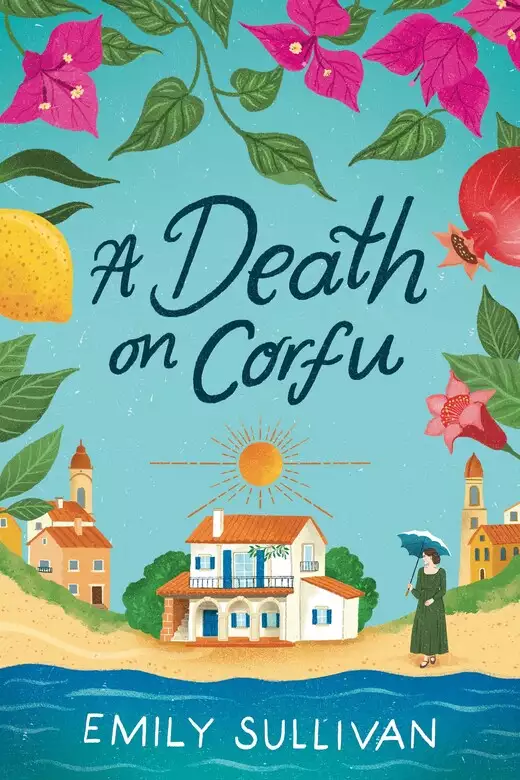
Living in Greece at the turn of the twentieth century, widow Minnie Harper struggles to find her place in a swiftly changing world. But when a local woman is murdered, her resolve is put to the test in a race to shed light on the truth . . .
The first in a new series for readers of Tasha Alexander, Deanna Raybourn, Anna Lee Huber, and Rhys Bowen.
Minnie Harper isn’t used to putting herself first. Not after she moved away from England only to be left raising two children alone on the Greek Island of Corfu following her husband’s unexpected death. But with her daughter begging to be sent to school abroad and her son grasping at his own independence, Minnie realizes she must prepare for the next stage of her life.
When famous mystery author Stephen Dorian settles into a neighboring villa to escape writer’s block and hidden scandals, she is intrigued at first by the handsome Londoner—until he proves to be nothing more than a boorish grump. Determined to avoid the man as much as possible, Minnie is shocked when he offers her a well-paid job as his typist. She isn’t in a position to turn down work, even from a man she has sworn to hate.
But before Minnie can fully regret her decision to take the job, she makes a horrifying discovery that changes everything. A young maid has been murdered, and local authorities aren’t moving fast enough to bring justice to the terrible crime. Unwilling to allow the death to fade into obscurity like the stories of so many other women deemed unworthy by society, Minnie launches an investigation of her own—and reluctantly accepts Stephen’s help. As she embarks on a dangerous search for answers that reveals another side of Corfu, unsettling questions take shape about her employer-turned-confidant and the culprit who just might do whatever it takes to strike again . . .
Release date:
April 29, 2025
Publisher:
Kensington Books
Print pages:
288
* BingeBooks earns revenue from qualifying purchases as an Amazon Associate as well as from other retail partners.
I have been often asked how I first met the great Stephen Dorian, author of the beloved Inspector Dumond mysteries. And while many know that I was hired as his typist during his stay on Corfu in the spring of 1898—where I had been living with my children since the death of my husband—our story actually began with a newt.
More specifically, one I found on my pillow.
At the time, my son, Tommy, then eight, was obsessed with the local fauna on the island. I encouraged this interest of his, as any good mother would, but a woman must be allowed her limits. On the morning in question, I awoke as usual to the sounds of Mrs. Kouris, our housekeeper, yelling at the neighborhood cats, who liked to gather at the kitchen door meowing for scraps. I’d explained to her many times that they would stop coming if she stopped feeding them, but she would only shrug and grumble under her breath. Given that this was her response to most things, I decided that, despite her protests, she must have a soft spot for strays.
As I was mustering the energy to start the day, my gaze caught on a rather large crack in the ceiling above my bed. I hadn’t noticed it until that moment and immediately began to fixate.
The presence of a crack was, unfortunately, not unusual. A canny estate agent had christened the little seaside villa the Lemon Grove House, and my late husband, Oliver, and I had purchased it sight unseen, aware that it would need work. The exact amount of work remained a mystery until we were standing in the foyer, surrounded by stacks of trunks containing all our earthly possessions. My daughter, Cleo, then six, clutched my hand tightly, while little Tommy, still only a baby, dozed on Oliver’s shoulder.
According to local rumor, the villa was originally built as a love nest for an English officer and his mistress, but hadn’t been inhabited for many years—and it showed. I was aghast at the state of the place: weather-beaten walls, a floor covered in dust and debris, and a kitchen so primitive it took me nearly an hour to prepare a simple pot of tea. But I can still remember the grin on Oliver’s face as he turned around and declared it “perfect.” After over a decade spent in the Foreign Service, my husband had decided to retire early from his post with the British embassy in Athens. But rather than return to England, we moved our little family to Corfu. Thanks to a tremendous amount of grit and some very helpful locals, we got the house into general working order before poor Oliver died, but that was four years gone now. And lately it seemed like a new problem arose every week. While my husband had left us with a good bit of money, the sum grew steadily lower each year. I found work when I could, but it was never enough to fully recoup what was spent.
I turned on my side, trying to remember if Nico, our handyman, was visiting family on the mainland this week or the next when I came nose to nose with a small brown newt. Though it was hardly the first time I had seen a newt and knew very well that they are harmless creatures, one does not expect to find them in one’s bed. The newt blinked its black, watery eyes at me, and I let out a very loud, very sharp shriek that woke the rest of the household, if not the neighborhood.
Tommy came rushing in, just as the terrified newt scrambled off the bed, while Cleo followed at the slower pace of someone who has suffered a great inconvenience. She was fourteen—a terrible age, really, both for her and myself.
“Tommy, darling,” I began once I regained some composure, “are you missing a newt?”
His brown eyes lit up. “You found Newton!”
I pointed to the corner of the room, where Newton was currently climbing up the wall.
“Newton the newt,” Cleo said with derision. “How original.”
“Yes, I thought so,” Tommy replied, missing his sister’s sarcasm entirely, as he was too busy capturing the wily creature.
“Very clever, darling,” I agreed as I threw on my dressing gown. “But I’m afraid Newton needs to live outside.”
“It was only for the night,” he admitted sheepishly, while gently stroking Newton, which seemed to put the creature at ease. “You weren’t supposed to know.”
I couldn’t help smiling as I tilted his chin up. “And yet sometimes our best-laid plans go horribly awry. But my nerves won’t survive finding another one of your animals in my bed.”
Given that Tommy’s interests lately had leaned towards snakes, lizards, and the occasional large, scary spider, I was lucky it had only been a newt that morning.
“May I still visit him?”
“As much as you’d like,” I promised. “Let me dress, and we can find a nice spot for him in the garden.”
That seemed to brighten Tommy’s spirits considerably, and he turned to his sister. “Would you like to come? I’ll even let you hold him for a moment.”
But Cleo looked appalled by the offer. “Absolutely not. I’m going back to bed,” she said in a huff.
“Not for too long, my love,” I called after her. “We’re going to the market this morning.”
She muttered something in reply that was punctuated by the slam of her bedroom door, and I cast a wary glance at the ceiling, praying the house would survive her.
After quickly performing my morning ablutions and throwing on one of the rumpled cotton caftans I wore around the house, I joined Tommy outside with my tiny cup of Mrs. Kouris’s strong Greek coffee. Then I followed him around the yard as he scouted out the ideal place for Newton to live, occasionally offering my advice, which was politely ignored. The morning was still relatively cool, and the haze off the Ionian Sea was just beginning to lift. Though the house may have been slowly falling apart, our little patch of land remained as lush and vibrant as the day we arrived. Graceful cypress trees cocooned the property, while a large, twisting grapevine provided much-needed shade over the terrace, where we ate most of our meals. Bougainvillea, marigolds, roses, and more wildflowers than I could ever identify blossomed in every available spot, perfuming the air with a rich, heady scent, while clusters of pomegranate, fig, and, naturally, lemon trees were in various stages of fruiting.
I typically spent my free hours in the early morning and evening pottering around the garden, as I had better luck growing things than fixing them. Once I finished my coffee, I fetched a small watering pot and refreshed my little plot of herbs and spring onions. There was plenty more that needed watering, but Tommy called me over to the small olive grove at the back of the garden. It created a natural border with the neighboring property, a much larger and better-kept villa owned by Mr. Howard, a London-based businessman who usually visited the island during the summer months.
It was while we were wandering through the grove that I suddenly felt the sensation of being watched. I glanced towards the sprawling, Venetian-style villa perched on the hillside above and was surprised to find a man on the balcony staring down at us. Our eyes met, and even at that distance, I felt a shiver run through me. He wore a paisley dressing gown opened to reveal a white dress shirt underneath, and a lock of dark hair fell across his forehead in a rather rakish manner as he leaned against the ornate balustrade. Given that a glass with a fingerful of brown liquid rested by his elbow, I surmised that this man, rather than waking early like us, had not yet gone to bed.
I raised a hand in greeting, which he returned with a hesitant nod before retreating back into the house.
“Who was that?”
I looked at Tommy and shook my head, still staring at the now-empty terrace. “I don’t know, darling.”
“It wasn’t Mr. Howard,” he said. “Because he is very old.”
“Yes,” I agreed absently, though Mr. Howard would likely object as he couldn’t be more than fifty. “We’ll ask Mrs. Kouris if she knows.”
A goat didn’t bleat on the island without her hearing about it.
Tommy appeared satisfied with that answer and set about releasing Newton in a nice, shady spot.
“Another Englishman,” Mrs. Kouris grumbled when we returned inside to ask after our mysterious new neighbor. “This island is already too full of them.”
I had become well-versed on the intricacies of my housekeeper’s dislike of the English over the years but did not take the slightest offense, as I had plenty of grievances of my own with my countrymen.
“Do you know anything else?” I asked. “Like how long he might be staying?”
But she shook her head with vigor, as if the question was repellent. I left her to finish making the spanakopita, a spinach-and-cheese pie we devoured by the trayful, and set about preparing the children’s breakfast. Tommy and I were nearly done with our fruit and toast when Cleo deigned to join us on the terrace. She was in a much better mood by then, and I was relieved to see her ask after Newton with what appeared to be genuine interest. While Tommy filled her in, my gaze kept slipping past them towards the villa on the hill, even though from this angle it was mostly obscured by the tree line.
He certainly looked like an Englishman, or perhaps an American, though Mrs. Kouris wasn’t interested in understanding the difference. I tried to remember all I could about Mr. Howard, but only a vague notion that he was somehow involved in book publishing came to mind. Now I regretted that I hadn’t been more neighborly during his visits, as short and infrequent as they were. Oliver had always been much better at that sort of thing than I. He made friends everywhere he went.
“Mama?”
I blinked and turned to Cleo, who sounded impatient. “I asked if you’re ready to go to town.”
“Oh, yes. Absolutely.”
She wrinkled her nose. “But you aren’t wearing that.”
I glanced down and realized I still wore the rumpled caftan. Given that I was an embarrassment to Cleo under the best circumstances, this would not do.
I excused myself to change into a pale yellow day dress she grudgingly found acceptable, and not long afterwards, we set out for town in our little donkey cart. Tommy stayed behind to visit with Mr. Papadopoulos, who lived down the road and was teaching him about the local flora and fauna. As we passed by the road that led up to Mr. Howard’s villa, I told her about the mysterious man I had seen that morning.
She immediately began peppering me with questions, but I told her all I knew “Mrs. Kouris says he’s English.”
“I’ll ask Juliet if she knows anything,” she said with a decided nod. Juliet Taylor was the same age as Cleo, and her mother knew nearly as much about the British residents of Corfu as Mrs. Kouris knew about the Greeks.
“An excellent idea.”
The rest of the drive passed amicably, and I enjoyed listening to Cleo’s gossip about her little circle of friends. Like her, they were the children of people who had once worked for the Foreign Service or from families who had stayed on the island after the protectorate ended in the 1860s. She and Tommy attended a small English school in Corfu Town, and while it was admittedly not the most rigorous education one could receive, they supplemented it with lots of reading at home. Oliver and I had both believed the freedoms the children would experience living on Corfu would be invaluable. Indeed, Cleo and Tommy’s childhood was nothing like the life Oliver and I had had. My younger sister and I had endured a series of mediocre governesses until I was old enough to attend Girton, though my parents had been quite against that idea at first. They wanted to send me to the ghastly finishing school my mother attended, where I would learn nothing more than how to catch a rich husband. It was only thanks to the intervention of my aunt Agatha, my father’s eldest sister and the family battle-ax, that I was allowed to attend the school of my choice.
Meanwhile, Oliver had been sent to Harrow at age six. Then it was on to Cambridge. I knew it was the usual course for boys of our backgrounds, but I could not bear the thought of not seeing Tommy every day. Most of Oliver’s colleagues in the embassy sent their children to school back in England as soon as they were of age, but our complete disinterest in continuing this tradition had been a large part of why we came to Corfu in the first place—and why I remained here after Oliver’s death, despite the never-ending parade of inconveniences.
Soon we arrived in Corfu Town and found the narrow, cobblestoned streets bustling with activity. I greatly admired the Venetian-style buildings near the harbor and, on more than one occasion, had given serious thought to moving here, as it would be far more convenient for both the children and myself. But my last memories of Oliver were so entwined with the Lemon Grove House that, despite its many nuisances, I couldn’t leave it, or him, behind. We tied up our donkey, Maurice, in a nice shady spot and set off to the market. I had only just reached my favorite stall, which sold the most delicious spice mixtures, when Cleo spotted Juliet with her mother and ran over to greet them.
“Mrs. Harper!” Virginia Taylor cried out as she waved her arm. She was an attractive woman with enviable blond hair and the kind of vivaciousness that made her an entertaining dining companion, though she was a bit exhausting in larger doses. Her husband had also worked at the British embassy in Athens, though not at the same time as Oliver, as he was quite a bit older than us. Now he did something in shipping, which, given the size and location of the Taylors’ villa, appeared to be very lucrative.
Aside from Juliet and Cleo’s friendship, I didn’t frequent the same circles as the Taylors. They were very much a part of the British community that still populated the island, whereas I kept more to myself after Oliver’s death. We chatted amiably for a few minutes about the weather and our favorite merchants until the girls ran off somewhere, giggling to one another.
“So then,” Virginia said, leaning towards me conspiratorially, “have you seen him?”
I furrowed my brow. “Seen whom?”
“Mr. Dorian, of course! Don’t tell me you haven’t found a reason to knock on his door yet,” she said with a laugh. “My goodness, if I lived next door, I’d be over there within the hour asking to borrow a cup of sugar.”
“Do you mean Mr. Howard’s guest?”
Her blue eyes widened at my confusion. “Minnie! You really don’t know him? That’s Stephen Dorian.”
I gave her a bewildered shrug in return, and she laughed again. “He writes the Inspector Dumond series. He’s nearly as famous as Arthur Conan Doyle!”
“Ah. I’m afraid I’m not much one for mysteries,” I said apologetically.
That had been Oliver’s preferred afternoon idle, and I had found him dozing in the hammock with a mystery splayed open on his chest more often than I could count. My tastes tended towards classic romances, history, or quiet little novels about everyday people. On more than one occasion, Oliver had playfully accused me of being a literary snob, and I suppose he wasn’t entirely far off the mark.
“I know it isn’t Shakespeare, but his books are so good,” Virginia insisted. “And he’s also terribly handsome.”
I made a vague murmur in response, as I couldn’t possibly comment on that, even as I instantly recalled his tousled hair and penetrating gaze. “Perhaps I’ll pick one up. Do you know if he’s here for long?”
“I’ve no idea. Oh! There’s Florence,” she said, waving to someone behind me. “She would know.”
Florence Belvedere was a pleasingly plump woman in late middle age with sharp blue eyes and light brown hair streaked with silver. If Juliet was the young person’s gossip, Florence was the oracle of the adults. Her family had been on the island since the days of the protectorate, but Florence had been educated back in England, where she’d met her husband, a barrister. They had returned to Corfu over a decade ago, once their children were grown, and settled in a charming white stucco villa not far from Mr. Howard’s. Though Florence tended towards pretension, on account of her lineage, she and her husband had been particularly helpful to me in the wake of Oliver’s death, for which I would always be grateful.
“Hello there!” she trilled, while a striking Greek girl with beautiful dark eyes and a mighty scowl followed a few steps behind her. “I’m so glad to see you both,” Florence said, before turning to the girl and barking at her in Greek while she gestured to a nearby stall. The girl made no response, but dutifully trudged off. Florence let out a sigh and turned back to us. “That’s our new maid, Daphne. I swear, it is impossible to find good help on this island. I’ll never understand how my mother survived all those years.”
Virginia hummed in sympathy while my smile tightened a little. Given that Florence had grown up not far from the site of the Achilleion, a literal palace that had once been a favored home of the late empress of Austria, I’d say her mother had done far more than “survived.” But I learned long ago that no one liked having their privilege pointed out to them—least of all the wealthy.
“Anyway,” she continued breezily, “we’re having a little soiree tomorrow evening to welcome Mr. Dorian to the island, and I’d love for both of you to come.”
Virginia shot me a knowing glance. “What a splendid idea, Flo. Mr. Taylor and I will be there.”
I was just about to politely decline when Cleo was suddenly at my side and gripped my arm. “She’ll be there too!”
“Cleo,” I murmured in warning.
“But, Mama,” she protested, “you never go anywhere.”
“Because I have you and your brother to care for, my darling,” I pointed out with a strained smile, which was true. But it was also true that attending a soiree was not how I wanted to spend my evening.
“I can watch Tommy. And Mr. Papadopoulos has been meaning to come round for supper. It will be fine.”
I blinked in surprise. Cleo had not ever volunteered to watch her brother before. Her assistance usually involved heavy bribery that was seldom worth the cost of enduring the complaints that followed. I narrowed my gaze at her in suspicion, but she returned it with a sunny smile.
“Then it’s settled,” Florence said. “Come up to the house tomorrow around eight.”
“Eight,” I balked. I was usually asleep by nine, at the latest. But I felt Cleo’s grip tighten, and I held back a sigh. “Sounds lovely.”
We then made a little more meaningless small talk before parting ways, and I picked up a few spices at the stall before Cleo and I set off for home. She chattered away about the soiree and asked what I would wear and how I would do my hair, and I answered honestly. “I don’t know. Why are you so excited about this? I’m the one going,” I grumbled.
But Cleo was undeterred and let out a wistful sigh. “I wish I could go to a fancy party with a famous author. Do you think there will be dancing? Oh, what if he asks to dance with you? How exciting!”
I could only laugh. I hadn’t danced with a man since Oliver and hadn’t been very good at it, even in my youth. “I doubt any of that will happen, darling.”
It was much more likely that I would spend the evening in a corner sipping a sherry and trying to think of clever things to say, only to then keep them to myself. I didn’t like attending parties where I didn’t know the other guests very well, but at least I used to have Oliver. Now, though, I would have to go it alone. The thought already filled me with a slick, nerve-wracking dread.
But Cleo didn’t notice my lack of enthusiasm, which was just as well, and began discussing wardrobe options. I had never been much concerned with fashion, and after having my children, it was far easier to wear practical things that could be easily cleaned. These days, they managed to keep their sticky fingers to themselves, mostly anyhow, but I still kept the habit. Besides, I had no one to dress up for—though, frankly, Oliver had taken even less interest in my wardrobe than I did. But perhaps Cleo was on to something. By the time we reached our home, she had discussed nearly every article of clothing I owned and deemed them all unacceptable. She found this distressing and promised to put together something by tomorrow.
“Really, it’s fine, Cleo,” I said wearily. The afternoon sun had grown uncomfortably hot, and I was tired of listening to her malign my wardrobe, as sad as it was. “I’ll wear the blue dress with the lace trim.”
“Mother,” she screeched in horror as if I had suggested wearing a dishtowel. She then made me swear not to wear the blue dress under any circumstances and hurried into the house, leaving me with the shopping.
“What is wrong with the blue dress?”
I turned to find Mr. Papadopoulos approaching with a quizzical expression. Our neighbor was a native of the island, but had left to attend university in Athens, where he taught botany before returning to Corfu to care for his aging sister. His wife had died tragically many years before in childbirth, and the loss of a beloved spouse was an unfortunate bond we shared. Now in his early sixties, Mr. Papadopoulos was still tall and lean, with just a dusting of silver in his black hair.
“I’ve no idea,” I replied honestly.
As he helped me down from the cart, I explained the invitation to the Belvederes’ and the apparently embarrassing state of my clothing. He chuckled. “It is hard to raise daughters, or so my mother always claimed. But then she had five of them, so perhaps you should count your blessings,” he said with a wink. Like most of the local men, he had a mustache, though he kept it neatly trimmed and wore a pair of wire-rimmed spectacles that added to his scholarly air.
“Goodness,” I replied, marveling at the thought of living with five versions of Cleo. “I will, though I suppose one must make allowances for her age.”
He nodded his head sagely. “That is also true. People often wish to be young again, but you could not pay me. Once was more than enough.”
“I agree.”
He then helped me unhitch Maurice and led him to the pen, where Tommy was feeding our little passel of chi. . .
We hope you are enjoying the book so far. To continue reading...

 Please log in to recommend or discuss...
