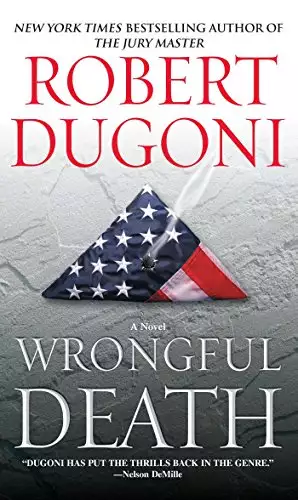
New York Times bestselling author Robert Dugoni tackles hot-button issues in this riveting legal thriller featuring attorney David Sloane. When a widow asks Sloane to take her case against the military, Sloane knows it's a lost cause but can't turn her down, even if it puts his own life--and the lives of his family--in dire jeopardy. Just minutes after winning a $1.6 million wrongful-death verdict, attorney David Sloane confronts the one case that threatens to blemish his unbeaten record in the courtroom. Beverly Ford wants Sloane to sue the United States government and military in the mysterious death of her husband, James, a national guardsman killed in Iraq. While a decades-old military doctrine might make Ford's case impossible to win, Sloane, a former soldier himself, is compelled to find justice for the widow and her four children in what is certain to become the biggest challenge of his career. With little hard evidence to go on, Sloane calls on his friend, reclusive former CIA agent turned private investigator Charles Jenkins, to track down the other men serving with Ford the night he died. Alarmingly, two of the four who returned home alive didn't stay that way for long, and though the mission's wheelchairbound commander now works for a civilian contractor, he refuses to talk. The final -- and youngest -- soldier is also the most elusive, but he's their only shot at discovering the truth -- if Sloane and Jenkins can keep him alive long enough to tell it. Meanwhile, Sloane isn't the only one on a manhunt. As he propels his case into a federal courtroom, those seeking to hide the truth threaten Sloane's family, forcing his new wife Tina and stepson Jake into hiding, where they become the targets of a relentless killer. Now Sloane must race to uncover what really happened on that fatal mission, not only to bring justice to a family wronged but to keep himself and the people closest to him from becoming the next casualties....
Release date:
July 25, 2015
Publisher:
Gallery Books
Print pages:
448
* BingeBooks earns revenue from qualifying purchases as an Amazon Associate as well as from other retail partners.
Chapter One CHAPTER ONE SEATTLE, WASHINGTON SIX MONTHS LATER
Theresa Gonzalez squeezed David Sloane’s biceps as each juror responded to King County Superior Court Judge Anthony Wartnik’s question.
“Is this your verdict?”
“Yes.”
After the twelfth and final juror confirmed her decision, Wartnik adjusted his black-framed glasses, made a few notes, and thanked the members of the jury for their service before dismissing them. Turning, he spoke briefly to the attorneys, complimenting them on having tried a fine case, and for their professional demeanor in his courtroom. Then he, too, stood and left the bench.
Sloane walked to where his young adversary remained slumped in his seat. Frank Martin was not gathering his documents or shoving binders into briefcases. He was not talking to his client, who sat looking just as forlorn in the chair beside him. Martin wasn’t moving at all. Pale, he looked stunned.
Martin looked up at Sloane as if he were from Mars. His client, apparently in no mood to be collegial, shoved back his chair, and brushed past Sloane, already pulling his cell phone from his pocket. Pacific Northwest Paper had sent the portly plant manager, rather than a corporate officer, to sit through the trial, and the man now bore the unenviable task of telling PNP’s officers exactly why they would have to pay Sloane’s client $1.6 million in damages.
It had not had to come to this. The case should not have gone to trial.
The first day Theresa Gonzalez visited Sloane’s office, she sat across his desk looking like a scared mouse. She told him she was terrified to go to court, that her English was poor and she feared not understanding the judicial system. Her husband, Cesar, had been electrocuted while operating a piece of equipment that had not been properly grounded at a PNP production plant. Cesar had been illegal at the time of his death, his green card long since expired. Theresa feared deportation, not for herself but for their three children. Sloane made sure that wouldn’t happen. Then he gave PNP every opportunity to settle. They had refused.
“You tried a good case, Frank.”
Regaining some color to his cheeks, Martin stood. “Apparently not,” he said.
“Your closing was excellent,” Sloane said. “I thought you had me.”
“So did I.” Martin continued to shake his head in disbelief.
Sloane felt no need to rub the young man’s nose in the verdict, having once been in Martin’s shoes. For thirteen years Sloane had represented similarly arrogant corporate clients in San Francisco before moving to Seattle two years earlier and changing his practice to nearly 100 percent plaintiff’s work. “Juries are unpredictable. You never know what they’ll do.”
Martin eyed Sloane with a sharper focus. “You did.” His eyebrows narrowed. “You said the verdict would be unanimous.”
“I was just—”
“How could you have known that?”
Sloane had made the prediction after PNP’s final refusal to settle at a mediation just before trial. He had hoped his certitude, and his reputation, would convince the company to reconsider. But PNP had remained recalcitrant.
“I was bluffing,” Sloane said.
Martin scoffed. “Remind me not to play poker with you.” He looked to the empty seats in the jury box. “It was as if they forgot all the evidence. You stood to give your closing and they just…forgot everything.”
Martin turned to the doors at the back of the courtroom with a look of dread. PNP’s officers were not the only ones who would be unhappy. Martin would have to explain to the law firm’s partnership board how he had lost a certain victory for a signature client. He looked once more at Sloane, then, with nothing left to say, he gathered his things and packed his briefcases.
Gonzalez stood huddled with her family at the back of the room. As Sloane approached, she stepped forward, still trembling. Tears streaked her cheeks with mascara. No more than five feet, she had to reach up to hug him. “Thank you, David. Thank you for everything.”
He let her cry for a moment. Then she stepped back, and one by one her relatives thanked him, her mother, white-haired and frail, last. The old woman stood on her toes as if to kiss Sloane’s cheek, but when he bent she whispered softly in his ear.
“Usted tiene el regalo. Usted es un curandero.”
She touched his cheek with a wrinkled hand, her brown eyes considering him as they had throughout the trial, not with curiosity, but with a knowing glint. A hint of a smile curled the left side of her mouth and she gave him the briefest of nods.
Sloane led the family to the courtroom doors, taking a moment to explain to Theresa what were likely to be the next steps in the legal process, including a defense motion for a judgment notwithstanding the verdict, and an attempt to settle the claim for less than the jury amount. Other attorneys had tried the same tactic. They had yet to succeed.
“Judges respect the jury system,” he explained. “They don’t like to overturn a verdict. But don’t think about that now. Just go home and enjoy this,” he said. “We’ll talk further.”
As the family filed out of the courtroom, the mother last, still smiling at him, Sloane let the courtroom door swing shut.
“You have the gift,” she had whispered, using the Mexican term, un curandero, referring to a shaman.
Sloane strode back to counsel table to pack his briefcase and felt the fatigue from the long days in the muscles of his legs and lower back. He wanted to get home to Tina and Jake, to think of nothing but a week of lying on the beach in Cabo San Lucas, their first vacation together. He and Tina had honeymooned in Italy after their wedding the previous summer, but because of the move to Seattle—both of them settling into new jobs, Tina trying to get an architectural practice off the ground and Sloane trying to re-create himself as a plaintiff’s lawyer—this would be the first time they took Jake with them for anything more than a day or weekend trip as a family.
The word made him pause. Family. The last time Sloane had considered that word was the day he left the fourth and final foster home in which he had been raised in Southern California. Sitting at the kitchen table, his foster father had turned to him in between bites of pot roast to advise that when Sloane turned eighteen he was on his own.
“The money from the state stops then. It’ll be time for you to go figure things out on your own. This family tried to do right by you, but you got to stand on your own now.”
That afternoon Sloane had walked to a hardware store to buy bolts to fix the Honda motorcycle he’d purchased, and instead found himself inside a marine recruitment center. He enlisted and went through boot camp thinking he’d found in the Corps the family he had never had, but after a while the empty feeling that something was missing returned, and the camaraderie and brotherhood that had initially filled that hole, no longer could.
Sloane heard the courtroom door swing open and turned, expecting Theresa Gonzalez. An African American woman entered instead. She held a manila file and spoke as she approached.
“Mr. Sloane?”
Sloane had noticed the woman in the courtroom during his closing argument. He estimated her to be late thirties to early forties, an attractive woman in a functional gray-and-black tweed skirt and jacket with her hair pulled back in a tight bun that accentuated high cheekbones and beautiful skin.
“My name is Beverly Ford,” she said.
He detected a subtle hint of perfume. “What can I do for you, Ms. Ford?”
“Adelina Ramirez is a friend of mine,” she said, referring to one of Sloane’s recent clients. Sloane had obtained a jury verdict on behalf of Ramirez and her two daughters after her husband was killed in a construction accident. “She said I need a wrongful-death attorney. She says you’re the best. She says you never lose.”
Sloane deflected the last statement. “Every lawyer loses, Ms. Ford. Nobody wins every case.”
“You do.” Ford spoke with a conviction that indicated she had not just taken a friend at her word. The verdict in the Gonzalez case was his eighteenth jury verdict in a row.
Sloane gestured to the bench behind counsel table. “Tell me how I can help you.”
Ford sat with her knees angled to face him. Her eyes, hazel with traces of yellow that reminded Sloane of sunflowers, regarded him steadily. “It’s about my husband, James…about what happened to him.”
“Tell me about it,” he said.
She took a moment and spoke deliberately. “James was a schoolteacher. He was a schoolteacher…and they went and made him a soldier.” Sloane sensed the story’s direction. “Then they shipped him off to Iraq and he got shot.” She pointed to a spot between her ribs. “He got shot in his side.”
“I’m sorry,” Sloane said, taking a moment to allow her to continue, but Ford sat stoically. “What is it you would like me to do?”
“I want to file a suit, a wrongful-death suit.”
Perplexed, Sloane asked, “Who is it you want to sue?”
“The United States government,” Ford said matter-of-factly. “And the military.”
BEVERLY FORD OPENED the manila folder and handed Sloane an article clipped from the New York Times discussing a confidential report from the Office of the Armed Forces Medical Examiner on Marine fatalities in Iraq. The report concluded that a large percentage of those fatalities had been from torso wounds that might have been prevented had the soldiers been wearing new ceramic-plate body armor that the Pentagon had, for two years, largely declined to supply to all troops.
Ford sat twisting her wedding ring and staring into the distance. “The day after he got his letter calling him to active duty, James kept trying to console me. He kept saying, ‘Don’t worry, baby. They’re not going to put me on the front lines—that’s for the marines. Besides, I’m going to be riding around in a big old tank. There’s nothing anybody can do to me inside a tank.’?” She looked back at Sloane. “Then they put him in a Humvee and sent him to the front lines. Can someone explain that to me? He was sent to fight the war on terror in an SUV.” Her voice softened. “He was a high school math teacher.”
Sloane knew little about military law and what he did vaguely remember wasn’t encouraging. He seemed to recall from his own service that it was exceedingly difficult for a soldier to sue the government.
“How did your husband get shot?” he asked. “Do you know the circumstances?”
Ford flipped through her file and handed him four multi-page documents. “The military gave me these. They didn’t want to, but I made a Freedom of Information Act request.”
A quick review indicated the documents to be witness statements, apparently from men who served with James Ford the night he died. Sloane thought it curious the military would give up witness statements, even to a surviving relative. In civil litigation, witness statements were rarely produced and normally protected as an attorney’s work product. A FOIA request didn’t change that.
“They awarded James the Purple Heart,” Ford said. “They said he dragged a soldier from a building just before it exploded.” She tapped her finger on the Times article. “No one told me about this. I found this out on my own.”
Having been wounded in combat, a Cuban bullet to the shoulder fired from a Kalashnikov rifle during the invasion of Grenada, Sloane knew the military had a claims process for injuries and deaths, though he had not personally used it. “The military has a procedure—” he started, but Ford interrupted him.
“I filed a claim,” she said. “The claims office said if I didn’t get a response within six months I had the right to file a lawsuit in court. I want you to take my case.”
Sloane sought more information. “Why do you think James died because he didn’t have the new body armor?”
“It’s all in there,” she said, tapping the file. “The armor wasn’t adequate, and the military knew it.”
Though it was tragic, Sloane sensed this was a case he could not win, and he did not want to give Ford false hope that he could, his reputation aside. Regardless of what James Ford had been stateside, in Iraq he had been a soldier, and soldiers died in war—too many, always, but it was a sad fact of combat. The difficulty was how to explain that to a widow of one of those soldiers looking to him for help.
“Mrs. Ford, my instincts and experience tell me we’d have a very difficult time proving your husband died because he had inadequate body armor.” He struggled to avoid the legalese while not sounding condescending. “What I mean by that is—”
“I know what you mean,” Ford said. “You don’t think we could prove that even if James had been wearing the new armor he would have lived.”
Sloane nodded. “I’m afraid so.”
Ford regarded him steadily. “James did what was asked of him. He did it without question or complaint. He did it despite having four children at home. He kept his end of the bargain, Mr. Sloane. All I want to know is if the military kept its end of that bargain.”
SLOANE DROVE WEST on Highway 518 past the Seattle-Tacoma Airport. Normally after a trial his thoughts were about all that had gone right. Tonight he could think only of Beverly Ford, a widow with four children, and the steely resolve that had burned in her eyes.
He looked at her file on the passenger seat and wondered if fate, more than Adelina Ramirez, was responsible for bringing Ford to him. He took a hand from the wheel and felt the raised red scar beneath his shirt just above his right pectoral muscle. More than twenty years later, Sloane could still see the fear in the eyes of the marine standing beside him on Grenada; as their helicopter transport lifed off, the young father of two realized he didn’t have his flak jacket. Just twenty, Ed venditti carried a photograph of his family inside his helmet. Sloane had no photograph. He had no family. He had no one, no mother or father, no grandparents or aunts or uncles. No wife or child.
“Take mine,” Sloane said, pulling him behind a rock cluster and slipping from his jacket.
Venditti resisted.
“Take it.” Sloane thrust the jacket against venditti’s chest before venditti could argue the matter further. After being shot, Sloane knew the truth would likely get venditti court-martialed. He told the doctors and his commanding officer that he had taken off his jacket because it made him feel weighted. They thought he was nuts, which prompted a psychiatric exam, whereupon the doctor had concluded:
His spontaneous decision to join the Corps is consistent with his spontaneous decision to remove his flak jacket. It is indicative of a man dissatisfied with his life and therefore prone to making rash decisions to change it. Such decisions could, in the future, endanger not only himself, but also those for whom he is responsible.
There were times when Sloane wondered whether the psychiatrist had been correct.
The freeway ended at First Avenue South, a thoroughfare of strip malls. Sloane considered pulling into the local Blockbuster and picking up a movie, then thought again of the file sitting on the passenger seat. Though dog-tired, he wanted to get through it before the weekend; he wanted to leave for vacation with a clear conscience and focus only on Tina and Jake. That meant reading it tonight.
He drove across the intersection through the town of Burien and descended Maplewild Road. The steep, winding access road led to Three Tree Point, a tiny beach community on the edge of the Puget Sound said to have been named for the three cedar trees at the tip of a spit of land that jutted into the slate-gray waters. Bald eagles nested in the limbs of one of the trees, and king salmon swam along the shores.
At the bottom of the hill, Sloane turned past the darkened windows of what had been a community store and parked perpendicular to a ten-foot-high laurel hedge separating his property from a public easement that led to the rock and shell beach at the edge of the Sound.
He stepped from his Jeep and pushed through a wooden gate he’d installed in the hedge to allow access to his back porch. The front door was around the other side, hard to access and rarely used by anyone. The three-story colonial with white clapboard siding had been built on a small bluff. Crabgrass sloped twenty yards to a cement break, buttressed by driftwood logs that had washed ashore, which separated the property from the beach. Sloane had rented a house for a year before his Realtor found the property. He wanted to live near the water, as he had in California, and he relished the chance to restore the 1930s home to its original grandeur. But as was normally the case, his legal practice had allowed him limited time to make the desired improvements.
He climbed the back stairs and removed his shoes, a house rule since he’d refinished the hardwood floors. Then he stepped inside the nook off the kitchen and hung his keys on a hook protruding from a life-size cardboard cutout of Larry Bird, the legendary Boston Celtics basketball player. The cutout had made the trip north from Pacifica when he moved. Tina had only mildly protested, knowing what the cutout meant to Sloane. It had once belonged to Joe Branick, the White House confidant of former president Robert Peak. Branick’s sister, Aileen Blair, had sent it to Sloane as a gift. Blair had been a lot like Beverly Ford when Sloane first met her at Joe Branick’s home in Virginia, resolved and determined. Sloane needed to know why Branick had sent him a package of documents just before he died, and Blair wanted to know who killed her brother and why. They struck a deal.
Aileen Blair had read the documents inside the package and looked up at Sloane in astonishment.
“But if the woman listed on these forms didn’t give her child up for adoption, then these papers make no sense,” she had said.
Sloane had come to the same conclusion. “No, they don’t. Someone forged them to make it look like Edith and Ernest Sloane adopted that child and named him David.”
“Who would have done that?”
“The only logical assumption is that it was your brother.”
“Joe? Why would Joe have forged them?”
“I think it was to hide my identity.”
“Why would you assume that?”
“Because Edith and Ernest Sloane did adopt a young boy, Aileen, but David Allen Sloane, seven years old, died in that car accident with them.”
Bud jumped onto the counter and meowed. It wasn’t love. He wanted to be fed. Sloane cradled the cat in his arm and walked into the kitchen, smelling garlic. He stopped at the stove to lift the lid on a pot. Tina’s marinara sauce simmered inside. He lowered the lid and walked from the kitchen into the family room, sprinkling fish food in the tank, which had also survived the move north.
“Anyone home?”
“In here.”
Tina sat in one of the two white wicker chairs on the enclosed porch. She lowered a paperback, set it on the navy-blue wool blanket covering her legs, and pushed her shoulder-length auburn hair behind her ear. “Isn’t it beautiful?” she asked, looking out the plate-glass windows. Wisps of maroon from the setting sun streaked the gray sky above the jagged, snowcapped Olympic Mountains.
Sloane ignored the view, thinking her just as stunning, and wondering how he had not seen it for so many years. Married less than one year, they had known each other for more than ten. Tina had been his legal assistant at Foster & Bane, in San Francisco, where interoffice relationships were taboo. He had not even known that she was attending school at night to earn a degree in architecture until the day she told him she was quitting and moving to Seattle.
Tina turned back from the view and caught him staring. “What?” she asked, with a hint of a smile, her eyes widening.
Sloane kissed her, and let the kiss linger. When their lips parted, Tina smiled up at him. “What was that for?”
“Just to let you know how much I love you.”
“Well, let me know some more,” she said.
He kissed her again, put Bud on the floor, and picked up what he thought to be iced tea, but tasted something stronger. “Getting an early start on our vacation or hard day at the office?”
“Both.”
He handed back her drink and sat in the other chair. “Still no word on that building retrofit in Des Moines?”
“They told me they liked our design, but they say the decision will be a while longer.”
“You know how cities work. It takes forever to get them to approve anything.”
“I know, but it would be nice to know before we leave.”
“So you’ll have a nice surprise when we get back,” he said.
She shook her head as if to shake away the thought. “Saturday we’ll be sipping margaritas on the beach in Cabo.” They’d timed the trip with Jake’s spring break from school.
“Amen to that.”
“Will the defense fight the verdict?”
“They always do.” He looked out the windows.
“You okay?”
“Hmm? Fine.”
“You don’t look like a guy who just won another big case.”
He turned to her. “You remember Adelina Ramirez?”
“Sure.”
Since leaving San Francisco, Sloane had devoted much of his current practice to helping Hispanic immigrants. Having not known who his biological parents were for many years, he had come to realize his own Hispanic heritage late in life. His dark hair and complexion came from his mother’s Mexican descent, but he was also tall, six foot two, with light eyes, genes that likely came from northern Spanish blood.
“A friend of hers came to see me after court today. Adelina told her I’m the best wrongful-death attorney in the state.”
“Smart lady.”
“She said I never lose.”
“You don’t. What happened?”
“You remember the report in the New York Times article attributing the deaths of some soldiers to inadequate body armor?”
“He was one of those?”
“The report was about marines; her husband was in the National Guard. He got shot in the side. I don’t know much about military law, but I remember after I’d been shot a JAG officer came to my room. The specifics are a bit fuzzy, but I recall something about a soldier not being able to sue the military, the possibility of injuries and fatalities being inherent in the job and benefits being the only remedy.”
“Did you explain that to her?”
“I told her I didn’t think she’d have much chance of success.”
“But…” Tina said, drawing out the word.
He shook his head. “I don’t know, maybe I just like a challenge.”
Tina smiled. “Or maybe you think you can help everyone.”
There was more truth in the comment than he wanted to admit. “She has four children.”
“Tragic,” Tina said. “So what’s bothering you?”
He turned to face her. “I don’t know. I also thought about Joe Branick today.”
“We’ve had this discussion. He wasn’t killed because of anything you did.”
“It was a selfless act, sending me that information.”
Tina put her paperback next to her drink, pulled back the blanket, and went to him. She leaned forward and looked him in the eye. Then she kissed him.
“And what was that for?” he asked.
“Just promise me you’ll start giving yourself credit for all the people you do help.” She struck a pose and changed the subject. “I bought a new bathing suit for Cabo. Interested in seeing it on?”
“On? Not really.”
She grinned. “Saturday we’ll be soaking up sun, and you’ll have a week to unwind. Think about that.”
“You’ll be soaking up sun. I’ll be puking off the side of a boat and getting sunburned while Jake fishes. Speaking of which, where is he?”
She rolled her eyes. “He won’t give up until he catches a king. I figured I’d let you reel him in tonight.”
“Thanks.”
She laughed and walked toward the kitchen. “It’ll be good practice for when you have to drag him off that boat.”
SLOANE ZIPPED CLOSED his leather jacket and stepped over the tree trunks and debris the Sound had washed ashore. Jake stood twenty yards down the beach, a lone figure outlined in a ghostly silver glow. The wind off the Sound prevented Sloane from calling out to him, and the boy was too fixated on his line in the water for Sloane to draw his attention.
During certain months king salmon, and the smaller silvers, swam along Three Tree’s shore, bringing out a parade of boats and anglers who fished from shore each dawn and sunset. Jake had caught the fishing bug after watching a neighbor boat a 34-pound king. Outfitted at the local Fred Meyer, he rushed to the water’s edge each day before and after school, sometimes at the expense of his homework. Sloane was learning that being a parent was a lot like being a lawyer. Finding out what the child really wanted was the first step to negotiating a compromise. They agreed that Jake could fish, but only after completing his homework, and only if he maintained his grades. His study habits had actually improved.
As Sloane neared, Jake caught sight of him. “David. Hi.”
“How’re they biting, Hemingway?”
Jake shook his head. “Not too good tonight.”
Now 11, the boy had lost much of his baby fat and was tall and lean like his mother. His sandy-blond hair and fine facial features bore a strong resemblance to his biological father, a man who continued to have little involvement in his son’s life since the divorce when Jake was four. Frank Carter wasn’t a bad guy. Sloane had met him a handful of times. He seemed decent, just too young to be a father. He didn’t want the responsibility of a child. It was easier just to show up for the special events, like birthdays and holidays. Sloane hoped someday Jake might take to calling him “Dad,” but he wasn’t pushing it.
Despite the chill wind, Jake wore baggy shorts, a hooded sweatshirt, a worn San Francisco 49ers baseball cap, and the clownish rubber boots Tina mandated after he ruined multiple pairs of shoes in the salt water.
“Well, it’s likely getting to be too late now. Your mother wants you to do some reading before bed.”
Jake snapped back the catch on the reel, prepared to cast. The green buzz-bomb lure twisted at the end of the line. “One more cast?”
Sloane looked at the light shining in the kitchen window and turned his back slightly. “I don’t think I saw you take your line out of the water.”
Jake drew back the pole and snapped it forward.
SLOANE LIFTED HIS head from the papers spread across his desk and looked out the windows of his home office. The lights in the houses on Vashon Island, four miles across the Sound, sparkled back at him, and the faint sound of cellos and violins resonated from the portable CD player, a Christmas gift from Jake and Tina.
Beverly Ford had done considerable research. At the start of the war, the military had issued body armor only to what it thought would be dismounted soldiers fighting on the front line. Command had to ditch that plan when it became clear there was no front line. That meant it suddenly needed 80,000 more vests, a need that could not be met overnight. Eight months after the start of the war, n
We hope you are enjoying the book so far. To continue reading...

 Please log in to recommend or discuss...
