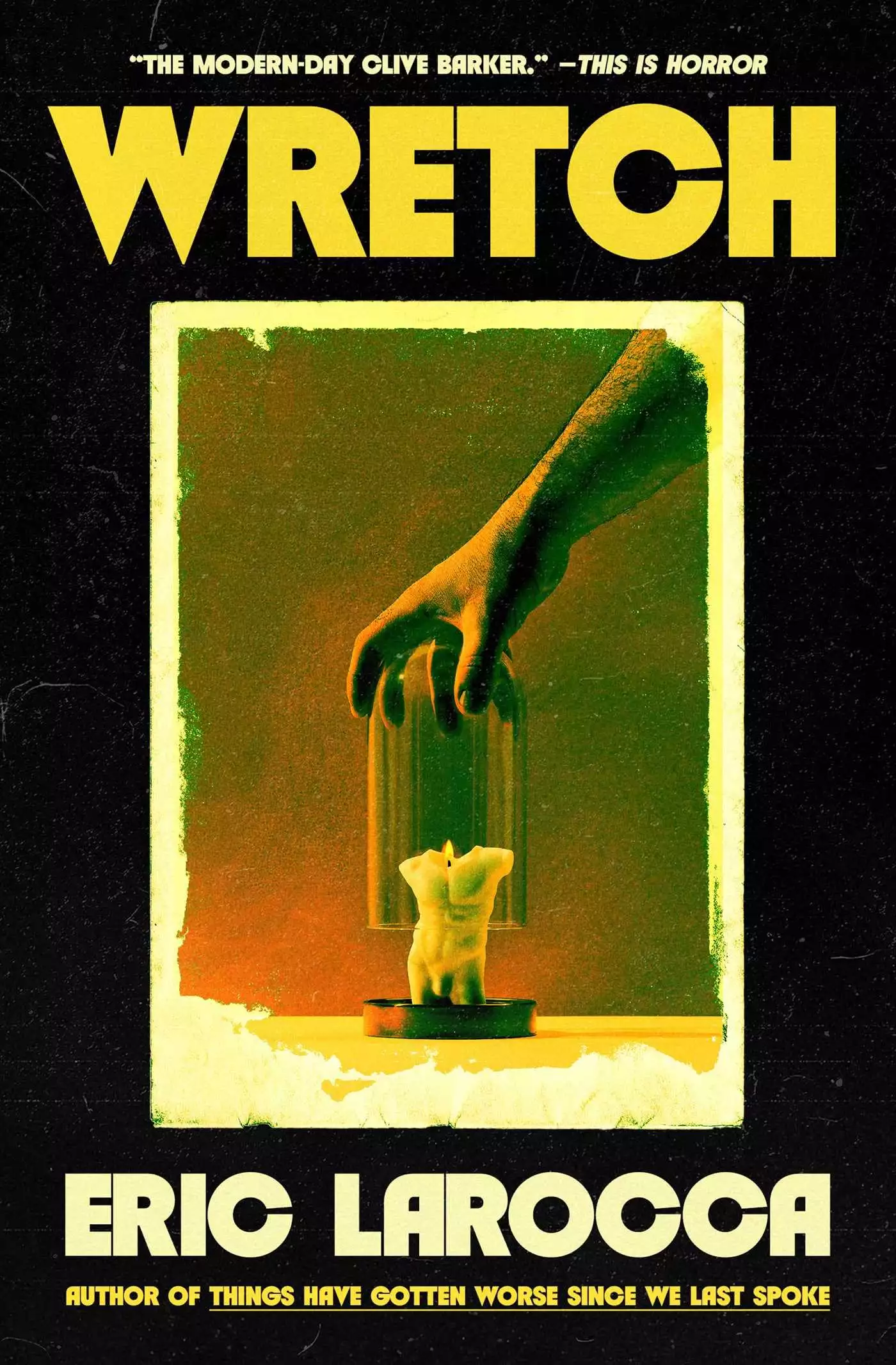
From rising horror star and award-winning author of Things Have Gotten Worse Since We Last Spoke comes a nightmarish, haunting, tech-Gothic thrill ride about sorrow, memory, and the unabashed complexity of love as a transgressive act.
After his husband dies, Simeon Link finds himself overcome by grief and seeking comfort in an unusual support group called The Wretches, who offer an addictive and dangerous source of relief. They introduce Simeon to a curious figure known as Porcelain Khaw—a man with the ability to let those who are grieving have one last intimate moment with their beloved...for a price.
Hallucinatory, fiendish, and destructively beautiful, Wretch transports us to a world where not everything is as it seems, and those we love may be the ones who haunt us most.
Release date:
March 24, 2026
Publisher:
S&S/Saga Press
Print pages:
288
* BingeBooks earns revenue from qualifying purchases as an Amazon Associate as well as from other retail partners.
Dear God, I think to myself, carefully sliding my index finger along the sharp edge of the razor while I squat on the lid of the toilet seat. This is no way to live. No fucking way to live, indeed…
Day after day, this prickly notion comes to me with hooks and fangs to spear my every waking thought, to wrestle me until my mind is sore and aching. It was innocuous at first. Of course, things are always so deceptively gentle when they first appear to you, especially when they want something from you. I suppose all things in this world want something from you, even something as innocent and as guileless as a thought. However, certain thoughts are carnivorous. I’ve learned this after years of noticing my mind become more and more polluted, the more upsetting and baleful thoughts taking root easier and spreading further until I’m infected. Yes, infected. Perhaps all human thought is a strange kind of infection, a sort of unseen disease that rots you from the inside out if you’re not careful enough. I thought I had been careful. I imagined I was clever when entertaining certain ideas, always attempting to push the more malignant, vindictive thoughts to the outermost corners of my mind where light cannot follow. But lately, more and more, these beliefs come to me when my guard is lowered, when the gates to the shallower lowlands of my mind are open and welcoming to any kind of malevolent trespasser or vagrant. Yes, these thoughts are trespassers. I find myself becoming more vexed by the day as I allow these ideas to plant themselves like perennials in the bed of my mind, destined to be cut down and then regrown every year like a new pernicious bloom.
Still, it’s more than obvious to me that this is no way to live—crouching on a rust-eaten toilet in the men’s room at work, my fingers skating up and down the length of a razor blade I brought from home. Just one mere slit, I think to myself, daydreaming about the self-carnage I could invite with such ease. Just one flick of the blade and I could open up a river current that’s livid and aching to be freed from the most vexing dam of all—my flesh. Yes, there are days when I wonder if my flesh will slough off similar to the skin of some tropical fruit, shrugging away like some expensive coat until the secret wellspring of blood I’ve been hiding deep within me unplugs and then rushes out like an uncontrollable geyser. Dear God, I ache for that! I think to myself, admiring the way the narrow blade glistens a little in the bathroom’s overhead fluorescent lighting. I’ve thought about killing myself for quite some time. However, ending things is so decidedly permanent. It’s the punctuation at the end of a sentence you must complete. There are no other words to be revealed, no other truths to be uncovered. The punctuation at the end of a misused life like mine is final, unable to be rectified or salvaged if you happen to change your mind.
I wouldn’t be able to change my mind, after all. I’d be without thought, without pain, without any semblance of reason. Of course, some of these thoughts are attractive to me and possess a certain sense of desirability. But as I gently slide my index finger along the edge of the razor blade with a silent threat to myself, I can’t help but wonder if this is how things are supposed to end for me. Naturally, I never envisioned myself living past the age of thirty-five. I always thought life for a gay man ends when you turn thirty. But as I grow older, I can’t help but wonder if I’d be interfering in the way things are supposed to be. Am I forcing punctuation in a sentence that must remain ongoing? I remain uncertain even now, sensing my blood coursing in all of my body’s main pressure points—a dim throbbing sensation aching me all over. If there were a time to slice myself open, now would be it. I can already envision how it might look when they find me—my bloodless corpse slumped against the side of the toilet like a discarded department store mannequin, a dark shadow of all my wants, needs, hungers stretching across the grime-covered tiled floor. There’s no poetry to be found here. But then again, I suppose there’s not much poetry in the art of killing yourself. There’s nothing poetic about slitting your wrists and slumping over across a toilet half-filled with excrement, all your shamefulness dripping down and pattering along the floor. I’ve entertained the thought countless times, but never here before, at my place of work. In fact, I feel a little unsettled at how easy it was for me to consider ending things so abruptly in a public bathroom. Have I no shame? Have I no common decency? I think about how my superiors might find me sprawled out on the floor, a blood-buttered razor gripped firmly in my hand. I think of how they might chastise me—even after expiration—and how they might curse me before I had an opportunity to finish my latest spreadsheet about our fourth quarter from last year. Nobody actually loves you, I think to myself. You are worthless to them unless you are giving more of yourself than you can offer. I suppose that’s true of most people. Sometimes what you must give is not nearly enough. It certainly wasn’t enough for my beloved Jonathan.
Just as I’m about to press the edge of the blade against the curve of my wrist, I hear a fist pummeling against the bathroom door. A man’s voice calls out to me:
“Simeon? Are you in there?”
I immediately know it is Henry, one of the middle-aged men from the accounting office, whose voice is watery and rotted-sounding, probably because he still smokes those god-awful cheap cigarettes, and a dim vapor of smoke seems to constantly shroud him.
The razor slips from my grasp and clatters on the floor. I hold my breath, wondering if he’s heard my fumble.
“Yeah, I’m here,” I answer, and then silently curse myself for responding.
Why did I feel obligated to answer him? I wonder to myself. Why am I so accommodating of everyone else’s needs but my own?
So I zipped myself up and excused myself from the washroom. Henry greeted me at the threshold with a look of suspicion. But there was no way he would have been able to guess what I had been doing. It’s not like I was browsing on my phone for child pornography like one of our previous associates, who eventually was caught and subsequently fired. Still, there’s a part of me that remains cautious. I’ve already been written up once for what was termed “excessive bathroom time.” I certainly don’t want to bring more attention to myself now.
“Hurry up,” Henry calls out to me from beyond the locked bathroom door. “Mr. Whittaker’s asking to see you in his office.”
That can’t be good, I think to myself. I’ve only ever met with Mr. Whittaker when I’ve fucked up in some way—whether it was due to the incorrect numbers included on my spreadsheet or my iciness when interacting with fellow coworkers. Of course, it’s never a good sign when your superior wishes to have a word with you. I swipe the razor blade from the floor and pocket it at once. Why didn’t I have the balls to go through with it? Surely there must be some way I can muster up the courage, the strength, to permanently end things. Why am I saddled with these meaningless human interactions day after day?
“I’ll be right there,” I call through the door, pressing my index finger against the toilet’s handle and flushing. “Just a moment.”
But I’ll need more than a single moment. After all, I’ve already wasted a lifetime of moments wishing my life were different, wishing I could somehow bring back my beloved Jonathan, promising to the void I’d do anything, would bear any burden to be with him one final time. I hear Henry’s footsteps, the squeak of his patent leather loafers on the linoleum floor while he retreats. When I’m certain he’s gone, I pull out my wallet and peel the small photograph of Jonathan from where I keep it safe, tucked behind one of my maxed-out credit cards. I gaze at the picture—the way Jonathan’s been permanently captured there. It’s a beautiful photograph. Jonathan, shirtless and wearing black sunglasses, is lazing on a checkered beach towel on a sandy dune in the hot Provincetown sun. His arm is lifted in the air to prevent me from taking the picture. A smile is slowly creeping across his face, half-formed, nearly there. Sometimes I glance at the picture and wonder if he wanted me to take the photograph. But I can’t be saddled with that introspection right now. I pocket the picture and ease myself off the toilet seat. I’m at the door in a matter of seconds, tugging on the handle and stepping out into the corridor. Henry’s not waiting for me there. Instead, the hallway is empty.
I make my way toward the main area where most of the cubicles are arranged. I hasten past Henry’s workstation and flash him a smile like a simple thanks for alerting me. There’s no gratitude in my warmness, however. I know I should be expecting the worst from my superior. In fact, he looks at me somewhat perplexed, like I disrupted him in the middle of something, like I misremembered our previous interaction at the restroom. But surely I couldn’t have misremembered something that happened only a few moments ago. Still, I shiver slightly and wonder why he looks at me so queerly, so suspiciously.
Finally, after what feels like eons when it should only have taken me a minute at most to walk from one corner of the floor to the other, I arrive at the threshold of Mr. Whittaker’s office—a small, cramped room that resembles almost a broom closet. It’s not the spacious, ornate office that one might expect for the vice president of a company. I knock against the door frame and peer through the sliver of open doorway. Mr. Whittaker reclines in his chair with the phone pressed against his ear. He glances at me and signals me to enter the room. I obey with little fussing, sliding inside the office and sitting in the chair across from his desk when he gestures for me to sit. Eventually, he hangs up from his phone call, and his attention snaps to me.
“I’ve been meaning to meet with you for quite some time,” he says, flicking his fingers across the computer keyboard and typing something I cannot see on his screen. “It’s such a busy time of year. You know, I’m sure.”
He glances down at my hands and notices the large emerald ring on the index finger on my right hand. He sighs and then draws in a deep breath, seeming to admire it.
“That’s a curious ring,” he says.
I shiver, a little unmoored by his fascination with the ring. Of course, I could tell him the story. I could tell him how Jonathan purchased the ring for me on a work trip to Ireland. Jonathan told me that he had bought it from a curio shop, and the shop owner had told him that the ring had belonged to a man who had been hanged in the village square in the early 1700s. Several people had told the story that the ring held mystical, healing properties. Apparently, it’s good fortune to touch the ring of a hanged man. I could have told him all that, but Mr. Whittaker would probably look at me as if my head had just spun around in circles. Instead, I accept the compliment with the little grace I can muster. Mr. Whittaker simpers and then returns his attention to the computer screen.
“I suppose you’re curious as to why I’ve asked to see you,” he says.
I swallow hard, not sure how to answer at first. “I know the quarter four numbers I presented at the board meeting were not correct, and I’m working hard to fix them with Accounting.”
“That’s a small part of why I wanted to see you,” Mr. Whittaker says, shrugging. “But it’s not the sole reason I sent for you.”
I shift uncomfortably in my seat. Naturally, I had expected the worst, and I was right for doing so.
“The board members have noticed your productivity slowing over the past few weeks,” Mr. Whittaker tells me. “Of course, we realize that you’re under a considerable amount of strain; however, we need to make deadline for certain deliverables, and we keep pushing things back to accommodate your workflow. It’s unacceptable and cannot be tolerated.”
My eyes lower until I’m staring at the floor. I can’t bear to look Mr. Whittaker in the face right now.
“Yes,” I say, exhaling sharply. “I know I haven’t been as productive as I would like to be.”
“Not to mention, the frequent bathroom breaks,” Mr. Whittaker says. “Plus, all the days you’ve been late to work… I’m afraid it’s sending a clear message to our board that you’re not invested; you’re not interested in assisting us as we work to meet these benchmarks we’ve set.”
“That’s not true,” I tell him.
Or is it? Of course I’ve been distracted for the past several months. What else could Mr. Whittaker have expected from someone who had just lost the love of his life? Naturally, I was afforded a few weeks of paid leave to grieve for my beloved Jonathan, but grief has no expiration date. It’s not some switch you can turn on and off as you please. Instead, grief feels like a constant pressure heating inside your gut—a painful reminder when you shift slightly and think it’s perhaps abandoned you for the moment. It never does.
“The board and I have been discussing how to handle this,” Mr. Whittaker tells me. “We’ve decided that we’re going to recommend you take an extended leave of absence. You’ve been warned before that this was a possibility. I’m afraid I have no other choice.… This leave will be without pay, unfortunately. After a few months, the board will hold a meeting and will make a decision about what’s to be done from there.”
I sense my heart beating faster and faster, almost like it was a drum of the inevitable doom closing in on me. It feels like the world is swallowing me whole for the sake of its own pleasure. Never mine. My own wants and needs do not matter. I suppose they’ve never mattered before. Why should they matter now?
“It sounds like I don’t have any say in this,” I say to Mr. Whittaker, and then recoil, surprised by my brashness.
“It’s the most sensible thing to do for now, I think,” he tells me. “I know it might be painful to hear, but we think it’s for the best.”
The best for who? I can’t help but wonder. For me? Or for the soulless company I’ve worked at as an administrative specialist for nearly five years? Everything in this world is a vampire. I know that for certain. Everything in this world wants to use you up until you have nothing left to give, until you’re a murmur, a pathetic stain etched into the pavement of a roadway heading to nowhere.
“You can take the rest of today off,” Mr. Whittaker tells me, easing back into his chair and trying to force a look of relaxation. “Collect your things and clear your desk when you’re ready.”
I swallow again, my throat burning with a question begging to be asked.
“Am I allowed to come back after a few months?” I ask him, dreading the finality of his answer.
“We’ll see what happens,” he tells me with a smile that looks so forced, so strained. “We’ll see where we are in a few months.”
But I already know what will happen at the end of a few months. I won’t receive a call from them. My phone calls will be ignored when I finally make a feeble attempt to reach out because my savings account has dwindled to nothingness.
I feel stupid for devoting so much of my time to this place when it abandoned me so callously.
“You need to find new meaning in your life, dear boy,” Mr. Whittaker says, reclining in his chair and scratching his marked wrist. “Connect with others. Go out and meet people. Be sociable. It will change your life.…”
I swallow nervously. Yes, perhaps he’s right. But I’ve never been much for charming others. I’m only skilled at finding companionship and meaning online. He probably doesn’t know this about me. Why should he?
As I turn slightly, my attention is caught by a small gilded-framed photograph arranged on the bureau beside his office desk. The picture is a distorted view of a grove of small hemlocks in some random grove, the image blurred almost like it had been filtered through a warped lens.
“That’s an interesting picture,” I say to him, stupidly thinking I might worm my way back into his good graces with such a senseless and idiotically kind remark. “A place you’ve visited?”
Mr. Whittaker glances at the picture and then back at me, his eyebrows furrowed and his mouth frowning.
“That’s a picture of my wife,” he says so matter-of-factly, and then resumes poring through the pages of notes filed in a small folder on his desk. “I took it last year.…”
I shiver slightly when he tells me this because I know for certain that his wife perished three years ago.
I excuse myself from Mr. Whittaker’s office and slowly make my way back toward my cubicle to gather my belongings. Yes, even Jonathan. I can’t help but think of him, his dimmed, vacant expression glaring at me from behind a portrait inside the empty gallery of my mind. He left me when I needed him the most as well. Perhaps I’m something that can only be used. Perhaps I’ll never know the joy of receiving from others.
While I march toward my desk, flitting by cubicle after cubicle, I rub the emerald ring on my index finger and pray for a miracle—a sign that I’ll be okay, that everything will pass in time. I’m met with nothing. There’s no cosmic signal, no matter how infinitesimal or minuscule. I can’t help but think of the poor man who once wore this ring, how the blood must have pooled around the edges when his fingers bloated blackish purple after he was hanged in the town square. I fantasize about his flaccid body swaying from some wooden post, eventually being cut down by the young, local ruffians who have been assigned to dispose of his corpse. The world can’t take anything more from you when you’re dead. He was free. Finally. The poor bastard was completely and utterly free.
We hope you are enjoying the book so far. To continue reading...

 Please log in to recommend or discuss...
