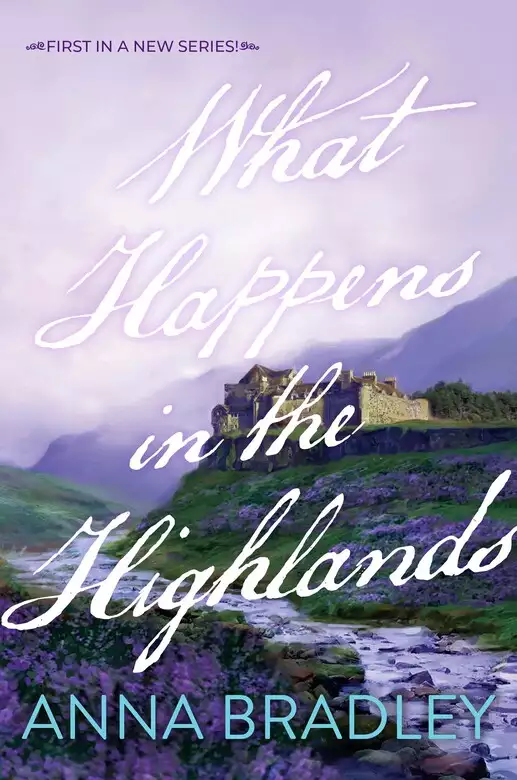
Three unusually gifted sisters in Georgian Scotland must protect their family fortress from those who would steal its rumored treasures—and their hearts—in this sweeping, adventure-filled, new historical romance series for readers of India Holton, Lex Crocher, Manda Collins, and Evie Dunmore.
In the months since their father, Rory, died, the MacLeod sisters have had to contend with bands of smugglers convinced he left a treasure buried within the walls of their home at Castle Cairncross. Only the most mystifying occurrences have foiled the thieves—stirring whispers that the sisters are sorceresses. Yet, they have no treasure, nor are they witches. However, each inexplicably possesses a unique ability. The eldest, Catriona, is a brilliant healer and alchemist—a skill she is about to put to unforeseen use . . .
Hamish Muir, the charismatic Marquess of Ballantyne and son of Rory’s business partner, has come to claim his share of the treasure. When he spies fiery-haired Cat in the village, he follows her. But the tables turn, and Hamish finds himself at Castle Cairncross—emerging from a daze . . .
Persuaded the castle harbors no treasure, Hamish remains certain Rory hid it somewhere. Cat offers a proposal: She will help Hamish decipher her father’s notes if he takes her on the treasure hunt with him—and her sisters are not left alone. Reluctantly, Hamish summons two Lairds to the castle. But as he and Cat set off to navigate a maze of maps and danger, a mutual respect—and attraction—ignites between them. Perhaps the real treasure isn’t gold after all . . .
Release date:
June 24, 2025
Publisher:
Kensington Books
Print pages:
336
* BingeBooks earns revenue from qualifying purchases as an Amazon Associate as well as from other retail partners.
She’d had the dream again tonight. The one where she was being chased.
Cat rested her palms on the rough stone edge of the window casement, sweat cooling on her skin, and stared blindly into the darkness surrounding her, searching for stars in the darkness over Loch Dunvegan.
How many times had she stood here as a child, gazing into the night sky?
More times than she could count.
Back then, she’d imagined the stars were winking a greeting for her alone, but there were no stars tonight, not even the faintest gleam of light in the sky to relieve the surrounding darkness. If it wasn’t for the whoosh of the waves against the shore below, she might have imagined the world had somehow slipped away—as if the sea, the castle, and the floor under her feet had tumbled into an abyss while she’d slept, leaving her alone.
Alone atop an ancient castle clinging to a bit of rock suspended over Loch Dunvegan, nestled between Dunvegan and Kilmuir, on the Isle of Skye.
Just her, and the endless approach and retreat of the waves below.
There’d been a time when she’d found the rhythmic rush of water soothing, a lullaby that would send her off into a dreamless sleep, but these last few months, it had turned ominous, like a lie whispered in her ear.
But that wasn’t what had woken her.
Not tonight, or on any of the dozens of nights before this.
It was the dream. The same one, every time.
In the dream, she was running from something.
No, not something, but someone, their heavy footfalls close behind her and growing nearer with every step, the heat of their ragged breaths stirring the hairs on the back of her neck to panicked attention.
No matter how nimbly she darted through the trees, she couldn’t elude them. She could do nothing but fly through the woods, the branches snatching at her skirts and tearing long, bloody scratches into her arms and face, and wait for the awful moment when a heavy hand would land on her shoulder and pull her down to the ground in a tumble of tangled limbs.
Thankfully, that moment had never come. Not yet.
Just as she’d give herself up to her fate, she’d wake, shaking and drenched in perspiration, her heart shuddering like a wild thing trapped against her ribs. She’d lay awake for hours afterward, every limb taut and her frantic heartbeat echoing in her ears as she struggled to put a face or a name to her pursuer.
But they were nameless, faceless, and silent, a hulking presence that loomed over—
Stop. She squeezed her eyes closed, shaking her head to dislodge the images threatening to unfold behind her eyelids, and turned away from the window and back to the comforting familiarity of her workroom.
It wouldn’t change anything to dwell on it, and goodness knew she had plenty to keep her busy while she waited for the sun to crest the horizon. It would be best to get it done now before her sisters awoke.
There would be fewer questions, that way.
She turned up the wick on the lantern sitting in the middle of the scarred table until it threw a bright circle of light over the clutter of shallow bowls, mismatched mortars and pestles, and a battered set of brass scales. Bits of torn leaves littered the floor underneath her, and the thick scent of black licorice hung in the air.
To one side of the table stood a row of four glass bottles, each with its own label, neatly printed in her handwriting.
And, in smaller print underneath, Relieves Cough and Inflammation.
The maidenhair fern was a useful little plant, and pretty, too, with its feathery, palm-shaped fronds. Ancient legend had it that any lady who could hold a branch of maidenhair fern without making the leaves flutter was as yet untouched. Over the years it had come to represent purity and innocence, and to symbolize the bond that tied two lovers together.
It was a sweet legend, but for all that maidenhair fern worked miracles on a trifling cough, there was nothing terribly intriguing about it. It was handy enough, but it was simple, humble.
Not like hemlock or foxglove. Aconite. Arsenic, Deadly Nightshade, or Cantarella.
Take foxglove, for instance. One ounce of fresh, ground foxglove leaves boiled in a pint of water, then strained, distilled, and sweetened with cinnamon oil made an admirable treatment for dropsy, but if one went a touch too heavy on the foxglove?
It could stop the heart.
They were fascinating things, toxic plants, requiring a light touch and an exquisite sense of balance. The delicacy of them appealed to her, the conundrum of a thing that was both useful and deadly at once.
That could preserve life or end it, depending on the slip of a hand.
Arsenic, for example, could be used as a preservative. Hemlock was often used as a dye, and in the proper doses, it offered a cure to those who suffered from breathing problems. Aconite made an admirable numbing agent as well as a sedative, and Deadly Nightshade could be taken to cure a cough or to treat melancholy.
But any one of them taken in excess?
Fatal. As for Cantarella, one needn’t look any further than the French nobility in the mid-seventeenth century for proof of its effectiveness as a poison. Those French courtiers had been a murderous bunch.
Her skills wouldn’t have gone unappreciated at Versailles.
But while the toxic plants were a great deal more interesting than simple curatives, she didn’t have much of an opportunity to indulge her interest in them. There wasn’t a demand for the trickier remedies in Dunvegan, and even less so for poison.
Oh, the villagers had their secrets, much like everyone else did, but these tended more toward the usual minor squabbles than they did the murderous. Livestock theft, land disputes, drunken belligerence, and on one notable occasion . . .
A bewitching.
Or so the villagers claimed, but the less said about that, the better.
She took up the glass flask that held her maidenhair extract and gave it a little shake. She’d hoped to make up half a dozen bottles tonight, but there wasn’t enough left for even one more bottle, much less two.
No matter. There was time enough yet to make another batch of extract before her sisters rose for the day. It was a painstaking process, but with any luck, the good citizens of Dunvegan had been so troubled with the cough this fall, Glynnis would take all six bottles she’d prepared.
She’d pay a nice sum for each bottle, and goodness knew, they could use the extra—
“You said you wouldn’t do this anymore, Cat.”
Cat jumped, dropping the flask with her maidenhair extract. It hit the old wooden worktable and the delicate glass shattered with a pop, the thick extract oozing into the cracks in the worn surface. “For pity’s sake, Freya!”
Her sister emerged from the shadows near the door and approached the worktable, her night rail billowing around her. “You promised you wouldn’t spend your nights up here in this drafty old workroom anymore.” Freya wrapped her arms around herself with a shudder. “You’ll catch your death.”
She had promised, but in her defense, she hadn’t thought she’d get caught. “That doesn’t excuse you sneaking up on me like that. It took me the better part of an hour to prepare that syrup, and now it’s ruined.”
“This is ill done of you, Cat.” Freya’s forehead creased with the disappointed frown she always wore whenever she caught one of her sisters doing something they oughtn’t to be doing. “I am sorry about your . . .” She waved a hand at the broken glass scattered over the worktop. “Your tubes and things.”
Cat glared at her sister, but she bit back the ill-tempered retort hanging on the edge of her tongue. She’d sooner berate the birds for singing than snap at her sister. Freya was a sweet, gentle soul who hardly ever had an unkind word for anyone, and when she did offer a reproach, it wasn’t ever out of anger, only concern.
“Are you having trouble sleeping again?” Freya slid one of the stools out from under the table and plopped herself down on it. “Did you have another nightmare?”
Not another one, no, but the same one, repeatedly, and each time it was more vivid, more frightening than the last. But it would only worry Freya if she said so, and there was nothing to be done about it, in any case. “No. I’m just restless, I suppose.”
“Restless,” Freya repeated, one eyebrow arched. “I see.”
Freya did see, and far too much, too. How was a lady meant to keep her secrets with such troublesome sisters about?
“Did we not agree, Cat, that you’d give up spending all hours of the night locked up in this dark room with your potions?”
Cat took up a cloth and tried to soak up the extract, then threw it aside in disgust when she only succeeded in smearing it across the table. “They’re not potions.”
At least, not this time.
If she did occasionally dabble with a toxin here and there, it was merely out of a thirst for knowledge, and it was no one’s business but her own.
“I seem to recall you promising you’d confine your experiments to the daylight hours,” Freya went on. “But perhaps that was a figment of my imagination?”
Had she promised? Yes, in a fit of misguided optimism, she’d made that foolish promise.
She should have known better.
By now, one would think she’d have learned that promises were ephemeral things and apt to dissolve the instant one’s circumstances shifted.
Well, they’d shifted, and not for the better.
Freya took up one of the glass bottles and lifted it to her nose. “Cucumber, with a hint of black licorice. My goodness, Cat, why are you up here in the wee hours of the morning making maidenhair syrup? I daresay no one’s going to expire of a trifling cough anytime soon. Couldn’t this wait until morning?”
“No, because . . .” Cat blew out a breath. She’d hoped to have this business settled without either her sisters knowing about it, but it seemed not one of the three of them could take a step inside these castle walls without the other two finding out about it.
“Because?”
There was no use trying to hide it now. Freya would persist until she had the whole of it. Despite her gentle nature, Freya was still a MacLeod, and she had a stubborn streak as deep and wide as Loch Dunvegan.
“Because I sent a note to Glynnis yesterday that I’d deliver the syrup today.”
Freya sucked in a breath. “Glynnis! You mean to say you’re going to the village today?”
A sharp rebuke rose to Cat’s lips—something about dramatics and making such a fuss over nothing, but once again, she bit it back.
As much as she hated to acknowledge it, Freya was right. It was no longer a comfortable thing, visiting with Glynnis, because as dear a friend as she was to them—Glynnis was one of the only friends they had left in Dunvegan—it always caught the villagers’ attention when they were seen in each other’s company.
A pair of peculiar women, their heads bent together, whispering.
No good could come of that.
“You can’t go, Cat. What in the world are you thinking, even considering it?”
“It’s only a brief visit, just long enough to—”
“Cat, please.” Freya reached across the table and gripped her hand. “You remember what happened the last time?”
Oh, she remembered. She wasn’t likely to forget it anytime soon.
Or ever. A lady didn’t forget the day the street emptied when she appeared at one end of it, or the echo of a dozen doors slamming shut, one after another, as she passed.
It wasn’t an experience she was eager to repeat, but there was no help for it. A review of her account books earlier this evening had told her that plainly enough. She’d counted and calculated until her head was wobbling on her neck, but no matter how many times she tallied her columns, the result was the same.
They were down to their last few pounds.
It was no wonder she’d slept ill and woken with her heart pounding and her lungs on fire in her chest, startling awake at every creak of the heavy wooden shutters, every crash of a wave on the rocks below her window. It was no wonder she’d dreamt of a mob of crazed villagers with pitchforks in their hands, chasing her and her sisters through the cobbled streets of—
No! It was a dream only. Just a dream.
Still, dream or not, there’d been no chance of sleep after that.
“Come now, Freya. There’s nothing to worry about.” Cat gave her sister’s hand a brisk pat. “Why, I’ll be there and then gone again before any of them even realize I came.”
“They will realize it, Cat. They always do, now.”
If only she could argue the point! More than anything she wished she could tell her sister it was nonsense, that none of the good citizens of Dunvegan cared a whit for what they did, but Freya knew as well as she did that it was a lie. Even Sorcha, for all that she did her best to ignore anything having to do with the villagers, knew it.
“I’ll be as quick as I can be. I promise it.”
Silence. Freya’s cheeks had gone pale, but she said nothing, only stared at Cat with an expression that made her squirm. “Please, Freya, don’t look at me like that. Say something, will you?”
“Say something? All right then, since you demand it. I’ll say that it looks as if you intend to break the second promise you made, just as you did the first one.”
“We need the money, Freya.”
Freya gave her a stricken look, then glanced away, biting her lip.
The silence stretched between them until at last Freya let out a long, slow breath. “You’ll only go to the apothecary? And you won’t speak to anyone aside from Glynnis?”
Alas, it wasn’t that simple. “I can’t promise I won’t be obliged to speak to Bryce, but you can be sure I won’t seek out his company. Indeed, I’ll do my best to avoid him.”
She always did, but Bryce Fraser was the apothecary, at least officially. Everyone in the village knew it was Glynnis who had all the medical and scientific knowledge, but naturally, it wouldn’t do for her to act as the village apothecary.
She was a woman, after all.
A brilliant one, with a great many unusual talents, including an exhaustive knowledge of plants and their medicinal uses that rivaled Cat’s own, but when had that ever mattered?
So, it was left to Bryce, a man without the faintest trace of his sister’s talents or intelligence, and if that weren’t awful enough, he was one of the few unmarried gentlemen in Dunvegan and fancied himself quite dashing, indeed.
God above, just the thought of those bulging blue eyes wandering over her made a shudder dart up her spine.
Freya’s lips turned down at the mention of Bryce Fraser’s name, but she didn’t offer any further objections. Instead, she caught Cat’s hand between her two cold ones. “You’ll see that you’re not left alone with him, won’t you? Not even for a moment, Cat. Promise me.”
“I promise it.” It was an easy promise to make, and unlike the others she’d made so recklessly, easy to keep, as well. She wouldn’t ever make the mistake of being alone with Bryce Fraser again.
Freya still didn’t look pleased, but she rose from the stool and crossed the room to the door, turning back to glance over her shoulder when Cat didn’t follow her. “You need to sleep, Cat. Come to bed. You can finish this in the morning.”
“I’d just as soon finish it, now I’ve begun.” There’d be no sleep for her tonight, in any case. There never was, after the dream.
Freya sighed. “Very well, if you must, but this is the last time.”
“The last time. I promise it.”
Dear God, what a liar she’d become! The truth was that promises were a luxury she could no longer afford. Still, she’d just as soon keep the worst from her younger sisters for as long as possible. She gave Freya what she hoped was a reassuring nod. “Go on, then. Off to bed with you.”
The workroom felt dreadfully cold and empty once Freya had gone with the darkness and silence pressing in on her. But she set to work, and by the time the sun peeked over the edge of the horizon, she had six bottles of maidenhair syrup waiting to be packed into her marketing basket.
She had no excuse for putting off her foray into the village now, but perhaps it was just as well. She couldn’t avoid it forever, and the sooner she went, the sooner she’d be back.
She paused at the window again before going downstairs, watching the hazy fingers of light struggling against a sky thick with gray clouds. From up here, the loch appeared as smooth as a sheet of dark glass, like the kindest of friends, tempting you to dip a toe in and refresh yourself.
To look at it now, one would never guess the treachery that lay beneath the calm waters, the swirling currents that caught you around the ankles and jerked you down into the deep, the rocky bottom falling out beneath you as the water closed over your head.
If the currents didn’t finish you, the jagged rocks you hadn’t noticed at first would do the trick. That, or the cold. It was a convenient reminder never to forget that danger lurked beneath the most harmless of surfaces.
It was rather like poison that way.
She closed her eyes, shutting out the sight of the deceptive waters below, and ran a hand over her eyelids. Had it only been a matter of months since a visit to the village had become something to dread, instead of a pleasure?
Perhaps it had been inevitable, the villagers turning on them as they’d done. If her father hadn’t been an infamous smuggler, or her mother a Murdoch daughter, it might have been different. If their Great-great-aunt Elspeth hadn’t met her end at the hands of a mob who’d lashed her to a stake and watched her burn, the villagers might have had more patience with them.
But so much wickedness in one family? There was no overlooking that.
She turned away from the window and made her way down the narrow stone staircase to the low door that led into the main part of the castle. From there, she emerged into the portrait gallery and hurried down the staircase to the entryway, but she came to a dead stop at the bottom of the stairs.
It was deserted.
Even now, weeks later, it still felt like a fist to her stomach to come downstairs and find Duffy’s usual place by the door empty. For as long as she could remember, his craggy face was the first thing she saw when she came down the stairs in the mornings, his stern expression softening into a smile when he caught sight of her.
She’d ask after his health, and he’d launch into his usual complaint about the damp making him “a wee bit achy” in the joints, and she’d smile because Duffy’s troublesome joints were as much a fixture at Castle Cairncross as the sixteenth-century suit of armor that stood in the alcove to one side of the staircase.
Then she’d tell him he mustn’t stay in this drafty hallway all morning, as it would only aggravate his joints, and he’d wave a hand and tell her that one room in the castle was as drafty as the next.
Over the years, this exchange had become something of a ritual of theirs.
But Duffy had been gone these past few weeks, and with him Mrs. Duffy, who’d been their housekeeper for as long as she could remember. She’d pensioned them off because she couldn’t in good conscience allow them to continue in the castle once the boats started coming.
If they’d stayed, it would only have been a matter of time before the villagers turned on them, as well.
She remained frozen at the bottom of the stairs, staring at the place where Duffy had once stood. The castle had never felt as lonely as it did now, not even after their mother had died.
“Cat?” Freya wandered into the entryway but paused on her way up the stairs when she saw Cat standing there, staring at nothing. “What are you doing?”
“Nothing, I . . . is Sorcha about?”
“No. She’s gone off on one of her adventures.” Freya waved a hand in the direction of the woods, which was the scene of most of Sorcha’s adventures.
“Ah. She’s wasting no time this morning, I see.” Goodness only knew what she got up to out there, but there were some things best left unasked, and Sorcha’s comings and goings was one of them. “You’re on your way up to the roof now, I imagine.”
“Yes. I felt a bit off this morning. I think a storm is approaching.”
For all her warnings to Cat about catching her death, Freya spent an inordinate amount of time on the chilly roof with her notebooks, thermometers, and rain gauges. “Don’t linger up there if it starts to rain like you did last time. You were in bed for a week.”
As scoldings went, it was a mild one. Freya’s mysterious aches were much like her own flutters and twitches, although in Freya’s case, it signaled an impending change in the weather.
Freya had the same connection to the elements their poor Great-great-aunt Elspeth had had, which was rather worrying when one considered Aunt Elspeth’s fiery end. Still, Freya’s talents had proved extraordinarily useful these past few months, perhaps even more so than Cat’s, though Freya’s particular skills didn’t line their pockets the way Cat’s potions and unguents did.
Yet they’d proven the difference between life and death, for all that.
“I won’t stay out for long. I don’t like that wind.” Freya regarded her in silence for a moment. “Perhaps you’d better put off your trip to the village for another day?”
“It can’t wait, I’m afraid.” Cat buttoned the front of her cloak and settled the deep hood over her head so it covered most of her face.
All the better to hide her from the prying eyes of the citizens of Dunvegan.
“I don’t like this, Cat.”
“Nonsense. I’ll be back before you know it, I promise it.” She drew her basket over her arm, taking great care to avoid her sister’s concerned gaze.
Freya let out a soft huff, but she said only, “See that you are.”
It would take an hour, perhaps a little longer. Really, it was hardly any time at all. Why, she’d be back before Freya had a chance to miss her. It was a walk into the village, nothing more. She’d done the same walk dozens of times before.
There was no need to fall into hysterics over it, for pity’s sake.
It wasn’t as if the villagers were really going to chase her into the woods. It was just a dream, nothing more. It meant nothing. She’d found the castle to be much the same this morning as she’d left it the night before, and her sisters engaged in their usual pursuits.
All was well.
But the uneasiness in her belly persisted. Her eyebrow was twitching most insistently, and there was an ominous tingle underneath her breastbone. As she made her way down the rocky pathway that led to the village, a spray of gooseflesh rose on the back of her neck.
She knew better than to dismiss her telltale tics and flutters.
Something was amiss. She couldn’t see or hear it, but she could sense it, the air around her alive and crackling with portent.
She’d long since learned to heed these sorts of warnings.
They were signs of ill-tidings yet to come.
Of all the cold, gray villages tucked into Scotland’s darkest, most desolate corners, Dunvegan was the dreariest Hamish had ever encountered.
Although, did the term “village” really apply here? It seemed a generous description of this tiny, rain-soaked shred of muddy earth. If Dunvegan held more than three dozen crofts within its borders, he’d eat his hat.
Well, perhaps not his hat. It was rather a nice one. A black silk jockey, of course, as the latest fashion in London dictated, but he’d much better have left it at home, as it would be a miracle if his cockade survived this incessant drizzle.
He emerged from the inn—the Merry Maiden by name, incongruously enough, as there was a shocking lack of both maidens and merriment in Dunvegan—and onto the High Street.
If one could call it that. The apothecary’s shop crouched at one end of it, and Baird’s Pub at the other, with little to be found in between them aside from a joinery, a stonemason, and a tiny bakery, which admittedly did make a nice barley cake.
And just beyond the High Street . . .
He turned and shaded his eyes from the pale November sunlight filtering through the clouds. There it was, looming over the village like a hulking giant.
Castle Cairncross, the source of all his frustrations.
Like most things in Dunvegan, it was misnamed. It boasted neither cairn nor cross, and neither was it named after Clan MacLeod, though it had been theirs since the dawn of time.
There was some sort of trickery there, no doubt. The MacLeods were a wily lot.
It was a horror of a place, done in rough, dark stone with a narrow turret to one side that was too tall for its width, jutting into the sky like a broken bone. The few muted rays of gray light that passed for sunshine in Dunvegan were no match for the shadows that atrocity threw over the village.
Beyond it, a gray horizon stretched to infinity.
If the MacLeod sisters had been anyone else—or, more accurately, if they’d had any other father—he might have felt a twinge of pity for them. It was unfair that three women should be doomed to spend their lives trapped inside that monstrosity.
But Rory MacLeod’s daughters were no concern of his, or they wouldn’t be, soon enough. He’d save his pity for those who deserved it, and from what he’d heard about the MacLeod sisters, they didn’t.
Not even one of them had appeared in the village this past week. That was reason enough for him to despise them, but their absence was the least of their rumored sins.
The worst of their sins? Why, that they were wicked, treacherous crones, of course.
Or so the gossips would have it. Some claimed the MacLeod sisters were simply doing the best they could to survive, while others maintained they were wily enough, but not dangerous. But there were those who insisted that the sisters were positively Machiavellian, redheaded mythical beings—sirens or sorceresses—with the power to cast spells and curses.
A shame, that. He was partial to both redheads and wickedness, but a man didn’t want to take a witch to his bed, did he?
To be fair, that bit about the spells had come from his cousins Dougal and Clyde, who’d made such a mess of this whole business weeks earlier that he’d been obliged to come to Dunvegan himself to separate the truth from the figments of their overly fertile imaginations. They were good lads, Dougal and Clyde, but perhaps not the brightest of the Muir bloodline.
Sorceresses, for God’s sake. . . .
We hope you are enjoying the book so far. To continue reading...

 Please log in to recommend or discuss...
