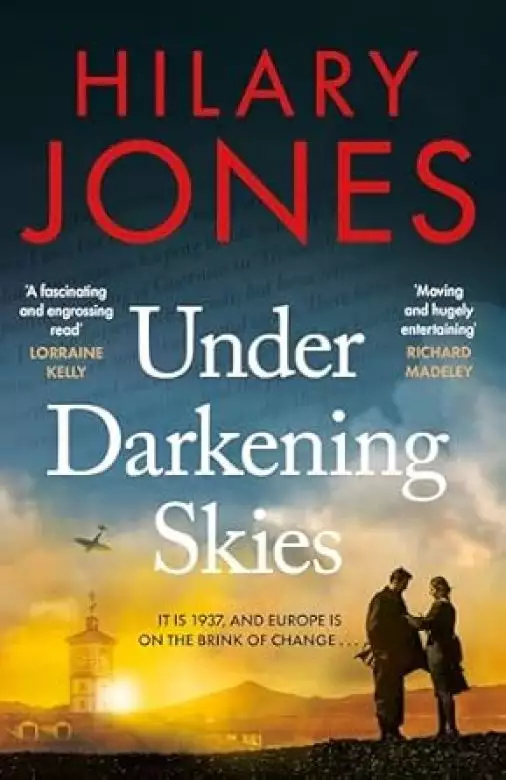
'An utterly absorbing page-turner' Lorraine Kelly It is 1937, and Europe is on the brink of change...
Kitty has escaped her family home in England to join an international brigade of fighters high up on the snow-covered Spanish borders, determined to lead an effective fight against the growing Fascist forces sweeping across Spain.
In Oxford, Grace has embarked on a new posting, working with two medical scientists - one Australian, one a German refugee - on the brink of a great discovery that will impact a life-changing treatment for infection. But for now, they need to keep their findings away from the envious eyes of Nazi extremists.
And in London, Lieselotte, one of the only surviving members of a German family rounded up by fanatics in their own country, is invited to a clandestine meeting, there to be recruited to work that will divert the course of international action.
As the years pass and the bloody fighting in Europe bites, these women - bonded by idealism, love and extraordinary courage - leave an indelible mark on the historical landscape , united in their efforts to make change in a world riven by war.
UNDER DARKENING SKIES is the concluding story in Hilary Jones's compelling and dramatic trilogy of the twentieth century, covering a time of upheaval, conflict and extraordinary leaps in medicine that affect how we lead our lives now.
Reviews for FRONTLINE and EYE OF THE STORM:
'Hits the spot' Jeffrey Archer 'An enthralling tale' Daily Mirror
'Anambitious, sweeping epic of a story, visceral in its descriptions, andwritten with great insight and empathy' Historical Novel Society
Release date:
July 31, 2025
Publisher:
Headline
Print pages:
464
* BingeBooks earns revenue from qualifying purchases as an Amazon Associate as well as from other retail partners.
Will Burnett woke up freezing and tried to extricate himself from the sleeping form of his wife. Trying hard not to wake Grace, he gently pulled his arm out from underneath her, though not gently enough, it seemed. She stirred and turned over, gazing at him with her beautiful blue eyes.
‘Where do you think you’re going?’ she whispered. ‘It’s so cold in this room, and a girl needs to be kept warm!’
‘That’s Victorian dwellings for you. As for me, I’ve been doing my best. And making huge personal sacrifices in the process.’
‘What sacrifices?’
‘Well, I can’t feel my left arm, for a start. It’s as if it belongs to someone else.’
‘Oh, do stop whining, dear.’
‘Whining? I need this arm! It comes in very useful at work, I shall have you know!’
‘Speaking of work,’ said Grace, ‘we’d better make a move. I can already hear the twins crashing about in the kitchen and if we don’t get a wiggle on, we’ll both be late!’
With the help of the man who had been so instrumental in offering Will his scholarship at St George’s all those years ago, their son, Daniel, had secured a training post in psychiatry at Maudsley Hospital in London, while his sister, Emily, had been perfectly happy to move to Oxford with her parents and explore her growing interest in engineering and aviation. A strange occupation for a girl, some thought, but Grace was secretly delighted as both she and Emily had always loved tinkering with engines.
‘And in case you’ve already forgotten,’ she added, ‘we have half the extended family coming over for dinner tonight, and we have nothing prepared.’
‘Damn. I had forgotten.’
‘I told you yesterday!’
‘Ah, that’s right.’ Will put his fingers to his temples in mock-reminiscence. ‘It’s all coming back to me, along with the feeling in my arm. I remember now – Jack is working locally over in Jericho, and Fitz is finally bringing Aunt Clara up on the train from London.’
‘You’re such a nincompoop.’
‘I don’t suppose Shauna will be coming, too?’
‘Fitz hasn’t said. But I can’t remember the last time I even saw them together. If ever there was a marriage of convenience!’
‘OK, so with Emily and Daniel both here as well, that will be seven of us. Eight, if your mother Dorothy finally decides she’s up to it. I’ll go to the outdoor market today for provisions. Do you want me to get a chicken from Kingswood farmhouse? I’ll be passing there anyway.’
‘Perfect. It’ll be lovely to have us all around the same table again, catching up on the family gossip, won’t it? It’s been a while.’
‘You bet. Oh, what about drinks?’ asked Will, trying to rub away the pins and needles that were still pricking his arm with a vengeance.
‘The cellar’s well-stocked, Will. What self-respecting medical family would have it any other way?’
‘Excellent. That’s Jack catered for, then.’
‘Never mind Jack. At the end of a busy week, I think we’ll all be in need of some fortification!’ Grace grabbed Will’s elbow with both hands and squeezed it as hard as she could.
‘Ow!’ cried Will, rubbing the limb furiously. Now it was super-sensitive, the nerves jangling as the blood slowly flowed back to revive them.
The dilapidated row of pre-Victorian dwellings in Oxford’s Jericho Gardens had, for decades, housed dozens of the poorest families. Now those houses stood cold and deserted, awaiting their fate. In moments, they would cease to exist.
Jack Burnett had found his calling in demolition, finding it so much more rewarding than construction. The tedious insistence of architects who rigidly adhered to technical plans and drawings was time-consuming, not to mention tiresome in the extreme. These people, he’d thought, these stuck-up graduates with their fancy degrees, who didn’t have the foggiest idea of how to build anything themselves, and who never got their hands dirty. Well, as long as I get paid, he’d supposed. He could absorb their idealistic claptrap and their new-fangled ways, provided it was worth his while. After all, it was the client who was forking out, not him. If their unnecessary attention to detail and their cravings for amendments created delays and rework, who was he to argue?
With demolition, it was different. What might have taken years to build could be flattened and destroyed in a matter of hours, the devastation bringing with it an emotional outlet for Jack’s unresolved anger and inner conflict. It was a form of catharsis. A painstakingly constructed dwelling, factory, or office block could be reduced to a heap of mangled steel and rubble in moments. It was noisy and messy, but it was quick, and effective.
In some ways, it was a bit like his relationships. So much easier to ruin and smash than to nurture and cherish. He was too impatient, really, to constantly revisit the same old project to refine and perfect it. He preferred something you could close the book on. It was the story of his life.
His relationship with Amandine was the nearest he had ever come to love. On the battlefields of Flanders, immediately after the Great War, their romance had blossomed at her father’s farm. Despite his gruesome job, clearing the fields of discarded ordnance and the rotting corpses that were being unearthed, he had found a woman who had given him everything he had ever wanted. Unconditional love for the first time in his life, understanding, and a chance to marry and raise a family. She had also given free rein to his unconventional, unpredictable, and often selfish nature. Yet still, he had rejected that love, and Amandine had let him go. He was young, impetuous and restless. He had simply not been ready to put down roots. It was a decision he often regretted, but he allowed himself little time for recrimination or remorse. At least his war wounds were tolerable.
Demolition, though, had given him a purpose. It was as if his inner demons could be drowned out, along with the memories of the devastating explosions he had set off in the tunnels he had mined under the enemy trenches at Messines and La Boisselle. Now, as he watched the huge wrecking ball freefalling on to the roof of 28 Jericho Gardens, he felt a familiar sense of elation. It was the same intoxicating excitement he had experienced as a little boy, mischievously hurling a lump of coal through a neighbour’s window or throwing a bicycle into the river.
Jack revelled in the thrill of it and assumed every hot-blooded young man would feel the same, which was why he had brought his nephew along with him this morning. Daniel had often asked what kind of work he did, and this project was an ideal opportunity to show him.
The huge, forged-steel sphere crashed through the tiles and slabs of masonry as if they were made of tissue paper. The crane hoisted the ball back up again on its steel chain, and, pivoting the boom to accelerate it towards its target, swung it to and fro like a pendulum until it was sent crashing through the walls of the little house and out the other side. It was rudimentary and capricious, and not a precision instrument by any means.
As Jack’s eyes sparkled and his body tensed with the thrill of the devastation, Daniel regarded him with interest. He already knew quite a lot about his uncle’s insalubrious past, and had often considered the differences between him and his own father. A pair of brothers, born just two years apart, yet so different in personality and outlook.
It was strange that Daniel’s grandfather, Robbie, had reacted so differently to adversity than Jack, who had rather seemed to take to it. When Robbie’s wife, Evie, had been taken from him in childbirth, he was pathologically bereaved. He had become withdrawn and depressed and had never recovered. He had survived the war, yet he had never been rehabilitated. Now, he languished in a residential home for the psychologically damaged and infirm. His son Jack, too, had witnessed terrible events, having tragically lost close friends, and suffered personally, but while Robbie would startle at sudden sounds and recoil from bright, flashing lights, Jack seemed to relish and embrace the unexpected. It seemed to give him focus and revive him, almost as though he lived for it.
Daniel looked over at the dust cloud rising from the wreckage of the collapsed building, the mangled iron rods jutting out from the rubble. Through the dust, he spotted his uncle gesticulating excitedly, and the quantity surveyor determining how many trucks it would take to clear the site. Two first-aiders were on standby in case anybody got hurt. There was also a policeman on hand for safety, to ensure onlookers kept their distance. It was people and personalities that piqued Daniel’s interest, rather than places and buildings.
Jack glanced back to gauge his nephew’s reaction to the demolition. He seemed to have been watching him instead of the unfolding scene. Daniel quickly averted his gaze, pretending he had not been staring. But Jack was fine with it. Daniel was a well-built lad, strong and athletic like his father, Will, but was also quiet, thoughtful, and curious. Better still, he rarely seemed to judge or criticise, unlike others Jack could think of. No, Daniel was a good lad. Jack felt relaxed and easy in his company, and was somehow calmer whenever his nephew was around.
The coq au vin that Grace and Clara had prepared had been heartily devoured, with nothing left to waste. Even the residual juices at the bottom of the serving dish had been mopped up with slabs of heavily buttered home-made bread. Now eight of them sat around the dining-room table, enjoying an after-dinner drink and a family chat. In the end, Dorothy had finally declined the invitation to join them, in one of her familiar states of unnecessary anxiety – this time over the welfare of Rupert and Henry, another two of her offspring. Fitz, Grace’s youngest sibling and MP for Southwark, had brought up to Oxford his newly appointed parliamentary assistant as well as Will’s aunt Clara, and had selected from the larder a ten-year-old single malt whisky from Oban. Jack, the rest of the bottle in front of him, was carefully protecting it from the hands of others.
Kitty, Will’s sister, was heading out to Spain. ‘Kitty can look after herself,’ said Fitz, trying to sound reassuring and to allay the fears of Will and Grace, who were going to take a lot more convincing. They both knew how unpredictable survival was in the theatre of war, and Kitty was still so young. Despite her adventurous nature and her passion for language and travel, they considered her rather too idealistic and naïve to recognise what might have been awaiting her in Spain, where a civil war had been underway for some months now.
‘She’ll be safe in the bosom of the Spanish Red Cross,’ Fitz added, ‘and besides, she has friends in Barcelona from the time she spent teaching there, as well as Thiago and Liese to hold her hand.’
Grace stared back at him. She had first-hand experience of what the fascists in Nazi Germany were capable of, and she had no reason to believe that those who had rebelled against the democratically elected People’s Second Republic and marched into Spain would be any different. Yes, it was true that their friend Liese was travelling with Kitty, but how many lives did she have left?
Armed with forged papers, Liese had narrowly escaped Germany only six months earlier, smuggled across the Dutch border in a horsebox. Had she been detained, she would undoubtedly have been arrested and sent off to a concentration camp, just as her parents had been. She and Grace had been through a lot together. They were the same age, and both specialised in infectious diseases. Liese was smart, savvy and cautious, but hatred could make people do dangerous things.
‘Liese knows what she is getting into,’ Fitz continued. ‘She hates the Nazis. That’s why she has been helping Otto Schiff.’
‘Otto Schiff?’ asked Grace.
‘He’s the director of the Jewish refugee community. She’s also been working with the immigration service at Bloomsbury House in London. She has been lobbying hard to accommodate as many German refugees as possible. She won’t be taking any silly risks.’ Fitz looked across the table towards his assistant, Stephen, for support. Fitzwilliam ‘Fitz’ Tustin-Pennington was gaining something of a name for himself in parliament as a committed and passionate liberal who was not prepared to compromise his principles. As such, he had become something of a thorn in Prime Minister Stanley Baldwin’s side – though secretly the PM rather admired him, what with his forthright approach and laconic sense of humour.
‘But I fear she will, Fitz,’ said Grace, cutting in. ‘I know Liese, she’s fearless. It’s precisely because she harbours such animosity against the fascist military that she might not act rationally. I’m worried for her, but much more worried about Kitty, who I sense is going for the adventure of it.’
‘I don’t think so,’ said Will. ‘She is as antifascist as the rest of us. Anyway, we couldn’t have stopped her. God knows, we tried hard enough. My little sister is just as impetuous and defiant as my wife.’
Grace raised her eyes to the ceiling, but grinned.
‘And what with her fervour to support the suffragettes – and the liberal philosophies that you’ve instilled into her, Fitz . . . well, the Red Cross will only make her socialist leanings stronger.’
‘Don’t blame me for the recklessness of your sister,’ Fitz retorted. ‘The Red Cross is only allowed to operate in Spain because of its neutrality. There’s no International Red Cross involved at present as it’s an internal conflict, not an international one.’ Stephen could sense Fitz becoming irritated, and nudged his foot under the table for reassurance.
‘Fitzy, for a politician, you’re so short-sighted sometimes,’ said Grace. ‘You’ve only got to look at what has already happened down there to realise the International Red Cross are bound to become involved. The appalling number of casualties and the atrocities on both sides could so easily spill over into a much wider conflict.’
Having patiently listened to the exchange in silence, Daniel diplomatically changed the subject to his grandfather Robbie, who he had been visiting regularly at the Maudsley Hospital, where he was being treated as an inpatient. Emily then brought the conversation round to her own favourite topic: flying. The human-powered aircraft Pedaliante had flown a full kilometre outside Milan the day before. But Will would not be distracted from his concerns about Kitty.
Fitz sighed. ‘Look, Will, if I didn’t have a dicky heart and could be of any use to the Republican cause, I’d be out there myself. As it is, I get breathless just arguing with Baldwin and Eden in parliament about their refusal to do anything. This Non-Intervention Agreement signed last August isn’t worth the paper it’s written on. Hitler and Mussolini are flagrantly ignoring it and are laughing in our faces.’
‘Britain and France adhere to it for fear of being drawn into the conflict themselves,’ said Will.
‘They are making it worse, in my opinion,’ continued Fitz. ‘They closed the borders and banned arms sales to the government whilst Italy and Germany are sending men, transport and arms, tipping the scales in favour of the Nationalist rebels. They’re even refusing to issue passports to people they suspect might be travelling to Spain, and are threatening to make volunteering illegal.’
Like the majority of the country, Will and Grace were sympathetic to the Republican cause, too. Will had come from a working-class background. His father had been a dockyard worker, his mother a seamstress. He had no time for the authoritarianism of the Army, and even less time for the church. He had fought discrimination and privilege to qualify as a doctor, and was all too aware that the health and social prospects of the poor and the less educated among his patients had been disadvantaged from the start.
Grace had come from an aristocratic background, an environment a world away from Will’s own. Her beloved father, Arthur, had been a liberal who had only fought for king and country in the belief it would make the world a better and fairer place. He had treated the workers on his estate with decency and fair-mindedness. He’d considered them equals, and such egalitarianism had rubbed off on Grace. Her service in the Great War had demonstrated all too vividly the brutal realities of fascism, and she realised her father’s liberalism was not dissimilar to the ideals of the Spanish anarchists who wanted equality and freedom from the aristocratic rule of wealthy landowners, and to run their farms and factories along communal lines.
‘Why don’t you just let her do what she wants?’ said Jack, his words a little slurred now. ‘We should all do what we want, shouldn’t we, Fitzy? Shouldn’t we, Stephen? Even if other people disapprove.’ There was a clear insinuation in the question, but no malice.
Jack had been around the block a few times himself. ‘Listen, Will, Kitty is my sister too, remember. We all take risks because we choose to. Sometimes we have to. You treat people with all sorts of contagious diseases, any of which you could catch tomorrow. Kitty is ten years older than we were when we enlisted. Leave her be.’ He poured himself another large tumbler of whisky.
‘I do admire her for going,’ said Will after a long pause. ‘Don’t misunderstand me, Jack. I love her determination and spirit. We might not want to admit it, Grace, but I suppose he’s right. We might have done the same at her age.’
‘You both did,’ said Clara, ‘only in a different war and in a different country.’
‘And you both survived, all right!’ said Fitz, cheerfully.
‘I supported Kitty and her decision,’ Clara added. ‘You might not thank me for saying it, but Kitty is a young woman who will not be caged, nor should she be. I’ve raised her as a mother would, and I hope I’ve done at least half as well as Evie would have done herself, had she lived. But if I know Kitty at all, she will flourish, and it will be the making of her. Although I will worry, I’m so very, very proud of her.’
The others were temporarily lost for words. They knew just how close Clara was to Kitty and how much they meant to each other. She was also wiser than the lot of them.
‘Look at my poor brother, Robbie,’ Clara continued. ‘Think of your previous neighbours in Putney; that lovely little boy, Freddie, whose short life was snuffed out by diphtheria. The people in your hospital wards, Grace, dying of TB or typhoid, and the ones who can’t be saved by surgery, Will. There are dangers everywhere you go. Yet we all need a purpose and a passion for life. I suspect that Kitty, just like the two of you, will always feel most alive in the presence of danger. I’m sorry, but there it is.’
‘That makes me feel pretty lifeless by comparison, Clara,’ mused Fitz.
‘Rubbish,’ she scoffed. ‘It wasn’t your fault the Army classed you as unfit for service. At least you tried. You have other talents, Fitzy. You have the power and voice to create political change. You have the ear of Baldwin, Attlee and Eden because you are reasoned and persuasive. You can probably do more than any of us individually. Your heart might be anatomically feeble, but at least it’s in the right place.’
Everyone around the table turned to look at Fitz, who was feeling a little embarrassed by the generous tribute. ‘On the left-hand side in the mid-clavicular line in the fifth intercostal space?’
‘Very good,’ said Will, laughing. ‘That’s exactly where it is. An honorary medical degree for that man.’
Kitty was not far from the snow-covered summit of the Cirque de Gavarnie in the French Pyrenees. Grabbing Thiago by the hand, she hauled him up the giant granite step to join the rest of their motley band, who had gathered around a broad, flat part of the path. Most of them sat catching their breath, hunched over ancient stones that had fallen from the peaks.
Kitty had known Thiago forever. Growing up, they had lived just a few doors away from each other in their little terraced houses in Chiswick, and had been in the same classes at school since they were four years old. Although she still adored him, she had long since outgrown him romantically, having once had a crush on him. Kitty knew Thiago was only here now because he wanted to come to the rescue of his grandparents, who were being persecuted by the fascist rebels. The two friends also shared the same political ideals. What they did not share was the same level of athleticism; Kitty’s hard-earned gymnastic and sporting prowess left the slightly-built Thiago in the shade. He sat on his haunches with his hands on his hips, recovering from the climb.
They had left the hut just outside Gedre two days ago; the ascent in the freezing, driving sleet had been relentless and exhausting. Since the border with Spain was now closed, it was their only means of crossing it unofficially. When their guide, Florentino, had first pointed out the vast semicircle of rock in the distance that formed the Cirque, Kitty had wondered how on earth it could possibly be scaled. Crossing over it into Spain seemed unthinkable. Yet they had been expertly led this way and that, under the trees of the lower slopes and over rock scree and across turbulent streams until they had started to ascend like tiny figures on a giant staircas. . .
We hope you are enjoying the book so far. To continue reading...

 Please log in to recommend or discuss...
