
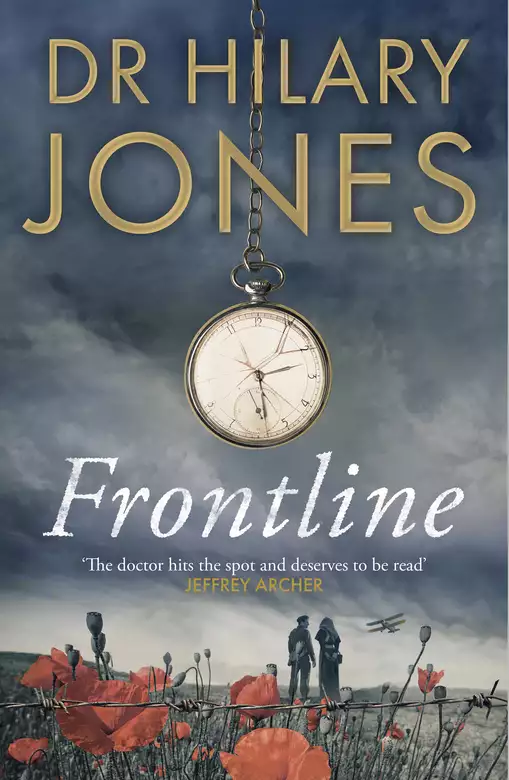
Frontline
- eBook
- Audiobook
- Book info
- Sample
- Media
- Author updates
- Lists
Synopsis
'The doctor hits the spot and deserves to be read' - Jeffrey Archer
'A story to get the heart racing' - Daily Express
'An enthralling tale' - Daily Mirror
'Dr Hilary is a master storyteller' - Lorraine Kelly CBE
___________
LOVE GAVE THEM STRENGTH. LOVING EACH OTHER GAVE THEM COURAGE.
Britain and her allies are engaged in a long war with Germany.
Grace is the daughter of landed gentry, volunteering as a nurse on the Western Front.
Will is the son of a dockworker, driven to enlist by a sense of patriotism and the thrill of adventure.
When their lives collide in a field hospital in France, they form a passionate connection.
This is a sweeping and sumptuous WW1 drama and historical epic, perfect for fans of Ken Follett, Kate Mosse and Jeffrey Archer.
Publisher: Headline
Print pages: 464
* BingeBooks earns revenue from qualifying purchases as an Amazon Associate as well as from other retail partners.
Reader buzz
 Please log in to recommend or discuss...
Author updates
Frontline
Hilary Jones
Whilst commenting daily in the media throughout 2020 and 2021 on the Covid-19 situation, it struck me how many parallels there are between the two types of conflict and how much civilisation and survival depend on the humanity, courage, altruism and professionalism of people working on the frontline. So, firstly, I would like to acknowledge the astonishing and selfless work of everyone involved in health and social care both here in the UK and throughout the world in giving me the inspiration to write my debut novel, Frontline, set during the time of World War I and the Spanish flu of 1918 when both tragic events occurred simultaneously.
I was also inspired by my grandfather, William Jones, who fought on the Western Front with the Queen’s Westminster Rifles, where he was wounded and returned to the battlefield three times. I am in awe of him and his entire generation, many of whom made the ultimate sacrifice and never returned home.
I would like to thank my literary agent, Kerr MacRae, for suggesting the idea of a series of novels to me in the first place and for his intelligent guidance and support from the outset. For me, writing Frontline has proved a great antidote to the relentless and sometimes harrowing focus on public health messaging during the Covid-19 pandemic and I have learnt a huge amount during its creation.
I have been constantly bolstered by the encouragement and enthusiasm of my editorial team at Welbeck and would especially like to thank Luke Brown, Angela Meyer, Jon Elek, James Horobin, Rosa Schierenberg, Alexandra Allden, Nico Poilblanc, Rob Cox, Maddie Dunne Kirby, Angie Willocks, Carrie-Ann Pitt, Sophie Leeds, Annabel Robinson and Sam Matthews.
I would like to thank my wife, Dee, for forgiving me my preoccupation with the book and also my mother Noreen for her enduring wisdom, experience and support.
My thanks to Kim Chapman, my hard-working and long-suffering agent and PA for juggling my diary, and to Rob Cremin, India Achilles and Jane Manley for their much appreciated behind-the-scenes assistance.
I have drawn on various sources of research for historical detail but would especially like to critically praise Gina Kolata’s excellent book Flu: The Story of the Great Influenza Pandemic of 1918 and the Search for the Virus That Caused It (Macmillan, 1999), True World War I Stories (Robinson, 1999) and Charles Horton’s Stretcher-Bearer: Fighting for Life in the Trenches, edited by Dale le Vack (Lion, 2013).
Dr Bradstock took one look at Evie in that dark, dismal bedroom and knew without doubt that the next person to attend her would be the priest to administer the last rites.
It had all been so perfect three days earlier.
The baby was anticipated with such excitement and joy. Evie and Robbie were buoyant and happy, and a new baby brother or sister was all their boys were able to talk about. Once Evie went into labour, the boys were kept well out of the way. Time, for the boys, passed slowly.
Ten-year-old William Burnett was both bored and on edge at the same time. In truth, he did not really know how to feel. There was a tension about the house that was strange and heavy. He was used to his older brother, Jack, poking fun at him or trying to wrestle with him when he was least expecting it. More disturbing to Will was his dad, who had been pacing the floor for hours without saying a word.
His mum was still upstairs with Mrs Collier and to Will it seemed like an age since she had been excitedly summoned from the other side of Turnham Green to come and help deliver the baby. There are only so many battles you can fight with a box of tin soldiers and Jack kept knocking them down as soon as Will had them standing in position, about to launch an attack.
A few days earlier Evie and Robbie had walked the boys out to Strand-on-the-Green, slowly because of Evie’s condition. Will had been entranced by the bustling activity on the river: the barges with their cargoes of coal and limestone; the skiffs and rowboats with elegantly dressed ladies reclining on cushions at the back; and last, but certainly not least, the magnificent paddleboat Corinthe, packed from bow to stern with all sorts of handsome people enjoying a party in the sun.
They’d ambled lazily along the towpath, passing the City Barge pub where loud groups of revellers were swilling beer from large pewter mugs. When Evie began to feel uncomfortable, they sat down on a wooden bench by the side of the river and fed the ducks with the dried crusts of bread she had thoughtfully brought with her.
Will was always keen for every duck to receive its fair share. He went to great lengths to ensure an even division of the contents of his paper bag. Sympathising with the smallest ducklings, constantly shoved out of the way and pushed under the water by the others, he hurled the crusts this way and that – feinting and dodging to throw the bigger, fatter ones off the scent. Only when he was sure that each little mallard had been fed did he sit back down. Evie gently took his hand in hers.
‘Look at that brother of yours, Will,’ she said. ‘My attention is diverted for a few seconds and there he is, trousers rolled up with his shoes and socks off, paddling in the river in all that mud.’
‘Can I go down there too, Dad?’ Will asked, but Robbie was not at all keen and pulled a face.
‘That water, young Will, is toxic. I should know from working at the docks. I wouldn’t let a dog go in there.’
‘But Jack is in there and he’s not a dog!’
‘That’s very true. He’s not even as obedient as a dog. But he’ll smell like one soon enough.’ Robbie shook his head. ‘If I’d seen him slipping away I’d have tied him to that willow tree over there and slapped his face with a wet fish.’
This made Will giggle.
‘Jack!’ Robbie shouted. ‘Come back up here now, it’s time to make a move!’
Robbie shouted again, but this time Jack did not have to pretend not to hear him because the sound of the London and South Western Railway train coming across Kew Railway Bridge drowned everything else out. Will watched in awe as the carriages rattled over the five-latticed girder structure. He idly wondered what would happen if the bridge collapsed and fell on the little ferryboat that was taking a group of people from the Richmond side of the river to the opposite bank. As the sound of the train finally disappeared into the distance and the ferryboat safely reached the shore, Robbie stood and suggested again that it was time to get back. But as Evie started to stand up, she cried out in surprise.
‘Oh goodness!’ she yelped. ‘I think my waters have broken.’
Will didn’t realise what she meant at first. When he heard the word ‘waters’ he thought it must be something to do with the river, but he knew that waters couldn’t break. What he didn’t know, however, was why his mum’s skirt was suddenly soaking wet when she had not been anywhere near the river.
‘The baby is telling me it wants to come out soon, Will, don’t worry.’ His dad added that they would have to get back home smartish and take the quieter route through the alleyway rather than the towpath, to spare Evie’s blushes. Jack took a while to catch up and Robbie had had to threaten to put him to bed early with no supper unless he hurried up, which did the trick.
‘Dad said you’re a dirty dog,’ teased Will, laughing. ‘Get away from me with your stinky clothes.’
‘Little Mr Goody Two-Shoes. Mustn’t get his clothes dirty, must he, Mummy?’ shot back Jack.
Their father had to pull them apart and walk between them all the way home after that.
Despite Evie’s self-consciousness about her wet skirt, they got home an hour and a half later without further trouble. Evie went straight upstairs to the cramped little bedroom at the back of the house. By now, the cramping discomfort in her lower belly was getting stronger and occurring more frequently.
‘You better call Mrs Collier,’ she told Robbie. ‘The baby is coming.’
Mrs Janet Collier, a birth attendant with no formal qualifications but plenty of experience, duly arrived at 368 Chiswick High Road forty-five minutes later with her precious little bag of obstetric tricks.
*
That was eighteen hours ago and now the fun of the previous day’s excursion was well and truly forgotten. The boys finally fell asleep around ten o’clock, Jack with the family cat curled at the foot of his bed and Will with his toy bear tucked tightly under his pillow.
Robbie would not allow himself to relax and only snatched an hour or two’s fitful sleep in his favourite saggy old armchair in the sitting room.
Why was it taking so long? he wondered. Evie’s previous two deliveries had been relatively straightforward. Although, he reminded himself, it was easy for him to say that. He would never know what childbirth felt like.
Mrs Collier had come downstairs a couple of times to utter the usual platitudes designed to calm a fretful husband, but Robbie felt anything but calm.
‘The contractions are good and strong, that’s for sure,’ did not settle his mounting anxiety. Then, at four a.m., ‘It’s just taking a little longer than usual,’ was delivered in a noticeably less certain tone, which magnified his increasing worries. Surely, thought Robbie, a third baby is delivered more quickly than previous ones? He was no midwife but by the age of thirty he knew that labour was usually shorter, not longer, with each subsequent pregnancy. He could not help thinking that all might not be well.
By seven a.m. no further progress had been made and both boys were up having some breakfast and were back to their normal bickering. Mrs Collier came down the stairs looking unaccustomedly concerned and hesitant.
‘Robbie,’ she said, touching his forearm, ‘I don’t want you to be alarmed but it’s taking longer than I thought and I’m going to need some help with this one.’
‘We can’t afford a doctor, Mrs Collier, you know that.’
‘I know that. I’m thinking of Kirsty Albright in Chesterfield Road. I’m not a beginner by any means in this line of work but she is a member of the Midwives Institute and has had all the compulsory professional training a midwife is encouraged to have these days. She’ll know what to do next.’
‘I’m not sure …’
‘You don’t have a choice, Robbie,’ she said more firmly. ‘Evie needs urgent help now. I’ve worked with Kirsty before. The powers that be frown on her associating with the likes of a mere mortal like me, unqualified as they consider I am, but apart from being a bit la-di-da and from a more well-to-do part of Chiswick, she knows that not everyone can afford medical help and she is always supportive of the local community.’
Soon, Robbie was out of the door, sprinting to Chesterfield Road on the other side of the village, clutching a scrap of paper torn hastily from the Middlesex Independent newspaper with the vital address on it.
Mrs Collier was flummoxed. Evie was not a high-risk patient. The contractions were frequent and strong. The baby’s head was engaged within the pelvis. Yet each time she examined Evie her cervix was not yet fully dilated and now Evie was exhausted and becoming desperate.
Downstairs, fed up and frustrated at having to occupy themselves for so long, the two boys had begun to bicker and squabble, a situation only briefly interrupted when their father fled without explanation. Mrs Collier, despite being a stranger to them, put a stop to the bickering, and while Jack tried to see how many spinning tops he could keep going at any one time, Will took his treasured Meccano set out of the dresser and attempted to build his own version of Kew Railway Bridge.
Half an hour later, Robbie burst in followed by a breathless and flushed Kirsty Albright who immediately rushed upstairs to be brought up to date by Mrs Collier. The midwife listened carefully to all she was told and then spent a few minutes patiently talking to Evie and getting to know and reassure her as best she could.
‘Thank you so much for coming, Miss Albright,’ Evie managed to say between contractions. ‘I don’t know how we will manage to reward you –’
She was cut short by the midwife as she palpated the contours of Evie’s baby and said, ‘You don’t need to worry about that. All that’s important right now is that this wee thing in here is delivered safely and soon.’
‘Oh, I couldn’t agree more. I’m so tired, I don’t mind telling you.’
‘Well, if I have anything to do with it, Evie, we will have your baby out before too long.’
Struggle as they might, however, the two birth assistants, each with their own considerable level of expertise, failed to accelerate the delivery. They recorded the strength and duration of the uterine contractions. They listened carefully to the baby’s heartbeat through the aluminium foetal stethoscope that looked like a smaller version of an ear trumpet. They checked the degree of cervical dilatation at the neck of Evie’s womb and carried out a manual sweep of the amniotic membranes to encourage the next stage of labour. Yet by four p.m., after twenty-four hours of natural labour, Kirsty Albright made the decision to apply forceps to the baby’s head and help things along. She was one of the few midwives in the whole of London who had any experience with them, and if ever a case warranted their judicious application, it was this one.
She succeeded, with a little difficulty initially, and with a whoosh of fluid a beautifully healthy and pink baby girl was delivered. Almost inevitably, there were a few lacerations to the vaginal walls and lip of the cervix. Kirsty Albright clamped the umbilical cord and cut it. She then handed the wriggling and crying little mite to Mrs Collier at the other end of the bed, who gently wiped away the soft coating of vernix from the baby’s skin and happily announced to Evie that she now had the daughter for which she had been hoping and praying.
By now, Evie was crying with happiness and relief, all the pain and anguish of the previous day for the moment forgotten. Even the baby’s increasingly vigorous crying was beautiful to behold. Within seconds of hearing that welcome sound, Robbie was bounding up the stairs, kissing Evie’s forehead, gripping her hand and grabbing the baby from Mrs Collier’s arms and blinking down in awe at this wonderful creation before him.
‘She’s gorgeous, Evie. The most beautiful baby girl I’ve ever seen. Here, take her.’
‘She’s just what we’d hoped for, Robbie.’
‘All our dreams come true.’
As tears fell all around, Jack, swiftly followed by Will and the family cat, piled into the room and jostled to find as close a position as possible to the newborn treasure, making the little bedroom very cramped.
‘She’s perfect,’ said Miss Albright, checking the baby over thoroughly and feeling relieved that her earlier, delicate work was now done. The forceps had barely made a mark on the newborn’s head. ‘Any name in mind?’
‘Kitty,’ answered Evie without hesitation. ‘She’s Kitty, isn’t she, Robbie? Named after my grandmother.’
‘Her or the cat that’s just followed the boys in,’ joked Robbie, ‘whichever you think is most important.’
‘So, it’s Kitty either way then,’ said Mrs Collier, smiling, ‘though this is no place for animals. We also need to finish off and tidy up a bit here, gentlemen, so if you wouldn’t mind …?’
Robbie took the boys downstairs again and Evie could hear them squealing with excitement in the living room.
In the bedroom, the placenta took an age to come free and Miss Albright noticed with concern it looked fragmentary and torn in places. The bleeding also took an hour or two to settle down to a trickle. Everything about this birth had been complicated, she thought.
*
Mrs Collier was already waiting with the front door open when Miss Albright arrived again three days later.
‘I’m so sorry to call upon you again,’ she said.
‘I know you wouldn’t have done unless you were worried.’
‘Come upstairs.’
As the qualified midwife walked through the living room the boys were reading comics and had a large half-completed jigsaw puzzle spread out across the floor. Robbie, however, looked dead on his feet.
‘She’s not right, Miss Albright,’ he said. ‘She is so weak and tired. She sleeps a lot, which is understandable, but sometimes when she’s talking she doesn’t make much sense. I pray you can help.’
The midwife could see that this man was worried sick about his beloved wife.
In the bedroom, Kitty lay peacefully in her wooden rocker cot which Robbie had lovingly made in advance. She was fast asleep and content. Evie, on the other hand, looked like a ghost, pale and still, with her face turned towards the door as the midwives came in. Her sunken eyes, once bright blue and sparkling, were now glazed over and unfocused.
Kirsty Albright knew what she was dealing with. Puerperal sepsis. The scourge of so many new mothers. A high proportion of those who experienced it would die, especially in families from poorer backgrounds like this one.
‘Hello, Evie,’ she whispered as she drew up a chair.
Recognition was delayed but it came to Evie eventually.
‘Miss Albright. It’s good of you to come.’ She added, earnestly, ‘Do you know what’s wrong with me? I have no energy. And I can’t stay awake to feed Kitty properly. I’m so worried. And the pain …’
Miss Albright held Evie’s hand and mopped her brow with a cool flannel.
‘You have an infection, Evie, but we will do everything in our power to help you get over it.’
Miss Albright asked Mrs Collier about how Evie had been since she was last at the house. The older woman gave information methodically and chronologically without referring to notes of any kind. Evie had slept initially after the birth but woke up with abdominal pain a few hours later. Despite that, she had put the baby to her breast and made sure that Kitty correctly latched on. Then she had dozed, but after the second feed she could not shake off a splitting headache and had felt hot and cold all over. She had tried putting Kitty to her breast once again but had felt weak and had no appetite. That’s when Robbie had called Mrs Collier back again.
Once she arrived, she had taken every hygiene precaution she could, applying poultices and changing dressings. She had carried out all the normal nursing procedures but had eventually realised she was losing the battle.
The younger midwife listened attentively and considered the circumstances as she knew them. This had been a prolonged, partly obstructed labour. There had been difficulties applying forceps and some tears to the genital tract. There had been a ragged, possibly incomplete placenta and a greater than normal amount of bleeding postpartum.
Opening her case, she withdrew her tools of the trade and checked Evie’s temperature. 103°. The mercury never lied. Her patient’s eyes had dark shadows beneath them and her skin was parched and wrinkled, both signs of dehydration. The conjunctiva was abnormally pale beneath the lower eyelids, too, a reliable sign of anaemia. Her pulse rate was rapid and thready; the midwife counted it out at 120 beats per minute on her trusty Elgin fob watch. Finally, she turned back the sheets to examine Evie thoroughly.
She was ill-prepared for what she saw.
She had certainly seen a number of cases of childbed fever before but none at this advanced stage and none so visibly evident. Evie’s lower abdomen was swollen and bloated and far too tender to be touched. Lower down, there was the unmistakable odour of infection and her feet were swollen and dusky blue. On her chest and arms, and also on her back when she was turned, there were scattered purple-red bruises under the skin that did not blanch when pressed as allergic spots do.
How had this horrific condition marched on so quickly? the midwife wondered. Once she had confirmed the diagnosis and the dismal prognosis she persuaded Robbie that attendance by a doctor was now imperative. By this time, however, Robbie himself was almost out of his mind with worry. Aunt Clara had collected Jack and Will to take them out for a walk, along with the baby and a supply of milk from the breast bank, so that had been one less thing to worry about for the time being. But paying for a doctor at a full sixpence for a visit was financially impossible.
‘There is a community fund available for this very purpose, Robbie,’ Miss Albright insisted, ‘and a local almoner to administer it appropriately.’
Any remaining worries about the money were quashed. Evie was the love of his life and he was utterly devoted to her. Whatever needed to be done had to be done.
The doctor was summoned at once and arrived within the hour.
Evie now knew the worst was coming, too. Despite the doctor’s gentle manner and best attempts at optimism, she understood the awful truth that the two boys she loved with all her heart and the baby girl she had finally brought into the world were going to grow up without her. It was too much to bear. Then there was Robbie. The man she adored. A wonderful father. A doting husband. At this realisation, her spirit broke and she struggled to stay conscious.
She lay there with Robbie’s handsome face close to hers, his brow knotted with concern and tears streaming down his cheeks.
‘Look after them all for me, Robbie,’ she whispered. ‘Love them forever, as much as I will love you forever.’
Then, somehow, as if all her remaining energy was summoned for one last act, she raised her hand to his face and ran her fingers softly across his lips as he tenderly kissed them.
When he finally placed her hand back down on the bed by her side, he knew she was gone.
In his agony, he didn’t notice the small figure standing in the doorway, blinking and looking on uncomprehendingly. His youngest son. Will had just witnessed his dear and beloved mother die in her bed, because she had had a baby and developed an infection. This moment would stay with Will forever.
Arthur Tustin-Pennington gazed through the tall sash windows of the master bedroom on the first floor of Woodmancote House. At the back of the house, on the far side of the manicured lawns and landscaped garden, backlit by the bright sunshine of a perfect August day, stood the majestic coastal redwood that Grace had climbed to the top of at the age of seven. Sequoia sempervirens was one of the tallest species of tree on Earth and his youngest daughter had scaled it effortlessly and fearlessly, sparing no thought whatsoever for the dangers or possible consequences.
He remembered hearing her before he saw her, her whoop of delight. ‘What’s she up to now?’ he’d said to Dorothy, his wife, before he strode out into the garden on his crutches. She had asked if she could spend the morning with Clive, the head gardener, and taking an interest in nature was a reasonable enough pursuit for a girl, even in her mother’s eyes, who frequently despaired of her boyishness. ‘Grace?’ he shouted. ‘Grace?’ but there was no sign of her, just the sound of a giggle being suppressed, and then not being suppressed anymore, becoming the joyous laughter he recognised so well. He let his eyes follow the sound of it, up the gnarled trunk in golden red, where, high among the branches, in one of the summer dresses that Dorothy insisted she wear, Grace was waving down at him.
Dorothy had been apoplectic. What was Grace thinking? She could have fallen and been killed. Where was Clive? How could Arthur be so cavalier a father as to allow a seven-year-old girl to expose herself to such peril? The row that had ensued was the latest in a catalogue of similar parental arguments about Grace’s impulsive and impetuous behaviour.
Arthur smiled now at the recollection of it. Grace had been perplexed at the scale of her mother’s reaction. What was all the fuss about? It was just a tree. She had climbed most of the others on the estate and her mother didn’t even know. Besides, it was a relatively easy one. Lateral boughs every few feet and fronds and needles reaching out like cupped hands to catch her and cushion her fall if she slipped. But she would not. She never had. Sure of foot, strong and lithe, she found it almost as easy as climbing the grand oak staircase inside.
As Dorothy had tutted and cursed about the hazards and repercussions of this apparently daredevil feat, Grace had blinked back and absorbed the tirade.
Her mother was forever fretting and worrying about such little things. She worried about the children going out in the rain, lest they catch pneumonia. She worried about them wearing insufficient clothes in the winter, swimming unattended in the lake at the bottom of the hill, not getting enough sleep, having dirty fingernails or greasy hair. She had forbidden them from riding the horses without the grooms present and tried to limit the time they spent playing tennis on the lawn or playing football in the paddock for fear of injury. Dorothy was a born worrier, a woman full of anxieties and complexes, who found things to agonise over even when no risk was apparent. Arthur had once confided in Grace after yet another stern telling off that if Dorothy was not worrying about something, she would more than likely become agitated and fretful about that in itself. She would convince herself that there might be something that she had missed and imagine some impending doom about to befall the entire family. There were seven children and that was a lot to worry about.
The boys had become accustomed to their mother’s foibles and fussy ways and generally did whatever they wanted while pretending to be cautious and careful in her presence. The activities they confessed to enjoying were certainly at odds with the truth. But boys would be boys of course and as far as Dorothy was concerned they were, within reason, much more able than the girls to fend for themselves.
Girls were the gentler, weaker sex. Their behaviour, comportment and roles in life were expected to be poles apart from that of the boys. Dorothy had been brought up in a manner completely separate to that of her brothers. She had not been permitted to play sport, to wear casual clothes, to consort or compete with members of the opposite sex. This mindset was ingrained in her, this unshakeable conviction about how her daughters could conduct their lives.
As far as her eldest daughter Amy was concerned, it was not an issue. Three years older than Grace, Amy was happiest wearing her pretty frocks, experimenting with different hairstyles and playing with her dolls. But from the moment Grace could stand and totter, she was adventurous and restless, on one occasion having to be rescued from falling into the roaring log fire in the living room when the grown-ups had taken their eyes off her for just an instant. Not interested in the usual girls’ things, she dressed like a boy, played like a boy, and in most sports either competed on equal terms with her brothers or surpassed them in athletic ability.
Her mother simply could not understand why Grace would harangue Douglas the gamekeeper into letting her drive the car around the grounds and tinker with the mechanics of its engine.
While Dorothy worried about her difficult and disobedient daughter, Arthur watched her development and accomplishments with growing interest and admiration. Grace was an explorer, a risk-taker, an intriguing and enchanting gamine. She was bright and intelligent, curious and determined. She was not brash and loud, full of swaggering bravado like her brothers, but quietly efficient, confident and capable. She was also, her father noted, very feminine at the same time. She moved as her name suggested, light on her feet, supple yet strong. Her smile lit up a room and she giggled and laughed easily with the boys. Tease her though they might, she was more than an intellectual match for any of them.
Now, as Arthur looked at the giant redwood, he could still picture her waving her red silk neckerchief at the house from her precarious perch 120 feet up.
Grace was simply extraordinary. Unstoppable, uninhibited, charismatic Grace. Grace the rebel.
Arthur would never openly admit that she was his favourite of the seven children. And now she was leaving him, doing what he had hoped none of his children would ever do.
*
He had known war himself. The Boer War, cruel and bloody, and all for the greedy pursuit of gold and diamonds. He had held his friend Alfred’s hand, while a field doctor did his best to wrap a bandage around his bullet-shattered shoulder. There had been very few nurses around and so he’d stayed there himself, listening to the screams, knowing for the first time what a bullet did to a man, what an awful thing it was to pull a trigger. Alfred had had his arm amputated, but it had made no difference. The rot had set in. The conditions weren’t sanitary and there were not enough doctors and nurses. He died in agony. Arthur was sure that could have been avoided.
Months later, how relieved he had been to head back home. The voyage from Eastern Transvaal was long and uncomfortable and he couldn’t wait to get back to his beloved estate in rural Gloucestershire where he could concentrate once again on r
We hope you are enjoying the book so far. To continue reading...
