
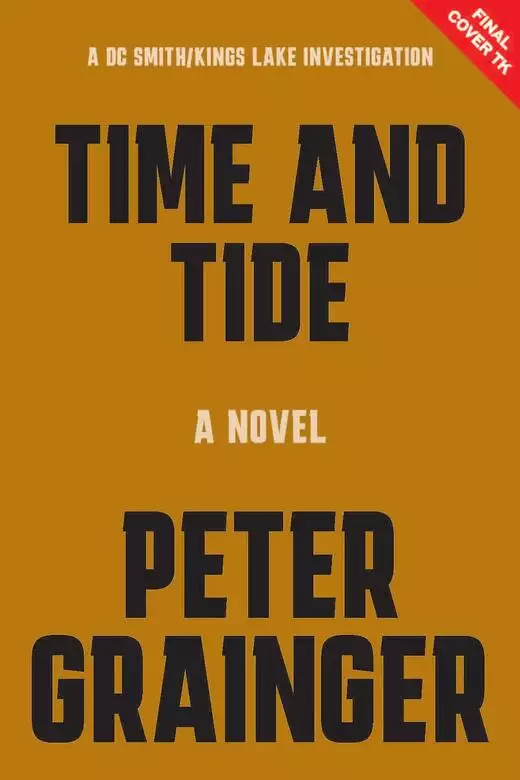
Time and Tide
- eBook
- Book info
- Sample
- Media
- Author updates
- Lists
Synopsis
Change is afoot at Kings Lake Central police station. A most unexpected new detective inspector takes up his post this Monday morning, and the oldest detective in the place takes a momentous decision. Around them, other officers are considering their own situations, and even the building itself seems to be facing an uncertain future.
But life and death go on nevertheless, and by lunchtime someone will make a grim discovery on the Norfolk saltmarshes. A stranger seems to have suffered a slow and agonizing death out there. As the team from Kings Lake uncover his story, they reveal another, much older one with its origins far back in the previous century. In the tide that governs the affairs of men, it seems, love and loss, betrayal and revenge are timeless themes.
Release date: January 27, 2026
Publisher: Union Square & Co.
Print pages: 496
* BingeBooks earns revenue from qualifying purchases as an Amazon Associate as well as from other retail partners.
Reader buzz
 Please log in to recommend or discuss...
Author updates
Time and Tide
Peter Grainger
It flowed in first amongst the eel-grasses, the glassworts and samphires, and then it slowly climbed the creek-sides, covering the roots of marsh grasses, sea-purslane and sea-lavender. Here the sea-water is life and death – too little and the marsh-plants shrivel, too much and they drown. They thrive only on the in-between, the place that is neither land nor water but a mysterious hybrid child of them both – mysterious, strange and beautiful.
The man who had lain in the marsh all night, in a tiny nameless creek not far from the winding channel that leads into the harbour at Barnham Staithe, felt not the mystery or the strangeness of the place, and his eyes, though open, could see none of its beauty. Eventually the water took him by the hand and lifted him, his fingers waving through the eel-grass as he continued his journey into the heart of the marsh, his head lolling to one side, or perhaps nodding, as if with death a little understanding had come at last.
It’s been a good summer after all, thought Sam Cole, as he watched the queue forming on the jetty down by the Lady Anne. June had been wet and windy, and as usual all the boatmen had said all the usual things – that it would be the worst season ever, that this was the beginning of the end of their business. But a good August, a long, hot August, had saved them as it had before – his father always said that, if August is alright you’ll not starve before January. The takings in August had been enough to see them through past Christmas, and now, if this September weather holds to the end of the month, they’d survive until the next season.
High water was at eight minutes past twelve in the afternoon – ten minutes to go. Sam Cole ate the last piece of battered fish and the last three chips from the polystyrene tray and watched his niece Janie working her way along the queue, taking the money from those who had turned up on spec, and checking the tickets of those who had bought the seal-trip in advance. He smiled – she always looks the part, Janie, all sun-browned and pony-tailed, blue and white striped T shirt and sailor’s cap; she even puts on her best Norfolk drawl sometimes. Not one of those people would guess the truth – she’s in her final year of university, going to be a pharmacist. Barnham Staithe doesn’t need many of those, though, so she’ll be gone for good soon. Makes you wonder who will be running the boats in a few years’ time, what with all the best youngsters leaving.
As he walked down, Sam Cole eyed the line of people. A few children but no toddlers or babies, thank God. Three dogs but they already seemed to be getting on with each other – a few years ago a full-on dogfight broke out on the twenty two foot dory and there aren’t a lot of places you can go to get out of the way of that. A couple of buckets of sea-water had done the job, and the threat to drown the bloody things if it happened again. Sam Cole took the old-fashioned view that on a boat the captain’s word is law, and because he was a big man with a beard, a man who didn’t say anything he didn’t have to, few of his passengers doubted that it was so.
Janie Cole cast off the Lady Anne at fourteen minutes past twelve o’clock and took her usual seat in the bows. Sam took the tiller, standing whilst the people sat in forward-facing rows. Cameras were clicking away already, though there was little to see as yet, and there was that sense of adventure and expectation which always comes as a boat leaves its mooring and heads for the sea. Not just for them, the holiday-makers, but for Sam too, though he had been doing this man and boy for almost fifty years. Seen everything in that time, of course, but you still feel it because it’s in our blood, island nation and all that. Sam Cole believed in blood.
He took a breath and caught Janie’s eye. She was watching him, smiling and waiting for him to begin.
‘Good afternoon, ladies and gentlemen, and welcome to Cole’s Seal Adventures. My name is Sam, and that’s Janie, the first mate. I’m going to tell you a bit about what we’re going to see this afternoon but you can ask either of us a question at any time. We’re a bit local but hopefully you will be able to understand what we say when we answer. Out on the sandbanks, we’re going to see two kinds of seal…’
The girl was twelve or thirteen, it’s difficult to say these days. She hadn’t taken any interest in the seals or the Sandwich terns or Sam Cole’s brief lecture on the effects of longshore drift. Janie watched her now as the boat began its journey back to Barnham, and thought, she hasn’t spoken once to her parents, didn’t want to come on a stupid boat-trip to see some stupid seals. The parents, come to that, had hardly spoken to each other – a sad, silent couple in their early forties, both bespectacled and bookish-looking, wondering what had happened to their lives… Janie had seen enough of that already – not a mistake that she intended to make.
When Sam pointed out the rusting hulk of the amphibious craft that soldiers had used to practise the D-day landings – or so the story went, no-one ever questioned it – all eyes but the girl’s went in that direction. She was leaning over the side a little way so that she could trail her hand in the water; against the rules of course but it didn’t look as if she would be getting any other enjoyment out of the day, so Janie left her in peace and watched the tourists take pictures of the DUKW and its customary cormorant.
But when Janie looked back, everything had changed. The girl was sitting bolt upright, her hand out in front of her, fingers dripping sea-water, and she was pointing. She looked at Janie then with a mute appeal, and Janie followed the pointing finger. There was something, just, in the widening wash from the Lady Anne, something that bobbed briefly, seemed to roll a little in the turbulence and then disappeared.
Janie nodded and said, ‘A seal. One often follows the boat back in.’
The girl was shaking her head, her face pale and wide-eyed.
‘What did you think it was?’
The girl wouldn’t answer – and then Janie realised that she couldn’t. Neither of the parents had yet noticed. Janie left her perch on the bow and crossed the six or seven feet to where the girl was sitting. She hunched down beside her and said, ‘It’s OK. What did you see?’
Still the words wouldn’t come easily. The girl opened her mouth and pointed again down the estuary, as if only seeing would make anyone believe what she had to say. Now the mother was leaning over, saying what’s the matter, is she feeling sick, and the girl was holding onto Janie’s arm, as if she was.
Finally, she said, ‘It was a man. A dead body. A man.’
Sam Cole had cut the engine to an idle. He said quietly to Janie, ‘It’s a high tide. We’ve enough water for another trip if we’re back in by two thirty…’
‘I think she saw something, uncle.’
‘Did you, though?’
‘Yes – something. I can’t be sure what. I told her it was a seal but I don’t think it was.’
‘What’s the mother saying?’
‘She says her daughter wouldn’t make it up.’
‘That’s what all mothers say until the daughters do. Sod it!’
The story had begun to circulate among the passengers, and two or three, the girl’s father included, were watching Sam Cole as if they understood the dilemma. The ebb wasn’t up to its full speed yet but in another half an hour or so it would be; anything in the water then would travel fast and this spring tide would take it out of the estuary and into the open sea. If he didn’t make at least one search and then they got back to hear that someone was missing…
‘Alright – I’ll come about. You get back to it and keep things calm. And get on the radio, tell Tommy what’s happening. Tell him to be ready to get down to Arthur’s and borrow his launch – not that we’re going to find anything.’
And then, to the passengers, ‘A slight detour, ladies and gentlemen. We’re just going to run back down to the corner and come over this bit of water again. You can help me out by keeping your eyes open for anything in the water that shouldn’t be there – some to the port, some to the starboard.’
There were nods and knowing glances, then, and some looked positively interested in the whole business. A seal is a seal is a seal – but a dead body? Cole’s Seal Adventures was suddenly excellent value for money.
One careful look would be enough to say he had made the effort, even if it was, in reality, no more than a gesture. Sam Cole knew the local waters as well as any man. He took the Lady Anne down to the corner as he called it, and then pulled around to come back along a line between the edge of the marsh and their original course; a sizeable object would likely drift into the slacker water until it reached the point where the two widest, deepest channels met. There the pace of the ebb quickened so much that he would need at least half throttle just to maintain the boat’s position, and the chance of finding anything floating would be virtually nil.
The girl sat with her mother’s arm around her shoulders and stared into the foot-well – she didn’t want to look at the water, and Janie Cole thought that whatever she had seen had truly frightened her. Most of the others seemed to be enjoying the bonus of a free trip, and she saw one character surreptitiously take a picture of the girl with an expensive-looking camera; she stared at him until he noticed her, and she kept on staring until he looked away. Some people really are bastards, she thought.
‘What’s that?’
The woman was the oldest person on the boat – a grandmother with her daughter and two young boys. She was pointing in towards the bank where a raft of the creamy scum and froth that accumulates with every tide had gathered. From her seated position, Janie could make out nothing but her uncle was standing at the tiller, and when she saw his face she knew.
The elderly woman gave a little shriek and then silenced herself for the sake of her grandchildren – she reached out with her arms and gathered them in, trying to shield them from the way life sometimes ends, as if one can do such a thing.
‘Janie?’
Sam beckoned to his niece, and when she was close he said, ‘Call Tommy. We need Arthur’s launch and a couple of men out here now.’
She was already working on the radio handset as he spoke.
She said, ‘What are we going to do in the meantime?’
‘Got no choice, have I? Can’t just stand by until they get here – this water will move in ten minutes. It already is, look. And I can’t pull the poor sod on board with all these people. We’ll just have to hold onto it until they get here.’
There was a long-handled boat-hook stowed under the starboard side. Sam Cole held it aloft and there was a gasp from someone who imagined the boat was about to return with one more passenger than it had when they departed.
He said, ‘Take the tiller and keep us as steady as you can, girl. It’s going to be a long quarter of an hour.’
Sam Cole went towards the bows then, and the people shrank away from him a little. He braced himself across the boat, and when Janie had manoeuvred the Lady Anne into position, he hooked the pole into the man’s clothing at the first attempt. Thank God, thought Sam, he’s face down.
There was silence then – even the screeching of the terns had died away. Sam continued to stare grimly at his catch until he heard the click of a camera’s shutter. When he looked up he saw the same man who had photographed the girl, inching forward to get another shot.
‘You press that button one more time, sir, and your camera is going to find itself in the drink. Whether or not it’s still around your scrawny neck is a matter of complete indifference to me.’
The man moved away and sat down. More seconds passed, and the note from the engine rose a little as Janie Cole held the Lady Anne’s position. Sam looked at her and nodded.
Fifty years, man and boy. He thought he’d seen everything…
The boat rocked a little in the swell, and the sun was shining. It was a lovely early September afternoon. After a little more of it had passed by, Sam Cole said, because there was no need to hide anything anymore, ‘And Janie? Call the police.’
Just a piece of plastic now – gone were the days when it would have been a brass plate screwed to a wooden door – but Alison Reeve stopped again and looked at the new plaque outside her new office. Detective Chief Inspector Alison Reeve. Finally.
Detective Superintendent Allen must have organised the plaque. He was good at the minutiae, to the point of being a little obsessive about it. If the job had gone to an outsider, that was something they would have had to come to terms with but Reeve knew him of old, and as she stood there, she reminded herself that it was important to maintain a positive working relationship with her new boss who was actually her old boss. It was important not to be influenced by certain members of the teams below her who were inclined to view the detective superintendent with amused contempt. She would not fall into that trap. The DCI vacancy at Kings Lake Central had been unfilled for a long time; now that it was hers, Alison Reeve was determined that it would be seen as a successful appointment from the very beginning.
But the envelope was there on her desk, just as Smith had said it would be, propped up against her favourite mug so that when one sat down, as she did now, it was directly in view, unavoidably the most significant thing on the table.
He had joked about it, of course, said that he wanted to be one of the very first people to write to her using her new, full, official title, and sure enough there it was written centrally on the envelope in his small, neat, grammar schoolboy’s hand. Reeve picked it up and examined it more closely, as if it was the initial piece of evidence in a new investigation. Or perhaps it was the final piece of evidence in a long-running one… Nevertheless, just as she had expected, the ink was from a fountain pen, a solid black ink, and the envelope itself was watermarked, not a cheap one, not one from the Kings Lake Central stationery cupboard. Smith had written this at home, up in that spare bedroom that had been his private office for as long as she had known him.
With the envelope in her left hand, she picked up the little, silver sword-shaped letter opener in her right. If she brought the two items together, the thing would be done, somehow. But the intimacy of that knowledge troubled her – she had been in that private office where few others who knew him had been, she had seen his books, files and folders, had held in her hand one of the Alwych notebooks that contained his personal record of every case that he had ever been a part of… She had been his apprentice, his protégé.
And now it had come to this. Just an envelope and a single sheet of paper that also would be watermarked, dated and signed. In more ways than one, as Smith himself might put it, this was his resignation.
She had put it down unopened. The envelope felt like the first crisis in her new role, and it was entirely typical and absolutely predictable that it would involve Smith. As soon as he had told her what he intended to do, she had warned herself not to feel responsible, not to be to blame for it. People move on, people climb ladders – he knew that, had done it all himself. They don’t all voluntarily jump onto the head of the longest snake on the board, true, but Smith understood how things work in the force as well as anyone.
So, Reeve told herself again, this is not my fault. There was always going to be a new detective inspector, and it was always possible that it would be someone from outside. It’s just unfortunate that it happens to be someone who…
Go on, she told herself – face up to it. It happens to be someone who only last year had sent for Smith and interviewed him at length as a person of interest in a murder investigation. Of all the people… There had been at least five applicants interviewed for the post but Simon Terek was the one that Superintendent Allen had pushed for from the very start. And you had to wonder, as Smith himself must have done, whether this was Allen’s revenge.
DCI Reeve switched on her laptop. The envelope was still in view, so she placed it in the in-tray – a nice, shiny, metal-mesh thing that, no doubt, Superintendent Allen had chosen for her from the office supplies catalogue – and logged in to her brand-new account as a senior manager. When this was sorted, and she already had the dates of three meetings to put onto the calendar, she would open that envelope and set in motion the retirement of the station’s most effective detective. She smiled at the phrase as she busied herself on-screen – effective detective. He would love that. She could use it at his leaving do.
She managed to ignore the letter for almost an hour, and by then it was the middle of the afternoon. Her first day in her new post and nothing dreadful had happened – in fact, nothing much had happened at all. She had attended DI Terek’s briefing first thing, more to welcome him rather than for any operational reason, and then after a few minutes she had left him to get on with it. The violence at three of Lake’s most notorious pubs last weekend now looked more spontaneous than premeditated – Smith himself had said it was the result of the unseasonably hot weather and too much spicy food – but tidying it up was a suitable first job for a new detective inspector. His presence, however, had enabled her to complete her checking of the evidence files in the Mark Randall case – the only complication there being that Brother Jeremy from the community at Abbeyfields was continuing to insist that he be charged with something alongside the strange and unworldly Brother Andrew. Trying to find a suitable charge because the arrested person really wants one isn’t an everyday problem but she had found what she thought was a worthy compromise – conspiracy to conceal evidence likely to lead to the conviction of another should keep the barristers amused for half an hour, even though Brother Jeremy would plead guilty to kidnapping Shergar at the drop of a hat.
She could, then, leave the envelope until tomorrow – it didn’t have to be opened on her first day in this job. Technically, it should have gone to his line manager but she understood why Smith hadn’t done that; it was no way to welcome your new DI, and under the circumstances Simon Terek might have taken it personally. And it was right that he, Smith, should let her know himself – morally right if not procedurally so.
Yes, she could leave it until tomorrow. Then she picked it up again, left-handed, and the little sword was in her right. Part of her – she wasn’t sure which part – wanted to know what he had written, of course. Was it just the single sentence required to signal the end of a thirty-year career? Probably, knowing Smith, but there might be more. He might have addressed her personally, have written something that would touch her, even make her cry. He could do that – he could always surprise you.
The internal phone began to buzz before she could insert the tip of the letter-opener, and she took that as a sign. Dealing with his resignation would be her first job tomorrow morning.
Superintendent Allen said, ‘Quiet first day, Detective Chief Inspector?’
‘Yes, sir. I was just thinking the same thing,’ but her thought at that moment had been to wonder what Allen would say if he knew what she was holding in her other hand.
‘Well, that’s over now. We’ve been without a DCI for so long they’ve all got into the habit of contacting me directly but this is where you come in, as they say. So, here you go, Alison. Forget about the weekend riots for a moment. Uniform have got a body up at Barnham Staithe.’
To reach DI Terek’s office, the one that had until so recently been her own, she had to pass room 17, the space shared by Smith’s and Wilson’s teams. She paused and looked in, and it seemed that they were all there, heads down, busy at their screens. Smith sat with his back to her, with Waters at another table to his right and John Murray to his left. It was Serena Butler on the fourth side of the rectangle of desks who noticed her and smiled, and Reeve felt a pang then because that smile was across a greater distance than it would have been only a week ago. She returned it briefly, professionally, and moved away before any of the others noticed her.
The door to the detective inspector’s office was closed, and Reeve took a moment to organise her thoughts. This was where it could get difficult, at least to begin with. She did not want to tell Terek whom he should send up to Barnham Staithe – that was an operational decision that he should take but he would not know that the harbour was no more than ten miles as the seagull flies from where Smith had his caravan. Would he view being told that as interference or welcome assistance? Reeve had no idea.
The answer was neither.
‘You say he has a caravan, ma’am?’
‘Yes.’
‘A caravan on a caravan site?’
‘Yes, he does.’
Terek seemed to find the idea of a policeman spending his leisure time in such a way extraordinary. She could tell him about Sheila, of course, and try to explain why they had wanted somewhere close to home, somewhere quiet but near to the sea and the dunes, but then it would all become very personal. Doing so would only underline to the new inspector that he was an outsider, a stranger who could never be a part of these lives in the way that Reeve herself was, and so, in the end, all she added was, ‘DC knows the area well. If it’s routine, he’ll clear it up quickly.’
‘If it’s routine?’
‘We get a drowning or two every year. They usually are.’
‘I see.’
Reeve wondered about that. Terek wore spectacles that were small in size but quite thick in the glass, as if he had more problems with his sight than one might expect a police officer to have. One effect was that unless he was looking directly at you, he seemed to be looking very directly somewhere else. And another odd thing that Reeve had noticed already was that the new detective inspector felt under no obligation to keep a conversation going, not even with his line manager on their first day in post.
After a few moments wondering what it was Terek might be seeing, Reeve said, ‘Yes… So, as we must send at least one detective whenever there is a body involved, we might as well send one who knows the area well.’
Surely she wouldn’t need to go any further than that.
Terek looked at his watch and said ‘It’s after three o’clock. This could involve overtime, ma’am.’
Understandable, perhaps – his not wanting to presume too much on his first case, and different police forces have very different cultures as well as economies where the matter of overtime is concerned.
Reeve said, ‘You’ll find most of our officers are flexible, Simon. There’s plenty of give and take. Someone like DC wouldn’t even ask unless it was part of a planned operation.’
Terek didn’t know about the resignation, of course. Should she tell him now and get it over with? Then she reflected that she ought at least to have opened the letter before doing so.
‘Thank you, ma’am. That’s useful to know. I think I’ll go myself in this case. I need to familiarise myself with the area and this is a good opportunity. I’ll take Sergeant Smith with me. We can chat along the way.’
Good idea, she thought, as she walked away from his office – and in my ideal world I’d wire your car before you go and listen in to that conversation. What I wouldn’t give to have a recording of your little chat along the way.
Detective Inspector Reeve would have been disappointed. She might even have wondered whether the device she had placed in the inspector’s car was working properly because of the long intervals of silence. It wasn’t as if these two men had nothing to talk about – far from it. They already had a most unusual history; last year, one of them had almost arrested the other, and now they might be about to work on a case together.
After thirty odd years in the business, Smith had a few golden rules for newcomers and for anyone who needed a refresher course or a bit of retraining. He thought this over as his new boss drove the car into the maze of narrow, winding roads beyond Hunston, and concluded that, in fact, all the golden rules could be reduced to one – and that was, assume nothing.
Half an hour ago, Smith had broken his own golden rule, and he didn’t feel bad about this because experience had also taught him that it’s the golden rules that get broken most often. He had, then, assumed that Detective Inspector Terek – odd surname still, and he never had looked it up – must have had an ulterior motive for getting the two of them out of the office and into a car together. That motive, surely, would be to clear the air about last year and the investigation into the death of Lionel Everett in Littlehill Prison. Having to interview a fellow detective about why his mobile number had been found in the cell of a murdered prisoner was, to say the least, a peculiar start to what now had to be a working relationship, if only for the few weeks that Smith was likely to have left in the job.
But no, it seemed. They had travelled the eleven miles to Hunston in virtual silence, a silence so complete at times that Smith wondered whether it was actually a virtual reality and someone had forgotten to switch on the sound. He had given directions three or four times, and made one brief comment about the fine weather – to which Terek had simply looked at him oddly and nodded.
In Terek’s position, of course, Smith would have got the other man to drive. This would not have been to save the old Peugeot’s legs so much as to give himself the opportunity to watch the newcomer as he drove. You can learn a great deal from watching others drive – it’s almost another little window into the soul.
Detective Inspector Terek and his Vauxhall took speed limit signs as instructions, perhaps even as orders. If the sign said ‘30’, he drove at twenty-nine miles an hour, and if it said ‘40’, he drove at thirty nine. The missing one mile an hour was probably to avoid not only a fine but also the points on his licence because it would be wrong for a policeman to have points on his licence… Anyway, this had worked out alright as far as Hunston, but the roads north and east of the town resemble capillaries when viewed on an old-fashioned map like the one under Smith’s passenger seat in the Peugeot; they lead to little villages with comical names and they are rarely straight for more than fifty yards at a time. Unfortunately, however, the speed limit on most of them was sixty miles an hour and Terek was intent on doing fifty nine.
Equally unfortunate was the fact that the inspector used only his brakes to slow down – the gearbox never got a look in, and so Terek was driving on his brakes almost constantly, so much so that after a mile or two of this, Smith began to feel a little sea-sick; something that never happened to him on a boat.
He knew the road intimately and could drive from his home to the caravan with barely a touch on the brakes. He also knew which stretches were likely to have the serious, coastal path walkers and which ones would have the day-trippers going for a wander away from the beach; if Terek kept this up, he’d have more than points on his licence, he’d have blood on his bumper. But criticising another man’s driving? Your new boss’s driving?
‘There’s a tight bend into Upper Snoring, sir – just up ahead.’
‘Thanks.’
Smith took hold of the courtesy handle above the door to counter the centrifugal force that was about to throw him into the driver’s seat.
‘Let me know when we reach it, then.’
‘We’ve just gone through it, sir.’
‘These roads are a nightmare, aren’t they?’
‘Absolutely, sir. Fortunately, the crime rate is low. We don’t have to come out here very often.’
‘OK, good, more local knowledge imparted. How much further to Barnhouse?’
‘Barnham, sir. Just another five miles…’
The Staithe has a charm all its own. Painters still go there to paint, sailors to sail, walkers to walk along the coastal path, and many others come simply to look at a scene that can have changed little over the centuries once one has left the car-park behind. The saltmarshes through which the many creeks wind are as flat as any horizon can be, interrupted only by the thin, scratchy vertical lines of the masts of many little sailing boats, with their lines that tink and rattle in the sea breezes.
Smith got out of the car feeling strangely grateful that he had made it one more time to one of Sheila’s favourite places. He took a deep breath of the mar
We hope you are enjoying the book so far. To continue reading...
