
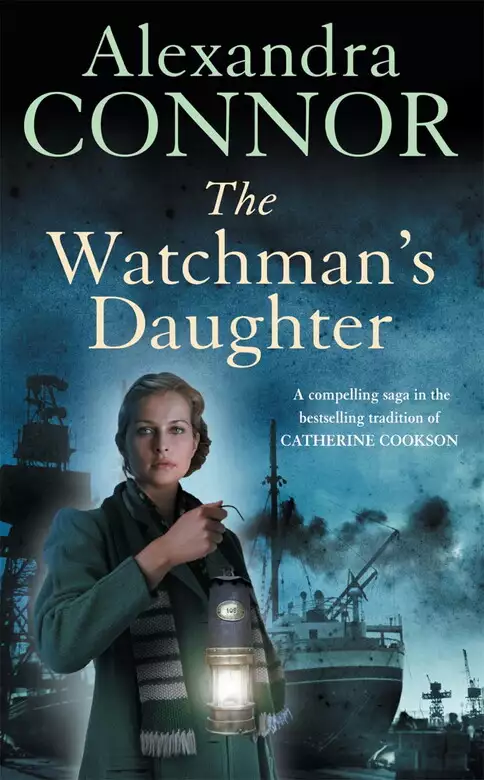
The Watchman's Daughter
- eBook
- Paperback
- Hardcover
- Book info
- Sample
- Media
- Author updates
- Lists
Synopsis
When those you love depend on you, how much would you be willing to sacrifice?
Alexandra Connor writes a moving saga in The Watchman's Daughter - a tale of true love, set against the backdrop of the Second World War. Perfect for fans of Josephine Cox and Rita Bradshaw.
Growing up in Preston's poorest area, Kate Shaw knows just how harsh life can be. With her father unable to do his night watchman rounds, Kate does all she can to help her family survive. But when Andrew Pitt comes into her life, everything changes. True happiness seems to be on the horizon for Kate as she and Andrew make plans to marry. Then tragedy strikes and Kate takes the only course she can to protect the people who depend on her. With her future looking hopeless, Kate must find a way to escape - and to get back the man she loves.
What readers are saying about The Watchman's Daughter:
'I am addicted to Alexandra Connor books. Always so well written, drawing you into the story and characters but never letting you totally guess the story line, always little twists and turns, totally enthralling'
'This book held your attention all the way through. Fantastic book'
Release date: February 4, 2010
Publisher: Headline
Print pages: 448
* BingeBooks earns revenue from qualifying purchases as an Amazon Associate as well as from other retail partners.
Reader buzz
 Please log in to recommend or discuss...
Author updates
The Watchman's Daughter
Alexandra Connor
Their father, Jim, exchanged a knowing look with Silky, his brother, then glanced back to the heavy-jawed man.
‘Ah, come on, Ivan, have another drink first.’
‘I don’t hold with drinking,’ Ivan replied sanctimoniously. He was the puritan of the family, the one who thought it his duty to be the moral arbitrator - a trait he had inherited from his grandfather, a man always fiercely judgemental of everyone - including himself. Ivan had few passions in life, except religion and cards. He was good at cards, well known for it, in fact. If he stayed sober. Which he did with everyone but his brothers. With every other man in Preston Ivan never touched a drop, but with Jim and Silky he sometimes relented. And they waited for it avidly.
Slowly Jim slid the beer closer.
‘I’ve told yer,’ Ivan repeated, ‘I don’t hold with drinking.’
‘You don’t have to hold with it; you swallow it,’ Silky replied, the fug of cigarette smoke circling around his dark hair and shadowing his slow-blinking eyes. ‘Come on, relax.’
‘I’m a God-fearing man,’ Ivan replied, his hands shuffling the cards deftly. He could be a right pain, could Ivan, but he was good at the core. ‘A bit of cards is all right, but drinking and smoking’s something else.’
‘Yeah, it’s drinking and smoking,’ Jim replied.
Kat smiled at her father’s wry retort. He might not have Silky’s charm or sensual good looks, but he had a shiny, good-tempered face, to match the good-tempered man he was. Now he leaned over and filled all three of their glasses, the froth of the beer slopping over on to the cards. Murmuring under his breath, Ivan wiped them on his sleeve and resumed his shuffling. From the front of the pub Kat could hear the sound of the other drinkers and the harsh shouts of the landlord throwing out a rowdy customer. But the landlord never threw the Shaw brothers out on a Tuesday night. Not when he got a cut for the use of the back room.
‘Look,’ Kat whispered to her brother. ‘Look, Micky, watch this.’
Straining forward, both of them watched Ivan deal out the cards with a professional’s skill, his hand movements so fast they were almost a blur. Then slowly and purposefully he leaned back, holding his own cards close to his chest. At the same time, Jim pushed the beer even further towards him, while Silky took a long, even swallow of his own drink.
‘I can see yer’ve a good hand.’
‘I never!’ Ivan snorted. His half-brothers exchanged a glance and watched as Ivan reached for his drink. It was the giveaway sign, the one they waited for. The movement that said, I’ve got the winning hand. Together they watched Ivan drink. Outside the door the two kids watched. They all watched, holding their breath.
‘Your call,’ Silky said, as Jim finished off his pint and lit another cigarette. Clenching it between his lips, he closed one eye against the rising smoke and jiggled his foot impatiently. The atmosphere in the cramped back room was becoming thick with smoke and the smell of beer, the landlord’s shabby fire in the grate peering blearily through the smog.
‘Watch this, Micky,’ Kat said again, nudging her brother.
Ivan was trying so hard to cover his excitement that his mouth dried and he took another drink. And everyone knew that Ivan couldn’t drink . . . His long, bony-jawed face flushed with the hit of the alcohol, his mouth working overtime as he talked to himself in a muted whisper.
‘Make yer move,’ Jim said, hustling him.
‘Come on, Ivan,’ Silky joined in, knowing that the only way they would get so much as a farthing from their parsimonious brother was to get him pissed first. ‘Make your play.’
The tension made Kat take in a breath as she watched her father and uncles. The whole scenario - the pub’s back room, the cigarette smoke, the beer, the well-handled pack of cards - enthralled her. She was suddenly propelled from the humdrum life of school, poor food, bad weather and no money, and transported into this glamorous, exciting little cocoon. She knew the familiar sights and sounds of the pub - they lived next door, after all - but that evening everything seemed changed. Her father and uncles weren’t working-class Preston men in a back street drinking hole; they were worldly figures from a story. Mississippi gamblers like she had heard about in school. They weren’t in a grim pub; they were on the river, with the sound of cicadas and water lapping in the slushy night . . . Mesmerised, Kat cast Silky in the role of handsome hero, her uncle’s flashy suit from the market turned into a silk dinner jacket. Even Ivan became another man: cunning as an alligator, a man no one would mess with. And of course her father had the starring role, the good-natured, prosperous bar owner, riding the waves of booze and money and good humour.
Peering through the gap in the door, Kat watched them, laughing silently with them when Ivan began to sing off key, Jim refilling his glass and Silky taking an obvious, over-dramatic look at his cards. They were all tipsy, giddy with smoke and beer, in good spirits, Ivan finally slamming down his cards and Silky scooping up the few shillings on the table with triumphant ease.
Aware that they could be discovered at any moment, Kat hurried Micky home. Creeping through the back door, they made their way upstairs, Micky slipping into the room he shared with his older brother, Billy. Back in her own room, cold and shivering, Kat huddled under the bedclothes. Sighing, she closed her eyes, remembering what she had seen and recalling everything, detail by detail. Her father and her uncles playing cards. Three brothers who had survived the Great War, done their fighting and wanted to relish the peace. Three brothers getting smoky lungs and drunker by the hour.
It was a memory she would never forget. Long after the family was ripped apart, long after booze became something she feared, long after the back room of the pub was closed. In her mind she held the image of the three men laughing - and the sound ghosted down the years like a friend.
‘Bugger,’ he said, shaking it vigorously.
It stayed out. He shook it again, watching as a weak beam gradually illuminated the uneven ground in front of him. Satisfied, Jim moved ahead, holding the light at shoulder height. He knew this patch of the Albert Edward Dock as well as he knew his own living room, but it paid to be able to see where you were going. There were too many bloody shadows and too many flaming surprises to be caught out.
Pausing, Jim listened to the slow lap of the tide, only a couple of yards away from his feet in the dock below. He liked water, thought there was something poetic about it. Even this water, slimy in summer and freckled with dock rats the size of Jack Russells. You could get some space in your head when you were near water, Jim thought, remembering Missie Shepherd again.
It had been his daughter’s fifteenth birthday. Katherine - Kat to everyone - had walked with him to the bottom of their street, and then waited until her father had disappeared out of sight before going home. Jim knew only too well that if you worked as a nightwatchman on the Preston docks, you had to make time for your family. Make sure you saw some of their growing up or before you knew it they were older and tougher and had no time for you . . . She’d made such a fuss of him that day, getting all excited about a little trinket box he’d bought off the market.
‘Oh Dad, I love it!’ she had said, throwing her arms around him, all ivory prettiness. ‘It’s just what I wanted!’
If she had known it was cheap, she hadn’t said. Not that she would have done, not Kat. Too careful of people’s feelings, especially his. Delighted that he had pleased her so much, Jim had gone on to work. And if he had stopped off on the way at The Dutchman’s Arms, who cared? It had been a bloody cold night; surely no one could have blamed a man for getting the blood moving around his veins? You needed something to keep out the winter chill when you had to walk round the freezing docks until six the next morning. And if the pint had been followed by a couple more, so what? It had hardly made a dent on his thirst, let alone clouded his judgement.
So with the pints inside him and buoyed up with Kat’s delight at his gift, Jim had moved from The Dutchman’s Arms to the docks. His round had begun as it always did, in the gloomy little office by the first warehouse. Office, Jim thought bitterly. What bloody wag had christened it that? It was little more than a rat hole, with its dank fire, mean little window covered with a damp spotted blind, and one third-hand chair, the horsehair stuffing of which poked into your arse. Anyway, that night - like every night - Jim had signed himself in and checked the rota. His job was simple, if long-winded. He would begin at the bank of massive warehouses, walking round and checking each door was locked, no windows broken, nor any other signs of damage. Particularly the kind of damage the down-and-outs did when they broke in, looking for something to steal, or a bed for the night. When he had finished, he would make his mark on each door jamb with chalk. That way his boss knew that all the warehouses had been checked. Then he would progress further into the docks and on to the quayside. Here he was looking for drunks - whom he then moved on. Sailors too pissed to find their way back to their ships on their own, or men who had got into fights and were stumbling around trying to get their bearings. Although not a big man, Jim was tough and took no nonsense. Occasionally, though, even he was unnerved.
Like the time he had checked Quay 14 and found a man hanging from a wire noose over the side of a docked ship. The vessel had been Norwegian, the captain assuring everyone that the man had committed suicide - but Jim was never convinced. He had heard a commotion in the minutes before he found the body, panicked cries silenced suddenly in the dark. When the light from his lamp had struck the body, it was still swinging eerily in the winter night. And besides the crimes, there were the accidents. It wasn’t uncommon for bodies to be washed up in the dock. Men and women on their uppers, poor, sick, or too drunk to fight the tide after a fall. Then there were the deliberate suicides, people who had chosen to drown - probably somewhere a long way from Preston. For weeks, sometimes months, their bodies had ridden the tides, and finally came to rest at the Albert Edward. Jim had seen them washed up on the silt. Often they were too decomposed for him to tell if they were male or female; frequently they were naked, the water having stripped them with its relentless ebb and flow.
Purposefully Jim walked on, putting the thought out of his mind. He would check the quaysides, make his mark on the anchor hold, then return to the hut and tick off the warehouses and quays in the ledger. The whole process would then be repeated at three in the morning and again at six, just before he finished his shift and Stanley Cunliffe came on for the day watch. Jim thought about the sweaty, thick-necked Stanley and what a bastard he was; always taking backhanders, creeping around the ships’ captains for favours and bullying everyone else. Like Missie Shepherd. Not much older than Jim’s own daughter, Missie had been whoring on the docks for over a year. Jim always turned a blind eye. Not like Stanley, who moved her on with a quick slap, or a jab in the ribs if she was sleeping it off. Jim hated cruelty, and tried to compensate. Couple of times he had even given Missie Shepherd a bob or two, told her to get herself a proper job. But a week later she would be back.
In the daytime the Albert Edward was a rough place, but at night, the dark, dangerous docks were no place for a woman - even a working whore. Jim had lost count of the times he had tried to tell Missie to stay away.
‘But there’s always good trade ’ere,’ she’d tell him.
‘There’s a lot of villains too. Stay off the docks, luv. Some bad types here.’
‘Yer not bad.’
Only a few days ago he had caught her leaning against one of the warehouse walls pulling down her skirt as a docker ran off, doing up his trousers. More concerned for the girl than embarrassed, Jim had walked over to her.
‘Jesus, luv, I saw yer hours ago. Have yer been here all night?’
Resigned, she had shrugged. ‘I got thrown out of me lodgings yesterday. If I don’t want to sleep rough, I’ve got to get the money fer rent.’
Sighing, Jim had studied her. God, if it been his daughter, his Kat, lifting her skirts to keep a roof over her head . . .
‘What about family, Missie? Have yer got no one?’
‘Nah, no one . . . Me mam’s dead, but she never said much about me father. Only some rubbish ’bout him being a big shot.’ Missie had paused, her head turning in the direction of one of the dockside pubs. It had been closing time; soon the sailors would be weaving their way back to their ships. Rich pickings for a working girl. ‘Got to go now,’ she said hurriedly, then added, ‘Thanks, Mr Shaw. Yer’ve always treated me right. I’m obliged to yer fer that.’
His thoughts returning to the present, Jim started as one of the great hulking ships at the dockside creaked mournfully in the wind, the anchor chain knocking against the stone siding. But from inside there came no sound. The crew were off for the night; those who remained on board were sleeping. In the morning they would unload the vast stacks of timber on to the quayside, to be transported to the Preston factories or further inland for building work - but in those silent night hours the crew slept on, rocked on the lapping water of the northern dock.
Weaving momentarily on his feet, Jim realised that the cold air mixed with the beer was making him slightly light-headed. Whistling, and trying to kid himself that he was sober as a Cheshire magistrate, he moved on. But rounding the furthest end of Warehouse 17, he nearly tripped over a hump of discarded rags. Muttering, he held the torch towards the bundle. Missie Shepherd was sleeping rough. Obviously she hadn’t made enough money for the rent that night.
‘Hey now, Missie, come on, luv. Yer’ve got to move.’ Jim leaned down and touched her shoulder. ‘Come on, luv, wake up.’
She didn’t respond. Obviously the worse for wear, Jim thought sympathetically, his own head beginning to thump. But when he touched her shoulder for the second time, Missie suddenly rolled over on to her back, landing with a muffled thud. Surprised, Jim held the light higher. Her throat was cut, severed from ear to ear. Missie Shepherd would never work the docks again.
And neither would he, Jim had realised in that instant. If he called for help, people would smell the beer on his breath and that would be the end of the watchman’s job. The end of security, end of regular money. Jesus, he had thought, wiping his mouth with the back of his hand. What the hell was he going to do? After another moment’s hesitation, he reached down and felt for a pulse. Instinct told him that Missie Shepherd was dead, but he was hoping that she wasn’t. That by some miracle he could help her to her feet and see her off and no one would be any the wiser.
Her wrist was hardly more than a winter twig in his hand. His lamplight fell on the pool of blood around her body and seeping into his boots. Breathing heavily, he tried to calm himself.
‘Steady, lad, steady now.’ He had shone the lamp around, searching the shadows, then looking back to Missie. ‘Aye, luv, yer were warned often enough. The docks are no place fer a girl. No place at all.’
And then he had thought of his girl, his Kat. Around the same age. God Almighty, what if it had been her? Another thought followed on immediately. Was the killer still out there? Relax, Jim urged himself, no one was after him. It had probably been some customer Missie had short-changed. A madman with a knife was the least of Jim’s worries. Stepping back, he fought a different kind of panic. Should he pretend he hadn’t found her? After all, poor Missie was beyond help, and if he didn’t report it he wouldn’t be involved. Wouldn’t risk being found out drinking on the job. A hard but decent job. He thought of Anna, his wife, and of his mother, Ma Shaw. Jesus, he couldn’t bugger up now, not with a family to support. Jim sighed desperately. He had lost too many jobs because of drink. Damn near lost the roof over his family’s head a couple of times. But that was in the past. Well, nearly . . . His conscience pricked him. If he was honest, sobriety had been temporary. For a year he’d stayed off the booze, but eight weeks earlier he had stopped by The Dutchman’s Arms to give a message to Captain Taylor. The Captain, a fair sort of a bloke, had offered Jim a drink, not taking no for an answer . . . That drink had tasted so good, bringing with it as it did a rush of confidence, a swift pushing away of problems. With each mouthful Jim shrugged off Amber Street and the burden of rent; his elder son’s contempt; Anna’s worrying health and his mother’s insidious nagging. By the time he was two thirds down the glass, Jim was happy and at peace with the world.
It wasn’t going to last.
Blinking, he stared at Missie Shepherd again. He would move the body. No, he thought, he couldn’t do that. Then what should he do? Wiping the back of his hand across his mouth, he fumbled for a solution. He would do his round of the warehouses and dockside, then come back and pretend he had just found Missie. Yes, he thought eagerly, that would work. The cold air would have sobered him up good and proper. By the time he went to report the murder, no one would be able to tell that Jim Shaw had been drinking on duty.
Casting one last look at Missie, Jim hesitated. He couldn’t in all honesty leave her exposed like that, not for the dock rats to find. Tenderly he took off her shawl and laid it over her face. She wasn’t much more than a kid. What a hell of a way - and place - to end up . . . A sudden noise made Jim flinch. Automatically he turned out the lamp and shrank back into the shadows. Was there someone still out there? The same man who had butchered Missie Shepherd? His heartrate accelerated, his mouth drying. Slow footsteps were approaching Warehouse 17. Jim moved backwards hurriedly. He had the advantage of knowing the docks and could move quickly, even in the darkness, skirting Warehouse 17 and making for the office. Inside he would be safe. From any danger - or any questions.
Closing the office door behind him, Jim peeked through the window. In the distance he could see a man walking around the side of Warehouse 17 - and coming straight for him. His mouth dried. The figure keeping walking. He could feel his body begin to shake, and then realised - with queasy relief - that he knew the man.
‘Yer bloody fool!’ Jim hissed to himself, going to the door and beckoning for his brother to come in. ‘What yer doing, Ivan, creeping around out there without a light?
‘What were you doing? Running off like a bleeding criminal?’ Ivan replied.
Striking a match, Jim relit the lamp, then studied his visitor. Ma Shaw had been married twice: first to Jim’s father, then to Nobby Lomax, a club-footed hobgoblin of a man from over Huddersfield way. No one knew why she had chosen such a weird consort. No one dared ask; and when he died soon after Ivan was born, he was forgotten within months. But if Ma Shaw had expected his son to be like his father, she - and everyone else in Preston - had been in for a shock. Ivan had taken after his grandfather. A big child, broody, with a sanctimonious streak. By the time he had reached fifteen and begun working on the docks, he had honed his curtness to perfection. He had a good heart, but - God only knew why - he couldn’t show it, his concern always coming over as criticism.
‘Yer’ve been drinking!’ he snapped suddenly at Jim. ‘Yer going to be sacked fer that. Then think where yer’ll be. Yer’ve got to be more responsible, Jim. Or, like Ma says, drink will be the end of yer. Yer’ll be out on the bloody street, that’s where yer’ll end up. Yer family desperate, no money, no roof over their heads. And all because yer can’t stop drinking. The boss will have yer fer this . . .’
‘Not if yer keep it quiet,’ Jim said hurriedly, appealing to his half-brother’s better nature. ‘Ah, come on, Ivan . . .’
‘I don’t hold with drinking,’ Ivan replied. He had been a member of the Temperance League since his teens. ‘Yer should have more willpower.’
‘Ah, piss off,’ Jim replied, out of patience, as he filled the kettle and put it on to boil. ‘Yer a stuffed shirt, Ivan, and no mistake.’
‘I know my duty. And I know yer. Just like Ma does. She knows yer fer what yer are, and always has done.’
Tensing, Jim waited to see what his half-brother would say next. Ivan was looking smug that he had something over Jim. Something he could harangue him with. And when he’d finished predicting doom for Jim’s family, then what? Would he report him? Jesus, wouldn’t that be just like Ivan? Reckoning that he was doing Jim a favour, saving his bleeding soul. No wonder Ivan had never married or had kids, Jim thought ruefully. What woman would want him?
‘By rights I should tell Mr Fleetwood,’ Ivan went on. After all, it would be the responsible thing to do. And the right thing for his brother. Maybe not a decision that would make him popular, but life was hard, and if Jim was going to get back on the straight and narrow, maybe it was worth putting a fright on him now.
‘Hey now, Ivan, let’s not be hasty!’ Jim replied hurriedly. ‘I need this job.’
‘But not enough to stay sober.’
‘I found a body,’ Jim said suddenly, watching with satisfaction as Ivan’s face grew waxy.
‘A what?’
‘Missie Shepherd. Round the back of Warehouse 17.’
‘She’s a prossie!’
‘She was a prossie, poor soul,’ Jim said, feeling no compunction about lying. ‘That’s why I had a drink, Ivan, I had to steady my nerves. Finding her like that, with her throat cut. And God knows if the murderer’s still out there.’
Ivan looked queasy. ‘Yer think he might be?’
‘Why don’t yer have a look?’
‘Nah,’ Ivan said, white as hill snow. ‘He’ll be gone by now.’
‘Yer right, and besides, he were after the girl.’
‘On the game, what did she expect?’ Ivan went on, shaking his head. ‘No whore can expect to die safe in her bed.’
Seeing how shocked Ivan was, Jim pressed his advantage.
‘That’s why I had to have a drink, to steady myself. Yer understand that, Ivan? I mean, even you can see that finding a dead body would shake up a man good.’ He hurried on, despising himself for having to kow-tow to his half-brother. But if Ivan told the boss, Jim would be fired. Then he would have to go home, tell Anna - and his mother. Jesus, Jim thought, he would lie until his tongue was on fire to avoid that. ‘Yer see how my hands are still shaking? I were in shock.’
‘When did it happen?’
‘Only minutes ago.’
‘Yer should have told Mr Fleetwood,’ Ivan replied. ‘I’ll go and tell him if yer like.’
Jim’s eyes narrowed as he watched his half-brother walk to the door.
‘But yer’ll stay nothing about my having a drink?’
‘I should fer yer own sake . . .’
‘But?’
‘I won’t this time,’ Ivan replied, adding pompously, ‘But if I ever catch yer drinking on duty again, Jim, I’ll report yer. Family or no family.’
‘Thanks, Ivan, I won’t forget yer kindness.’
Oddly enough, people from outside Preston seldom connected the place with seafaring, the dock being sixteen miles inland from the open sea. But for the dockers it provided steady paid work; hard, but out in the open air. Men who didn’t fancy factory work in the mill, or in engineering, went on the docks. Beside, you didn’t need education to be a docker, and most of the men who worked there had left school at twelve or thirteen, following their fathers on to the dockside. And so, around the Albert Edward, a small community built up, with its own shops and pubs. And whores. At night, the dockers went inland; home to the cluttered terraces around Kirkham Street and Fylde Road, where the handloom weavers’ houses stood. Originally workshops, these buildings were later sublet as cellar dwellings and soon became notorious.
From the first, Ma Shaw had been determined that none of her three sons would go into the factory trade - or face the hardship of the living and working conditions. As the cotton trade had thrived, more workers were employed and more and more cheap housing had been thrown up. Housing that was shoddy and insanitary. In fact, at one time, the child mortality rate in Preston was the highest in the country. So bad were the conditions that the average age of death was around eighteen years, with people squeezed like rats into a labyrinth of back streets. The entrances to these euphemistically named ‘courts’ were the sordid alleyways off the main streets. And the worst housing had been around Lower Friargate, along Church Street and the notorious Glovers Court. If you ended up there, you had nothing much - and nothing left to lose.
By comparison, the Shaws weren’t too badly off. They struggled and fretted about the bills, but they had escaped the bull pits of the slums, just edging on to one of the poor but respectable areas. Not in the cauldron, but within reaching - or falling - distance. And the memory of what was only streets away had kept Ma Shaw on her toes throughout her life. Equally perspicacious, Silky ran a tattoo parlour but had always turned away the worst drunks and the dirtiest whores. ‘Get sober and come back,’ he would say to the drunks. And to the roughest whores: ‘Just get out.’ As for Ivan, he was too fastidious to let himself slide into the rapacious viciousness of slum life.
Jim, however, was another matter. His mother’s dread of the slums didn’t extend to him. Blithely believing that he and his family would never end up there, Jim took chances a wiser man might have avoided. For periods conscientious, he would then be suddenly reckless and go back on the booze. And after the first drink, he couldn’t stop. If Anna had been a less forgiving wife, she could have put her foot down, but she believed in her husband, believed that he would never let her down. Even when he did, she gave him another chance. After all, without him, where would she have ended up? In fact, although Anna should have worried more about her husband, she was only really concerned about Billy, nicknamed Billy Fists around Preston because of his boxing ambitions.
The amateur pugilist was at that moment avoiding Ivan’s dour gaze as he pushed a cartload of timber over to the warehouse on the dockside. Billy couldn’t stand his uncle and made it obvious; Ivan was making it equally obvious that he thought Billy was a rough-head. Unloading some of the Russian timber, Billy wiped the sweat off his forehead and looked upwards. Later he would work off his extra energy at the gym, the owner even suggesting that he might make a professional boxer one day. Billy sighed. On either side of him were banked the bales of wood, a crane moving overhead as it swung another load on to the dockside. The early sun was shining mercilessly, throwing hot shimmers off the water and flattering the Albert Edward into some mockery of a northern Venice.
Leaning against the nearest wall, Billy rolled a cigarette. He was thinking about the unnatural heat and getting uncomfortable as sweat pooled under his arms. Then he thought about Jane Rimmer and felt his temperature rise even further. God, she was a looker all right, and she knew it. Billy smiled to himself. He had quite a girl, quite a girl. One most men would like to see on their arm. Mind you, Jane was a handful; she liked the good things and didn’t pull her punches.
‘If yer want to keep me interested, Billy Shaw, yer need to spoil me,’ she had said only the previous night.
‘I do spoil yer! I took yer to the pictures on Friday.’
She had squeezed the well-developed muscles in his left arm. ‘Took me to see a cartoon! Not that Popeye’s got anything on yer, Billy. Yer the best-built man in Preston,’ she had teased him, winking, the sexual innuendo just under the surface. ‘In fact, there’s not another man with what yer’ve got.’
Grabbing hold of her, Billy had kissed her, Jane pulling away, pretending annoyance. ‘Aye now! Yer can’t take liberties.’
‘I thought yer liked me taking liberties.’
‘I like yer taking me out as well,’ she had replied crisply. ‘But yer mean, right mean, Billy Shaw. Surely yer don’t have to give all yer wages to yer mam, do yer?’
He had felt the implied sneer and flushed. ‘Cut it out, Jane! Families round here pools their wages, yer know that.’
‘I were just teasing. Just having a bit of fun . . .’
Like hell, Billy thought, taking a drag on his cigarette. Jane liked to push him as far as she could. Liked to torment him. And it suited him - for a while. He had never been short of female attention, his obvious masculinity and hint of a future boxing career turning certain girls’ heads. They liked the toughness of Billy Shaw - and he played on that.
Suddenly spotting his uncle across the dock, Billy watched Ivan Lomax critically. Now what did that bastard spend his money on? No wife, no family, just himself to keep and the rent to pay on his poky rooms. Didn’t even drink - and unl
We hope you are enjoying the book so far. To continue reading...
