
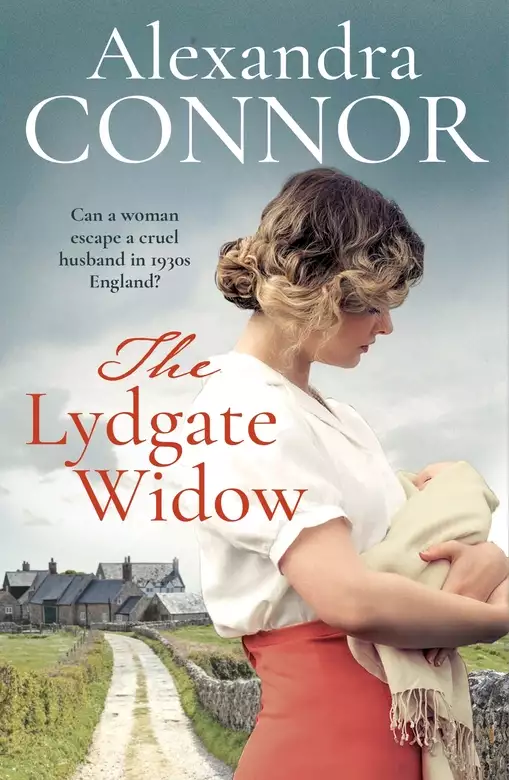
The Lydgate Widow
- eBook
- Paperback
- Hardcover
- Book info
- Sample
- Media
- Author updates
- Lists
Synopsis
Life has been hard for Adele Ford. Will she ever find the happiness she deserves?
Alexandra Connor writes a moving saga in The Lydgate Widow, the tale of a young woman facing unbearable heartache, and her ultimate triumph over adversity. Perfect for fans of Rita Bradshaw and Catherine Cookson.
Adele Ford's clearest childhood memory is of her father telling her about the enigmatic Lydgate Widow, whose abandoned house dominates the village. But the stories end abruptly on the day Adele and her sister are orphaned, and they grow up with only each other to rely on.
Adele finds work in an antiques shop, but when a wrongful accusation robs her of her reputation, her future looks bleak. So it's not hard for Col Vincent, a successful businessman, to persuade Adele to marry him. Adele grows to love him - until she realises that her husband is a violent man. In the 1930s, a woman who leaves her husband faces penury. Somehow Adele survives, and then news comes that will transform her life, bringing back the haunting memory of the Lydgate Widow - and the man who has loved Adele for decades...
What readers are saying about The Lydgate Widow:
'Thoroughly enjoyed this book... a brilliant ending that binds all characters together. This is the first book that I have read by this author, and it won't be the last'
'A superb read - five stars'
Release date: February 4, 2010
Publisher: Headline
Print pages: 448
* BingeBooks earns revenue from qualifying purchases as an Amazon Associate as well as from other retail partners.
Reader buzz
 Please log in to recommend or discuss...
Author updates
The Lydgate Widow
Alexandra Connor
Then she heard a thump, a dull, waxen thud of fist on flesh . . . Her teeth bit down harder on her lip, drawing blood. Think about something else, she willed herself. Think about something else . . . The blackamoor, she liked that. And the painting of the Chinaman her father had paid too much for at auction. The heavy feet echoed terrifyingly overhead. Oh God, Adele screamed inwardly as they descended the steps. Oh God . . . She huddled back against the wall, scrunching her six-year-old body into a tidy, hidden parcel of flesh.
‘Wait here,’ her mother had told her only moments before. Keep quiet.’
She couldn’t be more quiet.
But it wasn’t quiet outside. On the other side of the cupboard door she could hear a muffled scream, followed by her father’s voice.
‘You drive me crazy! You make me crazy!’ Then, suddenly, his voice petered off into silence.
What was happening?
‘Victor,’ Adele heard her mother say quietly, soothingly, ‘it’s OK, it’s OK. We can sort it out.’ She wasn’t frightened any more, Adele could tell that. She was back in control. ‘Darling, come on, come on,’ she coaxed him, comforting the man she adored. The man who adored her. ‘Victor, go upstairs and lie down.’
There was a long pause. Adele screwed her eyelids even tighter. This was worse than the screaming. This pause, extending too long and too eerily. What was happening? Would the cupboard door be snatched open suddenly to drag her out? God . . . she thought helplessly. God . . .
Then she heard her father’s voice again. Not violent any more. Tender, muffled.
‘Jesus, Lulu, Jesus . . .’
She could imagine his face pressed against her mother’s shoulder.
‘I never meant . . .’
‘I know, Victor,’ her mother said gently, ‘I know . . . You’re overwrought, darling. Go upstairs, get some rest.’
‘I didn’t mean to hit you . . .’
‘Sssh, it’s forgotten. I love you, Victor.’
‘I love you too,’ he replied desperately.
‘We love each other. Always and always,’ Lulu went on, her tone almost hypnotic. She was curbing his violence with tenderness. ‘You and I, always together. The two of us . . . Now, darling, go and lie down for a while. Rest a little. And forget what’s happened.’
Crouched inside the cupboard, Adele was still shaking and utterly confused. How could everything change so suddenly? From being terrified, her mother was now calm. From being violent, her father was now mild. How could it happen? How could anything change so quickly? A moment later Adele heard her father’s footsteps going upstairs. Ascending the steps over her head as she cringed in the cupboard below.
Then followed the closing of the bedroom door. A moment passed. Another. Then finally the latch of the under-stairs cupboard lifted. Automatically Adele cowered further back.
‘It’s all right, sweetheart . . . Your daddy was just ill, that’s all.’ Leaning inwards, her mother reached out to her, her figure silhouetted against the light of the hall. ‘Come with me, little one, come on.’ She took Adele’s hand and pulled her out into the daylight. Terrified, Adele studied her mother’s face; swollen, liver-coloured on one side.
‘Mum!’
‘It was nothing, sweetheart,’ she said reassuringly. ‘Nothing to worry about. Your daddy wasn’t feeling well. But he’s fine now. He loves me very much, Adele. He loves us all. But sometimes he gets all worked up.’ She stroked her daughter’s cheek. ‘You’ll understand, when you’re older. Love does strange things to people. They hurt the ones they can’t be without . . . Don’t be scared, Adele, please. Nothing’s changed. Nothing at all.’
Which was when Adele realised that adults - even the ones you loved the most - could lie to you.
But July came, then went, and Victor was still home. The medical report had cleared him. Which, by rights, was fair. After all, he had had an ankle deformity since childhood and wore an iron brace. The fact that the vain Victor had managed to hide his handicap so well had worked for him in the past, but not now. Now it seemed that he was getting away with something, and irritated by people’s assumption that he was draft dodging, he hoisted the bottom of his left trouser leg at the slightest provocation.
‘Look!’ he’d say to the dealers, or the market traders. ‘That’s why I’m here. I can’t fight with an iron on my leg.’
Not that he really wanted to fight. Not when the images of the Somme and the photographs of injured soldiers were splattered regularly across the front pages. He listened to the reports on the radio and seemed to hear daily about some family’s loss. A complicated man, Victor was torn between guilt and relief and tried to assuage his conscience the only way he knew how - by making many and various gestures of help to the bereaved.
People who had been suspicious of the flamboyant Victor Ford now saw him in a different light. He would - unexpectedly - come calling at some stranger’s house and give them something. Some object he had got at auction or off the markets. For your son . . . your father . . . he would say, hurrying off, knowing that they could sell it on. It was odd behaviour, typical of his extravagant nature, and it made an unexpected hero out of him.
Street angel; house devil. Wasn’t that how the saying went? And at first it was never more true of anyone than Victor Ford. But as time passed his public concern took precedence over his private rages, Lulu encouraging his generosity, shoring up his self-esteem. Before long, The Coppice had a saint in the making. Only Lulu realised how he struggled to control his temper. Weeks would pass quietly, and then some random word or action would spark an inferno of violence.
She loved him because she knew how hard he tried to keep himself in check. He idolised her because she loved him enough to forget.
And yet, to many people, living on The Coppice was no mean achievement. A road of neat semi-detached houses with back gardens and plenty of trees. The sooty smog of Oldham was within walking distance, the abject poverty of Salford not that far away. But The Coppice was respectable, with nice neighbours and net curtains. And residents who didn’t go out in curling rags, spit in the street, or steal. It was the kind of road that the slums looked up to, and the well-to-do on Park Road could mildly patronise.
Sighing, Adele glanced over at her parents. Two years had passed since she had witnessed that terrible fight, and it was as though it had never happened. The Ford family behaved exactly the way they had always done. Loving and affectionate. In fact, as Adele watched her parents, Victor kissed his wife on the cheek and tickled his elder daughter, senior to eight-year-old Adele by ten years. It was all perfect. Or so it seemed to everyone, except her. Nothing had been the same since that night, and although Adele loved her parents as much as she had always done, she remained baffled by their marriage.
Julia was immune to any ructions within the family. If she knew about the violence, she had never mentioned it to Adele. She either lived in ignorance or colluded with their parents; either way, she didn’t confide. After all, her sister was too much of a baby, whilst she was grown up, already eighteen.
Watching her sister as she reached for a book, Adele leaned back against a tree. It was warm, the sun high and hot, the tree branches swaying in time to the breeze and the marching tune from the bandstand in the distance. For a moment it seemed possible to forget the war, to imagine the world as it had been before the outbreak of hostilities. But the sight of a uniform reminded Adele of reality; a soldier sitting with his girl on a park bench, snatching a few hours before he would go off to fight again.
Feeling sleepy, she tipped her sunhat over her eyes, her parents’ voices low and intimate, an unintelligible murmur.
Her name wasn’t really Lulu, she was called something else entirely, but for years he had referred to her by that name and now she had no other. Snuggling against her husband, she turned her face upwards.
‘We have a home here,’ she replied, not unreasonably. ‘Why move? Think about it, Victor, there’s a war on, we can’t up sticks now.’
But the thought stimulated her; kept away the threat of impending boredom. She loved Victor Ford for many reasons - one of them his reckless streak. His terror of monotony, which coincided so perfectly with her own. Real life was dull and both of them dreaded melancholia. They thought alike, felt alike, were so much a part of one another that separation would have meant the death of both. ‘Just think about it,’ Victor murmured, laying his head on her lap.
For years they had lived on the meagre inheritance from Victor’s father. Along the way Victor had indulged his love of antiques and curiosities, making a modest fortune sometimes; making a fool of himself at others. Lulu’s work as a part-time cook helped, even though her ability was never up to her ambition. But when Victor’s parents died and they inherited a tidy sum, the Fords took their biggest gamble to date and bought the house on The Coppice. The trouble was keeping it.
‘Lulu? What are you thinking?’
She hushed him, her thoughts running back over their life together.
Being careful had never been their style. Their recklessness should have been followed by ruin, as night follows day; but they had been lucky. And luck had always come just when it was most needed. If they ran out of funds, Victor made a sale. If they lost money on one purchase, he would recover it - twice over - on another. The sums had never been huge, but it had been the excitement that counted. The certainty that there was no certainty. The luminous pull of the risk.
Flanked by a teacher on one side and a bank manager on the other, the house on The Coppice had told everyone the Fords had arrived. But fitting in was another matter. Lulu hadn’t been interested in the other wives’ chats and visits to the Mothers’ Union, and Victor had had no time for pubs or church. Instead, on many a Sunday morning, the neighbourhood had been treated to the sight of Victor unpacking boxes from the back of his car. His car, the first in the area. The one he only ran when he could get a ration of petrol. Which wasn’t often.
As so many said, ‘Typical! It’s all show with the Fords.’
But they were jealous. Everyone stopping to stare at the little car - as they stared at its occupants. Victor, polished and attractive, Lulu in her best clothes, glamorous on a shoestring. No one knew her clothes were cast-offs from the wealthy Jewish women in Southport and Lytham St Annes; no one needed to know that her exquisite boots were stuffed with paper at the toes to make them fit. It was the impact of their appearance that mattered, not how it had been achieved.
But now times were even tougher. It was wartime, after all, and people had more important things to think about than bric-a-brac. Which was not to say that there weren’t private sales still to be made. Widows who had fallen on hard times, families selling off possessions to keep a roof over their heads. They were more than eager to sell to Victor Ford, and he was always generous with his payments. It was a hard way to make a living, but Victor - for all his lofty ambitions - was a grafter.
Lulu stirred suddenly, Victor’s head heavy on her lap. ‘If we did move, where would we go? The girls are settled in school here, we shouldn’t really move now. I mean, it’s wartime . . .’
‘The war can’t go on much longer!’ Victor replied brusquely. ‘The soldiers will come back and then where will we be? We should move now, whilst we can. Go down south, maybe. We could settle anywhere, and the girls would like a change.’
He knew it was selfish to uproot his daughters and leave The Coppice, but lately his forays had led him further and further afield in order to find anything worth having. Burnley, Leeds, Halifax.
‘We could buy a shop. No one else would want to buy a shop in wartime.’
‘You said the war was going to be over soon . . .’
He tensed. ‘What’s the matter? You don’t like my idea?’
Lulu winced. The idea was intoxicating, and frightening. But more frightening was crossing her husband when he had that edge to his voice. Smiling, she stroked his forehead. If she was careful she could coax the temper out of him. Draw the violence out as effectively as lancing a boil. After all, Victor had a right to be exasperated, frustrated at not hitting the big time. He was just as smart as the top Manchester dealers, but he had never got the big break, the major sale.
The reason was obvious to everyone but Lulu and Victor. There was no point hoping to sell a silver candelabra in Oldham. Or a stuffed deer head in Bolton. If she had reasoned with him they could have made a better business. But Lulu didn’t want to reason. She was absorbed by her husband, sexually fascinated by him, too much a part of him to think for herself. She loved Victor, as Victor loved her - both of them stuck in a gluey web of fantasy and hope.
‘You’re right, darling, we could do anything. You know how much I believe in you.’
‘We have to get a break soon,’ he said, rapidly soothed.
‘It could happen any day now.’
‘Any day.’
‘You just carry on, darling,’ she mollified him.
‘We’ll show them,’ he said, taking her hand and kissing the palm. ‘We’ll show everyone what we can do.’
‘Of course we will. You’ll see, Victor, we’ll get what we deserve in the end. We’ll make it. We’ll surprise everyone.’
‘I never.’
‘You did!’ Mrs Redfern snapped back, her eyes bulbous behind her glasses, a faint moustache on her top lip. All those bridge parties, Lulu used to say, you’d think she’d look in the mirror now and again. ‘You were swinging on a branch.’
‘Only the one that comes over our side,’ Adele replied, remembering what her father had said. ‘Dad told me it didn’t matter if it was on our side.’
Mrs Redfern flushed. ‘I don’t care what your father might or might not have said. It’s what I say that goes.’
Stunned, Adele moved off, Mrs Redfern calling after her. But she wouldn’t stop. The woman was a bitch - hadn’t Julia said that? Head down, Adele turned the corner and began to trail a stick along the railings of another garden, ruffling the azaleas behind. The rainwater fell from their petals and mottled the stonework underneath. Everyone was against her. Mrs Redfern; her teacher, Miss Egan - and now she had detention. Again.
Slowly Adele walked back into the playground of St Luke’s. The girls at school had been teasing her, mocking her father.
‘Everyone knows he sells on the market, even though he pretends to be a dealer . . .’
‘My mother said he was a knocker . . .’
‘Isn’t fighting in the war, though, is he? Pretending he has a bad leg, dragging that leg iron around when everyone knows it’s a fake . . .’
That last insult had been too much for Adele. Without hesitation, she had struck out at her tormentor and sent the girl falling backwards into the watching group. Ten minutes and a cut lip later, Adele had found herself in trouble. All booked up for detention. And why? Because a girl from The Coppice shouldn’t act like a slum child.
‘They were saying things about my father—’
Miss Egan cut her off short. She had - like everyone else - heard the rumours. The Fords were little more than a laughing stock, for all their airs and graces. But Adele was different, a mature eight year old with a good head on her shoulders. Which was more than could be said for her sister . . . Miss Egan considered the attractive, rather vacuous Julia. A determination to marry was her only ambition in life. Or so everyone thought. But was there something else under the marshmallow coating, as Miss Egan suspected? Some sliver of well-disguised steel?
‘Adele, you have to listen to me,’ Miss Egan went on. ‘Fighting is not the way to sort out your problems. It’s unladylike, common. Only rough children fight.’
An old memory rattled inside Adele. She wanted to say, ‘You’re wrong. All sorts of people fight.’ But she held her tongue. You didn’t talk about family. Or family secrets.
‘You have to use your wits in life, not your fists. Use your intelligence, Adele, if you want to get on. You want to be someone, don’t you?’
‘I don’t know who someone is,’ Adele replied truthfully. ‘My father always talks about being someone, but he never seems to become him.’
Miss Egan blinked, wrong-footed. ‘What I meant was that you want to make something of your life.’
‘My father says that too. All the time,’ Adele answered. ‘He said it last Saturday when he brought home a piano. Said it would bring a fortune and we could all make something of our lives.’
Miss Egan regarded Adele thoughtfully. She was an attractive girl, with large dark grey eyes that seemed to bore into you and read your thoughts.
‘Adele,’ she continued patiently, ‘what do you want to do with your life?’
‘My sister wants to get married.’
‘But what about you? I know you’re only eight, but you’re a sensible child, so I think I can talk to you about such matters. What would you like to do?’
Adele gave the question some thought. No one had ever asked her before.
‘I like things.’
‘What kind of things?’
‘Paintings, furniture. You know, objects, books. Stuff like that.’ She warmed to her theme, encouraged by her unexpected audience. ‘We’ve got a bearskin rug at home.’
Miss Egan’s only brush with a bearskin rug had been in her nude baby photograph.
‘It’s not really a career, though, is it?’
‘It’s my father’s career.’
There it was again, the level, unfazed gaze. Smiling, Miss Egan let the matter go. Adele Ford was very young, after all, no good forcing a child to grow up before their time.
Something else was forcing Adele to grow up fast. Something that had nothing to do with Miss Egan, or careers.
Julia noticed such things; it was automatic for her to measure out people’s lives in terms of their possessions. You could measure out a good job in inches, a nice house in feet, and a marriage in yards. Which was why she wasn’t too bothered about the job she had just begun in Mrs Short’s florist’s. Mrs Short might be stocky, and sometimes too lazy to move, but she was Mrs Short, and in Julia’s eyes that was all-important.
‘Good Lord,’ Lulu said, walking in and tossing the laundry on to the kitchen table. ‘It’s so hot out there.’
‘You should wear a hat.’
‘Not to get in the washing!’ her mother remonstrated, quickly pulling down the cuff of her blouse.
But Julia had already seen it: the bruise. Just as she had seen the others over the years, and chosen to ignore them. If there was something her mother wanted her to know, she would tell her. If not, why poke your nose where it wasn’t wanted or start imagining things? Her mother and father were happy, everyone knew that.
‘Your father and I . . .’ Lulu paused, bending down to pick up a towel she had dropped, ‘are going to an auction tonight. It’s so exciting. Daddy’s seen a particular lot he wants.’ She waited for a response, then hurried on. ‘A washstand. French, your father thinks. And done up, it could bring a pretty profit.’
‘A washstand?’ Julia intoned softly. ‘What do we need a washstand for?’
‘Your father is going to do it up and sell it.’
‘Like the one in the shed?’
‘That was different,’ Lulu replied curtly.
‘It’s a washstand.’
‘But this one is French.’
‘And it needs doing up. Like the other one.’ Julia stopped buffing her nails and shrugged. ‘He’ll never repair it, Mum. You know that.’
‘Of course he will!’ Lulu responded half-heartedly. ‘Your father has a good eye for a bargain.’
‘Don’t let him bid too much, Mum.’
‘He knows what he’s doing.’
Looking away, Julia decided that further intervention would be pointless. The outcome was easy to predict. Her father would bid too high, carried away by the auction, not the lot. Her parents would come home giddy with excitement, going on and on about their wonderful buy. The French washstand would be sighed over and admired - and at the end of three days would be relegated to the garden shed.
‘We’ll be home late, love,’ Lulu went on, making for the stairs. ‘Sort Adele out for me, will you? See she gets a good tea and goes to bed early.’
Nodding, Julia glanced at the clock. Five fifteen. Adele would be home from school any time now and her parents would be gone by seven. If she was lucky she could get her sister to bed and then meet up with John at the corner around nine. She smiled to herself. John Courtland, twenty-two years to her eighteen, blond, tall - and if a little thin, that could soon be remedied by good cooking. As for his character, well, it was perfect for the ideal husband. It wasn’t that he was a complete fool; he was just pliable, eager to please. And dangerously uncertain of his own judgement. Julia frowned. She would have to watch that trait in him; make sure that she made all the important decisions. Make certain no one else got any influence over him. Mollified, she smiled to herself. John might not be a world beater, but he would do for her - and she found him very attractive. Mr John Courtland, soldier, but previously working as a clerk at the County Bank, Union Road, Oldham. A white-collar worker once. And would be again when he got home after the war.
Oh, he would do very nicely, Julia thought, snuggling up to her secret. They might only have been going out for a couple of months, but she was going to marry John Courtland. She thought then of her sister, Adele, catching them the other night when John had come home on leave. They had only been talking, but after a couple of minutes Julia had noticed a faint rustling behind the hedge. Once. And again. Then suddenly she had felt something cold and slimy slip down her collar.
‘God!’ she had shrieked, spinning round just in time to see Adele laughing and running away.
Of course John had been charming and concerned, but all chance of romance was curtailed as Julia had wriggled frantically to get the worm out of her blouse. He had gallantly offered to help. Red-faced, Julia had declined. The worm had then made its way - slowly and inexorably - down her camisole. Finally, panicked, she had dived behind the next-door hedge in the darkness, pulling off her top and shaking the worm into the bush.
Flushed by the memory, Julia decided that it was time she left The Coppice, the washstands - and her damn sister. Her future was clear. When the war was over, she was going to marry John and escape.
It was just a matter of time.
‘Hey, puss, puss,’ Adele called to it.
The cat blinked.
‘Hey, puss, puss.’
Irritated, the cat turned its back on her and jumped down off the wall.
‘Well, honestly!’ Adele snorted, flopping back on to her bed.
The summer night was warm, the clouds unmoving, the air still as a millpond. She knew when she heard the latch lift that Julia was sneaking out to see her soldier boyfriend. Adele smiled to herself. That worm had been an inspiration - and who could Julia tell? Not their parents, that was for sure. Their father would be enraged, and his temper wasn’t something anyone wanted to provoke. No chancer boyfriends for Julia; no soldier lads come back with big medals and big heads to carry off one of his precious daughters. Oh no, in time Victor himself would decide which suitors were right for his girls - although Adele had the sneaking suspicion that no one would ever come up to scratch. To hear their father tell it, the Ford sisters were the most intelligent, beautiful and desirable girls in the north-west.
Shame no one else saw them that way, Adele thought, rolling on to her side. The net curtain fluttered in a sudden unexpected breeze, then fell still again, limp as a glove. She imagined her parents at the auction and then driving home with something in the back, something daft they’d bought. Something destined for the shed. She could visualise her mother holding on to her hat as they drove through the summer night, her father, dashing and confident, flushed with importance. They were bidders at an auction. And for a while they would ride along in that euphoria. Buoyed up by a mirage; the old car shaking their bones fitfully as they took the road back home.
He would be telling her mother stories, Adele thought, thinking about that peculiar, intense connection between her parents. Thinking that one day they might turn the old car around and head away from The Coppice and on to only God knew where. She could picture them, their heads together, silhouetted against the moon as they drove into a distance which didn’t involve her. Or her sister. Somewhere only they could go.
A sudden palpitating unease made Adele nervous. Swinging her legs over the side of the bed, she stood up and walked to the window, then peered into the shadows below. She could see nothing, but after a moment there was a faint flicker of light. John Courtland was smoking a cigarette on the corner, waiting for her sister to come out to him.
Smiling, Adele decided that if she was smart she could use her sister’s romance to her advantage. Get Julia to do the washing up and make the beds - with the threat of telling her parents about John. She leaned out of the window, the August night sweet . . . Or she could play another trick on Julia, something really funny.
And then she heard it, the sound of someone hurrying up The Coppice. Unknown feet, determined feet, moving very fast. Purposeful . . . Transfixed, Adele listened to the footsteps coming closer along the street, along the row of neat houses, along the trimmed hedges and netted windows. Past the Redferns - and then the feet stopped. Outside their front door.
Moving downstairs, Adele could see her sister in the doorway, Julia shaking her head and then stepping back into the hat rack. So clumsy, so unlike her. Then John Courtland appeared in the hall, cigarette still in his hand, his expression bewildered, overwhelmed. And then she saw the owner of the feet, the man - the police officer - and he was talking.
‘. . . They were going too fast . . . Rounded a bend too sharp . . . I think your father lost control of the car . . . So sorry, Miss Ford, I’m so sorry. Is there someone I can contact?’
Step by step, Adele slowly made her way downstairs, Julia finally turning to her. ‘Go back to bed, love . . .’
‘What’s happened?’
‘Adele, go back to bed. It’s all right, it’s all right.’
But she wasn’t fooled. How could she be? Even if she hadn’t heard what the policeman had said, she would have known. After all, hadn’t she already seen her parents go driving off, silhouetted against the moon? The old car turned away from home?
Hadn’t she seen it? Hadn’t she already known?
It wasn’t until years later that Adele discovered how her parents had been found. They hadn’t died instantly, but had held on for a little while, grievously injured. It was supposed that her father had struggled to get out of the wreckage to raise the alarm. But Adele could never decide whether he had left her mother to get help, or to save himself.
I heard her, in the room next door, and later felt her lie down on the bed next to me. My own shock was too intense to let me cry; there was nothing in me but a feeling of isolation, of fear for the future, of disbelief that people so recently living could be so suddenly dead. I worried, too, about where they had taken our parents - and then thought of all the stories I had heard about people putting their dead relatives on display in the front room.
I prayed so hard that they wouldn’t make us do that.
‘Adele? Are you awake?’ my sister whispered, taking my hand. Her own was cold, her fingers wrapping tightly around mine. ‘Adele?’
I should have comforted her, but I couldn’t. I was just a child and my parents were dead and only my sister - just her, just Julia - was left. And it wasn’t enough.
‘Adele?’
I wanted to turn over and hit her, slap her viciously across the face, pummel her until she bled. But then I realised she wasn’t to blame. Julia hadn’t killed our parents; hadn’t propelled me out of my eight-year-old life into this limbo. It wasn’t her fault.
So I squeezed her hand. And a moment later I rested my head on her shoulder and we both gazed up at the ceiling together. For the remainder of that first night we lay there; on my parents’ bed, holding hands and staring into nothingness.
We held hands too when we visited our parents’ bodies in the chapel of rest, and later at the funeral. We held hands whilst the clergyman preached and people offered condolences. We held hands when mourners talked about our parents and how special they were. How unusual, how full of life.
They weren’t full of life any more. I knew that. They were dead. There was just my sister and me left. And I was holding on to her as tightly as she was holding on to me. We withstood it all together. Our hands clasped so tightly that our flesh burned. It seemed that if either of us let go we would break apart.
Separate we were nothing. Together we would survive.
On the night of the funeral, Mrs Lockhart from next door called round. She stood awkwardly in her black suit and hat, an overlarge handbag clutched in front of her like a shield.
We hope you are enjoying the book so far. To continue reading...
