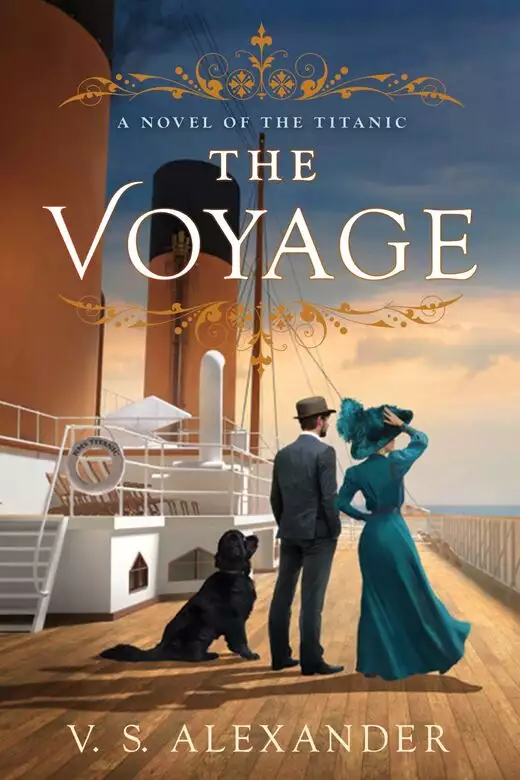
In a riveting historical novel, V.S. Alexander brings intriguing new perspective to a story that still resonates and fascinates today, as a young couple and their Newfoundland dog set sail on the Titanic’s ill-fated maiden voyage . . .
Finn, the loyal, steadfast Newfoundland dog owned by Sir Gordon Shelton, is quite at ease as he trots aboard the ocean liner at Southampton. The smell of the sea is welcome to him, for like all of his breed, Finn loves to swim.
His master, however, feels quite differently. Gordon has a deathly fear of water, no matter how much his wife, Ruth, tries to reassure him. But first-class passage on the Titanic, paid for by the Chairman of the White Star Line, is not an offer Gordon can turn down. Once the ship reaches New York, American-born Ruth will see her family for the first time since their wedding.
At least the Sheltons have no concerns about Finn’s well-being. There are a dozen dogs on board, all belonging to first-class passengers, and they receive regular walks and fresh food. Finn finds a traveling companion in Kitty, a pretty Airedale terrier who belongs to the Titanic’s most illustrious guests, John Jacob Astor IV and his young wife, Madeleine. Amid new friends and luxurious surroundings, far from the cares of daily life in England, Gordon begins to feel at ease and he and Ruth grow even closer, planning their future together.
Then tragedy strikes, unthinkable and terrifying. As the Titanic sinks into the icy depths on that fateful night, Finn’s only instinct is to protect those he loves. And at the end of this voyage, and throughout the extraordinary journey that follows it, that fierce loyalty will prove itself a beacon of hope, time and time again . . .
Publisher:
Kensington Books
Print pages:
320
* BingeBooks earns revenue from qualifying purchases as an Amazon Associate as well as from other retail partners.
Outstanding praise for the novels of V. S. Alexander
THE MAGDALEN GIRLS
“A haunting novel that takes the reader into the cruel world of Ireland’s Magdalene laundries, The Magdalen Girls shines a light on yet another notorious institution that somehow survived into the late twentieth century. A real page-turner!”—Ellen Marie Wiseman, author of The Lies They Were Told
“Alexander has clearly done his homework. Chilling in its realism, his work depicts the improprieties long condoned by the Catholic Church and only recently acknowledged. Fans of the book and film Philomena will want to read this.”—Library Journal
THE TASTER
“An absorbing, well-researched story that brings to life an extraordinary period in history, told from within the inner circle of one of the twentieth century’s most notorious characters.”—Gill Paul, USA Today bestselling author of A Beautiful Rival
“This haunting and engrossing novel will appeal to fans of Anthony Doerr and Kristin Hannah.”—Booklist
THE SCULPTRESS
“The novel is thoroughly researched, drawing readers fully into the saga with descriptive, often graphic details and strong characterizations. For fans of World War I historical fiction.”—Library Journal
THE TRAITOR
“Alexander brings his signature commitment to historical accuracy to The Traitor, immersing readers in the intrigue of the resistance. Fans of Anthony Doerr’s All the Light We Cannot See (2014) and Alex Rosenberg’s The Girl from Krakow (2015) will fall under the spell of this powerfully moving novel.”—Booklist
THE IRISHMAN’S DAUGHTER
“In this powerful historical saga, Alexander explores how Ireland’s Great Potato Famine of 1845 changes lives forever, and how love can blossom against even the greatest of odds. … Alexander’s research lends unquestionable weight to the story. … Accompanied by an expertly rendered plot, bold and empathetic characters, and prose that jumps off the page, this tale will particularly satisfy fans of historicals and those looking for stories about the redeeming grace of faith and hard work.”—Publishers Weekly (Starred Review)
August 1909
Finn stood rigid on the bank, uncertain whether the woman was drowning.
He had known her only a few months, but he’d seen her many times at Winthorp. He knew the scent of her, mostly of something his master called soap, a light aroma of lavender in the breeze. Her clothes often brushed against his nose, and he appreciated the silky gradations of her skin—the touch of her hand in his fur, rubbing deep into his spine as he arched against her fingers, the way she grasped his snout and shook it playfully, and the calm pats on the head.
But now, in the pond behind the house, she flailed her arms and beat them against the greenish water. Finn looked back at his home, more gray than brilliant to his eyes in the late afternoon. He saw the man who had taken care of him since he was a puppy. The man everyone called Gordon, or Sir Gordon Shelton, bounded out of the door, his face creased in concern, unhappy with the woman who ducked her head under the water and came up sputtering. He chastised her in words Finn had never heard, his tone desperate and pleading.
“Stop teasing, Ruth,” he shouted. “I’m getting cross. I know you’re a good swimmer.”
Ruth smacked the surface again with her hands, sending droplets skittering across the pond to the lawn. Water swirled in bubbly pools around her submerged legs. She started to laugh but instead reached beneath the murk, as if she couldn’t get her legs to move.
How many times had Finn seen Gordon in the pond? Only once, aided by a life belt strapped to his upper body. His master dared not go near water if he could help it. Finn could smell the ripples of fear emanating from Gordon’s body. The River Exe ran in front of Winthorp, a lazy distance from the home’s formal entrance of white classical columns topped by a slate-gray roof. Like his aversion to the pond, Gordon never ventured too close to the river’s banks. He admired it from afar, usually from the confines of his lounge chair perched halfway up the sloping lawn.
Ruth, however, took to the water like those web-footed, two-legged creatures with feathers that Finn liked to chase in perfume-laden springs, sultry summers, and luminous falls. In the shade of the willow tree, he had swum with her several times when the pond water ran clear and thin over them in a transparent sheet. Those times, she kissed his head and circled her arms under his abdomen while his strong legs propelled them forward.
“Ruth!”
Gordon’s anxious call rang in his ears. Finn watched the yellow light play and sparkle upon the surface while making up his mind. Ruth sank once more, and he sprang into the pond with a splash, the mossy green blinding him for a second. He pushed his webbed paws against the water, hardly noticing the swirl of it against his body. Finn snapped his jaws and partially submerged his head. The wool of Ruth’s bathing costume flapped against his mouth. Through the watery haze, he detected a clothed arm—the perfect limb to grab. He snatched it with his teeth and beat his paws upward in powerful strokes. He and Ruth broke the surface together.
She coughed up water and then sputtered, “I was playing … my foot cramped. I’m sorry.” She flung herself across Finn until he guided her to the bank. Once ashore, she slipped off him, onto the lawn’s damp grass. Finn shook the water from his black coat.
Gordon, florid and trembling, stood a few yards away. For a time, he was too angry to speak, finally saying, “Don’t be foolish.”
Ruth sat in the grass, massaging her left foot. She motioned for Gordon to sit next to her, but he didn’t move. “I shouldn’t have made fun.” She dug her fingers into her sole. “Ouch—that’s never happened. I don’t know what came over me.”
“Perhaps you swam too quickly after lunch.”
“An old wives’ tale.”
“Well, thank God for Finn,” Gordon said, his ire abating.
“It’s instinct with him.”
Finn, panting, plopped at Gordon’s feet. The man knelt, and he felt fingers walk through his wet fur.
The acrid fear Finn had sensed before was fading from Gordon’s skin.
“That’s why my mother and father gave me Finn, even at my age … in case I fell into the Exe or the pond. Once in the Exe was enough. It’s such a nuisance being—”
“—afraid of the water.” She said the words without judgment.
Gordon scowled. “Some of that. I appreciate its beauty and its power—what should I say—I’m cautious near the water. It’s been that way since I accidentally slipped into the river when I was old enough to know better. My father happened along and rescued me. I never liked to swim.”
“My dear, you’d best get used to the drink,” Ruth said. “Now that you have the opportunity …”
Gordon’s mouth turned down a bit under his mustache. “… the opportunity to be part of the White Star Line and the vast oceans?”
“Yes.” Flexing her sore foot, Ruth scooted next to Finn out of the willow’s shade and stretched her legs in the sun. “The warmth feels good.”
“It’s too hot for my dog. He doesn’t like summer.”
Finn looked at the pond, which appeared mostly yellow in his eyes, except for the brilliant points of light that glimmered like stars on its surface. He loved swimming here and in the river that ran to the English Channel. A breeze pushed the warm brackish smell of the pond into his nostrils.
Vast oceans. Gordon’s words meant nothing to him. He tilted his head toward the sky and surveyed the blue atmosphere that covered him like a curved shell. Could anything else on earth be that color? Perhaps this unknown thing, the ocean that his master mentioned?
Thursday, April 4, 1912
Sir Gordon Shelton preferred the train trip from Exeter to Southampton rather than a schedule of trains, an overnight in Liverpool, and a notoriously bumpy crossing of the Irish Sea. Open waters and cresting waves did nothing to alleviate his fear. And seasickness wasn’t his cup of tea.
Contract signings at Belfast, where Titanic had been outfitted by Harland and Wolff, could be delayed until the “Queen of the Seas” arrived in English waters. Gordon’s superiors at the firm of Adler and Fitch Solicitors, where he worked, had made that decision. The transactional cost of doing business was cheaper, too, with only a round-trip ticket to Southampton.
Gordon hoped he’d found favor with the elder statesmen of the firm, while working his way up from a junior solicitor to a full-fledged partner. But the older men valued Gordon’s father’s connection to J. Bruce Ismay, chairman and managing director of the White Star Line and president of the International Mercantile Marine Company. Fortunes had been made on lesser connections.
As he stood waiting for the train, he smoothed his suit with the palm of his hand. After breakfast, he’d asked Ruth, now his wife, to give him the “once-over” before saying good-bye. That included brushing the bowler hat, shining the shoes, trimming his mustache with the aid of the straight razor and mirror, inspecting the satchel with the all-important papers, kissing Ruth on the cheek, and rubbing Finn’s belly as he lay in front of the fireplace. He’d accomplished all that before stepping out into the chilly weather.
Ahead of him lay a behemoth—the world had never seen a ship like her. Titanic’s size shattered records, and her onboard luxuries were unparalleled in sailing history. She was longer than the Washington Monument in Washington, DC, and the Woolworth Building in New York City. She dwarfed the Egyptian Pyramids and St. Peter’s in Rome.
His stomach fluttered in anticipation of the slim possibility that the contract wouldn’t be signed on this day. Ismay wouldn’t be there. In his place, Thomas Andrews, the managing director of Harland and Wolff, the man most instrumental in the ocean liner’s design, was expected to put pen to paper. At thirty-nine, Andrews was ten years older than Gordon and had a reputation as a tireless worker with a penchant for details. The partners had told him that Andrews knew everything about the ship.
The Exeter train arrived and departed on time, and Gordon settled into his first-class coach seat to watch the Devon and Hampshire landscapes roll by. The English Channel presented itself in vistas, at times pearly gray under the clouds, or glaring to the point of blindness when the sun broke through. The water spread south in an unbroken sheet to the horizon, giving him a slight chill.
He cradled the satchel in his lap, always in his possession. The clack of the wheels and the gentle sway of the compartment nearly put him to sleep. But his head fell forward and then jerked back, causing the reality of his task to return. What if he couldn’t find Andrews? Would the man be too busy to see him? The correspondence requesting the signing had been answered with a curt, “Yes, April fourth, if all goes well.” It was, of course, signed with an illegible signature, which the partners swore was either Ismay’s or Andrews’s.
The particulars didn’t matter. He was on his way.
This day before Good Friday, Gordon spotted Titanic tethered at Berth 43/44. The imposing façade of the Southwestern Hotel, with its widow’s walks and bulky Romanesque design, anchored the far end of the dock. The railway ended within the White Star Dock Shed.
Emerging from the train, he gaped at the sight of the massive ship. The partners had told him it was largest moving object ever made by man; even the reciprocating engines in the ship’s bowels were four stories tall. Clutching his satchel, he meandered along the quay while activity flurried around him. Titanic lay placidly in the water, minor swells lapping her black steel hull. The upper decks gleamed white like snow. Four smokestacks towered over the liner; the lower two-thirds of those structures were painted gold but topped with black crowns. Masts, rigging, and the Marconi wires cut spidery triangles and arcs over her sleek lines. Loading ramps jutted from doorways cut into the ship.
Workmen wove between carriages laden with goods. Gordon’s sole task was to get the legal contract signed for the Devonshire Cream Teas business his firm represented. Once done, he would wire Adler and Fitch, and the tea, scones, clotted cream, and jam—a half-ton of it—would be on its way for Saturday delivery, well before Titanic’s anticipated departure the following Wednesday. The firm stood to make a tidy sum from handling the business and, by extension, a fortune from future voyages.
Wind caught the rim of his bowler and washed the fishy smell of the estuary over him, reminding him once again that water, his nemesis, appeared to be winning the battle of nerves. How he wished he could quash this fear, especially if Titanic loomed in his future. How many contracts would he have to sign, how many hoops to jump through, before the firm made him a partner? That was what his father had lobbied for; that was the sole reason for his education.
He stood below the ship’s stern for a moment before moving closer to the crowd of men and horses that pulled goods in an inexorable wave toward the liner. Titanic was printed in gold letters above the word Liverpool, the registry port. When he glanced at the estuary, a glimpse of red paint came into view on the hull and then disappeared below the undulating water.
“One, two, tree …” The man spoke in a Cockney accent as he counted bags of sugar and unloaded them from a wooden cart.
Gordon tapped him on the shoulder as others passed by. “I’m sorry to bother you, sir, but could you direct me to Mr. Thomas Andrews of Harland and Wolff?”
The man’s eyebrows shifted. He was dressed like most on the dock—a brimmed cap slung low on the forehead, scuffed leather shoes, and a cloth jacket and heavy pants to ward off the April chill. A pencil-thin mustache elongated his small mouth. “I know ’im. Wouldn’t have a job if I didn’t.” He pointed midship. “Wearing a brown suit. If you got business, you’ll find him there messing about with the big cargo. He’s expecting an automobile down there somewheres.” He turned back to his work.
Gordon pushed forward, and near the middle of the ship, just as the workman had said, he spotted a man on a gangplank, lording over an array of large crates holding the finishing touches of Titanic’s splendor.
“Mr. Andrews …? Mr. Andrews …” He raised his voice over the hubbub around him and thrust his right arm in the air.
The man replied with his eyes, turning his gaze toward Gordon. The look was business, but tempered by kindness in the pleasing oval face. A good man, he thought, with much on his mind, about a decade older, in his late thirties.
“Your business?” Andrews said. “I’ve only got a moment.”
“I’m Gordon Shelton of Adler and Fitch Solicitors in Exeter. I have a contract to sign for the delivery of Devonshire Cream Teas.”
Andrews descended like he’d been on an ocean liner all his life. To Gordon, the sight brought up stories of pirates “walking the plank.” He shuddered at the thought of the poor men who had gone to their watery deaths after being forced to jump into the sea from a ship. He admired Andrews for his fortitude and nonchalance onboard.
Andrews extended his hand. “A pleasure to meet you—I wasn’t sure which train you’d catch.” He studied Gordon for a moment. “You’re younger than I expected.” The aura of business evaporated. “Married? Children? My wife and daughter are at home in Belfast. I miss them already.”
“Yes, I married almost two years ago. Ruth and I don’t have children … yet. But we do have a dog, Finn, who’s like a son to us.”
“Finn?” Andrews put a finger to his head. “Ismay may have mentioned a dog, as well as your wife … and, of course, your parents. That’s where the connection lies? I can’t quite remember.”
“My father and Mr. Ismay knew each other through a connection at Harrow and became fast friends.”
Andrews smiled. “Bruce doesn’t forget his friends, especially if they’re school chums … of course it helps if they can aid the business.” He shifted and gazed at the Titanic from stern to bow. “Has your firm told you how much meat, fresh fish, sugar, flour, milk, and cream this ship will carry?” Andrews pointed to the cargo loaded on the berth. “The measurements come in tons, thousands of pounds, boxes and barrels. She’s carrying forty-thousand fresh eggs alone.” Tilting his head, he turned back to Gordon. “Mr. Ismay has asked me to tell you that you’re traveling on this maiden voyage on his ticket. He’s paying the first-class fare for you, your wife, and Finn, if you choose. Only first-class passengers can take their dogs. You will sail on the finest ship the human mind can conceive. I say that in all humility.”
Gordon stepped back, nearly stumbling against a wooden crate twice his size. “I don’t believe I can do that. I have obligations in Exeter.”
“Believe me, Bruce wouldn’t have mentioned it to me if it were not a fait accompli. Your wife is from New York City, isn’t she?”
Gordon nodded. “Yes … you seem to know much about me.”
“Relationships, my good man, relationships. They make good business. That’s all there is. Consider it a trip home for your wife. I can guarantee the voyage will be exciting.”
Gordon was stunned by Andrews’s announcement, a thunderbolt flung from the heavens to test him, like a tale told by the ancient gods. He grew anxious, knowing there seemed no way out of his dilemma. If he refused, he would be flouting his superiors, while also incurring the icy wrath of his father, a man who would belittle him as shiftless and indolent. The coveted position of partner would be in doubt. On the other hand, if his family traveled aboard Titanic, he would have to face the endless North Atlantic and all the dark terrors that his mind could conjure.
Gordon found a smaller crate, placed his satchel on it, and reached for the contract. “Mr. Andrews, may I ask you a question?”
“Of course. If we’re going to do business, call me Thomas, or even Tom, if you like. I understand you’re a ‘sir.’”
A shy smile formed on Gordon’s lips. “In hereditary name only. I find it a bit pretentious, although I believe my wife has no problem with it. She’s now a ‘lady.’” He withdrew the carefully printed white pages and a fountain pen from the satchel. “I’ve heard Titanic is unsinkable. Is that true? I have my reasons for asking.”
Andrews studied him, looking for something behind the question. “You’re uneasy on the water? Never a sailor or a swimmer?”
“No, sir … er, Thomas.” Propriety kept him from addressing the man as “Tom.”
Andrews put a hand on his shoulder. “Titanic is as safe as any human can make her. The notion that she’s unsinkable came from a magazine article, which was picked up by advertisements to profit from the ship’s popularity. White Star would never make such a bold claim, although I will stand by my assertion that she’s the safest ship on the sea. And we have lifeboats and life belts if anything were to go wrong.” Andrews patted him on the back. “But never worry … now, about the contract.”
The signing, with the scratching of pen upon paper, took only a few minutes. After a final handshake, Gordon walked back to the train station while Andrews returned to his cargo and myriad details. There was no time for a tour, Andrews had said, because so much “finishing work” needed to be completed.
“Be certain to interrupt me next Wednesday,” the designer said. “I’ll be busy, but I’ll make time for you.”
Gordon’s stomach turned over.
He wired Adler and Fitch from the station, announcing the completion of his task. Then he settled in for the trip back to Exeter. The brown leather satchel sitting next to him seemed diminished now that an “offer” had been placed in his lap. He was certain that Ruth would relish a return to New York on such a ship. What an honor and privilege it would be—an exciting voyage filled with wonder and delight! He needed to remember that, if only for the sake of his wife.
Not that Ruth was stuffy and looked down upon people. In fact, he felt she was more genuine and full of life than any English woman he’d courted. As far as money was concerned, her parents had more wealth than he expected to earn in twenty years. Not that his parents were paupers, but Winthorp was small compared to other English estates. When his parents had left it in 1907 for a smaller home, leaving Gordon and his younger brother, Robert, to tend the property, he had forgone a staff for frugality’s sake. Robert, who lived with him at Winthorp before the marriage, helped with the upkeep when his schooling and architectural studies didn’t get in the way.
Prior to his marriage, he wondered whether Ruth would be up to the tasks of cooking and homemaking, but she gratefully accepted them as a challenge. Domesticity was a new experience for her and one she embraced. Gordon often asked if she was bored by all the mundane matters of married life when she might be happier traveling, shopping, or just swimming in the pond or canoeing on the Exe. She always shook her head and smiled.
They met during a spring garden party at a neighboring estate in April 1908. Gordon was smitten with her breezy American style and chose to see her again. His parents approved when they found out that her parents, Charles and Clara Breckinridge, who hailed from Yorkshire before immigrating to the United States, had made a tidy fortune in the wool and carpet trade. After their first few meetings, Ruth admitted to Gordon that she was “not rich enough to be in the Four Hundred of New York society,” but her parents had sufficient money to present her. “I treated coming out as a duty rather than any love of social climbing,” she’d told him.
Gordon was taken with her long black hair, which she usually kept pinned in voluminous waves upon her head. He’d never seen her with her hair down before their wedding night. It excited him to feel the texture and length of her curls amid the subtle smell of Parisian perfume dabbed upon her body. He also admired her sleek face and high cheekbones with their touches of natural pink. In the summer sun, which she mostly avoided, she became quite bronze.
They were married at four in the afternoon on Wednesday, June eighth, 1910, in her parents’ townhome east of Central Park. After the ceremony, Charles and Clara hosted a tea, a small affair, but attended and talked about by some in New York society. She was twenty-three, and he twenty-seven. Gordon and his parents had sailed from Southampton for the wedding. During the voyage, and its generally calm seas, Gordon relied upon a series of powders and potions to soothe his nerves, resorting to an occasional shot of whiskey. Finn stayed at home under Robert’s care at the Devon estate. The arrangement suited both the groom and his brother, who tended to be happy as a solitary bachelor.
As the train rumbled on in its journey to Exeter, he thought of Finn and the bundle of fur that his parents had given him in 1907, a year before he’d met Ruth. During his childhood, he’d seen a parade of dogs, mostly hounds, at Winthorp; some had lived for only a few years, others for nearly a dozen. He’d loved them all but found their deaths, a grievous parting, to be difficult. When he’d left for university, thoughts of dogs had fled his mind in favor of his legal studies.
At first, Gordon wasn’t sure why his parents had given him the dog. Finn, as Gordon named him, was an added responsibility, but he soon fell in love with the pup, who took an instant liking to him. The dog showed affection to Robert, as well. An eternal bond had opened between Gordon and Finn—it was something that he couldn’t explain to others, even to Ruth after he met her.
“You need another rescuer in case you fall in the Exe again,” his father had joked upon presentation of the puppy.
Gordon didn’t laugh but looked to his mother for some explanation. She, sitting quietly in the chair across from him, gave none, but from the damp look in her eyes, he ascertained that she wanted her son to have a companion of some sort other than his brother and university chums. Here he was, nearly twenty-five and still unmarried. At least a dog was some company, his mother seemed to be saying.
Girlfriends had drifted in and out of his life. The flames of a few schoolboy crushes had been extinguished by his father, who always put learning and future income above marital bliss. His son was to be foremost a scholar, his father chided—the only way a man could provide a decent living for a wife and family. At university, he’d fallen for a willowy girl with red hair, creamy skin, and a light coating of freckles on her face. She was, Gordon thought, everything a woman should be: attractive, pert, stable, and equal parts intellectual and flirt. But his father’s early admonishments lingered, and the girl drifted away from him to another man whose studies were less on his mind. He found the breakup painful. His natural defenses clouded the skies of his heart for a time.
“Robert and I won’t be alone now,” he finally said about Finn. His. . .
We hope you are enjoying the book so far. To continue reading...

 Please log in to recommend or discuss...
