
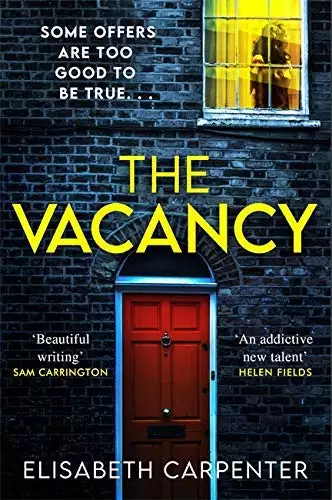
The Vacancy
- eBook
- Audiobook
- Book info
- Sample
- Media
- Author updates
- Lists
Synopsis
Running from her past, Rachel answers an advert to be a live-in assistant to glamorous and eccentric author Dorothy Winters. But behind the closed doors of Dorothy's house, she quickly discovers that nothing is as it seems.
When Dorothy's manuscript throws up striking similarities to events in Rachel's own life, she becomes convinced that the past she's tried to hide is catching up with her.
Then the phone calls start. The parcel arrives. The blood shows up in the bathroom.
And Dorothy's friend disappears.
Terrified of being blamed for murder, Rachel has nobody left to turn to.
Because who can she believe when she doesn't even trust herself...?
Release date: August 5, 2021
Publisher: Orion
Print pages: 320
* BingeBooks earns revenue from qualifying purchases as an Amazon Associate as well as from other retail partners.
Reader buzz
 Please log in to recommend or discuss...
Author updates
The Vacancy
Elisabeth Carpenter
The vacancy was advertised in one of the local newspapers. A live-in position was the perfect solution for someone practically homeless, like me. Dorothy Winters said she was a bestselling author (which made the prospect more attractive) and was looking for someone to type her handwritten manuscript along with other ad hoc tasks. I didn’t admit that I’d never heard of her, and told Dorothy I could type a hundred words per minute after working at the City Council offices for three years.
It was a little unusual that the position was residential, but Dorothy said, ‘I like to work in the evenings with a nice glass or two of something, but my eyesight isn’t great in poor light. Sometimes I can’t decipher my own writing the day after.’
I deciphered that to mean that Dorothy’s pissed handwriting was so illegible, it was an evening’s work (and a sozzled Dorothy) wasted. I hope I wasn’t expected to take dictation while the woman drank herself into a coma. I didn’t know shorthand, but I could record her on my mobile and pretend. And I actually was a fast typist. At least that part was true.
Dorothy had taken my CV at face value (though why wouldn’t she?) and said she would write to request references the old-fashioned way, which was ideal because the Rachel Benson who’d been employed by Salford City Council between 2014 and 2017 didn’t actually exist. I had listed my line manager as a Ms Eva Adams. She didn’t work there either, so Dorothy’s reference request would probably remain unopened. It was easy enough to find the council letterhead online to create my own.
I was surprised there were no other suitable candidates for the job. I thought I’d have been the last person she’d hire, especially after I turned up to the interview with a soup stain on my collar, flustered and tired after a sleepless night. But other, more sensible people, might’ve assumed Dorothy’s advert was a bit ambiguous and that the whole set-up was dodgy. Discretion essential evoked all sorts of images (cannabis farm in the attic, sex slaves in the cellar) but after talking to her, I reasoned that the possibility of seedy intentions wasn’t likely with Ms Winters. Though you never could tell with some people.
The weight of the suitcase was killing my shoulder. It was raining and the drains in the road were overflowing, making small ponds on the cracked road. I’d never been one for choosing weather-appropriate footwear and my soaking black canvas pumps sounded like flip-flops smacking soggy sand. It didn’t help that tree roots were trying to escape the ground, creating little hills that dotted the concrete path. To an onlooker, I probably looked like a staggering drowned rat.
Another new phase of my life. I’d had too many fresh starts and they were never promising or exciting because most of the time I moved from one bad situation to another. I couldn’t remember the first time because I was only two years old when my biological mother gave me away. I couldn’t picture her face; I had no memories of her at all. I’m grateful to her for two things: bringing me into this world and giving me up. When I was a kid, I overheard various versions of my story: that she was an alcoholic or a drug addict or maybe both.
By the time I was eight, I’d been with thirteen foster families and in three different children’s homes. This might not have been entirely accurate, but it didn’t matter after I moved into Jenny and Phil’s.
My last fresh start was when I married Matthew three years ago. He’d taken care of everything: sorted all the bills, the weekly shop, took my car for its MOT and always made sure it was filled with petrol. I made that sound like a practical arrangement, didn’t I? It wasn’t. Some relationships are complicated.
But he wasn’t here now. And the bravado I felt walking here for the interview last week had vanished because the reality had hit that I was about to live with a stranger.
I stopped at number sixty-three. Opposite, was a large building with a wooden sign that read: Whispering Oaks Residential Care Home. In front of it was an elderly man, sitting on a wooden chair under the smoking shelter. It was as though he was looking in my direction, but his expression didn’t change.
He shook his head and hollered, ‘Strange shit goes on in there.’
‘Are you talking to me?’ I shouted back.
‘I meant next door,’ he said. ‘That bloke and his mother.’
‘Right.’ I paused for a moment. ‘Maybe the mother’s not really there, like in Psycho.’
‘I heard that,’ he said. ‘I’m not bloody deaf and I’m not a bloody psycho.’
‘No, I said—’
‘Ah sod it.’ He stood and said, ‘You’re probably right,’ before shuffling into the building.
I expected this suburban street to be quiet, but strange people weren’t confined to city centres. They were everywhere.
I turned to Dorothy Winters’ house: a red-brick four-storey end-of-terrace. The windows got gradually smaller the higher they were.
My new home.
There was no gate, and both of the sloping stone gateposts were engraved with the house number. They were just above waist height and I gave them a firm shove to test their integrity: two Leaning Tower of Pisas which, thankfully, weren’t going to fall down any day soon.
I walked towards the house. The path was made of uneven concrete slabs and loose bricks jammed into the gaps. I stopped halfway to swap the suitcase to my other hand and glanced at the house next door. A middle-aged man, late fifties perhaps, was standing at the upstairs window. He raised a hand to wave, so I held up my aching arm and waved back a bit too eagerly. He wrinkled his nose, turned, and walked out of sight.
What a nosy old git. Perhaps the smoking man was right. I’d have to keep my eye on him next door.
The knocker on the large red door was a small, dismembered hand made of brass. Why would anyone want such a thing on their door? I tapped it against the door three times and felt like I was shaking hands with a child.
It took Dorothy Winters (top twenty bestseller in 1999) only a few seconds to open up.
‘Hello, Rachel,’ she said, standing aside. ‘You’re early. I was going to change into something more presentable before you arrived, but never mind.’
She was dressed in a maroon knee-length leather pencil skirt and a cream silk blouse and was the first person I’d ever seen who could pull off wearing leather below the waist. Her platinum blonde hair was styled in a loose bun at the side of her neck. She held a half-empty martini glass in her left hand, and I could smell the gin fumes from the step.
Dorothy glanced at my rather pitiful suitcase. I felt bad for thinking of it like that because it was the one Jenny and Phil gave me when I first moved out. It hadn’t aged well, but I couldn’t part with it.
‘Are the rest of your things arriving later?’ said Dorothy.
‘No,’ I said, stepping inside. ‘I travel light. We used to live on a boat.’
Why had I said that? I’d only ever been on a return ferry across the Channel on a booze run to Calais.
Dorothy raised her eyebrows.
‘How very bohemian of you.’
‘Not really,’ I said. ‘It was quite a nice one … a canal boat. It had an Aga.’
It was as though some part of my mind believed what I was coming out with. I’d have to try to say as little as possible in future in case I tripped myself up.
Dorothy closed the front door. She downed what was left in her glass and placed it on the hall table. ‘I’m so glad you accepted the position,’ she said, turning on her heels. ‘I’ve got a good feeling about you. The last couple of assistants haven’t been … hmm, what’s the word … mature enough for a position like this. One of them spent most of the time with her face in her mobile phone. Another one … well, there’s time enough for that story, isn’t there?’
No, I need to know now. And just how many assistants had Dorothy been through?
She led me along the hallway, passing a closed door. The walls were clad in dark mahogany that matched the floor. A long red rug brightened it up a little, but it was still rather dark.
Dorothy stopped at the second door. She selected a key from a set held together with a large nineties smiley acid face keyring. I bet she had a lot of stories to tell (excuse the pun). I wanted to know where she got that keyring from and I tried to picture her thirty years younger in an outdoor rave, dancing with her eyes closed and arms in the air.
‘A house is so much quieter without children, don’t you think?’ she said.
‘I guess,’ I said, wondering where that question came from.
‘Though my children have never lived in this house. When they were quiet or asleep it was OK, but I just couldn’t concentrate on my writing when they were pounding up and down the stairs, asking constantly when the next meal would be. As if I’d have known that.’ She unlocked and opened the door. ‘The husband was less tolerable, but I don’t have to worry about him any more.’
‘Do you have a lot of children?’ I said.
Dorothy’s mouth fell open slightly, but she’d made it seem as though she’d spawned a whole football team.
‘That’s a strange way of asking.’ She smiled as she walked into the room, flicking on a switch that turned on three lamps and spotlights in the ceiling. ‘I have three. Two girls and a boy. They don’t visit much now, though. Not since I moved up north. You’d have thought I lived on the other side of the world, not the opposite end of the country. They say they can’t understand what everyone says here. Ludicrous!’
The windowless room was about fourteen feet by ten and the floorboards were varnished in a rich dark teak. The rug in the middle was amber and russet with embroidered birds perched on branches. Against the walls left and right were units of white cupboards and shelves full of books.
‘This is the library,’ said Dorothy. ‘I’ve always wanted a library.’
‘Why do you keep it locked?’ I asked.
Dorothy placed a hand on her hip and tilted her head to the side.
‘Because there’s a key for it,’ she said. ‘I’ve always wanted a house with keys, too. It’s so gothic, don’t you think?’
Locked doors were a given in some of the houses I’d lived in as a child. They were neither gothic nor intriguing, but I wasn’t going to bring that up now. Tales of child abandonment tended to kill a jovial mood.
‘Yes,’ I said, catching my own reflection in the mirror hanging on a chain behind the door. I still wasn’t used to having such dark hair. ‘Very gothic.’
‘Would you like a gin and tonic, Rachel?’
I looked at my watch as though it would give me the right answer. She could’ve been testing me, and I was sure to fail. What time was appropriate to start drinking alcohol with your new boss? Twenty past never, probably.
‘I shouldn’t, really,’ I said, placing my suitcase on the floor. ‘It’s before five o’clock and you said in the interview that my normal working hours are eight until six.’
‘Did I?’
I nodded, trying to smile and make it reach my eyes.
‘Well, actually, this isn’t your first day …’ Dorothy sighed. ‘Well, never mind. Drinking alone doesn’t bother me.’ She surveyed the rows of books, her eyes resting on several of her own. She glanced quickly at me and again at the books, but after a few moments’ silence, she rolled her eyes. ‘I suppose I’d better show you to your room.’
I should’ve shown more gratitude for being in the company of an author and gushed about the rows of books. Or maybe curtsied and bowed my head. I followed her obediently up the stairs.
The walls were covered with framed pictures of different sizes: a black-and-white photo of ‘Women Factory Workers, Lancashire, circa 1908’; a recent wedding photo (the bride obviously wasn’t Dorothy, far too young); and, near the top, a picture of a little boy, aged about three. I wanted to stop and look because there was something about the background that looked familiar.
On the first floor, Dorothy stopped at the door next to the bathroom.
‘This is your room,’ she said, pushing it open. ‘Did I show you this during your interview?’
Had she been mentally present at the interview? She didn’t seem to remember much about it.
‘I don’t think you did,’ I said, as always, cushioning the negative with unnecessary words.
Dorothy leant against the door.
‘Have you always spoken like that?’ she said.
‘Like what?’
‘So well-to-do,’ she said. ‘I’m sure you had a stronger accent when I interviewed you. A Yorkshire accent, wasn’t it?’
So, she remembered that. I, on the other hand, had stupidly forgotten.
‘It’s when I get nervous,’ I said. ‘I’ve a Bolton accent.’
‘They both sound the same, don’t they? And there’s no need to be nervous around me.’
Only confident people said that. And no, the two accents don’t sound the same, Dorothy.
‘You needn’t pretend to be someone you’re not, Rachel.’ Dorothy knelt on the bed to open the pale pink curtains. ‘I do like a Yorkshire accent. It reminds me of Heathcliff.’
I wished she’d stop saying the name Rachel so much. It was like she was talking to a different person.
‘So, what do you think?’ she said.
It was a small bedroom, about eleven feet by ten, dominated by two huge antique wardrobes. There was a bookcase on the left and a chest of drawers against the back wall that had a small television on top. The wallpaper was white with blue flowers and matched the print of the quilt cover on the single bed. It was hardly cutting-edge interior design, but it was warm and light.
Along the right side of the bed was a single-glazed window that overlooked a long, narrow garden.
‘Sorry about the state of that.’ She picked at the peeling white paint on the window frame, revealing rotten wood underneath. ‘Oh, bloody hell, I’ve made it worse. I hardly ever come into this room. I’ll have to get someone in to fix it.’ She scooped up the flakes of paint and put them in the pocket of her expensive-looking leather skirt. She wrinkled her nose as she stood and smoothed it down. ‘Please just use that wardrobe.’ She gestured to the smaller of the two that was next to the chest of drawers. ‘The other one has my furs in. I can’t wear them these days without some leftie accosting me. It’s bad enough that I have to lie about this skirt.’ She winked at me. ‘I’ll leave you to settle.’ She glanced at my suitcase before walking to the door. ‘Though I doubt it’ll take you long to unpack.’ She headed towards the stairs and shouted, ‘Drinks in the library at five forty-five, prompt! We eat at six!’
‘Thank you.’
I closed the door and yanked my case up onto the bed. I sank down next to it, putting my hands on the soft brown leather as I looked around the room.
How had it got to this? Sitting in a single bedroom, living with a woman I’d had met through a newspaper advert. Why couldn’t I have been allowed to stay at home? I hadn’t seen my family for over a month; the homesickness felt like pain in my chest.
I wiped the single tear that had run down my cheek.
There was no point thinking like this – no time to get sentimental. I hadn’t received any hateful texts or poisonous emails in over three weeks. I hoped it was enough that I’d left. I hoped they thought I was hundreds of miles away.
No one knew me here. I could be anyone I wanted to be.
Finally.
Chapter 2
Kathryn had tried ringing him every hour on the hour six times. The contractions were now five minutes apart, and she should have known he wouldn’t be here to drive her to the hospital.
‘Has the mysterious Jack not shown up again?’ Her mother was sitting at the dining-room table, smoking a cigarette, her eyes unwavering from EastEnders on the kitchen telly.
Kathryn stopped in the doorway as another contraction took over. Tears came to her eyes. Everyone had said there was no pain like it. They could’ve lied to spare her the dread, but they were right.
She didn’t want to give her mother the satisfaction of seeing pain or anguish on her face. She wished she could cut this bloody thing out of her. What was the use of her going through this pain if Jack wasn’t here to witness it?
‘I’ll order a taxi,’ said Kathryn, walking to the hall telephone in short steps. Her hospital bag had been next to the front door for over a week now. It was one of the good things about having a sister – the only person in this shitshow of a family who actually gave a damn about her.
‘Don’t be daft,’ her dad shouted from the living room. ‘Your mum’ll give you a lift, won’t you, Marion?’
Kathryn knew without looking that her mother would be rolling her eyes and swearing under her breath.
‘Let me finish EastEnders first,’ she hollered from the kitchen. ‘Babies don’t actually shoot out of you, especially the first one. They take bloody hours … days, if you’re unlucky.’
Kathryn wished she could sit on the bottom step – or any step – of the staircase to sulk and wait, but she wouldn’t be able to get back up again without a hoisting hand. It was all so undignified, pregnancy. You had to give your body away to this thing growing inside you. Doctors and midwives prodding you, poking you. It was disgusting. Kathryn always took her mind somewhere else when she had check-ups.
‘Thanks, Mum,’ she said. ‘I’d appreciate a lift.’ If Kathryn told her what she was really thinking (Fuck you and your lift, you uncaring bitch), her mum wouldn’t bother. And as much as Kathryn made a show of attempting to call a taxi, she’d rather walk it alone than show up in a hired car with a stranger.
Even though the driver’s window was open, her mum’s cigarette smoke wafted towards her in the back. Kathryn inhaled it deeply, quietly, through her nose. She hadn’t had one for at least four months now. She didn’t want to be seen as someone who didn’t give a shit. There was a pack of ten Regal in her hospital bag and she couldn’t stop thinking about them.
‘Sorry, I can’t stay,’ her mum said when she pulled up in front of the entrance. She didn’t even attempt to get out of the car. ‘You know what your dad’s like about being on his own in the house.’
Kathryn heaved herself out and slammed the car door shut before bending slightly. The strength of the latest contraction made her want to pass out. If she did, her mother would have no choice but to get her fat arse out of the car, wouldn’t she?
Marion leant across the passenger seat and wound the window down.
‘Have you packed enough pads?’ she shouted. ‘You don’t want to be bleeding everywhere when it’s all over. You might be in there for days.’
Kathryn picked up the holdall, shook her head and walked towards the doors of Bolton Royal Infirmary.
Tears mingled with the rain on her face. She shouldn’t have expected anything from her mother – she was lucky to have been given a lift. She wouldn’t usually have cried about it, but all the bloody hormones made her feel needy and vulnerable and she hated it.
By the time she got to the delivery suite, she was begging the midwives to put her out of her misery. ‘Just kill me,’ she screamed. ‘I am not having this baby any more. I didn’t want it in the first place.’
‘Now, what sort of talk is that?’
Kathryn turned to the familiar voice and a wave of relief washed over her.
‘Chrissy,’ she whispered between breaths.
Her sister reached for her hand.
‘Squeeze as hard as you like,’ she said.
‘But … what …’
‘I couldn’t let you do this on your own, could I?’ She clung to Kathryn’s hand and perched on the end of a plastic chair. ‘Had to get the bus, mind. They’d already started on the lager by the time I came home from work.’
‘I wish they’d put me under a general anaesthetic.’
‘You don’t want to miss out on seeing your baby for the first time, Kathy.’
‘I don’t care.’
She really didn’t. She wanted to be put to sleep and wake up when everything was back to normal. And she’d find a way to get back to normal.
Six hours later it was over, and Kathryn was on a ward with three other mothers – one of whom snored like a tractor. At least she was in a bed next to the window.
She had arrived in hell; it was so baking bloody hot. Didn’t germs breed in heat?
‘Ten little fingers and ten little toes,’ said Chrissy. ‘You’ve made something so perfect, Kathy. I can’t wait till it’s my turn.’
‘You can have it if you like,’ she said.
Chrissy laughed. ‘I’m just popping to the canteen. I haven’t eaten since yesterday. I’ve been too excited.’
Kathryn wished she was excited. The thought of being alone with it made her want to run away yet feeling it in her arms was more enjoyable than she thought it’d be. Like a moving hot water bottle. There was an angry red rash across its forehead, though. Was there such a thing as concealer for babies?
It began to stuff its little fingers into its mouth. Shit, it was hungry. Kathryn couldn’t bear the idea of putting its mouth to her breast. What man would want her after knowing a baby had been there, too? It was disgusting to think about. She grabbed one of the three bottles of ready-made formula.
Chrissy came back in and laid a plated sausage roll on the bed.
‘I can’t eat that,’ said Kathryn. ‘I’m fat enough as it is.’
‘Don’t be silly. You’ve just had a baby. It’s not fat, it’s your muscles. It’ll take a while for them to go back to normal. I read it hurts when they’re contracting, too.’
‘Great. Something else to look forward to.’ Kathryn pushed the pastry away. ‘It stinks.’
Chrissy grabbed it from the bed and put it on the cabinet.
‘Ah,’ she said, stroking the baby’s cheek. ‘Feeding time, is it? Do you want me to do it?’
Kathryn cradled the baby tighter. ‘No. It’s mine.’
‘It?’ Chrissy stood and went to the window. ‘You’re going to have to think of a name.’ She sighed. ‘I’ll have to be getting home in a bit. I’m meant to be starting work in an hour.’
‘Don’t leave me on my own,’ said Kathryn. ‘I didn’t mean to snap.’
Chrissy turned and smiled. ‘OK.’ She sat on one of the plastic chairs. ‘I’ll ring in sick. I could stay with you all day if you need me to.’
After downing over half of the small bottle, the baby wouldn’t stop crying.
‘It’s wind,’ said Chrissy. ‘If you support the chin and rub the back, it’ll come up and out. Yes, that’s right.’
White vomit landed on the covers.
‘God, that’s disgusting. Chrissy, can you wipe it off for me, I’m not good with sick.’
Her sister rolled her eyes and plucked out a wet wipe.
‘It’s not like proper sick, is it? And you’re going to have to deal with the nappies yourself soon.’
‘Why won’t it stop crying? The wind must’ve gone by now.’ Screaming and screaming and screaming. The baby looked so ugly when it was red and shrieking. ‘There, there,’ said Kathryn, bringing the baby close to her chest, stroking its head. ‘You’re mine, little one. Be good for Mummy.’ That was what babies liked to hear, wasn’t it? She didn’t like the sound of Mummy, though. Perhaps she’d make it call her by her name.
Chrissy stood and almost lunged towards her.
‘Here, I’ll walk around with—’
‘No, you won’t.’
Kathryn slid off the bed and paced the room, rocking the baby up and down. Her head was going to explode if it carried on like this.
Outside, she saw a couple. The man was carrying the car seat with their precious little bundle. Pair of smug bastards. Kathryn pictured the man as Jack and the woman as his wife. How dare they be happy when she was left to go through this alone? How fucking dare they?
She went to the plastic cot and placed the baby inside; its face was almost purple from crying and fretting.
Kathryn slid on her shoes and took her coat and cigarettes from the small bedside cupboard.
‘I’m going for a walk,’ she said.
She knew her sister was shouting after her as she walked along the corridor towards the lift, but she didn’t care.
What an ungrateful little shit. After she’d carried it for nine months, living inside her like a parasite. And then having to go through all that pain.
If it couldn’t behave then she’d bloody well teach it a lesson.
Chapter 3
There were only a few items in my make-up bag: concealer, eyeliner, mascara, and tinted lip balm. I learned from the age of five – when they finally. . .
We hope you are enjoying the book so far. To continue reading...
