
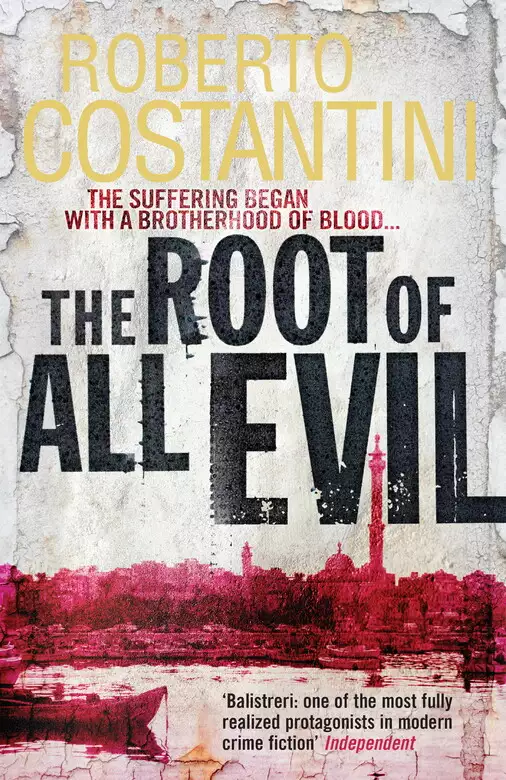
The Root of All Evil
- eBook
- Paperback
- Audiobook
- Hardcover
- Book info
- Sample
- Media
- Author updates
- Lists
Synopsis
We first meet the brash Roman police detective Michele Balistreri in The Deliverance of Evil, which Jeffery Deaver raved is "a nonstop thriller that drives readers relentlessly from the first page to the last" and Publishers Weekly called "a politically charged, Machiavellian tale of fiendish complexity." In The Root of All Evil we go back to the 1960s, when post-colonial Libya fell prey to the sprawling greed of the West, where the young Michele suffered a succession of personal blows that would scar him for life. The death of his mother; the unspeakable horror that befell his best friend's family; his father's role in Gaddafi's ascendance to power; and the innocent blood pact that would corrupt the course of his future.
Release date: July 31, 2014
Publisher: Quercus Publishing
Print pages: 688
* BingeBooks earns revenue from qualifying purchases as an Amazon Associate as well as from other retail partners.
Reader buzz
 Please log in to recommend or discuss...
Author updates
The Root of All Evil
Roberto Costantini
In the darkness of the Alhambra Cinema only the projector’s hum can be heard. I look at my grandfather Giuseppe’s impassive face as Rock Hudson and Kirk Douglas exchange a last glance or two.
‘Who’s going to win, Grandad? The one who’s quickest on the draw?’
My grandfather’s Giuseppe Bruseghin, born in 1899: a peasant from the Veneto and loyal to the ruling House of Savoy. After the rout at Caporetto, then the Austrian collapse during the First World War, he was one of the few not to jettison arms and uniform and hide himself away on some farm. He doesn’t like guns or gunfights and only puts up with Westerns because of me, the grandson he dotes on.
‘Michelino, in real life it’s not always the first to shoot who wins.’
He tries to clip me playfully round the head, but I dodge his hand. I don’t like his answer.
Kirk’s quicker on the draw; Rock fires straight after. A long, silent pause. Rock and Kirk exchange glances one last time. Then Kirk looks at the girl and keels over. She runs over to him as he lies on the ground, not to Rock Hudson, the winner.
‘But Grandad, doesn’t the girl always fall in love with the winner?’
My words are silenced by protests from the neighbouring seats.
Every so often Grandad pretends not to hear. But I’m well aware of this: he does it when he doesn’t want to answer. In 1940, his son, Toni, had joined the GIL, the Gioventù italiana del littorio, as the Italian Fascist Youth Movement was known, and had gone off to fight in the wretched war. He was killed on the last day of fighting, still wearing his Fascist uniform, while everyone else was getting out. So when King Victor Emmanuel III; his son, Umberto; the politicians; and the Fascists took to their heels, escaping northwards and leaving the Italian troops at the mercy of the partisans on one side and Germans on the other, Toni went out to meet the enemy.
My grandmother died of typhus and a broken heart straight after Toni’s death. My grandfather had to bring up his daughter, Italia, on his own: an adolescent girl who read Nietzsche and made an idol of both Mussolini and her brother, Toni.
It’s when I sound too much like Toni that Grandad doesn’t answer me.
In the end we learn that Kirk’s character went into the gunfight with his pistol unloaded on purpose. I read the credits, bewildered. If Kirk knew he’d loaded his gun with blanks, there must have been something in his look before shooting that I’d missed. The Alhambra’s sliding roof opens up on Tripoli’s clear blue sky, letting in the smells of eucalyptus and horse droppings, the sounds of carriages and carts and the muezzin’s cry calling for afternoon prayers.
It’s two in the afternoon, and the first show’s over.
The usherette comes round with drinks and ice cream. Grandad buys me another packet of nuts and gets up to leave.
‘Please, Grandad, can we see it again?’
He’s used to these requests, as this isn’t the first time. He knows I’m bored at home. Friday’s the Moslem holy day and my best friends, Ahmed and Karim, are with their father at the mosque. I wouldn’t be studying anyway, given there was no school on Saturday or Sunday.
‘All right, Michelino, but only once more, not twice, like the other day!’
* * *
We live in Sidi El Masri, just outside Tripoli, ten kilometres from Piazza Castello at the city centre. The Sidi El Masri road’s a long boulevard flanked by eucalyptus, with no houses until the twin villas owned by our family.
The two villas built by my grandfather stand on one side of the boulevard, surrounded by a wall two metres high and accessed through a large wrought-iron gate leading on to the metalled road. The gate is ornamented with the linked initials of my father and mother’s names, Salvatore and Italia, creating a symbol that looks strangely like the American dollar sign. My mother hates it, but my father likes it. It was his idea, and it’s a reminder that a real family is always united.
Behind the villas there’s a wicket gate in the surrounding wall that leads out into the countryside and to Grandad’s olive grove. Just outside the gate there’s a small pond with frogs and then a dirt path that runs for two kilometres through the bare fields to the Al Bakris’ wooden shack, where Ahmed and Karim live, right next to a horrendous cesspit.
After their shack the dirt road runs on for a kilometre along the Bruseghin olive grove. A car can barely get down it. Herdsmen use it for their goats and have their huts beside it. It curves round and joins the boulevard after our two villas, just before the Esso petrol station on the way back into Tripoli.
Although the two villas are a couple of kilometres from the olive grove and the herdsmen, the smell’s just the same – especially from the cesspit that serves as a latrine ditch for all Tripoli’s wooden shanties, and as fertilizer for the olives.
I love the smell of earth, eucalyptus and olives and am very proud of Grandad’s olive grove. He got married at the end of the First World War and studied for his building surveyor’s certificate. He arrived in Libya in 1932, six years before the mass colonization of the country that Mussolini called the Fourth Shore, bringing his wife and two children, the twelve-year-old Toni and Italia, who was only two. Thanks to his qualification, he was able to help with the construction of the new agricultural villages founded by Libya’s Italian governor, Italo Balbo: Castel Benito, D’Annunzio, Mameli, Bianchi, Garibaldi, Crispi and Breviglieri. In exchange, the INFPS – the National Fascist Institute for Social Security – together with the King’s legal representative, awarded him an estate a few kilometres outside Tripoli, plus a thousand olive trees ready for planting.
But the land was covered in sand. Grandad employed six Libyans to work with him; they cleared the sand away and erected barriers to keep the dunes at bay, thus putting a brake on the infamous ghibli, the hot wind that blows in from the desert.
Then they dug the well down to the water table and created irrigation channels, and Grandad was eventually able to plant the olives. He knew it would take years for them to produce anything, so in the meantime he kept his job as building surveyor, helping to construct housing for the colonists. Thanks to those years of sacrifice, today Grandad owns Libya’s largest olive grove.
My father, on the other hand, can’t stand the smell of olives. It reminds him of his childhood in Palermo, two parents and five sons in a single room, the lavatory shared with three other families.
For him, it was the smell of poverty.
* * *
We see the entire film again. As Kirk Douglas goes to the gunfight with an unloaded pistol, I study his face very closely.
Now I get it.
Grandad takes me back to the villas in the Fiat 600 and at six I have a snack of buttered bread and jam, nuts and dates. I then get astride the veranda railing, about a metre and a half from the ground. The mabrouka, the Arab housekeeper, has been told not to let me, but she’s supervising the cook, who’s preparing the evening’s couscous. The gardener pretends not to notice, and my father’s away at the office in Piazza Italia, next to the castle in the city centre. Jet, the boxer dog, looks at me with big soft eyes in his flat muzzle. He looks at me like that so as to seem less ugly: that way maybe he can scrounge a date. I always give him one, even though my brother, Alberto, says they’re bad for him.
This railing’s my horse and I’m Kirk Douglas. I’ve my guns, hat and boots with spurs that I got for Christmas. I know it was Papa and Mamma who gave them to me, not Father Christmas. Grandad likes to think I still believe and that it was Father Christmas, not him, who gave me a Zorro outfit.
I’m galloping along furiously, perhaps too fast. Papa doesn’t like to see the marks of the spurs in the railing’s white paint. For him, they’re the mark of my idiotic dreams. He’s telling me more than ever to think of reality and my homework, like my elder brother does.
Fortunately, as usual, Papa’s in town working. He’s with a disagreeable young man called Emilio Busi, who’s just come over from Italy and dined with us a few days ago.
It’s very hot. My neck’s dripping with sweat, an ant’s running along my arm and the sparrows are making a heck of a racket. I squash the ant. The sparrows’ll pay for it later with my Diana 50 air rifle.
Having come back from prayers in the mosque, Ahmed’s waiting for me for our gunfight. He’s in the middle of the stretch of dust and sand, dressed up as a cowboy with the costume they gave me years ago that I don’t wear any more.
As always in our gunfights, Ahmed’s prepared to die. He takes the role seriously, as he does everything in life. He’s tall, dark, with slightly wavy black hair and a sullen but intense look, just like his younger brother, Karim, and his little sister, Nadia. They all take after their beautiful mother, Jamila, Mohammed’s second wife. Handsome Arab kids.
Ahmed’s a little pezzente, which is what the native Libyans call Italians like me, ‘a little grabber’. I’m the son of one of Tripoli’s richest and most influential families and yet I’ve chosen him as my closest friend. ‘Friend’ isn’t a word we use, and neither of us likes speaking of friendship, like a pair of girls. But it’s obvious I prefer to spend every afternoon playing out with him rather than being taken to the exclusive clubs along the coast to play with the Italian, English and American boys there.
The plan for our games is always the same: he loses and I win. It’s a pact that’s taken for granted and, usually, there’s no exception. But today there’s a change.
Laura’s standing in the shade of the eucalyptus tree, chatting with Karim, who’s her age. He doesn’t want to be in the film. He’s very religious and says that Westerns are for unbelievers. Laura’s always telling Karim how handsome he is.
Laura offers to act in the film, just to please me, but she never shows any great enthusiasm. She’s nearly two years younger than Ahmed and me, and it’s obvious she likes me, but she never does what I say.
I should put Nadia in, in her place, just to spite her. Nadia’s always hanging around wanting to play with us and would love to act in our film. But I know Laura couldn’t care less if I cast Nadia in her place or not. And then Arab women don’t act in films, even pretend ones. Ahmed and Karim wouldn’t take it kindly.
‘Stop chattering, Laura. You have to watch the gunfight.’
Karim’s protective. ‘My fault, sorry.’
He’s always taking her side.
I get off the horse-railing and go up to Ahmed. Jet’s with him, licking his hand. In the afternoon, when he wants to go and run like crazy through the fields, it’s the two of us who take him. But Ahmed’s the one who runs around after him.
‘I’m keeping an eye on him. Too many females with rabies out there,’ he says.
I walk up to him, hands in my gun belt.
‘You win today,’ I whisper in his ear, and enjoy his look of amazement.
Ahmed shakes his head and stares at me. He doesn’t like surprises; he prefers everything to go along as planned.
‘Mikey, I’d rather lose, like I always do.’
‘Don’t worry, Ahmed, you can lose. But this time I’m going to die, you stay on your feet. Now, take ten steps back.’
With our backs to each other, we start to measure the paces, while Karim counts them out. That’s the part I have him play. Then we turn round and look each other in the eye.
Laura isn’t paying attention – her mind’s on a butterfly. Or occupied with her own thoughts, which are always a little strange. She once said that she didn’t like either the sun or the dark, and that she wanted time to pass quickly but still. Ahmed thinks she’s mad, but Karim says she’s a genius.
Then we each fire a shot. A few seconds of suspense. Kirk Douglas falls to his knees. Now I’m on the ground, a hand on my chest, my eyes half closed. I see Ahmed’s Rock Hudson standing still, dumbfounded, almost scared by this unexpected outcome.
Finally, Laura and Karim pay attention. Surprised. This is the first time I’ve been beaten in a gunfight. Ahmed’s looking pale and says nothing. They all come up to me as I play the part of Kirk Douglas’s dead body. Now Laura should go to Ahmed’s Rock Hudson, my rival, the winner. But she doesn’t. She stands there, looking down at my corpse, deep in thought.
And at this point Jet comes up and licks my cheek, probably attracted by some jam left on it. I hear Karim sniggering, and I open my eyes, furious.
‘I’m sorry,’ says Karim, ‘but we don’t get it – you’re always the one who wins.’
I explain the new twist to the plot. As Kirk Douglas, I unload the gun before the gunfight so as not to kill my very best friend, Rock Hudson.
Laura smiles at me, nodding in approval.
‘Bravo, Mikey. The winner always turns out to be hateful.’
Ahmed’s still confused.
‘I want to be the one who dies.’
Laura darts a look at him.
‘You wouldn’t let yourself be killed because your gun wasn’t loaded. Not even by Mikey.’
Ahmed looks askance at her. He seems upset. There’s no love lost between them. He’s afraid that one day I’ll show more regard for her than for him.
Karim steps in. ‘I wouldn’t let myself be killed for either one of you. But I would for Laura.’
He’s the spitting image of Ahmed. They look so alike, but their characters are opposite. Karim’s the idealist, Ahmed the realist.
Ahmed strokes the dog. He looks at me.
‘Should we take Jet for a run, Mikey?’
Every Saturday evening, people are invited round and the space in front of the two villas fills up with all the important people among the Italians, Americans and Libyans: owners of estates, entrepreneurs, directors of the AGIP oil company or the Banco di Roma, diplomats, American officers from the Wheelus Field Air Base, dignitaries and ministers of Libya’s King Idriss.
On these evenings, we take turns with Arab, Italian and American cuisine. Tonight’s an American night: a barbecue of hamburgers and sausages prepared by William Hunt, followed by Coca-Cola and popcorn bought by his wife, Marlene. Laura’s mother doesn’t like to cook.
With a bag full of popcorn, and bottles of Coca-Cola, Laura and I sneak off behind the villas, where her father William’s built a car port to keep the sun off the cars. We sit down underneath it to chat. It’s only childish gossip. She’s ten, I’m twelve.
‘Your mother doesn’t cook either, does she, Mikey?’
‘Never. My grandad says she should never have married.’
‘But then…’
‘When she was eighteen, she met Papa. He was already qualified as an engineer.’
‘And as handsome as Clark Gable.’
I look at her, amazed. Sometimes this little kid is crazy, just like Ahmed says.
‘What?’
She laughs.
‘Marlene says it, but she’s just joking. Your papa’s Sicilian, isn’t he?’
‘Yes. He’s the fifth son of a cobbler and a chambermaid, with four older brothers. He grew up in Palermo’s poorest district and was the only one of the brothers to go to university.’
‘How come he went, and not the other brothers?’
‘He was born in 1925, so was too young to fight in the war. But his four brothers did, and so stopped their education. Then they helped the American forces to land in Sicily.’
I pull a face, and she sees it.
‘Don’t you like us Americans?’
‘I don’t like Italians. They always betray you.’
She looks at me a little confused, then changes the subject.
‘How did your father get the money for his education?’
‘He worked as an assistant to a barber and studied English at night.’
‘Then he met your mother?’
‘He finished university in 1948 and came to Tripoli for a Sicilian firm. He met my mother and they married straightaway. A year later, Alberto was born, and the year after that, I was born.’
‘Your mother’s very rich, isn’t she?’
She has this way of coming out with things. Just as they are. Anyone else would find a different way to say it.
‘My grandad has the money. The villas and the olive grove are his. Mamma seems unfriendly, but she’s only very shy. She doesn’t speak much, but she reads plenty of books. History, philosophy, that sort of thing.’
‘And she’s a Fascist, isn’t she?’
Again, she has that way of coming out with it. Papa would be against her being my girlfriend.
I look at her.
‘Did your mother tell you that as well?’
‘No, my dad said it. He says it’s a shame, because your mother’s like a queen.’
‘A queen?’
‘Yes, Dad says that if your mother had been born in the sixteenth century she would have been a queen.’
I don’t want to talk about my parents any more.
‘Tell me about your mother and father. How did they meet?’
‘Oh, it’s a wonderful story, Mikey. The opposite of your parents’. The poor but beautiful one was my mom. Dad comes from a very wealthy family of Texas oilmen.’
‘Isn’t he a war hero? My mother told me he was.’
Laura doesn’t seem proud of it. Not like I’d have been.
‘They gave him a medal when he was with the Marines in Korea. Now he’s like an ambassador, but he’s not really. Although he works at the Wheelus Air Base, he’s always travelling about on missions, as he calls them. And then he leaves me and Marlene on our own.’
‘Your mamma’s very beautiful.’
I say this with genuine enthusiasm, and she smiles.
‘Mom’s twenty-seven, fifteen less than my dad. She was born in California and she was such a beautiful baby that her parents called her Marlene because they hoped she’d become famous, like Marlene Dietrich.’
‘My father says she’s more like that American actress he likes so much, Ava Gardner. And how did they meet?’
‘Marlene wasn’t even sixteen when she left home to take acting lessons in Hollywood. She worked in a diner to support herself.’
‘A little like Papa!’
‘Yes. She served my dad a steak in 1951. He was there in Hollywood for a weekend, but was actually living in Virginia on a course at Langley Air Base.’
‘And then you were born?’
‘Kids don’t get born straightaway, you know, after just a kiss. Dad finished his course at Langley and married her. And I was born at the end of April in 1952.’
‘You really take after your mother. But your complexion and eyes come from your father.’
‘My parents say that I take after him as well in my character.’
‘So you could kill an enemy?’
She looks at me a little sullenly.
‘I hope my dad has never killed anyone. Or if he did, it was only to defend other people.’
‘Were you in America before coming here?’
‘No, we’ve been in London, Paris and Rome. Dad was always travelling about, and Mom went to the film festivals. After three years in Rome, here we are.’
‘Is your mother happy about being in Libya?’
‘Not at all – she says it’s a sandpit. But Dad’s given her a special present to help change her mind. It’s a new sports car, and it’s coming tomorrow. It’s a Ferrari.’
A flame-red Ferrari 250 GT Spider California is a coupé convertible. I see it next morning outside the Hunts’ villa.
On Sundays, Alberto and I are regular guests there for an American breakfast: pancakes, cornflakes, toast, eggs and bacon. That’s how I see the red Ferrari.
My parents never have breakfast with us boys on a Sunday. Papa goes to Mass at seven and then on to the Hotel Waddan to read his paper, Il Giornale di Tripoli. Later he drops in on Don Eugenio at his parish church, St Anselm’s, where all the Italians who count for anything in the city meet up. Mamma always keeps to herself. I think she’s no time for Mrs Hunt. I’ve no idea why.
Alberto only takes little bites of what’s on offer. Instead, he asks Mr Hunt how they build the skyscrapers in the United States, that vast country so far away. He also asks him about the new young President, John Fitzgerald Kennedy. William Hunt isn’t very keen on him.
I listen in and grab whatever I like most without bothering too much to ask. Cornflakes, French toast, pancakes and syrup. Laura’s mother likes me and calls me Michelino-the-Hoover, because I swallow everything in sight.
After a grapefruit juice and a slice of flatbread toast, Marlene Hunt’s already been out jogging, which she never misses. She always takes her run along the path that starts behind the villas: two kilometres through the arid countryside as far as Ahmed’s wooden shack and the cesspit. She does it twice, there and back again. Eight kilometres every day, and in less than an hour.
‘When I start taking longer than an hour, then I’ll know I’m getting old,’ she says.
She comes back, glowing and panting, covered in the sweat that makes her running vest stick to her and puts a shine to those long legs below her shorts. My father’s right: she looks like Ava Gardner, but even more beautiful.
Marlene aims a clip at the back of Alberto’s head, offers a kiss to Laura and a smile to me. Nothing to her husband. Then she goes off to take a shower. When she comes back, she’s wearing a pink T-shirt with not much underneath and a pair of cut-off jeans.
‘Hey, kids, would you like to go the seaside in the Ferrari?’ she asks.
I rush off home to get my trunks and sandals.
‘We’re going to the beach. Let my grandad know,’ I tell the mabrouka.
We jump into the Ferrari. Marlene and Laura sit up front, Albert and myself behind. We fly down the Sidi El Masri road towards Tripoli, overtaking a few old Fiats, Hillmans and Morrises. The wind slaps into our faces; we don’t even see the eucalyptus trees whizzing by at the side of the road.
‘Too fast for you?’ Marlene yells out.
No, I want her to go even faster.
* * *
It takes us only a couple of minutes to get from Sidi El Masri to the Tripoli outskirts. Marlene stops for petrol at the Esso station.
The guy at the pump is Vito Gerace. He is a Sicilian of about fifty from the same poor district in Palermo as my father, and is one of my father’s minions. He’s a rough sort, with a great bush of hair and heavy eyebrows that meet over the bridge of his nose. People say that he gets drunk in the brothel every Saturday night.
The Gerace family came to Libya from Palermo along with my father, Ingegnere Salvatore Balistreri. Vito’s wife is Santuzza, ten years his junior, and a distant cousin of my father. She’s a good-looking woman, humble and cheerful, and works as a seamstress for the wealthy Italians and Americans.
Vito has a son, Nico, who’s my age, and we share a desk in the same class at school. His regular features come from his mother, but his curly hair, bushy eyebrows and hairy arms and calves come from his father. Along with the hair, a noticeable speech impediment has given him an inferiority complex and no self-confidence.
Vito Gerace raises his black eyebrows and stares first at the Ferrari 250 GT Spider and then at Marlene Hunt, his eyes coming out on stalks. He takes an awfully long time to clean the windscreen so he can ogle her suntanned legs.
Nico looks her over admiringly, too. He knows she’s acted in Hollywood and he has a fixation on all actresses of cinema and television. He’s got pictures of all the stars stuck on the underside of his desk: Rita Hayworth, Ava Gardner, Marilyn Monroe, Brigitte Bardot, Sophia Loren. All of them together, available for him in his imagination.
As we come into Tripoli through the Garden City district, Marlene’s forced to slow down. We drive past the Royal Palace, with its copper domes, and come to the cathedral square, with its ugly box of a post office built by the Fascist regime. There aren’t many cars, but the place is full of carriages, carts drawn by camels, bicycles and pedestrians in the middle of the road.
We take Corso Vittorio Emanuele, otherwise known as Shara Istiklal. Shops run by Italians are closed on Sundays, while those belonging to Jews and Arabs are open, including our favourite ice-cream parlour, Girus.
Marlene parks the Ferrari between a donkey and a Fiat 600, and out we get. Everyone’s looking at us, and I mean everyone. Not at us boys, but the Ferrari and Marlene Hunt, who looks as beautiful as a goddess.
After an ice cream we go down Corso Vittorio to Piazza Italia with its Fascist-era arcades. We turn round by the fountain and take Corso Sicilia, the Italian name which even Libyans prefer to Shara Omar Al Mukhtar. Coming out of the centre, we set off again at speed towards the beach. We pass on the popular ones, the Lido and Bagni Sulfurei, with its smell of Wadi Megenin, and head towards the more exclusive beaches attached to private clubs with English names like ‘The Beach’ and ‘The Underwater Club’.
Another ten minutes and we’re at the Underwater Club. We’re already in our trunks and get into the seawater pool. William Hunt arrives later in his Land Rover, but stays resolutely in his clothes, smoking a cigar in the shade of the terrace.
Tall and blond, with steel-blue eyes, he’s a Texan who appreciates Libya’s desert more than its sea. Also its petroleum, which we hear so much about. Meanwhile, Marlene does her usual fifty lengths of the pool, then gets out, spreads out a towel and lies down in the sun.
She really is a goddess; you only have to look at her. Although only twelve years old, I can see that myself, with her eyes that go right inside you, her shiny raven hair running in waves halfway down her back, her slender, tapering legs, her bikini top undone at the back for the perfect tan and the bottoms pulled down just within the limits of decency.
Laura tells me her parents are complete opposites. Marlene’s easily bored. She’d like to go to the swish parties held at the embassies, grand hotels and out on terraces overlooking the sea, but William says they’re nothing but places for airing other people’s dirty linen in public.
I can see all men’s eyes continually turning to look at Marlene. I should think William Hunt knows; he must do. Laura, as well. But I don’t know if they’re happy about it.
* * *
Our morning at the beach over, we go back to the villas. Ahmed and Karim come over after lunch. They go to the Libyan school on Shara Ben Ashur and have lessons on Sunday morning.
We play football on the spare ground in front of the two villas. Two against two, Ahmed and me against Alberto and Karim. We kick the ball about among the beetles and lizards, and there’d be no problem, except that Laura’s the referee and she stops play with an old whistle just whenever she feels like it. She knows nothing at all about the game. So we take our cues from the Italian radio Sunday-soccer broadcast. When the Juventus game’s over, then so’s ours.
Laura knows there’s only a minute to go. Karim trips over the ball and she blows the whistle for a penalty. Ahmed looks furious.
‘Laura, you’re crazy!’
Jet’s slumped in a corner by his kennel, panting with the heat and drooling a great deal. Ahmed and I’ve spent a whole hour with the tweezers this afternoon, pulling out the damned ticks that nest in his ears.
‘Shall we go for a run, Jet?’
His two large eyes simply stare back at us. Normally, he’s up and running as soon as we say the words. But this time there’s no reaction. He lies there, gasping for breath and drooling.
‘He’s too hot,’ says Karim.
Ahmed shakes his head, unconvinced. ‘Jet would go for a run even in the ghibli.’
He’s my dog, but Ahmed considers him under his protection. Woe betide anyone who touches him.
‘Perhaps we can take him after sunset, Ahmed.’
We exit by the back gate. The pond’s almost dry, the frogs making a melancholy croaking noise. We run along the path behind the villas up to the wooden shack where Ahmed and Karim live with their extended family.
From there we pass through the Bruseghin olive grove and by the huts of the men who herd their goats there. We never pick olives up from the ground; it’s hard to tell them from the goat droppings.
Sunset’s the right time for our big-game hunting. I shoot the doves in the eucalyptus trees with my Diana 50 air rifle, while Ahmed concentrates on the scorpions with his throwing knife. Out of fairness, it’s never from a distance of less than two metres away.
Karim never takes part. He reads the Koran, Arabic poetry and the history of Libyan heroes such as Omar Al Mukhtar, who was hanged by the Italian colonial powers. Karim never kills anything, but he collects the bloody booty for us.
When we come back for Jet, Grandad’s standing by the kennel. Next to him is the young local vet, wearing a rubber glove as he caresses the dog’s head. Jet looks at us with his sad eyes, his nose on the ground. Grandad shakes his head. The vet turns towards him.
‘I’m sorry. Jet has rabies.’
* * *
Grandad, my parents, Alberto and the vet go inside, into the living room.
Ahmed, Karim and myself stay outside, next to the dog. Ahmed talks to him in Arabic.
After a while the Hunts come over from the villa next door, my parents perhaps having called them. William and Marlene go straight into the house; Laura comes over to joi
We hope you are enjoying the book so far. To continue reading...
