
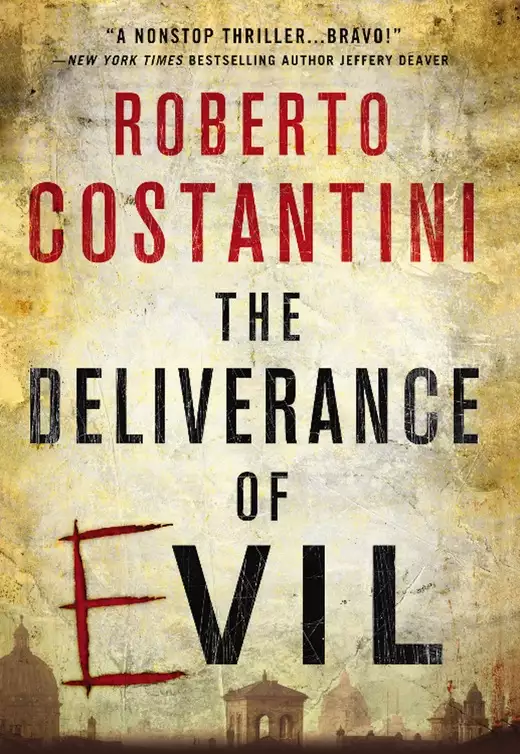
The Deliverance of Evil
- eBook
- Paperback
- Audiobook
- Hardcover
- Book info
- Sample
- Media
- Author updates
- Lists
Synopsis
On 11 July 1982, Elisa Sordi was beautiful. Commissario Michele Balistreri was fearless. Italy was victorious.
A killer was waiting...
On 9 July 2006, with Sordi's case twenty-four years cold, and Balistreri haunted by guilt and regret, Italian victory returned.
And so did Sordi's killer...
But this time Michele Balistreri would be ready. This time he would fear no evil.
(P)2013 WF Howes Ltd
Release date: February 11, 2014
Publisher: Quercus
Print pages: 576
* BingeBooks earns revenue from qualifying purchases as an Amazon Associate as well as from other retail partners.
Reader buzz
 Please log in to recommend or discuss...
Author updates
The Deliverance of Evil
Roberto Costantini
“PLACE YOUR BETS” WERE the first words I heard Angelo Dioguardi say.
I’d entered the smoke-filled room where they were playing poker only because the bar cart was in there, and it held a bottle of Lagavulin.
I knew three of the four players by sight, but not the tall young man with long ruffled blond hair, sideburns, and blue eyes, in front of whom almost all of the chips were piled.
“Holy shit, Angelo, that’s more than a month’s earnings,” grumbled the young lawyer with whom he was battling for the pot. I could see this meant the lawyer earned ten times my own salary.
The young man gave a contrite smile. He looked almost apologetic. He was the only one who wasn’t smoking, and the only one without a glass of whiskey in front of him. I glanced at the table as I poured myself some of the Lagavulin. They were playing a round of Teresina poker. Based on the cards that were shown, the lawyer looked to be the winner. But there was only one card face down that, if it was the fair-haired guy’s, would give him a lead the lawyer couldn’t beat.
I shot him a brief glance, and he sent me back a friendly smile. I left the room without waiting for the lawyer’s decision.
Camilla was waiting for me outside the room. She was the reason I was there that evening. Our host was Paola. I’d met her when she came to the local police station to report the presumed theft of her schnauzer, which had gone missing while it was running around the park. Paola was very pretty, if a little too refined for my taste. I had found her dog for her, which had only been lost and not stolen after all, and then I asked her out for a pizza. Nine times out of ten my rough-edged charm, combined with the badge of rank, did the trick in these situations. But Paola just laughed heartily and added, “I have a very good boyfriend, and I’m very faithful. But I might have a close friend I could introduce you to; she likes men like you, a bit surly and macho. Perhaps you’d like to come over tomorrow evening . . .”
She lived in a luxury apartment in Vigna Clara, one of Rome’s best neighborhoods. The apartment was on the third floor and overlooked a quiet little piazza: open, tree-lined, no noise. It was paid for by her parents in Palermo so she could study in Rome. Her friend Camilla wasn’t bad, except she was a bit of a snob. But during the previous dozen years I’d decided, given I’d lost the one woman who had meant something to me, I’d make do with the sum of the particulars of others. At thirty-two I could manage to think of at least one positive particular in every pretty woman who happened to come within reach. Naturally I’d discovered a long time ago that “the particulars” of a woman are only discovered during sex, when the gestures, the looks, the words, and the sighs manage to be almost truthful.
That wasn’t happening on that particular evening, though. Paola’s friend was spending the night at Paola’s place, so I wasn’t going to get her into bed. Toward midnight I got ready to say good night. As a young police captain, I had to get up at half past six the next morning. I was getting ready to leave when the poker players came back into the living room: three beaten dogs and the fair-haired one with his blue eyes lit up.
“Paola, your boyfriend must have made a pact with the devil,” said the lawyer as he waved good-bye with the others to the evening’s hostess.
The blond guy slumped into the armchair across from mine. Now that he had finished taking them to the cleaners, he was ready to enjoy the bottle of Lagavulin. He poured himself a generous measure and, seeing my glass was empty, filled it without even asking. He raised his glass in a toast. His clothes, his wild hair and five o’clock shadow—everything about him made him seem out of place in that house and with those people. Which meant he was more or less like me, except I was a master in the art of hypocrisy, a true chameleon of the secret intelligence service who had learned how to conceal his contempt, while he was just a kid from the outlying suburbs and the one who was genuinely out of place.
“To this magnificent whiskey and those who appreciate it,” he toasted, displaying the working-class romanesco accent of the outer suburbs.
He offered me a cigarette. He smoked those awful Gitanes without a filter that left tobacco on your tongue and a foul smell everywhere.
“But they taste great,” he said. “And I count them out carefully, no more than ten a day.”
No one in Rome’s elite smoked those cigarettes. Marijuana was in, but plain cigarettes smacked of the slums. Of course, it was clear the fair-haired guy didn’t belong to the elite. I thought that if Paola had chosen him and was so faithful to him, then the guy had to have hidden qualities. And the only ones that I could think of were those you demonstrated in bed.
“So, you’re the big winner?” I asked him. He nodded, but showed no interest in pursuing the subject.
“Then you really are lucky. There was only one king left that could have given you a straight. Out of ten possibilities, at least.”
He didn’t say a word. (Only after a good deal of whiskey could I get him to confess that he’d held nothing more than two nines.) “Professional secret,” he said, making it clear he was letting me in on a very special confidence. By then the lawyer was already downstairs and on his way out.
While Paola and Camilla were chatting in the kitchen, Angelo asked what I did for a living.
“Bravo, Michele. At least you’ve got something to get up for every day.”
I shook my head. “In reality, it’s all routine. In a district like this, about the biggest case I’m going to crack is your girlfriend’s missing schnauzer.”
“Oh, you’re the one who found the dog? He smiled and nodded in the direction of the kitchen.
“Camilla’s cute,” I said. “Too bad she’s sleeping here tonight.”
He thought about this for a moment. Then I saw him get up and stagger into the bathroom without even closing the door, followed by the sound of retching and moaning. The girls rushed in, as I did too. He was lying on the bathroom floor, looking pale, having thrown up in the sink.
“Should I call a doctor?” asked Paola, panic in her voice.
“No, no,” he groaned. “Girls, go make some coffee, would you? Michele, stay here a minute.”
Ejected from the bathroom, Paola and Camilla went back to the kitchen, and Angelo winked at me.
“I’m totally fine, but let’s scare them a little more.”
He stuck two fingers down his throat. More retching, and the girls raced back into the bathroom.
“I’m calling a doctor,” said Paola, more concerned than ever.
“No, it’s okay. The worst is over. I’ll take care of him.” I spoke in the same authoritative voice I’d used when she’d come to report her missing schnauzer. Decisive, calm, reassuring. I knew what I was doing.
Angelo went on a good while longer, with more well-feigned sounds of retching and groaning. Then I took him on my shoulders to carry him to Paola’s double bed.
“Christ, you’re heavy,” I said as I put him down.
“You have to suffer at least a little in order to get it . . .” He winked at me again and started to moan softly.
The girls came in with black coffee. Angelo tried it with groans of disgust.
“What should we do?” The girls were hanging around for instructions, subdued now by my air of calm in the face of Angelo’s collapse.
“Let him stay the night,” he said, taking Paola’s hand. “If I feel bad again, at least he’ll be here to help.”
I bravely offered to sleep in the living room with the schnauzer, seeing that Camilla was in the guest room. My gesture was greatly appreciated. Then, later that night, it occurred to Camilla that the dog’s snoring might be bothering me, and so she had me move into her bed.
And that’s how I came to know Angelo Dioguardi.
. . . .
The police station in Vigna Clara was about exciting as a nursing home. In that well-off residential district of Rome, a policeman lived the life of a retiree. Well-ordered streets, beautiful homes, greenery everywhere, its inhabitants all formally educated and having achieved economic success by any means, legal or otherwise: tax evasion, bribery and corruption, carefully controlled contracts. All these were means that the Italians, especially in Rome, had employed since the end of the war as they sought the good life, whatever the cost.
I’d been stationed there for almost two years, thanks to my brother Alberto and his contacts in the Christian Democrats.
“Think of it as time to recuperate, Mike,” he said when I started there. “Take a couple of years to get yourself back together, and then decide what to do with yourself. Time to straighten up.”
As if his younger brother’s previous turbulent thirty-two years could be wiped away. But then Alberto had always been like that. He was an optimist, highly intelligent, forceful—qualities he shared with our father, who left Palermo for Tripoli after World War II.
A Sicilian from the lower middle class, Papa studied engineering in Rome and became a wealthy businessman in Libya, one of the few who was able to steer through the murky waters of Italian politics, granting it the absolute minimum attention possible and using it only when necessary. And in order to marry the daughter of Libya’s biggest Italian landowner, Papa was willing to become the most dedicated of Catholics from conviction and for convenience in order to get into the right circles, and he was willing to do business with Jews on the one hand, Arabs on the other, and Westerners with both hands together.
Alberto shared some of my father’s skills, but he was a better person by far: sensitive, well-adjusted, generous, and even-handed. A model son. In complete contrast, I was the one who, right from the beginning, hated my school run by the Christian Brothers, and spent all my time with a Diana 50 air rifle, shooting turtledoves from a three hundred feet away. I was the one who only passed his exams each year because Commendatore Balistreri was a big shot in Libya.
My troubled childhood was spent serving as an altar boy with a priest who couldn’t keep his hands to himself and fighting with the Arab and Italian boys my age. I grew into a lonely, turbulent, and angry adolescent. I devoured Homer, Nietzsche, and the early works of Mussolini. No calculated decisions or compromises: only honor, action, courage. My path was clearly marked: at seventeen, I left behind me the first dead in a Cairo shaken by the Six Days War; at eighteen, I killed my first lion in Tanzania. At nineteen, I was plotting against Gaddafi, who had just taken power. At twenty, I claimed the right to decide on the death penalty for those who were traitors.
Then Rome and college. By 1970, I’d even managed to pass a few classes. Over time I made the natural progression from the Movimento Sociale Italiano to the ultra-right extra-parliamentary Ordine Nuovo, with its two-bladed Fascist ax and SS motto “My honor is loyalty.” Three years spent clashing with the Reds—posting manifestos by night, days spent attending fiery meetings. Then, at the end of 1973, a Christian Democrat minister ordered the Ordine Nuovo to disband and had its leaders arrested. An act of madness that let loose dozens of youths, some too young and naive to see the distinction between conflict and the abyss. While many of my friends chose armed conflict, killing enemies, I paused to reflect. I understood they were moving toward bombing ordinary people, collaborating with common thugs, betraying our ideals, and so I agreed to help the secret intelligence service stop them. After four years of being a chameleon, working undercover for the security forces, it was still plausible that I was on the side of the good people who were preventing massacres of the innocent. Then, in 1978, the Red Brigades seized Aldo Moro and right-wing criminality joined forces with left-wing terrorism. Intelligence was ignored. Aldo Moro was assassinated. I protested, and my cover was blown. At that point I could have continued and ended up in a block of cement at the bottom of the sea, or else I could renounce changing the world and ask my brother for help.
It was my brother, Ingegnere Alberto Balistreri, who brought me back from the edge of the precipice. The Minister of the Interior owed him a favor. So I managed to obtain a philosophy degree, using my credits from the early 1970s and taking some more classes. Then they let me join the police, and I passed the exam to become police captain. In 1980 I received my first posting in Vigna Clara, one of Rome’s quietest neighborhoods.
But at night I wanted to get away from that false Rome and keep my distance from the rich and their neighborhoods and the historic center, where the city’s chaos and decadence were on display. I rented a studio in Garbatella, a working-class quarter built by Mussolini, where apartments cost very little in those days and true Romans took the cool spring air sitting outside the cheap bistros that served the best food and wine in the city.
In fact, I dedicated myself to the only real passion I had left: women. Any woman, of whatever kind, race, or age, so long as she was good-looking and didn’t waste my time with the usual runaround. I was voracious; I wasn’t looking for friendship, intrigue, or protection. They lasted so little time that I didn’t take the trouble to learn their names. I only needed to know them in the most thorough way possible, something not too difficult for a young good-looking police officer of a certain rank. Hic et nunc was the way for Michele Balistreri; nothing of sin, confession, regret. I was one of the elite—those the world doesn’t understand, those who don’t give a damn what the world thinks of them. Nor what God thinks, either.
As Alberto used to say to me, and I used to echo, this was only a moment to reflect, a little bit of rest, sailing slowly along a quiet river, carried along by a gentle current. After the turbulent years I’d experienced, this was exactly what I needed: solitude, a cushy day job, eating well, screwing a lot, playing poker, thinking about nothing at all. It was a delicate balance between pleasure and boredom. No emotional ties. Love was a country where it had rained salt, and it had turned into a desert.
But I told myself over and over I would leave as soon as I could. I’d never become a senile old cop, stuck at a desk and serving a cowardly and corrupt state. I’d go back to Africa to hunt lions and leopards, far from false and sanctimonious Italy. Far from everything I detested. Far from the battles I had lost.
. . . .
A few days after our first encounter, Dioguardi readily agreed to play poker with me and two of my friends in the police. This was odd, because we’d only just met and I myself would never have risked putting my money on the table with three strangers who knew each other well. But, as I came to find out, Dioguardi was the opposite of me in many ways—and one was being able to trust his neighbor.
We played until two in the morning in the back room of a piano bar near Piazza di Spagna. In less than half an hour, I realized he was a world-class player. He had technique, imagination and daring. After two hours he’d won a pile of money. Then, in the following hour, he lost more than half of what he’d won.
“You lost on purpose,” I said, after the other two had left.
He shook his head, embarrassed.
“I was doing a few experiments, things I could use to improve. I do it when I’m winning comfortably.”
“As in a preseason friendly game against a bunch of amateurs.”
He smiled. He admitted that he played rarely, and only then with wealthy old boys. He won a lot of money, but he was a little ashamed of it and never boasted. I discovered later that he donated all his winnings to charity. His fabulous bluffs in the game were little sins for him, something that—along with his Catholic ethics—was nothing to be proud of.
We went into the crowded bar. A group of young men were singing to the piano music, led by a beautiful black woman.
As soon as she spotted him, she called out, “Angelo, Angelo, come over here!”
He tried to wave her away, but she kept calling him. In the end he went over and the girl pressed his lips to hers. I saw him blush and step back. Then she raised his arm, as if declaring him the winner, and turned to the crowd.
“This is my friend Angelo, the best undiscovered vocalist in Rome, who will now sing for us.”
In the field of singing, too, he was in a class by himself. He performed every song the crowd requested and ended with a rendition of “My Way” almost worthy of Sinatra himself. After his performance, he introduced me to the woman, then left us alone just long enough for me to get her phone number. He’d figured me out.
It was after three when we left.
“Michele, let’s go to Ostia.”
“Ostia? It’s January. What would we do at the beach?”
“There’s a little bakery there. At six they bring out the best pastries anywhere near Rome.”
He wanted to talk. Me too. This was really strange because, over the years, my desire to socialize with other men had worn off. We went in his beat-up Fiat 500, and half an hour later we were parked on the promenade. The stars were out. It was cold, but there was no wind. We opened the windows to smoke. The sea was a millpond; we could smell the sea air and hear the waves lapping a few yards away from us. There was nobody around.
Unlike me, Angelo was always willing to talk about himself. He was born poor in a Rome where everyone except his parents was getting rich, some legally and some less so. He’d grown up in the poorest area of Rome. He was the son of a small-time singer and a fortuneteller, two starving wannabe artists who later moved to the country; two failures, at least by societal standards, both dead from cirrhosis of the liver when Angelo was still a teenager. But he said they had both given him a great deal. His vocalist father had given him his singing voice, and from his fortunetelling mother he learned to bluff and think on his feet.
In time he had gained two things: a well-off girlfriend, Paola, who worshipped him and would marry him within the year, and a small real estate business, thanks to her uncle, Cardinal Alessandrini. The cardinal was just over fifty and was responsible for arranging housing for the thousands of priests and nuns who came to Rome to study or else a few days of pilgrimage and sightseeing. The Vatican owned hundreds of convents, hostels, and apartments and their running had been entrusted to Angelo Dioguardi who, although he’d given up on his education, was a good Catholic and was obviously to be the husband of the Cardinal’s niece. Although Angelo was manifestly unsuited to an office job, he applied himself with dedication and energy—exactly the opposite of how I handled my employment. And he was the opposite of me when it came to women, too. He knew a lot of them, but he never took advantage because of his unshakeable loyalty to Paola. In love, he was an idealist in search of the single perfect relationship. This would turn out to be the ideal situation for someone like me, who was always on the prowl: Angelo drew them in, and I closed the deal.
“Are you really completely faithful to Paola?” I asked. I was expecting him to give a speech on love in reply, but Angelo surprised me.
“She’s beautiful, kind, smart, rich, and the niece of a cardinal who gave me a job, and I’m a poverty-stricken nobody who didn’t finish school. I can only be thankful; I’ve no right even to desire anyone else.”
We were still there at dawn. We got out to stretch our legs. The bakery was closed, but the lights were on and it was emanating a yeasty smell. I took a cigarette from my second pack. I offered him one, seeing as he’d finished all his.
“No thanks, Michele. A pack of Gitanes every two days and no more.”
“You’re too strict with yourself, Angelo. You should let yourself go once in a while.”
He ran a hand through his wavy blond hair, then pointed to the water.
“How about a dip?”
“Are you crazy? It’s January and dawn.”
“You won’t feel cold once you’re in. And it’ll give you a perfect appetite.”
That’s exactly what he said—a perfect appetite. He switched on the Fiat’s headlights and directed them toward the few yards of sand that separated us from the water. A minute later he was stripped down to his briefs.
“Come on, let yourself go, Michele,” he said.
Then he ran to the water and dove in. I saw him swimming furiously in the beam of the headlights. I don’t know what came over me—something I hadn’t felt for many years. A minute later I was in the water, too. The cold took my breath away, but the more I swam to warm myself up, the more I felt a joy I’d forgotten, brazen, irresistible, that took over my whole body.
As promised, the pastries, still warm from the oven, were perfect.
. . . .
So I began to get to know Angelo better. Underneath that affectionate, sunny, and angelic face lay a heart left on its own too soon and seeking a safe and permanent harbor. Love and work were a refuge for him. No strange ambitions, no adventures: a more or less regular life. No more than ten Gitanes a day, no more than a couple of glasses of whiskey. That way he stayed clear-headed when he played poker. Every time we went into one of Rome’s piano bars—something we did often in the following months—the same thing happened. The singer knew Angelo and called him on stage. The female singers always tried to take him home, but he was incorruptible. In this he was truly my opposite, or perhaps he was what I could have been. Angelo was unassailable.
He laid down strict rules for us when it came to poker. Spots were limited to a certain number, and at the end of the evening the jackpot was divided according to the number of chips we had. He almost always won, and the few times he lost I was sure he’d lost on purpose, just as he’d done during our first game. In the beginning we played with my brother, Alberto, and another engineer, a colleague of his. They tried to persuade Angelo to use their high salaries and stocks and shares to bankrupt a casino but, ever in line with his Catholic morality, Angelo wouldn’t do it.
We saw each other almost every evening. The standard routine was pizza for four: myself, Angelo, Paola, and my girlfriend of the moment. Then came a short stroll through Trastevere. We’d stop for a smoke, and drink one last beer in the splendid piazza by the church of Santa Maria. At that point, there was a choice: either I went off with my girlfriend or, with Paola’s blessing, Angelo and I would say good-bye to the two of them and ride around Rome in my Duetto or his Fiat 500. (This usually happened when I was no longer interested in sex with that night’s companion.) We would stay in the car and talk. Unending icy winter nights with the windows down to let out the smoke. Warm spring nights when we squashed the first mosquitoes. Our conversations ranged from chat about sports and politics to deeper existential problems. Despite not having finished school, Angelo was a great debater and could defend his Christian vision of the world divided between good and evil.
We were inseparable on those magical metaphysical nights that filled our lives for no apparent reason whatsoever.
May 1982
ANGELO’S OFFICE WAS LOCATED in the residential complex where Cardinal Alessandrini lived. There were low-rise buildings, each three stories high, surrounded by a park, on Via della Camilluccia in one of Rome’s greenest residential areas. Alessandrini lived on the top floor in one of the buildings and had given the other floors over to Dioguardi for his offices. The third floor was used for administration; the second floor was open to the public—that is, priests and nuns looking for accommodations.
On one of my days off, a Saturday at the beginning of May, I went to meet him there. It was a glorious morning—the skies clear, the sun already warm. In my old Alfa Romeo Duetto, I crossed the historic city center crowded with tourists. Every so often I slowed to admire a young female visitor. Near the Colosseum I saw a German blonde with huge tits and the words Über alles printed on her T-shirt. In Piazza di Spagna, American girls in shorts were sitting on the Spanish Steps, and in Piazza del Popolo, where the bars were already full, two gorgeous Japanese girls were taking turns photographing each other. Eventually I drove up the winding slopes of Monte Mario and came to Via della Camilluccia. A huge green gate barred the entrance to the park where the two low-rise blocks were situated, separated by a huge fountain, a tennis court, and a swimming pool. It was a little corner of paradise allowing some privileged people to live a separate life, far above that wonderfully chaotic city crawling with people and traffic.
I drove the car up to the gate. A severe-looking woman in her sixties came out of the gatehouse. She looked me up and down skeptically, unable to decide whether I was an encyclopedia salesman or some lackey of one of the rich people around there. I stared back at her with one of my own surly looks, a gift that came naturally to me.
“Can I help you?” she asked with a Southern accent.
“I’m a friend of Angelo Dioguardi’s.”
“You’ll have to park outside. Only the residents can park inside.”
She saw me surveying the handful of vehicles parked on the enormous grounds. Among them was a stupendous Aston Martin, Angelo’s Fiat 500 and, gleaming in the sunshine, a Harley-Davidson Panhead.
“The Count doesn’t want nonresidents’ cars past the gate. And if it was up to him, you know, nonresidents wouldn’t even be allowed in on foot,” the concierge added with a note of disapproval, whether for the nonresidents or the count I couldn’t decide.
Fortunately, parking on that quiet green road was no problem. The residents all had garages, and there were no stores or restaurants around, only trees, well-tended flowerbeds and Filipino au pairs pushing strollers carrying the children of the wealthy. Their parents were off having coffee in Piazza Navona or out on the golf course.
“You have to walk to the far end of the grounds. Go around behind the pool and the tennis court, and you’ll get to Building B. You can see the balcony from here; you can’t miss it,” she explained, as though talking to a small child.
As I passed Building A, the one nearer to the gate, I felt I was being watched. I turned upward and caught sight of a reflection on the third-floor balcony. Someone was spying on visitors through a pair of binoculars. I stopped to admire the Aston Martin parked in front of the entrance to the building. The Harley stood beside it. I went around the large fountain and onto the pathways between the tennis court and the swimming pool; tall trees prevented me from making out Building B.
I came across a lanky and energetic young man. Thick red curls, blue eyes, freckles, probably not more than twenty. He was wearing a priest’s cassock.
“Are you lost?” he asked in a thick American accent.
“I’m not sure. I’m looking for Angelo Dioguardi in Building B.”
“You’re not a priest,” he said, smiling as though he’d said something witty. He explained, “Only priests and nuns come to see Angelo. I’m Father Paul, assistant to Cardinal Alessandrini.”
He accompanied me to Building B’s front door.
“Angelo is on the third floor. Call me if you decide you’d like to become a priest. Maybe I can help.”
He really was a bit too much of a joker for a first encounter. I recognized it instantly as a way of covering up his insecurity—and Father Paul’s insecurity exuded from every pore.
I went up on foot. As I was going past the first floor, a girl with the features of a young goddess came out of a door. She was wearing a long white nurse’s coat, and I would have considered feigning illness on the spot. That kind of a uniform tends to disguise the figure, but no kind of dress could have hidden that curvaceous outline.
She stopped dead, her eyes lowered. “Please, go ahead,” she said, pausing to let me pass. Her voice was soft and childlike, a little dreamy, like her smile. Her arms were full of ring binders.
“Can I help you?” I offered. She kept avoiding my eyes and shook her head, distracted. A ring binder fell to the tiled floor. While I was bending down to pick it up, I caught the scent of her soap. “I’m really sorry,” she said, absurdly overapologetic.
I couldn’t persuade her to give me any ring binders, and we went up to the second floor in silence. She ushered me through a small door into a long corridor with several doors leading off it.
“Mr. Dioguardi’s office is at the end,” she said. She hadn’t once met my eyes, and she quickly disappeared into the first room on the right.
I found Angelo behind a desk, buried under papers, ring binders, and folders of every kind. Behind him hung a huge photo of the Pope. I almost laughed at the sight of him in that setting. In the workplace, his complete inability to keep things neat was striking.
“I know, Michele—your brother looks the part behind a desk, but I look silly. Worse, here I am making a mess in a job that demands organizational skills.”
“At least you’ve got some good-looking coworkers,” I said, gesturing toward the corridor.
“I guess you saw Elisa,” he replied, laughing.
“If that’s the kind of young goddess you have carrying your bits of paper . . .”
He explained that Elisa Sordi had been there for two months as a weekend assistant; she was in college, studying to become an accountant, and would be taking exams in June. She was only eighteen.
“And from whence does this manna from heaven descend on you?”
“Paola’s uncle, Cardinal Alessandrini. Our illustrious neighbor the senator, Count Tommaso dei Banchi di Aglieno, introduced him to Elisa. The cardinal and the count do favors for each other, even though their morals and their politics are polar opposites: the cardinal’s a Catholic democrat, and the Count’s an anti-Church monarchist despot.”
“I think they’ve done you a favor this time, Angelo. Sure, she’s a bit young, but you know I don’t hang about . . .”
He shook his head with a smile.
“She’s not your type, Michele.”
“And why not?”
“She’s awkward, incredibly shy, and a very devout Catholic—someone like me, who really believes.”
“Is that what you think of me, Angelo Dioguardi? That I’m only a collector of fucks from cheap sluts?” I asked in a tone of obviously feined disdain.
I expected him to laugh but instead he made a face. It was the noise of ring binders falling to the floor behind me that made me realize what was happening. Blushing, Angelo rose to help the girl gather them up. I turned round with my most innocent smile. Elisa was standing there with a stunned expression on her face, a look of shock in her eyes. Not having the gift of invisibility at my command, I excused myself and went to the men’s room, where I remained for a long time, cursing myself. The face I saw in the mirror was that of a vulgar idiot who had just made a complete fool of himself.
I went back into Angelo’s office only when I was sure Elisa would no longer be there. He gave me a sardonic grin that made me furious.
“Asshole! What’s so funny? You could have warned me, couldn’t you?”
“I tried to, Mike. Anyway, Elisa certainly knows what you’re about now. But if she has a sudden stroke and loses her memory, I’d say you’ve got a chance . . .”
We ended up shutting the door and settling down for a chat over a beer. There was no ashtray, because Angelo didn’t smoke in his office, so I used the wastepaper basket. Angelo explained his work to me. The Vatican sent him the scheduled arrivals, and his three regular staff allocated the available housing to the priests and nuns—in separate quarters, naturally—while his responsibility was to take care of hostels and convents for any upcoming conventions. As for emergencies, such as unexpected arrivals, he was always on call, no matter the time of day. That was why he needed extra help on Saturdays and sometimes Sundays too. This extra help came in the shape of that young goddess Elisa Sordi, the girl about to take her exams in accountancy.
“So, on Saturdays you’re here alone with her. How do you resist?”
“There’s nothing to resist. I’ve already told you, Elisa’s off limits. Go on, admit it: the truth is that my being faithful to Paola upsets you, and you’d feel better if I stepped over the line once in a while.”
That wasn’t true. I wasn’t jealous of the self-control he applied to this renunciation. I’d had to work on self-control a good deal myself and was still alive because I’d learned it the hard way before anyone had had a chance to kill me. But I really didn’t understand self-control applied to sex—it was like sucking mints to hide bad breath. And I wanted my friend to see it as I did: self-imposed faithfulness was like renouncing life itself. And that really was a deadly sin.
At half past one, Elisa knocked and put her head around the door, avoiding my gaze.
“May I go out for something to eat?” she asked.
It seemed an old-fashioned request, like asking for permission to go to the bathroom. I went to the window to watch her leave. A young man was waiting for her outside Building B’s main door.
“You said she was a little saint,” I said to Angelo.
“Shit, Mike, you’re still planning on trying to get into her pants? That’s Valerio Bona, an old friend of hers. Anyway, it’s no business of ours.”
The goddess was going off with a guy her own age who was short and skinny and wore glasses. It was absolutely ridiculous—such a waste. He looked like a loser. She’d taken off her white coat. She was dressed simply and modestly in loose-fitting pants. A sweatshirt tied around her waist camouflaged her splendid behind.
I could have some fun with a girl like that.
I intended to do everything I could to cancel out my tactless behavior. After all, it was only the first time we’d met.
. . . .
Angelo had to discuss a couple of matters with the cardinal before we could go for some lunch.
“Come with me, Michele. He’ll be happy to meet you. It’s always useful to know a policeman,” he said with a grin.
The cardinal’s penthouse was enormous: a spacious living room, several bedrooms and bathrooms, together with a large balcony overlooking the grounds, with a view all the way to the entrance on Via della Camilluccia, where the gatehouse was located. The living room was full of young African priests and nuns speaking French. It was like a deluxe Catholic youth hostel.
“These are the people we have to find places for. They should have left this morning but there’s a coup d’état going on in their country, and they’ve closed the airport,” Angelo explained.
The only white face apart from ours was that of Alessandrini, who was mingling with the young clergy in his everyday clothes. He poured lemonade into their glasses from a large carafe. A short, middle-aged man who radiated great energy, his lively, intelligent black eyes stood out against his cropped gray hair.
He came up to me with a smile and an outstretched hand. “You must be Michele Balistreri,” he said. Then, turning to Angelo, he added, “Help yourselves to lemonade. I’ll be back in a minute.”
He picked up the telephone and spoke in perfect English.
“You can tell His Holiness that, with all due humility, I do not agree. There’s no violence. It’s a bloodless coup. The fact that they’re not Catholics is another matter, but we can find a way to have a dialogue.”
He came back, pushing his glasses higher on the bridge of his hooked nose.
“The current Vatican hierarchy has no love for communists, exactly the same as you.”
I looked at Angelo, who shook his head. No, he definitely wasn’t the type to gossip about me with the cardinal. Either the cardinal could read in my face what I was thinking or he had looked into my background because I hung out with his niece’s future husband. I didn’t care.
“I don’t agree with the Vatican on any subject. Not even on communists.”
The Cardinal ignored my comment and led us to the only corner of the living room not taken over by noisy young Africans.
“Your Eminence, we have some problems,” Angelo said. “We can’t manage to find places for all of them in our housing and the hotels are booked with tourists. We’re looking for about twenty beds.”
This was a different Angelo Dioguardi than the one I knew. He was awkward and insecure. The cardinal was too important for him.
Alessandrini laughed. “My poor Angelo, I see you can’t multiply beds like Our Lord did with the fishes! But it’s no problem. The priests will stay with me. Naturally, you’ll have to accommodate all the sisters. You can never be sure . . .”
“Your Eminence, this is a big apartment, but there aren’t enough beds. We’re talking about twenty priests. Where will you put them all?”
The cardinal pointed to the terrace. “I slept out there last night to keep cool. It’ll be no problem for them—they’re used to it in Africa. I’ve already sent Paul to get some sleeping bags from San Valente.”
Angelo relaxed and the cardinal turned to me. “So, you’re a policeman?” I had heard the word spoken with a thousand different shades of meaning: often ironic, sometimes even offensive. But Alessandrini said it with pure curiosity. At the same time, he was telling me that he knew all about me. In that residential complex, you entered only on foot and after all your details had been checked.
“I wanted to be a policeman when I grew up, but the Lord had plans for me to serve a different kind of justice,” he said.
I had my own opinions about the conflict between earthly and divine justice, but I figured it wasn’t the right time to discuss Nietzsche and the Gospels. This powerful and friendly man may have been admirable, but I didn’t find him likable. He was a priest and, after years of religious schooling, I knew that a pleasant manner could merely be ash over hot coals. I had learned to be wary even as a young child, from the moment in the fifth year of primary school when a soft hand infiltrated my shorts while I was being told about the goodness of Our Lord.
He read my thoughts. “Yes, I know, you’re very much the layperson and opposed to the Church, or perhaps even opposed to religion. Look, I respect justice on earth, but I also recognize its tragic errors. In this world, justice is often in the wrong hands.”
I was losing patience. “If we waited for the next life, we’d be living in tears, tormenting ourselves with our sins. When remorse turns to penitence and absolution, it’s only a way of avoiding life.”
Seeing Angelo’s look of alarm, I stopped, but the Cardinal wasn’t the type to be offended by an insignificant nonbeliever like me.
“Mr. Balistreri, I realize that the only sin you recognize is what we call crime. And punishment is meted out on earth, possibly in prison. But it was the justice of the Enlightenment, not faith, that instigated the guillotine of the revolutionaries, and they didn’t only decapitate the guilty.”
“While no mistakes were made under the Inquisition, is that it?”
“The Inquisition is one of the Church’s many embarrassments. And really it was earthly justice.”
Cardinal Alessandrini had very clear ideas and was willing to promote them even if they went against Vatican dogma.
I would have preferred to wait in Angelo’s office for Elisa to come back, but I realized after opening my big mouth about easy lays and sluts it was better to allow things to settle. And so I let myself be persuaded to accompany Angelo to the church of San Valente to help Father Paul.
While we were walking back over the grounds toward the exit, I glanced up at the third-floor windows. Elisa’s office window was the only one wide open. I lit a cigarette and again saw the sun’s reflection from Building A’s penthouse balcony.
“There’s someone up there who likes playing around with binoculars.”
Angelo nodded. “Manfredi, Count Tommaso’s son. He’s a bit strange, but if I were him I’d have problems too.”
It seemed impossible to have problems in this branch of paradise. But I’d learned that family wealth doesn’t immunize people against the world, especially when they’re young.
“What kind of problems does he have, apart from a problem with spying on passersby?”
“Manfredi’s problem is his father. The count’s a very powerful politician, the leader of a party that wants to bring the monarchy back to Italy. He’s got vast economic resources, thanks to his family’s investments in Africa. Timber, minerals, livestock.”
I’d also had an important man for a father. I could guess what Manfredi’s problems might be. But there was far worse, as I soon learned from Angelo.
“The count married a very young woman named Ulla from an aristocratic family in the north of Europe. She was only seventeen at the time. She got pregnant right away. She continued to go riding and the fetus suffered. Manfredi was born with a severe birthmark and a harelip—you can barely look at him. Apart from that he’s a healthy kid and highly intelligent, but a difficult character. I feel really sorry for him; I don’t know what I’d do in his place.”
The little freak with the binoculars got no sympathy from me.
“There are worse things in life, Angelo. There are people who live quietly with much worse disabilities. Anyway, why don’t they operate on him?”
“They’ve consulted plastic surgeons all over the world. The birthmark is too big to be removed—the technology just isn’t there yet. Maybe someday.”
A blue car entered the grounds and parked next to the Aston Martin. A member of the entourage got out and quickly opened the rear door. The man who emerged immediately commanded respect. He was about forty-five, dressed in an impeccable blue pinstripe suit despite the heat. Tall and ramrod straight, he wore his black hair combed back from his wide forehead. He had a long aquiline nose, a thin mustache and a well-trimmed goatee. He didn’t so much as glance at us. He whispered in his bodyguard’s ear, then slipped through the front door of Building A.
“Real friendly,” I observed.
Angelo smiled. “The Count doesn’t much like human contact, especially with those who are not his peers.”
The bodyguard came up and, pointing to me, addressed Angelo. “Is the gentleman with you?”
“Yes, he is,” Angelo replied, cowed.
“Then please inform your guest that these grounds are private property and smoking is strictly forbidden,” he said sharply. He turned and walked away.
I’d never heard of a residential complex that banned not only parking, but smoking, too. A place where they spied on you from the balcony and knew all your details. I could see why young Manfredi’s life might have been difficult. I was careful not to stub out my cigarette on the ground for fear I’d be set upon by a pack of Dobermans or transferred to some forgotten police station up on a mountaintop.
Angelo explained that the count occupied all of Building A and owned the entire residential complex. The Vatican only rented Building B. As we were passing through the gate, he introduced me to Gina Giansanti, the concierge.
“Next time, finish smoking before you come in,” she said. I wasn’t sure whether that was a rebuke or a gesture of solidarity.
At the gate, I turned around and gave a little wave to the binoculars reflected on the balcony. Bye-bye, Manfredi.
. . . .
The church of San Valente was fifteen minutes from the complex along the Via Aurelia Antica. The Saturday traffic was calm. Many stores were closed, and Romans were having lunch at home or picnicking in one of the parks. We drove down a small lane and I parked on a patch of unkempt grass between overgrown shrubs and hedges. Everything was tumbledown, left to its own devices. The church was small, very simple. Its walls were peeling from decades of exposure to the sun. On the opposite side of the grass stood a small white house. Next to it was a single tree that had been planted recently.
A dozen children between ten and thirteen were playing soccer and a blond girl of about twenty was acting as referee. Another girl was clearing a long table set outside, directly under the tree.
We went around to the house. Disorder ruled everywhere; the place needed a great deal of work. The lanky Father Paul, sweating copiously in his cassock, was loading sleeping bags into an old Volkswagen Beetle.
“Angelo!” he called. “And Angelo’s friend, the soon-to-be priest.”
This time I smiled at him—his desire to reach out was almost painful. We helped him to load the car.
“Eat with noi?” said Paul finally, in his mixture of English and Italian, as we washed our hands in a simple bathroom with a chipped basin.
“Would you like to eat something?” Paul asked.
We sat outside, and the blond woman brought us plastic cutlery and some lukewarm soup. Then she said she was going to wash the dishes.
“Don’t the children help?” asked Angelo. I knew that as a child he’d cooked, cleared the table, and washed his own dishes.
“Difficile, only at start,” explained Paul. “Would you like to speak to a bambino?”
“Thanks, maybe next time,” I said. “I have to be back at the station. I’ve only got time for a cigarette, assuming we can smoke here.”
Paul burst out laughing. “I don’t smoke myself, but I’m not crazy about it like the count. You’re free to kill yourself.”
I opened my second pack of the day and went to light a cigarette. Angelo signaled to me not to.
“Long time in Rome?” I asked Paul. I was consciously omitting verbs, as if this would help him understand better.
“Almost one year. I’m taking some classes and working with Cardinal Alessandrini. When I’m finished I’m going to open an orphanage like this in Africa. If you hurry and become a priest, you can come with me.”
Then Paul grew serious.
“How old were you when you knew police work was your vocation?” That’s the word he used: vocation.
“I don’t know whether it’s my vocation, but I became a policeman two years ago.”
I saw him make a quick calculation about my age. He came to the conclusion that he still had some years to go in order to be certain of his own vocation. I imagined that, in the years to come, several of his firmest convictions would be strenuously put to the test.
Sunday, July 11, 1982
I HADN’T SHUT MY EYES for almost two weeks. The World Cup coming to an end in Spain had disrupted Italian life. After an uncertain start, Italy had beaten Argentina, Brazil, and Poland. Those were evenings of unforgettable excitement that segued into poker with Angelo, Alberto, and other friends and, for me, often ended in bed, each time with a different woman.
On the day of the final against Germany, Rome was in the grip of a creeping sense of triumph that was ready to explode into ecstasy. Shops selling national flags had sold out. Those unable to buy one in time had hung out three colored towels to simulate the national tricolor. Then even the towels sold out and desperate latecomers were forced to put out painted sheets.
No one doubted Italy would win the World Cup that evening. Rome woke more peacefully than usual under a clear blue sky: it was as if the entire population wanted to conserve its energy to play the final against Germany. Even the usual Sunday exodus to the beaches was largely reduced for fear of getting stuck in traffic coming back and not being in front of the television set at half past eight.
I took the opportunity to stay inside the police station in peace and quiet and sign some papers. Not that there was much to do, but I wanted to be sure I’d have no problems that evening. Angelo called a little before lunch, having just come back from Mass with Paola.
“Wait until you see what I’ve got planned for tonight, Balistreri.”
“After seeing how you organize the folders in your office, I have my doubts about your planning skills. What’s up?”
“We’re all going to Paola’s for the final; your brother’s bringing his German girlfriend, so we can tease her a bit. We’ll eat and have a drink during the match. When it’s over, Paola and the others are going to raise hell out on the streets—”
“Excuse me, Angelo, but what if we lose?”
I already knew the answer. “It’s not going to happen, Michele. That’s not part of the plan.”
“Okay, so we win. What happens next?”
“Next we stay in the apartment—you, me, Alberto, and a colleague of his—and play a little poker. When the others come back from celebrating, you can go off with one of the women. They’ll all want to keep partying.”
“Okay, Ange. . .
We hope you are enjoying the book so far. To continue reading...
