
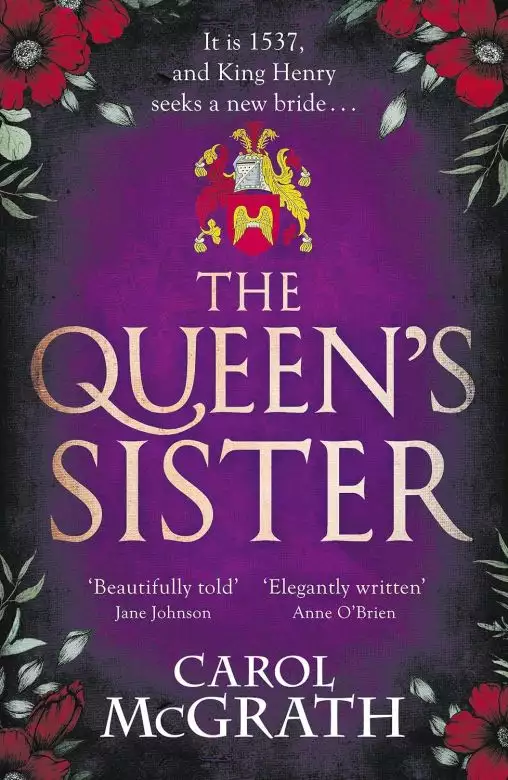
The Queen's Sister
- eBook
- Paperback
- Audiobook
- Book info
- Sample
- Media
- Author updates
- Lists
Synopsis
A mother, a wife, a woman of substance...
At nineteen, Elizabeth Seymour is already a mother, has been recently widowed, and seen her Queen, Anne Boleyn, lose her life. Against the wishes of her father, she heads North, away from Wulf Hall and the court in London to Yorkshire, determined to establish a new beginning as a landowner and business woman. As her family in Wiltshire curry favour with King Henry, aided by Thomas Cromwell, Elizabeth makes Kexby Manor her home, finding loyalty among her people there.
Soon, news comes to Elizabeth of the King's desires for her sister, Jane and while her brother, Edward, encourages her own betrothal to Gregory Cromwell, son of Thomas. It is a happy second marriage for Elizabeth, but it brings unwanted involvement in the dark plots and secrecy of the court, while in the wider country, changes in religious practice threaten to alter the traditions and values of all she has known...
THE QUEEN'S SISTER vividly imagines the story of the woman possibly portrayed in Hans Holbein's beautiful painting 'Portrait of a Lady,' and is a colourful, meticulously researched novel of Tudor life behind the scenes.
What readers say about Carol McGrath's novels:
'Another beautifully crafted, well-researched work of historical fiction from Carol McGrath'
'Brimming with intrigue, tension and adventure, The Lost Queen is a powerful Medieval tale full of atmosphere, danger and emotion and transports the reader to another world'
'The story of Matilda is strikingly brought to life with this beautiful written novel'
Release date: August 18, 2026
Publisher: Headline
Print pages: 400
* BingeBooks earns revenue from qualifying purchases as an Amazon Associate as well as from other retail partners.
Reader buzz
 Please log in to recommend or discuss...
Author updates
The Queen's Sister
Carol McGrath
Dark falls early in the afternoon. It has been a long journey from the City to Yorkshire in deep winter. At last, the moated manor house of Kexby rises through the creeping mist. It’s a mysterious rambling building surrounded by trees and hills. Kexby Manor was given to myself and my now deceased husband, Anthony, by King Henry on our wedding day. It had belonged to Cardinal Wolsey and so I have expected great comfort. Anthony told me Kexby had once long ago belonged to his own family.
After we wed, he said we should settle there and make it our home.
I objected, saying it was too distant from Wulf Hall, too far from Queen Anne’s court and my friends. I knew that Anthony liked the new Queen of England, Anne Bullen, and hoped his admiration for her might persuade him to settle in the City, not far from the centre of a courtier’s world. I wanted to be closer to my sister, Jane, and the maidens who had been my companions in the Queen’s chambers before my father decided I was to wed this much older man, a widower.
Anthony had told me firmly that we would come south regularly. He wanted me to be happy at Kexby and that his decision was made. He reminded me that the cardinal had ordered the whole interior of the Kexby manor house to be refreshed, even arranging for a fireplace to be built in the upper hall, the central hearth demolished in the lower hall, and for walls to be oak panelled in the bedchamber and in the great parlour. We would establish ourselves in the north.
However, we never lived in the north after all, for Anthony was posted to the castle of Mont Orgueil on the island of Jersey, from where he would govern the island. I was only fifteen years old when our son, Henry, was born a year later. I was pregnant again when Anthony took a sudden pain to his heart. My own heart was broken after he was struck down on a windy October morn. I had come to care for him, despite the difference in our age. Mine was not a passionate love such as poets speak of, but a deep affection born of calm and mutual respect. My kindly husband was buried on the island. It was clear that I must secure my widow’s portion of Kexby Manor, and a merchant house in York.
It pained me to leave my small boy on Jersey in the castle bailiff’s care, though I understand it is not sensible to travel during midwinter with a tiny child, while pregnant with another. I passed a week during Christmastide at Greenwich with Queen Anne, who was very kind to me, and with my unwed sister Jane, still one of her ladies. Jane could not persuade me to remain for long at the Christmas court for my husband’s death is too recent for such festivities. I could not enjoy the continual music making, mumming and dancing at Greenwich so I departed for the north on New Year’s Day. Otherwise, I thought to myself, I’ll run out of money and have no dwelling other than my own family’s home at Wulf Hall in Wiltshire. My father would soon marry me off again. I decided then to make my own way in life. If ever I remarry, it will be to a man of my own choosing.
We ride into the courtyard, myself, my lady called Madeleine, two female servants and my six guardsmen. Stable boys come racing over the slippery cobbles to help with our horses. I had ridden most of the way north, sheltering from bitterly cold, harsh winds wrapped within my canvas cape and fur-lined gown, my underdress the warmest wool kirtle I could find in my travelling box. My lady-in-waiting, older by two years than I at nineteen, sat for most of the journey in a wagon, with two servants and my travelling chests.
A tall woman, wearing a sensible plain gown and coif covering a glimpse of grey hair on her brow, hurries from the porch to greet us. She is followed by a bustling, rotund man of a similar age, his kindly crinkly face creasing into smiles. My lady attendant drops a curtsey to her and the middle-aged woman does the same to me. There is a rattling, noisy activity behind me as my luggage is unloaded from the wagon and my guard dismounts, their horses neighing and stamping the ground, puffs of steam billowing from nostrils.
I assume the woman is the housekeeper. A ring of keys hangs from her belt. Seeing my glance at these, she speaks. ‘I am Mistress Eugenia Buxton, your housekeeper and my husband is Master William Buxton, steward of Kexby.’
Master William steps forward and bows. Rising, he glances up and sniffs the bitter air. ‘My Lady, welcome. Come away inside out of the bite.’
‘Hurry, Lady Elizabeth,’ his wife says. ‘Your messenger came in good time. There’s been a hot supper ready since he told us of your imminent arrival, and a warm chamber too. The manor has not had a mistress for many years and the cardinal, though much loved here in the countryside, only visited Kexby on an odd occasion.’ She crosses herself, presumably because Cardinal Wolsey had died disgraced, on his way to London from York many years before. Hurrying me towards the door she adds, ‘But rest assured we have done our best to look after it all.’
‘I thank you.’ I turn to her husband. ‘Do you have accommodation for my household guard, Master Buxton?’
‘The manor has a substantial guard house beside the stables. It’s warm and comfortable. We can send meals over to them unless you prefer otherwise.’
‘They will eat in the hall with the rest of the household,’ I say at once. Master Buxton calls instructions to the boys minding the horses and we all process through the enormous porch into the hall. The first thing I notice is the crackling, spluttering fire blazing in the hearth. A cloth-covered table is placed at the upper end. Another solid oak table is placed lengthwise. On either side benches are squeezed against it. I observe that a door along the wall opposite the fireplace must open into a screen passageway.
Mistress Eugenia ushers myself and Madeleine to the top table, which is set with silver and generously laden with food – crisped small fishes, winter salads, pies, cheeses, meats and mountains of bread rolls on platters. As I take my seat, as if from nowhere, the manor’s population appear in the hall to take up places along the board. They appear awed by my presence and are quiet as they squeeze along benches to make room for the six soldiers who will remain with me for my stay in Kexby. Master William Buxton, I see, is already conversing with my sergeant and draws him to sit at the high table with us. A white-robed priest, who I am told is Father Adolphus, blesses the supper. Warmed wine smelling of spices is poured for those of us seated along the top board. Napkins are placed over our shoulders by servants and we break bread. Determined not to appear greedy, I manage to avoid falling upon the food before me, though I am hungry as a half-starved beggar. I force myself to eat daintily as I politely converse with the housekeeper.
‘I expect you observed a quiet Christmastide, My Lady,’ Mistress Eugenia says.
It was a sensitive comment, considerate of my husband’s recent passing, so I reply, ‘I always enjoy the season but have come here from Court seeking peace and contemplation.’ I say nothing of how I was relieved to escape Court life and that even the joy of meeting my brothers and my sister could not make me less sorrowful for the husband I had lost. I add, ‘I am expecting a child.’
‘Oh, my dear lady,’ she says, glancing at my midriff. ‘You do not show. A new birthing at Kexby will be a marvellous event. We shall take great care of you. And you have a son too, we hear, an heir for Kexby. Will he join you soon?’
‘He is not two years old and for now is well cared for in Jersey but I miss him very much.’
Mistress Eugenia speaks of babies, of a nursery, of the joy my children will bring to the manor, but I am tired and only half listening, nodding and smiling graciously. Looking along the table, I am pleased to see the steward continues to enjoy a conversation with my sergeant.
‘May I ask, My Lady, when the child is due?’ Mistress Eugenia says.
‘At midsummer, and until then I shall reside here or in York.’
‘Lady Ughtred, we hope you will remain with us on the manor?’
‘I hope so too. Do you have children, Mistress Eugenia?’
‘We have three, aged seven, five and four, two boys and a girl. They are seated below. Without doubt, you will meet them tomorrow.’
I note a happy group of chattering children nibbling on bread, sitting beside a woman whom I assume is their nurse.
It is a comfortable start to my time at Kexby. The housekeeper is respectful and friendly and the servants clean; the hall is bright and warm with hangings and long windows glazed with panes of opaque glass. These prettily reflect the candlelight cast from wall sconces. A sweet apple tart is served, along with a honey hippocras. As I rise from the table to retire to my chamber, I think that I am most fortunate, though I still have concerns. Tomorrow I must attend to the business of running a manor or, at the very least, begin to understand how productive Kexby can be.
My circumstances are straitened since Anthony’s death. My husband had a previous marriage and grown children to provide for, and there is little for me. Before I climb up into my high bed, I add into my prayers that somehow I shall find the means to live comfortably here.
Spring 1535
Time passes quickly as I become used to Kexby, study the manorial accounts and learn from Master William about his management of the estate. Before I know it, the sky is a wash of blue and there are new leaves on the beech trees in the woods close by the manor. As I walk about the field paths with Master William, it is a pleasure to watch lambs gambol and nibble upon new grass. He tells me we can anticipate good wool sales in York and will enjoy fresh lamb upon our Easter table. I think back to the past winter. It was bitter and we were often indoors embroidering by the fire in the great parlour.
On other afternoons, I had passed pleasant hours in the still room with Mistress Eugenia and two girls from good families who accompanied me here from Jersey. I want them to learn how to make salves from glovewort rhus tox and grease to ease winter stiffness in the hands; to mix woodruff willow bark with almond oil to heal aches in the legs and feet; to bind mistletoe with rose juice to lay on the face to cure headaches; to pound fennel in wine for shortness of breath, which, as I swell with my child, I find afflicts me often. The still room is filled with chatter and the scent of herbs. Meanwhile, Madeleine began letting out my gowns because I can feel my fatherless child tumbling about inside my womb.
Mistress Eugenia then promised that when my time arrives, she will send to Wilberfoss Priory, only a morning’s ride away, for two Benedictine nuns skilled with midwifery. Her own cousin, another Elizabeth, is their prioress. I am young and do not fear childbirth. I said, ‘I am glad your cousin’s priory is still thriving. So many small nunneries have closed these past years. Priories such as Wilberfoss are a great loss to the people.’
In reply, Eugenia lowered her voice as if the very herbs tied to the rafters were spying upon our conversation. She glanced sideways at the two busy girls chattering at the other end of the bench. They were clearly not listening or even interested. She said, ‘In these parts nuns and monks are respected. We do not take well to change in the north.’ She shook her head, adding, ‘How will it all end, My Lady? Our people cannot understand why saints of whom they are well fond appear to have fallen from grace.’ She wiped a tear from her cheek with her sleeve. ‘You are not even supposed to use certain talismans during labour or borrow the slip of St Catherine’s shroud held in York’s cathedral. Still, we do have a piece of her girdle in our church. You could have it by you in childbirth as a comfort and a protection.’
I doubt any of these relics are genuine. There are too many bits of shroud and girdle belonging to St Catherine in our churches. ‘God will lend his protection if He wills my safe delivery,’ I replied. ‘But let us hope Wilberfoss Priory continues to thrive. I shall be glad to accept the nuns’ help.’
Like my old mistress Queen Anne, I feel we do not need a panoply of saints to speak to God on our behalf, nor do we need to purchase indulgences to aid our way to Heaven. I am unsure about the necessity for a priest to give us penances when we have sinned for I believe we should consider our own consciences and determine to do better in the future. Even so, it bothers me that many small nunneries and monasteries are threatened with closure. At Christmas, Queen Anne spoke of creating places of study and learning and new hospitals to replace monasteries and nunneries. This, I consider acceptable.
I busied myself with mortar and pestle and turned the conversation to happier things such as the little nightgowns I am trimming and hemming with embroidery for my coming baby.
Mistress Eugenia smiled. Beyond her smile, concern clouded her grey eyes and I suspect, though she would not dare speak it, she does not trust King Henry to be responsible for the souls of his subjects. Yet, she should trust in God.
Master William and I continue to walk along the edge of a field which is being ploughed. Grain is scattered by men and women tossing it from sacks. It reminds me of the scene of sowing seed in my translation of St Luke’s Gospel, a treasured gift from Queen Anne following her coronation, when I rode on horseback with her other ladies to Westminster’s great church. It was a day of celebration for Anne Bullen but sadly Londoners did not welcome her as their queen. They had loved Queen Katherine, banished from Court and divorced by King Henry. My sister Jane, who had served Queen Katherine, was now a lady-in-waiting to Queen Anne Bullen. I was so favoured on occasion when Anthony was summoned to London.
We pause momentarily to watch the grain fall in little showers into furrows. Although we own flocks of sheep and the Kexby lambs are plentiful, Master William has concerns about the coming grain harvest. The ground had remained cold and hard throughout February. Only now are ploughs turning the soil and labourers scattering the seed. I study the boys standing about the fields like scarecrows, flapping ragged arms and making noises with clappers to frighten away the greedy thrushes and blackbirds attempting to stalk the furrows and steal the precious kernels. Birds are nesting in the trees and hedgerows. They will have young to feed but so do we.
Master William studies the sky. ‘As long as it remains fair, we’ll get the planting done without mishap, but the harvest will be late this year. Let us pray for fine weather and soft showers at the right time.’
I nod my agreement though I know little about farming. I had been a lady of the Court and castle, and my knowledge of the countryside has, until now, been limited to falconry and summer picnics. My father, after all, is guardian of the great hunting forest at Savernake in Wiltshire. I whisper my own prayer to Christ that Kexby will not fall into debt during my first year here. Master William has told me it’s been a struggle to break even; to make repairs to fences where needed, to upkeep the manor house and church.
We stop, lean on a fence and look over a fallow field full of grazing sheep. He says, ‘The manor farm has not made any profit since before the cardinal owned it.’
For a heartbeat, I glance up at clouds chasing through the sky, echoing the shapes of the sheep and lambs in the field. I determine to right this deficiency. As I catch the soft spring scents of primroses and hawthorn from the verges, a tiny gem of an idea comes to me. I turn to my steward. ‘Kexby must become more profitable than from sacks of raw wool alone. If you still have stores of last year’s fleece, we could spin and weave it here and sell cloth in York.’ I think for a moment. ‘Master William, say we make changes, employ our own weavers and sell a fair amount of finished cloth? I am sure the labourers’ wives spin their own wool into thread and would be happy to be paid to spin extra.’
His forehead creases into lines as he appears to consider my words. After a moment of thought he says, ‘Yes, ’tis true, the manor once turned a fine profit with the weaving of cloth. Cardinal Wolsey had no interest in it. He had other sources of income. No need to have weavers here anymore, was his thinking. Still, not so long ago, worsted was woven here at Kexby and good worsted always fetches a reasonable price.’
‘We can do better than worsted. Ladies at Court wear mixed fabrics these days. I myself have gowns of silk and linen woven together. The patterns can be interesting, flowers, leaves, insects for example, and the colours are attractive. Besides, such fabrics can bypass sumptuary laws and so they appeal to merchants’ wives who like to imitate the nobility.’ My voice grows increasingly determined. I look up at him. ‘Can you investigate weaving, Master William? I am sure it is worth doing so. We’ll need to employ competent weavers to take on such a project.’
Master William looks doubtful. A long moment passes until, at last, he gives me a warm smile, which to my relief reaches his eyes, making them glow like the moon on a summer’s night. ‘We can give it a try, Lady Elizabeth, in a small way mind. We can see if it’s possible. I must go to York next week with Cook. I have contacts amongst the city wool merchants, and I’ll try to attract weavers to Kexby again.’ He adds with firmness, ‘If we weave cloth here, it should be cloth such as the worsted we sold in the past. It’s what buyers want. And we’ll need it fulled and dyed, but there’s plenty of such mills about us here.’
‘Then let’s keep this year’s cloth simple,’ I concede. He knows more on the subject than I do, and if we are successful and turn a profit, we can try out new fabrics next year.
Eastertide creeps up on us and Master William returns from York with good news. Four weavers will come to us in May. They’ll set up looms in empty cottages, which we will make ready for them with the thatch mended, fresh limewash, cleared kitchen gardens, straw on the floor and basic furniture. I am pleased with the outcome, even if the first weave is to be the serviceable worsted.
‘One of the weavers can weave scarlet from our finest wool, My Lady,’ William says proudly.
‘Can he weave patterns into it?’
‘Yes,’ he says. ‘Nothing fancy, mind. Maybe that of a repeated oak leaf.’
‘Of course,’ I reply. ‘If we make enough profit from our cloth this year, we shall invest in linen thread and try a new mix next year.’
Master William has purchased spices and new beeswax candles for Easter. We keep some for our table and give a supply to the village church for the Easter procession. Father Adolphus tells me the villagers will be pleased that there are to be no changes to the Easter masses and asks if I will come to church on Friday next.
‘I’ll attend the procession,’ I say with enthusiasm. ‘We must make sure the villagers all have lamb to eat for their dinner on Easter Day. Why not open the second hall to our people?’
‘They will be grateful for your kindness,’ he splutters, while coughing.
‘Let them know, Father, and I shall send you a posset for that cough later. Red clover in an infusion with honey will ease it.’
I have come to like the stately, thin Father Adolphus, even though he clings to all the old ways. He uses the Latin Vulgate Bible for the Mass, which people do not understand, and he loathes what he calls Lollard influences, the pernicious ways of new evangelicals. This makes him popular with the villagers. Of course, Father Adolphus is a Cistercian. He wears a white surplice, which, on dull shadowy days, makes him appear ghostly. I have noted how he moves quietly as a shadow. He would be standing beside you before you know it.
On Good Friday, my household processes through the garden gate to the church path where we join the villagers and Father Adolphus, who leads us inside. I am wrapped in my squirrel fur-lined cloak and new sheepskin boots, a gift from the village cobbler, warm my feet.
It is a day filled with the smells of wet wool, bodies in need of a wash, and candlewax. I feel sorry for those who are barefoot as they slowly creep forward along the nave to the cross and do not rise until they kneel and kiss Christ’s feet. Many of my own household, too, crawl to the cross, including Master William, his beard neatly trimmed as is tradition on Sharp Thursday. I am not expected to kneel before the cross on account of my large belly, though my two maids and Madeleine do not either. And to my surprise, nor does Mistress Eugenia. She complains of aching knees. I listen closely to the Latin Mass, understanding the verses well. Others may not grasp the language, but they know the Passion story from the paintings on the church’s south wall.
Father Adolphus reads the relevant verses from the Gospel of St John without coughing and I am glad the possets have helped him. Shadows stretch along the nave, cast from those who remain kneeling on the cold paving stones as, one by one, church candles are extinguished until only one central candle remains lit. Christ’s sacrifice gives us light and hope. Uplifted, we file out into the chill grey day, back to the manor house through the blasts of sleet that fall. I am glad of the blaze in the hearth on our return to the hall, and I am even better pleased to eat the slices of beaver flesh doused with an almond sauce we have for dinner. It is still the Lenten season.
On Easter Day, the manor smells of spices and roasting lamb. After the Sunday Mass, villagers drift over the moat bridge into the manor courtyard. Trestles are set up in the old hall and fiddlers, drummers, as well as flute players move amongst my people. I greet everyone, by now knowing most of them by name, and wish them joy and good health. I distribute eggs, their shells coloured golden by boiling in onion skins. We are overjoyed to have eggs and meat after the interminable winter fast. How tired I am of almonds, salted herrings and beaver flesh. But as I turn away from the merrymaking to enter the manor and my own feast with the manor’s household, Master William touches my arm. ‘I do not like the look of those strangers. Look over by the garden wall.’ I follow his eyes to glance at a group of cloaked men and, at once, turn back to William.
‘They have a sourly look on their countenances,’ he says. ‘Shall I ask the captain to watch them . . . just in case they mean us harm?’
‘Do so, Master William. You are sure they are not the weavers you have hired come early?’
‘No, these are strangers. I’ll find out whose family they might know. They have the empty look of the dispossessed about them.’
I count the intruders, five men in all. ‘Find out their purpose. They seem as if they are watchers and not part of any family here. I must go into our own feast as the household will not start without me. Do what you can, William. I’ll return later.’ I peer up at the clearing sky. ‘The sun is shining at last,’ I say. ‘Nothing must mar our Easter Day.’ I see Captain Jack, the sergeant of my guard, moving amongst the villagers. I say, ‘Ask Captain Jack to keep an eye out. Our villagers deserve their dancing and music making in peace.’
When I return to the courtyard, my captain approaches me and says he has discovered the strangers are on their way to York. They were half-starved, he says, so he allowed them to eat with the villagers. Afterwards, they went on their way without complaint. He confides to me that he overheard them talking amongst themselves.
‘They were saying if the King’s commissioners were not closing down monasteries, they could have found shelter for the night.’
I shake my head. ‘It’s true. Once the monasteries close there is little provision for those who are hungry.’
‘My Lady, those men sounded bitter and I heard them complain to any who would listen.’
‘But they have truly gone now?’ A niggling concern begins to bother me that we could be in danger.
Noting it on my face, Jack says, ‘Worry not, my men will make a patrol as dusk falls, just to be sure.’ He nods at the dancing couples. ‘This will go on until midnight. They are grateful to you for providing such a feast.’
His words make me glow with happiness. I instinctively touch my midriff. I hope Prioress Elizabeth comes to us soon, and I make a silent prayer to Christ that the commissioners, whom I know to be investigating small priories throughout the land, will not threaten Wilberfoss Priory with closure.
Our village life resumes as normal and spring turns into summer. I take up my embroidery again and each evening stitch tiny garments. My time draws nearer. Some days I think wistfully of Henry until, finally, a letter comes from Jersey, one penned before Eastertide. I read:
Your son Henry thrives.
How I long to see my boy before he forgets he has a mother. I write back:
Please make arrangements for Henry and his nurses to come to me in July. I shall send a guard to escort them to us.
Now, I must wait patiently for a reply from Jersey.
The woods are spread with bluebells. Our weavers arrive and are busily working raw new wool into cloth. The village women have already earned extra coin by spinning the wool as fine as they could. Master William organises the fulling and dyeing of the cloth for us. We are keeping it plain, mostly brown worsted, but they weave red and blue scarlet as well for wealthier customers. The blue is a rich cerulean shade, the brown as rich as oak wood and the red the colour of rowan berries. I am proud of what has been achieved.
‘The red has depth,’ I say to William, who has brought me samples. ‘When will we have enough to sell?’
‘Michaelmas soonest. Meantime we are selling extra fleeces in York since we need to pay the weavers.’
‘And the grain . . .?’
‘Coming along, My Lady. We’ll have enough to keep us in bread for the coming winter.’
I am content, and now I anticipate a visit from Prioress Elizabeth, for very soon I shall withdraw from the world until my child is . . .
We hope you are enjoying the book so far. To continue reading...
