
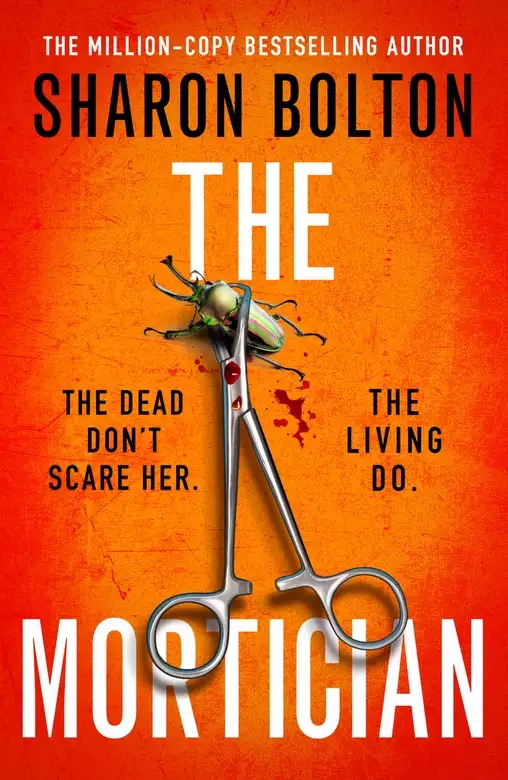
The Mortician
- eBook
- Hardcover
- Book info
- Sample
- Media
- Author updates
- Lists
Synopsis
Prepare the body. Don't ask questions. Protect the ones you love.
Mortician Ella Foxton has built her life around honouring the dead and guiding them to their final resting place. Her peace is shattered when Jonny Massey, a notorious gangster, arrives at her small funeral parlour demanding she provide a lavish funeral for his brother Jimmy.
As Ella prepares Jimmy's remains, she soon realises it's not just a body Massey wants buried, but a lifetime of violent secrets. Secrets that may just tie the Masseys to a double murder investigation headed by the tenacious DS Brian Rushton.
Caught between a live investigation and warring gangs, Ella must decide how far she'll go to bring the truth to light.
After all, the dead can't speak, but every body tells a story . . .
PRAISE FOR SHARON BOLTON
'Will have readers looking nervously over their shoulder with every page they turn' Mick Herron
'Propulsive . . . buckle up for some high-stakes drama' Guardian
'Filled with intrigue and suspense . . . Spellbinding' Clare Mackintosh
'Menacing and complex' Observer
'A master thriller writer' Jo Spain
'Nail-biting, heart-pounding suspense that leaps from one dizzying twist to another' J.P. Delaney
'One of my favourite crime writers' Jane Casey
'Horrifying and addictive' Catherine Cooper
Release date: November 5, 2026
Publisher: Orion
Print pages: 336
* BingeBooks earns revenue from qualifying purchases as an Amazon Associate as well as from other retail partners.
Reader buzz
 Please log in to recommend or discuss...
Author updates
The Mortician
Sharon Bolton
The chiming of the nearby church clock was a normal sound, comforting, something the little girl had known every day of her five years of being alive, and so she did not stir. The chimes went on: eleven, twelve. Silence reached for long seconds, stretching towards the minute.
A silence that was broken, then, by a whirring and a tapping, a clattering, rattling sound, neither normal nor comforting. Still sleeping, the little girl tried to push it away. This sound was wrong.
Clickety, clickety, click; giant insects with gleaming carapace shells and probing antennae scuttled into the little girl’s dream. Swarms swept down the walls of her bedroom. Over the rose-pink carpet they came, climbing up the bed covers, higher and closer. The nightmare bumps – her own heartbeat turned audible – sounded loud in her dreaming ears. The little girl woke, panting, damp with sweat.
Summer this year had brought an unprecedented heatwave. Around town the dry earth cracked, flowers wilted, and by noon the pavements had become too hot for dogs to walk on. On the moors, scrappy fires sprang up as though sparks had fallen from above in lieu of rain. They burnt brightly, fiercely, but died quickly for want of fuel; the coarse grass had long since shrivelled to dust.
The little girl was plastered with sun cream before she left the house each day, and at school afternoon playtimes were cancelled for fear the children would succumb to heatstroke. Nighttime brought some relief, but not enough; even with every upstairs window left open, the air inside the house was stifling.
Sometime, in the last few seconds, the rattling had stopped.
She blinked, and only then knew for sure that her eyes were open – something else that was wrong. Her bedroom was never this dark. It was a night of the dark moon; the brief time, never more than two days, when the moon became invisible in the sky. The little girl’s mother always knew exactly where, when and in what shape the moon would appear, and the two of them sat often at the window before bed, looking out at it. So, there was no moon in the sky tonight. But there was a streetlamp almost directly outside the house that usually flooded the room with soft, yellow light.
Not tonight.
As her eyes became used to the blackness, the little girl’s room appeared around her. She could make out the white wardrobes to either side of the door and the slender bars of her brother’s cot. She could hear his soft panting and a faint whistle, not quite a snore, as he took in each breath. The curtains, pale pink and patterned with unicorns and rainbows, bounced in a rare breeze. The little girl was never entirely at ease when she woke in the night, but this seemed normal enough. The sound of her frightened heartbeat faded.
Then resumed. Because the rattling was back. Awake now, she could pinpoint its source. It was coming from outside, from beneath her window. She clasped her eyes shut and huddled beneath the damp sheets. And then another sound, from downstairs this time; the sound of a cupboard or a door being opened. Something fell over, as though someone was walking around in the dark.
The little girl wanted nothing more than to go back to sleep, to pretend none of this was happening.
Click, click, click: the sound of leather, or wood, bouncing against the same material. There was something mechanical about the sound. It stopped and was followed by the familiar creak of an adult’s weight on the stairs. She shifted, and her long hair caught beneath her body, as though someone had pulled at it. Gasping, she sat up.
From what little she could make out, everything looked as it should: her bed, to the right of the window, her brother’s cot to the left, the play-tent which frightened her at night because she could never be sure there was nothing hiding in its shadowy interior.
Her brother slept. His sleeping bag had been discarded in favour of a lightweight sheet, but he’d kicked it off. He lay on his back, in nothing but blue-striped pyjamas, his little fists clenched by his ears.
The rattling sounded again.
Without thinking, or she might never have done it, the little girl pushed back her sheet and stood up. Something outside was making that noise and curiosity was getting the better of fear. With both hands she took hold of the curtain edges and made the smallest of holes through which she could peep.
The house she and her family lived in was old, as were all the houses on their street. Over a hundred years ago, when the town was one of the busiest in the Northwest, they’d been built for the people who worked in the factories, with tiny front gardens, no bathrooms and a toilet in the back yard. Her mother had told her all this and, also, that one day they’d move to a new house with a big garden that she and her brother could play in – but for now, the house was solidly built and warm and would keep them safe.
At first, the little girl saw nothing out of the ordinary. Cars lined the street as they always did. There were no lights in the houses opposite, but that was normal too. The white van parked outside the house was unusual, but not so much as to alarm her. The streetlamp directly outside had gone out, which explained how dark it was, but other lights in the street were shining. Then a figure stepped out from behind the white van, followed by a second. Big boys, she thought, not men, because neither looked as tall or as broad as her dad. Both were dressed in dark clothes and one of them held something in his right hand. He raised it aloft and started circling his hand at the wrist. The rattling sound rang out through the night.
Heart hammering, the little girl pushed the edges of the curtain even closer together. Other than the continual circling of a wrist, neither of the boys moved. Then the other stepped closer to the front gate and looked directly up.
Not a boy at all. A monster. The most horrible thing she’d ever seen.
‘Don’t you worry, Mrs Cousins, we’ll soon have you bright-eyed and bushy tailed for your big day. How’s the water for you?’
The water on Ella’s hands was tepid, cooler than she’d have wanted running over her own head, but no complaints were forthcoming.
‘This is a new brand I’m trying.’ Gently, she wrung the excess water from the woman’s hair before squeezing out the contents of the metal tube. She worked in a spiral, starting at the crown of the head and moving outwards. ‘Nice and gentle. No scary reactions to worry about and it’ll cover the grey nicely.’
Mrs Cousins didn’t reply but she’d never been a talkative woman. It took Ella only a few minutes to massage in the hair dye – caramel, a nice soft colour, flattering to older complexions – and then she set the timer for thirty minutes. Stifling a yawn, she glanced at the clock before moving on to her next client.
‘Now, Mrs George, let’s get your make-up sorted, shall we?’
Ella removed and discarded her gloves before pulling on a fresh pair. She applied moisturiser to Mrs George’s dry, sagging face, easing the skin of her neck round to minimise the appearance of wrinkles. A subtle clip behind the head might help, and her hair would hide it. Holding the colour chart by her client’s face, adjusting the overhead lamp for better visibility, she chose a foundation shade and began applying it with a soft sponge. She used a second sponge to remove any excess – she’d learnt from bitter experience not to overdo it – before applying blusher, concealer, powder and mascara. She removed stray hairs from the woman’s eyebrows before pencilling in the sparse patches. From a drawer labelled Susan George, she took a small pair of earrings. They held no value but were pretty. With a lipstick, she applied soft colour to the woman’s lips.
‘Beautiful,’ she said, which was pushing it a bit, but Mrs George certainly looked a lot better than when she’d arrived.
The woman’s clothes were hanging nearby. Ella kept the gown in place as long as she could to preserve her client’s dignity as, piece by piece, she dressed her. Bra, knickers and tights caused the most difficulty, but she’d moisturised and powdered the woman’s skin earlier in the day. The dress chosen by the family was summery, a pale pink spotted with blue flowers. The shoes, too, were pink. When there was nothing more she could do, for this client at least, Ella used the hydraulic lift to transfer the woman back into the storage fridge. She’d be put into her coffin the next morning, an hour before the cortège was due to leave.
‘You get a good night’s sleep.’ Ella smiled as she closed the cabinet. ‘Big day tomorrow.’
Ella reached up towards the ceiling, arching her back. She’d been at it for sixteen hours straight, but the outbreak of summer flu six weeks ago had taken everyone by surprise. Not least the country’s undertakers.
With a few minutes remaining before Mrs Cousins’ dye needed to be rinsed out, Ella crossed to her desktop and found the video she’d made earlier. Six hours ago, make-up fresh, hair in a neat French plait, she’d looked a whole lot better than she did now. Her scrubs were freshly laundered, and her visor threw a soft focus over her face; one that was almost as good as a Photoshop filter.
Behind her, the prep room was immaculate. When she’d first thought of creating an Instagram account, Ella had invested in a complete refurbishment, one that hadn’t proved easy, or cheap, in the old building. It had been worth it. The worktops, which ran around three sides of the room, were a soft, robin’s-egg blue while the cupboards, most lockable, shone an icy white. The steel and chrome were polished to a mirror-like shine. It looked like a high-end medical facility.
‘A lot of my clients like to supply their own make-up,’ the slicker, earlier version of Ella explained to an unseen audience. ‘It doesn’t work, I’m afraid. The complexions I’m dealing with need a different approach.’
The camera panned back at that point, almost professionally – she really was getting quite good at this – to reveal the dummy head and her open case of specialist cosmetics.
Back on screen, Ella said, ‘Now, let’s make this lady beautiful.’
The film sped up, showing Ella applying base, primer, foundation, concealer, contouring, blusher, highlighter and, finally, touches of colour. She finished with rose pink on the lips. The music playing was James Blunt’s ‘You’re Beautiful’. Cheesy as hell, but often as not, cheesy worked. Finally, she added her now-trademark hashtag: DeathDoneDecently. Satisfied with how the piece looked, she opened Instagram and posted it. She’d check the stats in the morning. Nighttime was always quieter, but her US followers would still be up, and she was getting quite a fan club in South Asia.
‘Fuck, is that a stiff?’
Ella spun round to see a boy of maybe fifteen staring down at the remains of Mrs Cousins. He was tall and thin, with red hair and pimples. He stepped closer, seemed on the point of reaching out to poke the woman’s cheek.
She snapped, ‘Don’t you dare touch that lady!’
How the hell had he got inside? Her doors were locked – the double doors that allowed access from the yard, the back door that led directly upstairs to the flat and the front door, the one that led into reception from the street. The windows, too, had secure locks. Ella never worked alone in an unlocked building at night.
Heart thumping, she told herself to show no fear. Most people were nervous of the dead; with luck, he would be too. ‘You can’t be in here,’ she told him. ‘You need to get out. Now.’
In response, he inclined his head towards the front of the building. ‘You’re wanted,’ he told her. ‘Look sharp.’
‘Who are you? How did you get in here? And – no, don’t bother – I’m calling the police.’ She’d reached behind to where she was certain she’d left her phone. Nothing came to hand, and she didn’t like to turn her back on the lad.
‘Good luck with that,’ he said. ‘Boss is out front.’ He waited a second longer, then, ‘Sod it, I’ll let him in.’
And with that, he was gone, banging the door between her workroom and the parlour. With no choice, conscious that the dye on Mrs Cousins’ hair would soon need rinsing, Ella followed, spotting and grabbing her phone on the way.
Three coffins, side by side, were almost more than her small parlour could hold, but they’d all be gone before close of play tomorrow; correction, today, it was already past midnight. Three funerals in one day. Before the flu it would have been unheard of. She reached reception a second after the boy.
The street outside, visible through large windows both sides of the glass-fronted door, was old and black, its stonework stained by over a century of mill smoke. The buildings were tall and, from certain angles, seemed almost to overlap, cutting off all light the sky might otherwise offer. Determined sunlight sometimes made it down to the flagged pavements and cobbled road; moon and starlight, never.
In this dark street, a group of people waited. Closest to the door was a thickset, bald man in his mid-sixties, wearing a suit but with a high-necked cravat in place of a tie. Other large, heavy men stood near him, and several boys of a similar age to the one who’d broken in – who was looking at her now, expectantly. ‘Where’s the key?’ he demanded.
Heart thumping, Ella said, ‘Who are these people and what are you all doing here in the middle of the night?’
‘That’s the boss,’ he replied. Then, with an expression that said she was clearly stupid, ‘Jonny Massey.’
That name meant something.
‘Well,’ she said. ‘This won’t do. I’m not open for business, not until nine o’clock tomorrow morning, and I prefer appointments to be made in advance, by telephone.’
The big, bald man stepped closer to the door and raised his fist. He knocked four times, looking her directly in the eye.
‘I’d let him in if I were you.’ The ginger-haired boy had taken a chair, feet crossed at the ankles, arms folded, as though waiting for a show.
‘What does he want? ‘
A low-pitched snigger. ‘You thick or something? He wants a funeral.’
Without another word, Ella moved around her desk and pulled open the top drawer. The door key was inside. Ignoring the boy’s outstretched hand – he’d pushed himself to his feet again – she stepped around him before unlocking the front door and pulling it open. The ringer sounded, which it would continue to do until the door was closed again.
The big, bald man stepped inside. ‘Miss Foxton?’ The bell was still ringing.
Ella inclined her head. ‘And you are?’
He held out a hand. ‘John Massey. Friends call me Jonny.’
His hand felt big and cold and very strong. Oh God, she knew who he was now.
Massey turned his head to the street. ‘Fuck’s sake, you lot, get inside or piss off. I can’t hear myself think.’
Suddenly, the small reception area was a mass of movement as everyone in the street crowded inside.
Massey was a gangster. An actual gangster. Complete with gang.
‘Carl, Jace, watch the street,’ Massey snapped, and two of the boys slipped back outside. Leaving eight people in her reception.
Everyone in the Northwest knew the Massey name. They’d featured on the news only the day before. A shooting at one of the nightclubs they owned.
These people were murderers, armed robbers, drug and people smugglers. They were the very worst of humanity and she was alone with them at midnight as they made themselves at home, peering at her certificates on the walls, reading the dedications in the thank-you cards set out on the dresser, sniffing the flowers.
Conscious that she was shaking, Ella walked behind her desk. At the very least it would put some distance between her and the rest of them. She should have agreed to the panic button, she realised, but it had seemed an unnecessary expense when Olly had suggested it. Nobody kicks off in a funeral parlour, she’d argued.
As one of the boys took a tissue from the box she always kept on the side table she told herself to get through this, whatever it was. Survive the night. Tomorrow – no, as soon as they were gone – she could call the police, tell them she’d had no choice but to let them in, that one of them had broken in somehow. The police would understand. She just had to get through the next … how long were they planning to stay?
‘Please, have a seat,’ she said to Massey, hoping her voice sounded smoother than it felt in her throat.
The ginger-haired lad was flicking through one of her albums, the one that showed the various coffin and casket options available. Another lad was peering inside the urn samples, as though expecting to find them otherwise than empty. A third was hovering in the doorway between reception and parlour. The other four were men, large and silent, who took up positions behind the boss and kept their eyes focused on the middle distance.
‘Please don’t go through there,’ Ella said to the boy in the doorway. ‘It’s very disrespectful to the dead.’
‘You three, steady down.’ Massey squeezed himself into a chair and movement in the room stilled.
‘So, Mr Massey, what can I do for you?’ Ella asked.
‘My brother passed away yesterday.’
‘Saturday, Jonny,’ one of the men corrected him. ‘It’s Monday now.’
Of course. A man called Massey had been shot at the nightclub on Saturday evening.
Ella said, ‘I’m very sorry for your loss.’
She waited for the half-smile, the nod of acknowledgement. They were important, the little rituals of death. There it was. It became easier, fractionally, to take in breath.
‘May I ask your brother’s name?’ First step, show interest in the departed. They remained real people, valued people, even after death.
‘James Massey. We called him Jimmy.’
‘Again, my condolences.’ She raised her eyes to look around. ‘Normally, I’d offer coffee or tea but I’m not sure I have enough cups.’
She sensed a relaxing around the group. It was working, they were responding to her authority. And her politeness.
‘That’s no problem, love. And I apologise for disturbing you at this hour. But I know you’ve been working late recently, and I wanted to come in person. That would be tricky during the day. I’ve been busy too.’
She said, ‘And what can I do for you, Mr Massey?’ while dreading that she already knew the answer.
‘We’d like you to handle the arrangements. You’re spoken well of locally.’
‘Well, that’s nice to hear,’ she said, after a moment. ‘But I’m a very small business. Are you sure one of the more established firms wouldn’t be …’
‘No, love.’ He held up a hand to stop her speaking. ‘We want you. Jimmy was a fan. He used to say, when his time came, he wanted you to, you know, do the business.’ The man ran a hand over his face. ‘None of us had an inkling it would be this soon, mind.’
The police would sort it out. They’d understand she’d been coerced. No one would expect her to work for known criminals. She just had to get through the next few minutes, get them out of here.
‘He talked a lot about that stuff you wrote at Christmas, you know? The Swiss death cleansing malarky.’
‘Swedish death cleaning,’ Ella corrected. She’d been struck by the idea after reading a magazine article the previous summer. A Swedish author had come up with the term, the premise being that those nearing the end of life should be encouraged to rid themselves of everything that wasn’t either truly essential or deeply meaningful. The process not only saved loved ones the trouble and distress of clearing out the deceased’s possessions, but, allegedly, produced a feeling of release and relief. The process, the Swedish woman had argued, could be beneficial to people at all stages of life.
Shortly after Christmas, mindful of the increased amount of junk households all over the country would be dealing with, Ella had posted about it on her website, arguing for the need for people to take responsibility, as much as they could, for their own deaths, and not leave too much of a burden for grieving loved ones.
‘He was doing it,’ Massey said. ‘He spent the last few weeks clearing out crap, so I wouldn’t have to. Said it made him feel a whole lot better, was even nagging me to do it too. Hell, maybe he did see it coming.’
‘Boss,’ one of the men said, at the exact moment that Ella saw flickering blue lights out of the corner of her eye. All heads turned to see a police patrol car pull up. Ella’s heart, already racing, became almost painful.
Outside, the driver door opened, and a uniformed officer left the car, taking two strides towards the glass-fronted door. Massey got to his feet. As Ella held her breath, eyes fixed on the young male officer, she became aware of movement around her. She risked taking her eyes from the police officer, now standing directly outside the door. Everyone in the room, other than Massey and Ella herself, had pulled scarfs up over their faces. One of the youngsters had even produced a Halloween mask, a sinister green snarl of a thing with a huge, grinning mouth.
Massey and the constable locked eyes. Then a whirring sound broke the silence. The ginger-haired lad was spinning something around in his hand. So was one of the others. Clatter, clatter, clatter went the sound as every man in the room stared out at the police officer. From the shadows, the two lads who’d been left behind as look-outs, Carl and Jace, closed in on him. They, too, wore latex Halloween masks and held the noisy spinning toys in their hands.
Ella wanted to stand up, to yell at them to stop it, but the noise the lads were making was drilling into her head. It surrounded her, getting louder, until it seemed she couldn’t remember a time of silence. And something was constricting her throat, it was shrinking in on itself, as though a strong hand was wrapped around it, squeezing until the sides touched. Her head began to spin.
‘What’s happening?’ she managed.
‘Hush, love.’ Massey hadn’t taken his eyes off the police officer. ‘Not your circus, not your monkeys.’
The police officer took a step back, finally breaking eye contact and almost tumbling off the kerb. Then he turned, climbed back into his car and drove away. His blue lights, this time, were turned off.
The little girl had been screaming for several seconds before she realised she was doing it. The noise she was making shocked her, but it was impossible to stop. Her brother was awake, yelling along with her. On the landing, a light came on, and her mother appeared in the doorway, barely awake. The terror on the woman’s face relaxed when she saw both her children unhurt.
‘What’s the matter? For heaven’s sake, what happened?’
The little girl kept on screaming.
Her mother went to the toddler first, scooping him up and holding him tightly against her shoulder. Then she came to her daughter, dropping to her knees and wrapping her free arm around her. The little girl clung to her mother.
‘Monsters,’ she managed. ‘Monsters outside.’
The toddler was not so easily quieted; he yelled even more loudly.
Her mother gave a heavy sigh. ‘This again. There’s no such thing as monsters.’
‘They’re outside, Mummy. They were looking at me.’
Her mother stood, pulling against the child’s efforts to keep her close. Stepping to the window, she pulled the curtain aside and looked down at the street.
‘There’s nothing outside,’ she said. ‘You had a bad dream. Get back into bed while I calm Munchkin down.’
Shivering, despite the heat, the little girl did what she was told, wiggling over to the side of the bed furthest from the window. Her mother, meanwhile, was walking circles, in that short-stepped, bouncy way she had when she was trying to soothe the toddler. From downstairs came the sound of glass breaking and the little girl whimpered again.
Her mother sighed. ‘It’s only Daddy. I’d better go see what kind of mess he’s made. Sweetheart, snuggle down. Go back to sleep.’
Without waiting to see if she was being obeyed, the child’s mother, still carrying her brother, left the room. The little girl heard her mother’s footsteps on the stairs, then her voice calling out softly.
‘Scott? What’re you doing?’
A startled cry, a heavy moan, then a thud; her brother gave out a terrified scream.
Long moments passed before the little girl found the courage to leave her room. Several more before she could bring herself to tiptoe along the landing. Downstairs her brother continued to scream.
She’d never been downstairs by herself in the night before. The stairs were steep and narrow and the hallway beyond was dark as a cellar at night. The black void at the bottom of the stairs terrified her.
The little girl forced herself to go down the steps, one at a time. She was too small to reach the light switches, so she made her way in darkness, one step after another, her feet and ankles growing cold. A draught had found its way into the house somehow. Reaching the bottom, she turned in the direction of the only light she could see, one that was coming from the kitchen.
Her mother and brother lay on the hall floor. Her brother, trapped beneath his mother’s body, was purple with terror and screaming as though his throat might tear apart. Her mother lay still. Creeping closer, terrified now, the little girl approached the prone woman. Blood was pouring from a wound on her head. She felt it, warm and sticky, on her fingers.
‘Daddy!’ the little girl yelled. ‘Daddy, help!’
No one answered. No father came to the rescue.
The little girl grasped hold of the toddler and pulled him free. He was heavy for her to lift, but she managed it. On tiptoe, she inched her way along the cold tiles of the hall floor. The kitchen door was ajar. She . . .
We hope you are enjoying the book so far. To continue reading...
