
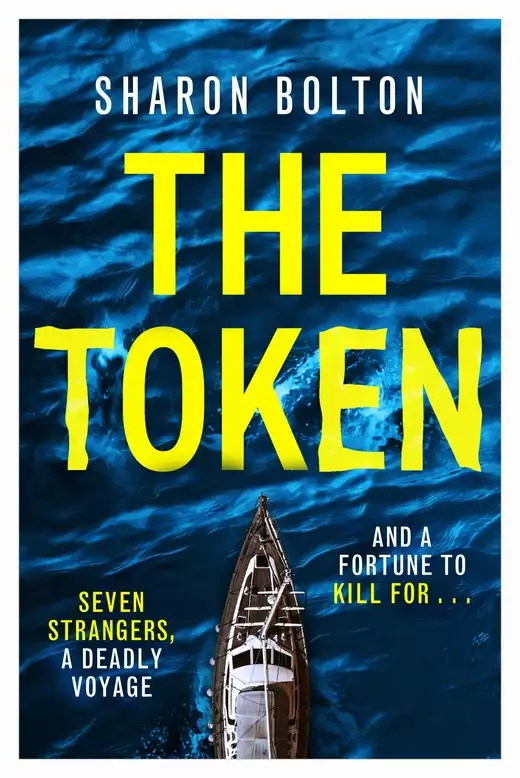
The Token
- eBook
- Hardcover
- Book info
- Sample
- Media
- Author updates
- Lists
Synopsis
Seven beneficiaries. Seven people who stood to gain a huge amount of money, for a reason none of them yet understood.
Seven strangers receive a mysterious note informing them of their impending inheritance of billionaire Logan Quick's fortune. They each receive a token and soon embark on a doomed cruise where they will have to conquer their own demons, and each other, for a chance at the money.
But someone on this boat has something to hide.
Can the survivors work out the truth... or are they destined to drown?
Release date: November 6, 2025
Publisher: Orion
Print pages: 400
* BingeBooks earns revenue from qualifying purchases as an Amazon Associate as well as from other retail partners.
Reader buzz
 Please log in to recommend or discuss...
Author updates
The Token
Sharon Bolton
The water hit her full in the face, a foretaste of what drowning would feel like.
Gasping, Holly struggled to keep upright on the drenched seat. Beyond the sails, she saw the swell of the ocean, mustering its strength, getting ready to throw them into the night again. Each time they slammed down into water that felt solid as rock, she felt sure the hull would shatter.
She clenched her eyes shut and tried to picture her son’s face. Pale skin, big dark eyes, curly hair that he hated getting cut.
Closing her eyes didn’t help. With her eyes closed the sounds of the Atlantic at night amplified. The sea sucked at the boat, as though trying to eat it whole, and the wind was a constant presence: racing through sails, dancing around the mast, tormenting the numerous ropes until they rattled like old bones.
‘Big one,’ muttered the skipper. He was a man in his mid-fifties called Thomas, with fading red hair and a faint Cornish accent. Holly had met him hours earlier, had handed him her life with a brief shake of the hand. He’d promised them his boat, a forty-foot sailing yacht called Gemini, which was more than capable of taking eight people to St Helen’s on the Isles of Scilly. The night crossing would be dull, a bit cold, but he had to be back in Plymouth by midweek.
They’d set out on water still as a mill pond, gleaming gold in the setting sun; the storm had come from nowhere. An experienced sailor might have spotted the cumulonimbus clouds on the western horizon and known that severe weather was imminent. Holly had not. Which rather begged the question – why hadn’t the skipper?
From Plymouth Sound, Thomas had aimed for Lizard Point, the most southerly tip of Cornwall, informing his crew that the wind was a steady northwesterly, sixteen knots, perfect sailing conditions. Tug, one of the other passengers, who didn’t seem affected by the rolling, rocking motion, had cooked supper. All had been well. But then the wind had strengthened, tipping the boat over at what felt like an impossible angle and most of their small group had been unable to keep their food down. A relentless darkness had fallen, and the land became a series of distant lights. Rain fell and the wind started to gust. Those not required on deck had gone below.
And now, somewhere between two and three o’clock in the morning, three people were on watch: Holly, the skipper and a man called Craig who’d spoken little since the storm broke. He sat beside Holly on the starboard cockpit seat, his gaze fixed on the ocean.
The two-metre wave, the promised ‘big one’, rolled beneath the hull and then they were roller-coasting down the other side. Almost immediately, the next wave broke over the bow, surging up the side decks, cascading over the cabin roof. Holly turned her head to avoid taking it full in the face.
Some way behind the boat – impossible to judge distances at night – she caught sight of two tiny lights, one red, one white. Thomas had told her to keep a look-out for other vessels; the big ships moved fast. She was on the point of mentioning it when both lights vanished.
‘It’s pushing thirty-five knots,’ Thomas said. Craig answered with a grunt.
There was something up with these two. Hours earlier, Holly had begun to suspect they didn’t get along, and that made no sense, because if it hadn’t been for Craig’s old friend Thomas, who owned a boat, the trip wouldn’t have been possible. But she’d seen none of the ease in each other’s company, heard none of the banter, that signified old mates. They’d spoken together rarely and only then in hushed voices.
‘Where are we?’ she asked, finding her voice.
Thomas didn’t look her way. ‘About five miles further west than when you last asked.’
He hadn’t struck Holly as being a talkative man, but he’d grown increasingly silent, even sullen, as the night passed. She wondered, and it wasn’t a comforting thought, whether he too was alarmed by the turn the weather had taken.
‘Holly.’ Thomas turned her way. ‘I’m getting odd readings from the chart plotter. Could you go below and check what position the instruments are giving you? You’ll find paper on the chart table. Write it down.’
Below was the last place Holly wanted to be. Going below made the nausea twice as bad. But she did need the loo. She got to her feet, bracing herself against the tilt of the boat.
‘You can put the kettle on if you want,’ Craig said.
He was joking. She hoped. There was no way she was handling boiling water.
‘Close the hatch behind you,’ Thomas warned.
The cabin was even darker than the last time Holly had been below. In fact, pitch black. It smelt of sweat and vomit, of diesel and the remains of supper that only Tug, Craig and the skipper had been able to keep down. Two indistinct forms lay on the two bunks: Tug would be one, Robin the other. One of them was snoring in a steady, rhythmic fashion. Tara and Sabri, two of the other women on board, were in the starboard stern cabin, while Cheryl, too large to share, was in the bow cabin by herself. When the current watch ended, Tug and Robin would go up top with Sabri and Tara. Cheryl had been excused watch duty.
Using memory alone, Holly found the door of the toilet, or the heads, as she’d been taught to call it. The tiny cabin stank like the public lavatories in Exeter city centre. The light switch didn’t work for some reason, but she could hear liquid sloshing about on the floor. Refusing to speculate about its nature, she tugged off her lifejacket and coat. The boat bounced, throwing her against the fibreglass wall. Bracing herself, she pulled down her jeans and managed to land on the tiny toilet.
Back in the main cabin, a figure made her jump, but it was only Tara, in fleece pyjamas, fluffy socks on her feet, which she’d regret if she was heading for the loo. She carried a tiny torch that shone a beam of bright light in the gloom. A loud snore rang out.
‘I can’t believe they can sleep in this.’ Tara kept her voice low. ‘I heard Tug say the wind was a force six gusting seven.’
‘Is that bad?’ Holly asked.
Tara shrugged; she didn’t know either.
‘How’s it going up there?’ Tara glanced at the hatch. ‘Still raining?’
‘Hard to tell where the water’s coming from.’ Holly groped her way towards where she remembered the chart table being. There’d been a series of tiny lights on it earlier, but they all seemed to have gone out. As though the boat had lost all power. Tara’s next words stopped her. ‘I hope we’re doing the right thing.’
Holly opened her mouth to reply and found herself flying through the air. She crashed into the chart table and for a moment was conscious of nothing but pain. A deafening crashing sounded from above, followed by the scraping of running lines. In the cabin, crockery rattled in one of the cupboards and the cutlery tray flew open, scattering utensils across the floor. As the boat righted itself, Tug sat upright.
‘What the hell?’ He seemed fully awake. ‘Who’s on deck? And what happened to the frigging lights?’
‘I’m on deck.’ Holly had no memory of getting to her feet, but she was clutching the companionway rail, heaving herself up the steps, pushing aside the hatch as the boat tipped again.
Chaos. A sea-soaked, bewildering scene of chaos.
Water was surging over the port deck. The boom, the huge, reinforced tube of aluminium that held the main sail in place, was swinging from one side of the cockpit to the other. There was no sign of either the skipper or Craig. Ignoring the pain in her ribs, Holly stretched up to look over the cabin roof towards the bow. Both men had vanished.
The boat swung again, tipped again, and a torrent of water came racing along the starboard deck.
‘Skipper!’ she yelled. ‘Craig!’
The guard rail was under water. They were going over this time, and there was nothing she could do to prevent it. She clung hard, could feel herself falling.
Holly slid along the cockpit floor, could see the ocean beyond the stern, a great, gaping maw, greedy to claim her, and came up hard against the wheel. As she clung on, thinking of nothing but survival, the boat straightened and veered round, bringing the boom crashing across the cockpit again.
‘What’s happening?’
She twisted round to see Tug, his coat unfastened, no life jacket, yelling at her from the cabin steps.
‘Craig and Thomas are gone.’ Holly had to shout to be heard. ‘They’re not on the boat.’
Muttering a curse, Tug pulled himself into the cockpit, ducking low to avoid the swinging boom.
‘Hold her steady,’ he called. ‘Put the engine on.’
As Holly fought her way round the wheel to the engine controls, she saw Tug grab the main sheet, the rope that controlled the huge sail, and haul it in. She pressed the On button. Nothing happened. There was a Start button too, so she pressed that. Nothing. The buttons seemed dead. She noticed, then, that the electronic instrument panels had gone dark.
Tug, behind her now, pulled her to her feet.
‘See if you can see them,’ he yelled into her ear. ‘Keep hold of something. Robin, get up here!’
The other man, Robin, appeared on the cabin steps.
‘We’ve got a man overboard.’ Tug was still bent over the engine switches as he yelled at the new arrival. ‘Get to the radio. Press that red button, the one with the plastic cover. Hold it down for five seconds then release. Holly, can you see them?’
Holly had both arms wrapped tight around the back rail. ‘Nothing,’ she shouted back.
‘The life jackets have lights,’ Tug yelled. ‘You’ll see them. What the fuck is wrong with this engine?’
So much black water. Holly blinked. Was that …?
She felt Tug grab her hand, then close it around a rope. ‘Hold this,’ he told her. ‘Let it go when I say so. I need to reduce the jib.’
There was something in the ocean, but it was so hard to judge distances at night.
‘OK, release it slowly,’ Tug was saying. ‘Keep your eyes on the water.’
The rope burned through Holly’s hand as Tug wound half the big sail away. Behind her, in the cockpit, she heard Tara’s voice.
‘Tug, Robin says he doesn’t think the radio is working. Can you come and look at it?’
Something that could have been a light. There it was again. Gone in an instant, but this time, she was sure. ‘I saw a light. Tug, I saw a light.’
She glanced up at the tall man by her side. In the darkness, his face seemed frozen in terror.
‘Tug!’
He seemed to pull himself together. ‘Point to it,’ he told her. ‘Don’t take your eyes off it. Not for a second.’ To Tara he called, ‘Get Robin up here. I need someone on the helm.’
Holly turned back to face the stern. The light was gone.
‘I’ve told Cheryl to stay in her cabin!’ Minutes later, Tug was at the helm, the only one capable of stopping the boat from being swamped by waves. His fingers clutched the wheel like claws. Even with his strength, every gust, every rogue wave, threatened to spin them out of control again. ‘She’s not mobile enough to move around the boat right now.’
Holly, Tara, Robin and Sabri were squeezed together on the starboard cockpit seat, holding on for dear life and staring down into churning black water. The relentless pounding of the waves against the hull seemed to have intensified.
Tug wiped salt water from his face. ‘OK, it looks like something happened, maybe a freak wave, maybe the boat hit something in the water, and both Craig and Thomas went overboard. They’re both wearing life jackets, so should still be alive, and our first responsibility is to find them.’
Holly glanced sideways, from Robin to Tara to Sabri. Three faces, all looking as terrified as she felt.
‘On top of that we’ve no electrics,’ Tug went on. ‘I can’t begin to explain how that happened, but there we are. I’ve switched batteries, but it makes no difference. We can’t put the engine on or radio for help. We’re out of phone range and will be for hours yet. With this cloud cover I can’t even use what little astral navigation I once knew. On the plus side, the boat looks sound, the conditions are challenging but manageable and we can use the sails. And we know roughly what heading we were following. We have to retrace our course and look for our two lost crew members.’
A shock of fear rippled through Holly. Go back? They couldn’t go back. They had to press on, as fast as they could.
‘Shouldn’t we launch the life raft?’ Tara called.
‘Not while the boat is safe,’ Tug replied. ‘And let’s all pray it stays that way. Right, that’s your job, Tar. I need you to poke your head below every five minutes. Any sign of water on the cabin floor and we rethink. The rest of the time, both you and Sabri look out for anything in the water. You too, Holly.’
There had been water on the floor. In the heads.
‘How could they both go overboard?’ Sabri looked as though she suspected Holly of sabotaging the boat. ‘Did neither of them say something? Call for help?’
‘Not that I heard.’
‘Likely one of them slipped and grabbed the other,’ Tug replied. ‘Either way there’s a good chance we’ll spot them.’
‘What if we don’t?’ Sabri asked.
‘We’ll find them,’ Tara said.
‘And if we don’t?’ Sabri insisted.
For a second, no one replied. Then Robin spoke up.
‘I guess we split the money six ways.’
I’m doing it, texted Holly. Today. I’m burning this place to the ground.
The conditions were perfect for arson. It hadn’t rained for a fortnight and the wind was light but constant. The building, with lots of old timber, would go up like a torch. In the bag at her feet were a box of Cook’s matches and a bottle of nail varnish remover. Down the corridor was a room that wouldn’t be used for the next hour, and she knew from experience that she’d find in it a lot of flammable material.
An emoji came back: a man’s cartoon face holding a hand against his forehead. At the same time, the woman across the desk put the phone receiver down.
‘Sorry about that.’ She gave Holly a tight smile. ‘Where were we?’
‘You were about to explain why that bitch in human form thinks it’s OK to read my son’s worry book out to the entire class. He’s embarrassed, humiliated and feels completely betrayed. Do you have any idea how hard it was for me to get him in the car this morning?’
‘Miss Baker.’ Lines appeared around the headteacher’s mouth like the rays on a child’s drawing of the sun. ‘Either you moderate your language, or this interview is at an end. I won’t tell you again.’
‘OK, she’s an insensitive, unprofessional bully who thinks embarrassing and humiliating a ten-year-old is acceptable behaviour. That worry book is private. My son has it for a reason. This has all—’
‘I understand he was writing in it while the class was engaged in a task.’
Holly clenched her fists. ‘That’s literally what it’s there for. He needs an outlet for his negative feelings. You’ve been told this several times. His counsellor has written to you.’
A line of boys, some of whom Holly recognised as her son’s classmates, ran past the window in the tail end of a noisy game. Charlie would not be among them. Charlie stayed in the car until the first bell of the day had stopped ringing. Charlie was always the last child to enter the school building. Apart from those who were late.
Charlie was never late. On the few occasions that Holly hadn’t been organised enough to get to the school gates on time, he’d refused to go in.
Mrs Milton sighed. ‘Miss Baker, we do our best. But there are twenty-eight children in Charlie’s class. We simply can’t give him the attention and the specialist care that you, clearly, think he needs.’
‘I was promised last term that all staff would undertake autism awareness training. Ofsted now recommends it as best practice.’
‘In ideal circumstances,’ the headteacher countered. ‘It’s something we hope to get round to in the next year or so.’
‘He leaves this shithole in less than nine months.’
With an exaggerated sigh Mrs Milton pushed her chair back a couple of inches, as though needing to distance herself from the contamination that was Holly. She said, ‘Charlie’s father phoned me last week.’
Holly told herself to stay very still. ‘He did what?’
‘I found his approach constructive. He thinks, and I agree, that—’
‘I have custody of Charlie. You shouldn’t be discussing him with anyone but me.’
‘We think it best to include both parents in our conversations about a child’s welfare. Mr Collingwood feels Charlie would thrive in a smaller environment, one more tailored to his particular needs. I understand there is a very good independent school in Weybridge that have offered him a place.’
The bell rang, loud and insistent, making further conversation impossible. Milton got to her feet.
‘You’ll be wanting to get to work,’ she said. ‘Let’s talk again when you’ve had time to think through what I’ve said.’
After crossing the room, she held the door open for Holly, giving her no choice but to walk through it. The corridor outside was busy, as staff made their way to classrooms for morning registration. Children poured through the main door and streamed up the stairs. The younger boys’ changing room, the place she’d identified as the ideal ignition point for the fire, was a short distance away. The bins were always full of old paper towels; discarded PE kit and sundry lost clothes littered the floor and benches.
Well, obviously not while the place was full of kids. She wasn’t a monster.
A school bus pulled up alongside Holly’s car before she had the chance to drive off. Unable to complain – she’d parked illegally when all was said and done – she resigned herself to at least a five-minute wait. The bus was always full, and the kids never seemed to leave it quickly or even willingly.
Pulling the morning’s post from her briefcase, she started to sort through it. A couple of subscriptions that she really should cancel because she never got round to reading them and an underwear catalogue that she pushed back into its envelope. Not something Charlie needed to see. There was an A5-size envelope with the stamp of an estate agent in the top-right corner. And it was a posh-looking envelope: good-quality paper in a colour between ivory and cream, a first-class stamp, her name and address in a calligraphic script. When she picked it up, it was heavy.
Curious, and because the bus had by no means finished offloading its cargo, Holly opened it. A coin of sorts fell out, enclosed within a small plastic square. It was a little like the commemorative coins that Charlie received occasionally from her parents to mark important national occasions – royal weddings or jubilees. This coin, though, showed no financial value, nor did it display the sovereign’s head. About an inch and a half in diameter, it appeared to be bronze but probably wasn’t, and at its centre was carved a star inside a circle. Around the edge ran a line of text that wasn’t English.
It was accompanied by a very short letter; curiously, from a firm of solicitors that she knew, which she’d had several dealings with.
This is your token. Keep it safe. Tell no one. On the event of my death, it entitles you to an equal share of my wealth. Good luck.
Logan Quick
Christ, thought Holly. Logan Quick was one of the richest men in the UK.
Cheryl Young’s alarm went off, as usual, at eight thirty, vibrating away beneath her pillow. She woke with a start.
She didn’t always dream, but earlier that morning she had, and it had been a good one. A young man she remembered from years ago, who’d smiled at her more than once as they’d cleared the glasses in the beer tent. He’d been tall, handsome and dashing, a little like a buccaneer of old. She’d never spoken to the man, didn’t even know his name. He might not even be alive any more for all she knew, but he came back into her head from time to time. The man, whom Cheryl had named to herself Nicholas, because that had always been her favourite boy’s name, belonged in the realm of what might have been. In the dream, she and the man – Nick – had been behind the tent, he’d stepped closer until she could feel his arms around her, his lips pressing closer to hers, the bubble of excitement in her stomach. She didn’t care what anyone said, she knew what romance felt like.
But the dream was slipping away, as most dreams do, and so she got up, pulling on a dressing gown and stepping into slippers. The heating never came on until nine thirty when her mother woke. For the next hour the house would be cold, and it had to be silent, but the hour was hers.
Cheryl stepped carefully downstairs, knowing from long practice which stairs creaked. As the years and the pounds had accumulated, more of them made more of a noise, but her mother slept more deeply these days. The house smelled of stale smoke, as it always did in the mornings, but opening windows would make it too cold. In the kitchen, she boiled water on the hob, because it made less noise than the whistling kettle, and took her tea through to the sitting room. She didn’t risk lighting a fire – Mum would know – but she wrapped herself in the throw from the back of the sofa and was cosy enough. She switched on the TV, using the subtitles app, until the post arrived at nine. As the hour drew near, her heartbeat began to build.
It was rare for the post to be late. When their usual postman was away and his replacement wasn’t familiar with the route, it happened; also, sometimes when the weather was bad, but Cheryl had a plan for those times. Anything she didn’t want her mother to see went straight into the meter box by the front door. Her mother checked the meters every day, but not usually until the evening.
The brochure from Saga was due. At fifty-one, Cheryl wasn’t sure she was quite old enough for Saga holidays, but she loved the photographs of people who, although older, were still so glamorous, with their beautiful hairstyles and clothes. The men always had hair – silver, true, but perfectly styled – and no one was ever fat in the Saga brochure.
The Saga brochure wasn’t about what might have been; the Saga brochure was about what could still be.
Today was going to be a late-post day. She wouldn’t have time to look at it before she had to see to Mum. Her morning would be tied up doing chores and then there was the solicitor’s appointment in the afternoon. Her mother, it seemed, was finally getting round to making her will. For some reason, the thought made Cheryl nervous.
Back in the kitchen she filled the kettle and had just switched it on when the alarm, loud and demanding, went off in her mother’s room.
Footsteps on the path outside. She heard the letter box opening and post dropping onto the floor. Cheryl dashed out and gathered it up. The brochure had arrived, plus a gas bill that her mum would want to see and grumble over. And an envelope, a posh one, addressed to her, not her mum.
The envelope was cream and textured, and her name and address on the front seemed to have been handwritten, until you looked closely. And it was heavy. There was something inside other than a letter.
‘Cheryl!’ Right on time.
‘Coming, Mum.’
Cheryl gathered the post up and pushed everything but the phone bill into the meter cupboard.
Lauren was still asleep when he came out of the bathroom. She lay in the centre of the bed, where she’d rolled as he’d left it. Her butterscotch hair was spread over the pillow and what he could see of her face was plump and pink, slightly creased from being pressed against the bedding all night. There was a thin sheen of sweat at her temples and her entire body was on full view. Lauren was never cold, and she slept like a newborn baby. Increasingly, these days, there were times when he envied her; others when it annoyed the hell out of him.
Still damp from the shower, he found the chillier air of the bedroom cooled him quickly and he checked to see if any windows were open. Lauren would air the room when she got up and change the sheets, putting them quickly into the laundry. Soon there’d be no trace of the night they’d spent together.
Feeling a moment of regret that he couldn’t climb back into bed, wrap himself around the furnace that was Lauren’s plump body and sink back into oblivion, he walked to the table beneath the window where his laptop sat. Pain was forming around his nose and forehead, and he’d woken feeling stiffer and more cumbersome than usual. Both were sure signs that the barometric pressure was dropping and a storm was coming in.
Sure enough, the clouds out west were moving fast.
He sat and tapped a key to wake up the laptop. His new website, one he’d created himself with no assistance from tech support, was ready to launch. He’d been through it many times but knew it wouldn’t hurt to run one last check.
His photograph dominated the home page. Photoshop had erased the fine lines around his eyes, forehead and jawline, offering a hint of the man he’d been ten years earlier. He’d been tempted to lower his hairline, darken the hints of grey at his temples, but knew it wouldn’t do to look too handsome. He wasn’t entirely sure about the font: Bradley Hand suggested he was trying too hard to be hip. He tried it in a lower size. That was better: craig lewis: fire safety consultant; it made the lower casing look less pretentious.
The menu bar running along the top of the home page invited the user to check out his CV, his contact details including his address in Newquay, client recommendations and the various services he offered.
A sound in the corridor outside made him jump b. . .
We hope you are enjoying the book so far. To continue reading...
