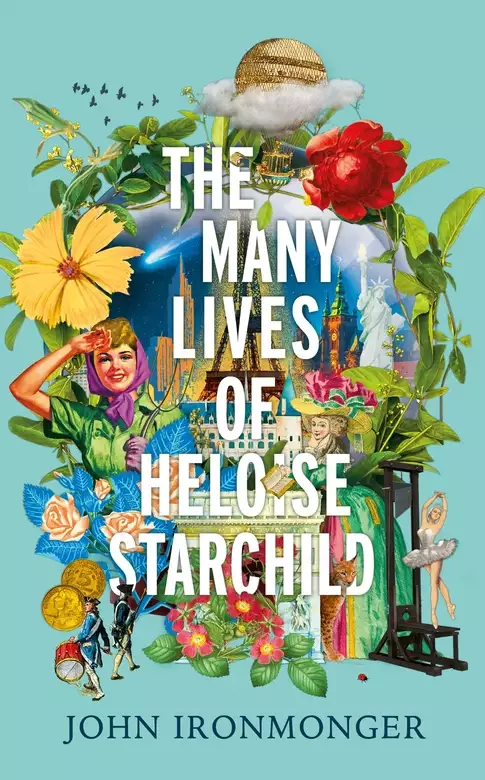
REMEMBER ME WHEN THE COMET COMES... On the day the comet came, a girl named Heloise was born. She would live a fine life, and inherit a fortune, but would meet a cruel, untimely death.
Years later, strange dreams plague Katya Nemcová, a teenager burdened with a rare and curious gift. Memories come to Katya in her dreams - images and stories from a past that isn't her own. Are these ghosts real? And what of the memory she seems to have of Heloise's treasures, two centuries old?
A novel that spans the history of Europe - from revolutionary France to the world wars, the Prague Spring, post Brexit Britain, and beyond - this is the irresistible, adventurous and affectionate story of a quite extraordinary woman, her exceptionally talented ancestors, and the curious memories they share.
Release date:
June 22, 2021
Publisher:
Orion Publishing Group
Print pages:
320
* BingeBooks earns revenue from qualifying purchases as an Amazon Associate as well as from other retail partners.
The man is on a hillside when he first sees it, low on the horizon, the faintest smudge of light against the empty black of sky. There it is, for a second. And then gone. An object as much of his imagination, perhaps, as of the universe.
His heart quickens. He bends to his telescope, squinting in the darkness, pushing so close his eyelashes brush the glass.
Where is it? Has it vanished? He pulls his face away and studies the sky.
There! Between the Twins and the Great Bear. A fleck of white. He aligns the telescope and peers through it again. ‘Sacrebleu!’
He whispers to the woman, beckoning her, as if volume in his speech might frighten the object away. ‘See there.’ His voice betrays his excitement. ‘The comet – exactly as it was foretold.’
She drops her face to the telescope.
‘Do you see it?’
He can hear her soft breath in the winter air.
‘It is Helios,’ she says, ‘the god of Athens and Rome.’
‘It is.’
‘When the ancients saw such a thing as this, they would say, “Behold Helios circling the world in his chariot of fire.”’
‘Yet we know better,’ he says. He blows into his hands to defeat the cold. ‘We are modern people now. We understand the mathematics directing this celestial messenger on his endless journey.’ A thought has come to him. ‘Perhaps if our child lives a long life he may see it return.’
‘Perhaps then, if our child is a son you should name him Helios.’
‘It would be an unusual name,’ he says. ‘He would be a child of the stars.’
All of the universe had shrunk to a small, dark circle at the distant end of a telescope, and in that circle a feather of brightness like the softest pinch of down from a dove.
‘A messenger of fire from a faraway world,’ he tells her. ‘What futures might he foreshadow?’
‘Futures?’ she asks.
‘There will be many. Every time he visits he sees how our world has changed.’
The woman blinks. She stumbles slightly, as if startled. Her balance is lost and the telescope swings away. Her hand drops to her belly, she reaches out and takes her husband’s hand, presses it to her middle.
‘Something has awoken him – he’s kicking,’ the man says. His eyes shine at this.
She smiles at him. ‘Or maybe . . . she.’
1
Katya, 1952
It rained like the storms of Genesis the night Katarína Němcová was born. The Tatrzańska River burst its banks, and a tide of mud and debris swept along the dirt lane to the Němcov farm like an avalanche. The midwife’s bicycle stuck stubbornly in the mudslide at the top of the track leading down the river valley to the village of Nová Vyšný, and the midwife, unwilling to launch herself on foot into the deluge even for the birth of a baby, was forced to ring her bell furiously to announce her presence. The infant’s father, Jaroslav, ran all the way up the track through the mud to collect her, and he carried her back to the homestead over his shoulder like a sack of corn, with no boots on his feet and nothing more than a strip of tarpaulin held over his head to shield them both from the rain.
Katarína’s mother had been in labour for fourteen hours. She had been awake for thirty. She had very little energy left. Blood vessels had burst in her eyes.
‘What kept you?’ Jaroslav asked the midwife.
‘Twins in Stará Lesna,’ the midwife told him, ‘a rainstorm in Poprad, and a stillborn in Vysoké Tatry.’
When baby Katarína (known from that day as Katya) was born, an hour or so later, a tiny grub of an infant, underweight, blue, slick with mucus and blood, her mother Frantiska died. Baby Katya took her first breath as her mother took her last, like the blow and suck of an accordion – out, and in. One soul departed, and the other gave voice to the trauma in a wail, a cry to the gods.
In the foothills of the Tatras the rain would often fall as snow in November. In the winter of 1952, the village would say, it fell as tears. Every household sent someone to the funeral of Frantiska Němcová and the weeping was as loud as had ever been heard in the graveyard of the small white church on the hillside where the young woman was laid to rest. Baby Katya’s grandfather Krystof (Frantiska’s father-in-law) slipped on ice on the morning of the burial, cracked his skull on the cobblestones, and came to the funeral with bloody bandages swathing his head. Six young women from the academy in Štrbské Pleso, friends of the dead woman, wearing white-and-black uniforms, looking cold against the snowscape of the High Tatras, sang a lament that started quietly like a whisper but grew into a crescendo, and the grey-coated crowd around the grave held hands with one another and murmured along with the chant. Many of the women wept. There were so many in the churchyard that latecomers had to stand behind the wall along the roadside, taking shelter under the oaks.
Snow began to fall as the bearers lowered the coffin into the ground.
Baby Katya’s father, Jaroslav, like a frozen statue at the graveside, wore the same black greatcoat his grandfather had worn when he came back from the war in 1918; even stripped of all insignia and colours, and faded from years of wear, it lent him a military bearing. The long-faced priest with heavy eyebrows who swung incense over the mouth of the grave was Jaroslav’s brother Paul. He laid a hand on Jaroslav’s shoulder when the words had all been spoken, as the crowd pressed forward to throw soil.
Thunk. Thunk. The earth was rocky in the Tatras. It fell onto the coffin like shrapnel.
‘She only lived here for nine years, and yet they loved her in this village,’ the priest told Jaroslav.
‘They did.’
Wiping cold dirt from gloved hands, mourners lined up to pay their respects, blowing lungs of steam as they waited. ‘We are so sorry,’ they said, each one clutching young Jaroslav’s hand, some of them offering a kiss to his cheek. ‘She will be missed,’ said others. ‘God will bless her daughter,’ many said.
A woman bent with age, her head buried beneath a black wool shawl, cupped Jaroslav’s hand into her own. ‘Does the infant have the gift?’ she asked, her voice a watery cough.
‘She is only five days old,’ Katya’s father said. His eyes were red from weeping and from the cold. ‘How would we know? We will not know for a dozen years or more.’
‘Do her eyes shine?’
‘Yes, they shine.’
The old crone kissed Jaroslav’s hands. ‘Then she has the gift,’ she said.
‘Perhaps,’ Jaroslav said. He returned the kiss.
‘I pray to God for it.’
‘You should not. It did not bring Frantiska joy.’
‘But I will pray all the same. It will bring her back.’ The woman released his hands.
The priest took the old woman’s shoulder. ‘Veruska Maria, you should get out of this cold. It will kill you.’ He steered her away, her feet crunching on the newly fallen snow.
By the time the line of mourners had shrunk to a straggle, the snow was drifting down in flakes as big as roses. ‘We should get inside,’ the priest said. ‘We should get warm.’
‘She shouldn’t be buried like this,’ complained a farmer from Starý Smokovec. Beneath his coat he was wearing the blue one-piece boiler suit he wore to milk cows at the collective farm. ‘All this . . .’ he waved an intolerant arm, ‘. . . all this religion. This chanting. It is not the communist way.’
‘Her family was from the West. It is what she would have wanted,’ Jaroslav said. His eyebrows hovered low over his eyes.
‘Well, it’s too late to ask her now.’
A man wearing no hat, the tips of his ears glowing purple in the cold, whispered something into Jaroslav’s ear, so quietly, Jaroslav had to lean close to hear it.
‘Is it true she was in Lidice?’ he asked.
The farmer nodded, a faint drop of his head. ‘She was.’ This reply, too, was a whisper.
‘How did she survive?’
‘By the grace of God,’ Jaroslav said. ‘The grace of God and a stubborn will.’
A Russian GAZ-M20 automobile, like an overweight cockroach, was parked at the top of the lane, as close as it would dare come without running into deep snow, and the driver, a jowly man with a Bolshevik budenkova cap, sat watching the funeral stony faced without once leaving his vehicle, or turning off the engine.
‘Look at him,’ Krystof said to the priest, nodding up towards the man in the motor car. ‘NKVD.’ He spat into the snow as he spoke the words. ‘Russian secret police. Just in case Frantiska was a spy. Someone has been telling them stories. What do they imagine she can do, now she’s dead?’
A tractor from the collective farm came to sweep away snow but it left a landscape of grey mud beneath its wheels. Mourners found themselves picking their way up the hill to the church hall along a perilous trackway of snow and mire. Jaroslav’s sister Marta, wearing impractical high heels, carried baby Katya, swaddled in so many blankets only the infant’s eyes showed through. In the warmth of the Tatry Kostol hall everyone wanted to see the child, but Marta was sparing. ‘She is sleeping,’ she told almost every person who tried to lean in for a closer view.
It was almost an hour before the baby opened her eyes and cried. The hubbub in the hall died away and the cry of the tiny infant rose above the heads of the mourners like the call of a wild bird.
‘It’s Frantiska,’ said Verushka Maria, the old crone, her voice heavy with age, and many heads turned her way. ‘It’s little Frantiska reborn. I know that voice,’ she said. ‘I would recognise her anywhere.’
2
Katya, 1965
It had been a hard winter. There were snows still on the Tatras in April, and even on the foothills. The ground in the meadow field had frozen as hard as cement for four months and now, with the thaws of spring, it was as soft as marshland.
‘I think my mother’s dreams have started,’ Katya told her father. ‘I’ve been having them for a month.’
They were steaming the pipes of the milking machine with vapour from an iron kettle. The machine was still a novelty on the small farm. ‘Keep the teat cups clean and the cows will be spared infection,’ Jaroslav would tell his daughter. It was a lesson the collective had taught him when the device was installed. But the pipes would freeze in the cold barn, and the machinery would fail, and Jaroslav would wonder if the mechanical milker was a blessing or a curse.
‘Are you sure these are your mother’s dreams?’ Katya’s father asked, even though he knew the answer.
‘Last night I dreamed of Paris.’
‘How do you know it was Paris?’
‘I just know. It was a gala with lords and ladies in masks and fine dresses. A carriage with twelve white horses. Two men flying high in the sky in a balloon of blue and gold.’
Jaroslav turned his face away. He was occupied coiling rubber piping onto a spool. When he spun an iron handle, the tubes would twist like reluctant snakes. ‘Well, those are your mother’s dreams,’ he said, after a while. He put down his spool and took his daughter’s hand. His eyes looked sorrowful. ‘So I expect you’re right. Your mother warned me, long before you were born. She told me if we had a daughter, the dreams would start sooner or later. I had hoped perhaps they wouldn’t. They won’t always be so bright.’
‘I know they’re mother’s dreams because I remember them,’ Katya said. She unwound a strand of hair from her forehead and began to coil it around her finger, first one way, and then the other. ‘I know what real dreams are, but these aren’t the same. With real dreams I’ve forgotten them before I climb out of bed. What did I dream about? By breakfast I can never tell. But not these: these are dreams I can’t forget. They are part of me. They stay with me. The gala with the fine ladies and the golden balloon might as well have happened to me yesterday. It’s as if it was part of my own past.’
‘I know,’ Jaroslav said softly.
‘They’re sharp, these memories,’ Katya said. ‘So sharp that I’d recognise the faces of the people if I saw them in the street. I know their names. I know their voices. The men wore wigs with curls. Monsieur Philippe had a beard like a spear and—’
‘Can you speak the language?’ Jaroslav asked.
‘The language?’
‘The language in your dream? Tu parles français?’
The girl hesitated. ‘I don’t know.’ She looked puzzled. ‘I must have understood the language or else . . . how would I have known what was going on?’
‘It will come to you,’ Jaroslav said. ‘I don’t claim to understand it. Your mother spoke five languages and not one of them did she learn in school. You must be strong, little Katya. Your mother would dream up memories that only her mother could have had. And now you can do the same. No one else has this gift, Katya. Just you.’
She was thirteen, Katya, as wiry and slender as a wild deer, a farm girl from her boots to her breeches. She could rise early and slip unheard into the yard, and drive cows into the parlour before her father even appeared at the door with the ashes of his first cigarette. ‘She doesn’t look a lady,’ Krystof would say wryly of his granddaughter, and he didn’t mean it unkindly. She had the look of a girl raised by menfolk, badly combed, unpampered, a feral creature, perhaps, not tall, not girlish, not over-bathed or scented, born perhaps of wild things. She had, at thirteen, shoulders that could carry a feed sack, but little in the way of curves. Not a lady then. Yet the straw-coloured curls that framed her face seemed delicate, and her features were small, and when she soaked away the farmyard stains and pulled on one of her mother’s vests, or the red linen pinafore her aunt Marta had made for her, she could turn the head of any man in the valley. ‘She has eyes as sharp as a kite,’ her father would say of her, and this was true. She had an inquisitive expression, and a way of raising her eyebrows in disbelief if anyone tried to tell a falsehood; and she had a fire at her core that could make her very company feel dangerous, precarious, as if something within her was spoiling for a fight. Perhaps this was a teenage thing. ‘Take a deep breath,’ Jaroslav would tell her, when some injustice or other had raised her hackles. ‘It won’t help anyone if your face turns our milk to butter.’
‘One day I’ll take you to Paris,’ Katya told her father, confidently. Her face displayed the insouciance of her age. ‘I don’t care about the party rules, or what the collective says, I shall take you to Paris, and show you the place in my dream where I saw the balloon.’ Her face was set in youthful determination.
Jaroslav offered a rueful smile. ‘Maybe one day.’
Katya looked down. ‘I know her name,’ she said. ‘I know the name of the woman in my dream.’
‘You do?’
‘Her name was Heloise.’
‘So it was,’ Jaroslav said. ‘Your mama spoke of her often.’ He squeezed Katya’s hand. ‘They are ghosts, Katya. Ghosts. They are dead and gone. Every day when your mother rose she would say to herself, These things are past. You should say it too.’
‘These things are past,’ echoed Katya. She lifted away her father’s arm and swung a fresh bucket onto the iron range. ‘These things are past.’
‘It is wise not to talk about them,’ Jaroslav said. ‘Except to me.’
‘Would people think me mad?’ Katya asked.
‘Perhaps.’
According to the files and ledgers of the committee for agriculture of the province of Prešovský-kraj, the Němcov farm should have been a jednotné roľnícke družstvo, an agricultural cooperative, owned by the people and run for the people, and managed perhaps by a graduate in dairy husbandry from a city college, answerable to the voice of the people and the rules of the party. But with just thirty-one cows, and only twenty-six in milk, they didn’t need a great deal of help from the people to manage it, and somehow the farm had remained a family affair, and no sharp young graduate had ever shown up to take over. The farm had been Krystof’s until the day a runaway bullock stamped on his left foot and broke half a dozen bones; Jaroslav had stepped in to run things, and somehow no committee had ever approved this family arrangement nor thought to rescind it. Before Krystof it had been Old Man Gregor Němcov, Krystof’s grandfather who had lived at the farm when there were no committees, and no collectives, and a farmer could own his land and sell his own produce, and do what he liked with his fields; and before Old Man Gregor, another Němcov, his full name now forgotten, and before him another, and surely another. There had been Němcovs raising cows in this valley for generations. The soil was in their blood.
Two boys from the nearby city of Poprad came on bicycles every day for the morning milking. They were barely older than Katya. Jordy was lanky and sharp, with a face like a rat and teeth that grew in awkward directions. ‘Good teeth to bite a man with,’ Jaroslav would say of Jordy. His father was an official in the Štátna bezpečnosť, the state security agency. Everyone would be careful on the farm to measure what they said in Jordy’s earshot. He was a reliable worker, and he seemed honest enough, but you could never be too cautious. Who knew what he might report back to his father?
The second boy, Marat, was older but somehow still a baby. He had never taken to schoolwork, had never learned letters or numbers, and he mumbled his words so softly that few, apart from Katya, could decipher anything he said. It didn’t seem to matter. Words are not an essential currency in a milking parlour. Both boys were good with the cows, and that, Jaroslav would say, was all he needed. ‘The cows know,’ he would say, and he would tell Katya, ‘We’re lucky to have any help at all. All the village boys go to the cities these days. No one wants to milk cows anymore.’
Katya’s grandfather, Krystof, would appear after breakfast with a cigarette between his lips and a shovel in his hands, ready to barrow muck out of the byre and spread new straw. On days when Katya was at school, Jaroslav’s sister Marta would walk from her job at the telephone exchange to help with the afternoon milking. Katya would help her father and the Poprad boys with the dawn milking, and afterwards she would dress for school while Jaroslav harnessed up the horse, and the boys lifted the filled milk churns onto the dray cart. It was a routine born of practice and economy of effort. In summer months they were smiles and laughter, but in the winter they would muffle up to save precious body heat, and they would pull on heavy leather gloves, and toil in silence as the east winds leaked into the byre. Jaroslav, now forty, stocky with a wide moustache and a sorrowful expression on his face, would wear a one-piece boiler suit, military winter fatigues, and a Russian ushanka hat with earflaps that tied beneath his chin. ‘These winds come all the way from Siberia,’ he would say. He would pull his hat low over his eyes and his cold nose would glow like a beacon.
At eight o’clock in the morning, with every cow milked and the churns all filled, they would stop whatever they were doing to count the chimes from the town hall clock at Nová Vyšný and listen to the echoes of the bells down the river valley, and this would be the sign for Jaroslav to drive the milk cart to the dairy, stopping off just once at the corner of Vodárenská and Fraňa Kráľa so Katya could walk the last ten minutes to school.
‘One day,’ Jaroslav told his daughter as their old horse pulled them along the six-kilometre trail into town, ‘you will dream bad things.’
Katya was silent. She was watching a rat scuttling down a ditch, its sinuous black tail drawing circles in the air.
‘Katya?’
The rat disappeared into a hole.
‘I know, Father.’
In April the snows of the Tatras were melting. The rivers were deep with melt waters. Katya swung off the dray cart at Vodárenská and blew her father a kiss, stepping over the rebellious stream of cold mountain water that ran alongside the road.
‘One day,’ Jaroslav told her, leaning from the dray, ‘memories will come back to you like a flood. This is what happened to your mother. I know. She would want me to warn you. It won’t be an easy time.’
‘These things are past,’ Katya said.
‘They are, they are, my little Káťa. There are good things in your past, and there are bad things. There are good people and bad people. There are dreams that will wake you up with a smile, and dreams that will leave you screaming.’
‘You have often warned me of these things, Papa.’
‘I know. But it still won’t make it easier when the time comes. One day, too, you will learn where Heloise’s gold is.’ He grinned and blew a kiss.
‘Heloise had gold?’
‘So your mama told me. Just be sure to tell no one.’
‘I won’t.’
In the afternoon, when there was no real work to be done, and if the skies were clear, Jaroslav would sit outside on the farm bench with Krystof, his father, both of them looking up towards the mountains as if in search of inspiration from the heavens, and they would smoke together, dark and oily tobacco rolled into papyrosas, until, on a still day, the smoke would hang over them like a cloud. Katya’s little terrier dog, Zora, would squeeze onto the bench beside them.
‘You should take a new wife,’ Krystof would tell the younger man, from time to time.
‘Why should I? You never did.’
‘Times were different.’
‘Times are never different.’
On this day, Jaroslav told his father about Katya’s dreams.
‘Everything comes around,’ the old man said. ‘We think it’ll be summer forever, but winter is always waiting.’
‘What if she wants to leave?’ Jaroslav said. He was rolling tobacco between his fingers. ‘She is already talking about Paris. She will want to go there.’
‘She surely will. But we are Slovaks.’ Krystof shrugged. ‘This is the East. This is not the West. Where can we go? The gates to the rest of the world are closed.’
‘It worries me that she won’t be happy here. Not for much longer. Why should she be? She will see too much of the world in her mother’s memories. And who knows? She may want to go looking for her gold. Who could blame her? I would want to go too,’ Jaroslav said. He looked up to the mountains where the peaks were hidden in cloud. ‘I have always wanted to go. Not because of the gold.’
‘I know,’ Krystof said.
‘I have lived without gold for forty years, I can live without it for forty more. But all the same. It would be good to see more of the world than this valley. Good to be able to stand up and speak my mind. Frantsya and I would make all kinds of plans, but nothing would ever come of them.’ He rolled the papyrosa between his fingers and his thumb and tamped down the tobacco. He let his voice grow quieter. ‘Frantsya wanted to show me America. She wanted me to see New York. She told me I would have been a rich man in New York. I would drive a Cadillac. We would take holidays in California.’
‘We all have dreams,’ Krystof said. ‘Even Comrade Stalin couldn’t stop people dreaming. Heaven knows, he tri. . .
We hope you are enjoying the book so far. To continue reading...

 Please log in to recommend or discuss...
