
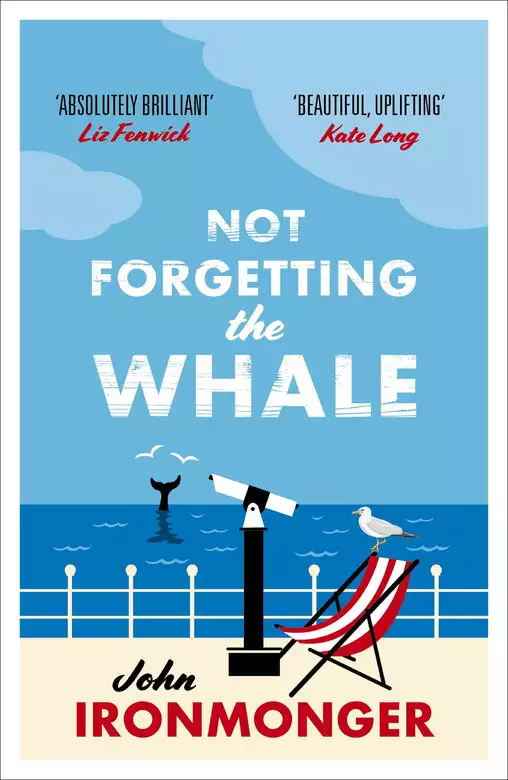
Not Forgetting The Whale
- eBook
- Paperback
- Audiobook
- Hardcover
- Book info
- Sample
- Media
- Author updates
- Lists
Synopsis
When a young man washes up, naked, on the sands of St Piran, he is quickly rescued by the villagers. From the retired village doctor and the schoolteacher, to the beachcomber and the owner of the local bar, the priest's wife and the romantic novelist, they take this lost soul into their midst. But what the villagers don't know is that Joe Haak worked as an analyst and has fled the City amid fears of a worldwide banking collapse caused by a computer program he invented. But is the end of the world really nigh? And what of the whale that lurks in the bay?
Intimate, funny and deeply moving, NOT FORGETTING THE WHALE is the story of a man on a journey to find a place he can call home.
Read by David Thorpe
Release date: February 12, 2015
Publisher: Orion Publishing Group
Print pages: 320
* BingeBooks earns revenue from qualifying purchases as an Amazon Associate as well as from other retail partners.
Reader buzz
 Please log in to recommend or discuss...
Author updates
Not Forgetting The Whale
John Ironmonger
Guardian
‘A book which pulls off its strange premise with charm, wit and devil-may-care storytelling. Huge fun to read, sneakily sad in places. A tragicomic – but mostly comic – meditation on memory and humanity, which will stay with you for a long time’
Mark Watson
‘This story twists like a pretzel, the author teases and tantalises the reader, and it’s delightfully unexpected’
The Times
‘A love story that is also a story of ideas … touching and gently written’
Metro
‘This is an absorbing and unusual novel suffused with intelligence, charm and humanity and I highly recommend it’
Bookseller
‘This is a tremendously enjoyable book. And as the front pages crowd with headlines that grow ever more grim, Not Forgetting the Whale offers a very welcome alternative’
Independent on Sunday
‘A gentle and uplifting tale of warding off apocalypse in a remote corner of Cornwall … charming’
Financial Times
‘A compelling and unusual modern fable. If the apocalypse comes, I’m heading straight for St Piran’
Natasha Solomons, author of Mr Rosenblum’s List
‘This is one of the best books I’ve ever read and it was impossible to put down’
NewBooks magazine
‘Absolutely brilliant’
Liz Fenwick, author of The Cornish House
‘Beautiful, dark, uplifting’
Kate Long, author of The Bad Mother’s Handbook
‘A warm-hearted book crammed with interesting ideas. It’s a book full of doomsday predictions with a city boy in a starring role that makes the world seem like a more hopeful place. It’s also very, very good’
Emerald Street
‘An exciting and moving read’
Essentials
‘It’s easy to see this simply as a modern interpretation of the story of Jonah and the whale, but this charming tale by John Ironmonger … is considerably more complex … it’s a love story of sorts and, above all, it’s about the innate goodness of people and our connections with the wider world’
Press Association
In the village of St Piran they still speak of the day when the naked man washed up on Piran Sands. It was the same day Kenny Kennet saw the whale. Some say it was a Wednesday. Others seem sure it was Thursday. It was early October. Unless it was late September; but almost half a century has passed since the events of that day, and the turmoil of the days and weeks that followed, and no one, at that time or since, thought to write it all down. So memory is all we have, fragile though this may be. There are some in the village who claim to recollect every detail, as if perhaps it happened last week. They would have been young when these things happened, and their stories are part of a web of tales that echo of the old days, and the world as it was, and they all tell of the naked man, and they all tell of the whale.
Many who shared in these events are no longer with us. Old Man Garrow is long since dead. So too is Dr Mallory Books, and Martha Fishburne, and the Reverend Alvin Hocking, and Jeremy Melon, and many of those who helped to rescue the whale. But their stories survive and they are told by the children and the grandchildren of the villagers, by neighbours, and by friends. They are told too at the Festival of the Whale held in the old Norman church every Christmas Day. So if you should ever find your way to St Piran (which might be hard to do), you will hear the story in the streets and in the bars; and if you should stop a villager or two, and ask, they might sit you down upon a bench with a view out over the swell of the ocean, and there they might recount the tale, about the beach, and about the whale, and about the naked man. They might, perhaps, walk you down along the ancient harbour wall and the rocky path around the headland to where the shingle and the sands begin, and there they might show you the rock where Kenny Kennet stood when he saw the whale; and just a clamber away they will point out the stretch of sand where the man named Joe was found. They might look out to sea, to the uninviting rocks that garland the beach like a giant’s necklace. ‘How,’ they might ask you, ‘could any man float among all those and not be cut to shreds?’
‘It was an unconventional entrance.’ That’s what Jeremy Melon, the naturalist, would say of Joe Haak’s arrival in St Piran, when he gave the annual address at the Festival of the Whale. ‘Trust Joe to get carried naked onto the beach by a whale! Other people ask for directions and drive politely onto the quay in daylight. But not Joe. Oh no. Joe wants to make a dramatic entrance. So he sneaks into town in the middle of the night, swims all the way out to sea, and rides back in on a bloomin’ great whale.’ And every time Jeremy Melon told this tale he would bow his legs wide like a cowboy straddling an enormous horse, and he would swing one arm as if holding a lasso. You could picture Joe mounted on the great beast, steering it through the rocks and up onto the sands. Jeremy would know, as well as anyone, that very little of that story was true; but there were tiny fragments of truth in there somewhere, and fragments of truth are often all we need to help us understand reality. Jeremy’s story would make people laugh – even those who had known Joe Haak. And that, in the end, was what mattered. ‘Sometimes exaggeration can be closer to reality than truth,’ Demelza Trevarrick the novelist would say. And it seemed to Jeremy Melon that this was the way St Piran preferred to remember Joe Haak. They didn’t want the serious Joe, the geek who had spent his life bent over his computers, working out the mathematics of Armageddon. They didn’t want the slick, spoilt city boy who wore silk ties and drove fast cars and earned more in a month than they could earn in a year. They didn’t want the Joe that none of them had known – the insecure, troubled Joe, the Joe beset by demons, the solitary Joe that lurked in the darkness fighting his private fears. None of these is the man they remember at the Festival of the Whale. The man they celebrate was a hero. He was a prophet. He was the man who saved the world. And if you live in the village of St Piran, then St Piran is the world – for you at least. And so, the years have passed, and the real memories of the man called Joe have become confused with the stories. There would be children at the Festival of the Whale, listening to Jeremy Melon speak, who would now always picture the young Joe Haak, naked, astride a whale, and perhaps, when all who knew him have died, this will be the image that remains.
It was Charity Cloke who saw him first. Just seventeen she was then, so fresh of complexion that her cheeks shone like clover honey. They would say in St Piran that she was ‘late to blossom’, but a summer of soft Cornish sunshine and warm Atlantic winds had swept away any lingering trace of adolescent spots, and scowls, and rolls of baby flesh, and the girl who took to the beach with her dog on that October morning (or was it perhaps September?) was truly a girl no longer. ‘Trees that are late to blossom,’ Martha Fishburne would say, ‘often blossom best.’ And Martha was a teacher, so she would know.
Charity Cloke was walking her dog along the strip of dry shingle that ran between the beach and the cliffs, just above the litter of seaweed discarded by the tide. The few autumn holidaymakers who might, on a warmer day, have ventured onto the sands were muffled up, walking the clifftops instead. The beach was all but deserted. To hear the stories now, you might believe that half the village was there, for many claim to have seen the man, or to have helped him away from the sea, but when you sort through the accounts, and when you listen carefully to who saw what, only five people, including Charity Cloke, can be said, beyond doubt, to have been there that day; six, if you include the naked man himself.
There was Kenny Kennet, the beachcomber. He was prowling the shingle at the east bay looking for mussels, and crabs, and flotsam, and driftwood. He would, if the finds were good, turn the driftwood into works of art he could sell to next summer’s tourists. The mussels and the crabs he would cook up, and eat. And the flotsam – well – that would depend upon whatever he found.
Old Man Garrow the fisherman was there, but, as villagers would say, Old Man Garrow was always there. He would sit on a bench for much of the day when the weather was fine and the winds were low, his knitted hat pulled over his ears, and here he would smoke his pipe and gaze out across the waves, drawn by the swell of the waters and the slap of the salt spray and the call of the herring gulls; and here, perhaps, he would dream of the years when the ocean was his home.
Aminata Chikelu, the young nurse, was there. She worked the night shift at the cottage hospital in Treadangel, so the morning on Piran Sands was, in a sense, the evening of her day. Aminata would unwind, when the morning was fair, with a walk along the narrow path that hugged the coast. Here she could let the stresses of the night shift evaporate away. ‘What do you do in the hospital at night?’ people might ask; ‘I watch sick people sleeping,’ she would say. And so she did, out on her rounds with her dim torch and shoes that didn’t squeak, checking the drips, and the drugs, and the pulses of her long-stay, elderly and (often) dying patients. Few of us live quite as intimately with death as nurses do; and the Cornish coast, Aminata would tell you, was one of the places where people came to die. There are worse places to live out your twilight years. But would you imagine, if you swapped your city home for a cheap retirement cottage by the sea, that one night you might exhale your final breath within the antiseptic confines of an overheated hospital ward, with no one to hold your hand or watch your parting but a willowy nurse from Senegal? And even for those possessed of sufficient imagination, it might be hard to picture a fairer face, or a softer voice, or warmer hands to ease their passing than those of Aminata Chikelu. She was blessed with the coffee-and-cream complexion that spoke of a cocktail of genes within her ancestry, a little bit of Africa and a little bit of Europe, and a little bit of who-knows-where; a hybrid confection that had favoured her with the perfect combination of features, dark sub-Saharan eyes, thick hair that she wore beribboned in braids, a slight Celtic nose, and a beguiling gypsy smile.
Last of all on the sands that day was Jeremy Melon the naturalist and writer. A lean and singular figure, Jeremy came to the cove, or so he would tell you, for inspiration. Sometimes he would set up an easel and daub at a canvas with watercolours, but this was never especially his thing. Words were his thing. Stories were his thing. More often he would pick his way across the bay at low tide, contemplating the creatures in the rock pools, imagining the stories of their lives. How curious it must be, he would think, to be a worm, or a fish, or a seashell, in a pool. At high tide your life would become a part of the great ocean that girdles the planet. You could come and go as you choose. You could sail out on a wave and float or swim to the beach at Port Nevis, or over the seas to Tahiti. Then the very next moment, the tide has abandoned you; the sea withdrawn; and now you occupy a fragile kettle of water with no refuge from the desiccating powers of the sun, or even from beachcombers such as Kenny Kennet who might scoop you into a bucket and fry you. One day, Jeremy Melon would think, he could write a story about this.
Six people then, and one dog; and one of the six was lying naked, face up, and looked to be drowned.
People would ask of Charity Cloke, ‘was he as beautiful … you know … down there?’ and they would flick their eyes suggestively downwards. What they meant, of course, was, ‘was he as beautiful below the waist as he undoubtedly was above it?’ And Charity Cloke would respond with a coy smile, and her honey cheeks would blush. ‘I’m not telling,’ she would say, and she would lift her eyebrows just so – happy to be possessor of such intimate information, but never inclined to share it.
Above the waist, the man on the sand would be said, by many, to be beautiful. Cold from the sea, his flesh seemed translucent, his blue veins like a secret map beneath the pale paper of his skin, his hair strewn across his face like wet wheat after a storm. But what the villagers who mooted the subject with Charity Cloke already knew (because the rumours had clearly told them) was that the naked man had exhibited, on that day, a physiological phenomenon quite unusual for any man drawn from cold water. Dr Mallory Books would use the proper medical term when explaining this to Charity. The man from the sea, he would say, was ‘priapic’. Very cold water, he told the young woman, can, in some circumstances, cause vasodilation. And vasodilation can result in the reaction that Charity Cloke observed. Don’t worry, Dr Books told her, the tumescence was involuntary. ‘These things don’t last long,’ he said. And sure enough, within minutes of his arrival at Dr Books’s little surgery in Fish Street, the effect had receded, the man’s erection subsided, and Miss Cloke’s further blushes were spared.
You could, if you were a visitor to St Piran, piece together the sequence of events on Piran Sands and the village of St Piran that autumn day by overlaying the stories told by Charity Cloke and Kenny Kennet, and Jeremy Melon. You could add to these the reported accounts of Casey Limber the net-maker, and Dr Books, and Old Man Garrow. If you were to do this, you might, with some confidence, be able to unravel the true course of events on the day when everything started.
You could begin with Kenny Kennet, the beachcomber, picking among the rocks at the east end of the bay with his plastic sacks, his pond nets, his oddments of equipment. These were rocks he knew well. He had been scouring this cove, and a dozen others around the coast, for fragments of the sea’s discarded treasures for ten or fifteen years now; since leaving school, if his account is to be believed. His hair, rarely cut, was dreadlocked, coiled and stiff, like strands of rope bleached by the salt and the wind; now that the days were growing cooler he held the unruly locks in place beneath a linen gendarme cap. He wore jeans from Oxfam rolled up to the knee, and a Guinness T-shirt, and a pointless cotton scarf. He was bent, prying mussels from a rock with a flat-bladed knife, when, on an impulse, he straightened up, scrambled a dozen feet or so up the headland and, from this commanding position, gazed out towards the sea.
What was he looking for? ‘Nothing in particular,’ he would say. This was simply something he did. He was hoping for drifting debris perhaps, for floats he might sell back to the lobstermen for the price of a glass of beer, or for scraps of net for Casey Limber.
What he saw, however, was the whale.
At first it might have been a dolphin. Or even a harbour seal. It slipped into view like a shadow beneath the waves, like the grey-green hulk of an ancient wreck, rolling slightly, sucking the sunlight from the water. It seemed to Kenny as if a hand had waved in front of the sun, sending a slice of darkness scudding along the deep. And then with barely a ripple, the leviathan sank, and was gone.
The water was dark and deep at the headland. Kenny Kennet knew that, but he’d never seen a dolphin quite this close to shore. He stared at the empty stretch of sea, reflecting on what he had, or hadn’t, seen. It must have been a dolphin, he thought. Unless … unless perhaps it was a whale? There was a sheen now to the water where the giant shape had been, as if a thin film of glass had been left upon the sea. The beachcomber turned his face away to see if anyone else was there who might confirm his sighting. And, just a hundred yards or so away, was Charity and her poodle.
‘Hey!’ Kenny waved both arms. ‘Hey.’
His cry caught the attention of Charity Cloke, and also of Aminata Chikelu, who was further up the shore, and of Jeremy Melon too, who was still exploring rock pools.
‘Hey,’ Kenny called again. ‘I think I saw a whale!’
‘A what?’ shouted Charity. Jeremy and Aminata were too distant to join in the exchange.
‘A whale.’ Kenny made a beckoning gesture.
Charity Cloke broke into a run across the sand towards the headland. There were several spits of rock to negotiate.
‘Quick!’ Kenny could see the shape again, emerging slowly from the depths.
‘I’m coming.’ Charity used her hands to steady herself around a spear of barnacle-encrusted rock.
‘Quick.’
In the ocean the leviathan was surfacing. The tide appeared to be rising with the beast, a waterfall of spume and foam was flooding from its flanks. Now it was a discernible shape, a striated barrage balloon flexing and rippling. Could it be a submarine? The thought struck Kenny, but in an instant the suggestion was dispelled as the great grey back of the cetacean surged above the surface, and with a monstrous snort a plume of water flew from its blowholes.
‘Oh my God!’
A few yards from the shore Charity Cloke was screaming.
‘It’s all right,’ called the beachcomber, his eyes transfixed by the whale. ‘He isn’t going to hurt you.’
But Charity wasn’t screaming at the whale.
Later, Charity would say that it wasn’t the man’s nakedness that caused her to scream. Nor was it his prominent erection; his ‘priapic state’, as Dr Books had called it. ‘It was just a shock,’ she would say. ‘I came around the rock, and there he was – lying there. I thought he was dead.’
The man on the beach may not have been dead, but he was certainly cold, and very still. Jeremy Melon was the second to arrive on the scene. If anything, Jeremy seemed even more shocked by the man’s appearance than Charity had been. Then Kenny came down from his rock still flushed from his encounter with the whale.
‘What the …?’
‘I think he’s dead,’ said Charity.
Three people now stood looking at the body on the sand, and not one dared touch him. It was the terrible inertia of crisis that held them back. The immobility of indecision. It was a man … of course; his terrible tumescence was proof of that; but his skin was so white and so bruised with sand that at first, Charity had thought, he may have been a porpoise. Or a seal. Or a dead thing dredged up from the depths and deposited like debris on the beach.
‘Who is he?’ Kenny asked, as if knowing this might help.
‘I’ve never seen him before,’ said Charity.
Jeremy shook his head slowly. ‘Me neither.’
‘Should we …’ Charity started.
‘Do what?’
‘Give him the … kiss of life?’
The pause was awkward. Neither of the two men seemed anxious to administer such a therapy.
‘I’ll do it,’ said Jeremy, after a moment. He was sinking to his knees.
‘No. I’ll do it,’ called a voice from behind. Aminata the nurse, glowing from her run across the beach, had arrived. She pushed between them and dropped to the sand. ‘Hold his arms for me.’
They did as they were told. The castaway was cold and soaking wet; he hadn’t been out of the water for long. Perhaps the surge-wave from the whale had driven him ashore.
‘Get him onto his front. We have to empty his lungs.’
This was a team activity now. They flipped the body over, ignoring the impact this would have on his erection. Aminata thrust her palms down hard on his back. Water spluttered from his mouth. She pressed again. He seemed to choke.
‘I think he’s alive,’ Aminata said. ‘He didn’t have much water in his lungs. Flip him back.’
Clumsily they turned him over.
‘I think he’s breathing,’ Kenny said.
‘Let’s make sure.’ The nurse squeezed shut the man’s nostrils and closed her lips around his mouth, exhaling into his lungs. His chest rose, and then, as she released her hold, his chest fell. She blew again.
‘He’s definitely breathing,’ Jeremy said.
‘One more time.’ Another lungful of warm Senegalese air expelled into the cold alveoli of the man who wasn’t dead. And this time, as Aminata released Joe and his body fell slowly away, their lips seemed to separate reluctantly, like the desperate mouths of parting lovers.
‘He’s freezing,’ said Charity.
‘It’s the cold that’s kept him alive.’ Aminata was peeling off her coat. ‘But all the same, we have to warm him up. Let’s put this on him.’
‘Where did he come from?’ Kenny asked.
‘Does it matter? Here. Give me a hand.’
‘He needs some … trousers,’ said Charity. It was as close as she would get to referencing the man’s condition.
‘He’s not having mine,’ said Kenny.
‘He can have mine.’ Jeremy pulled his belt loose. ‘Don’t worry. I’m decent.’
‘More decent than he is,’ said Aminata.
They pulled Jeremy’s trousers over the castaway’s wet legs. Jeremy, in his windjacket and boxer shorts, surveyed their handiwork. ‘Now,’ he said, ‘we’d better get him to Doctor Books.’
Old Man Garrow, sitting on his rock, tapping down the tobacco in his pipe, watched the foursome struggle to lift the man. At first each rescuer took a limb, dangling the stranger sack-like between them, but this proved cumbersome. They stopped and made a basket of their arms and slung the man between them. It wasn’t elegant, but it was easier.
Garrow tapped his pipe on the rock. ‘Did ee zee yon whale?’ he asked, as they made their ponderous progress up the sands.
‘I saw him,’ said Kenny. ‘He was as close to me as you are now.’
‘Ees bad news,’ said Garrow, rising heavily to his feet. He gave a deep and throaty cough. ‘Ee shawn’t be this close.’
‘No,’ said Kenny. ‘Mr Garrow, we have to take this man to Doctor Books.’
‘A whale in the cove, ees bad.’
‘Yes,’ said Kenny. ‘We have to go.’
‘Fishermen in’t goin’ to like it.’
‘I don’t suppose they will.’
‘It wasn’t a fish-eating whale, Mr Garrow,’ said Jeremy. ‘From what I could see, it was a fin whale.’
‘A fin whale, is it?’
‘They don’t eat fish. It’s a baleen whale.’
Aminata broke in. ‘Mr Melon, much as we’d all like to stand around and discuss the biology of whales, I really think we need to get this man to the doctor.’
‘Of course. Of course.’
The path along the beach at Piran Sands leads around the rocky headland and then turns immediately inland onto the great granite stones of St Piran village harbour. Here a pair of sea walls reach out like protective arms holding away the ocean from the unimposing strip of low whitewashed buildings that line the quay. It was around this headland that the rescue party stumbled with the body of the stranger suspended awkwardly between them. On the dockside they drew the attention of every villager with a view of the harbour. Casey Limber the net-maker was the first to spot them. He had been walking along the harbour wall in the direction of the beach when he came upon them. They were soon joined by Jessie Higgs the shopkeeper, and the fishermen Daniel and Samuel Robins, and the landlord of the Petrel Inn, Jacob Anderssen, and two of the girls who packed fish, and Captain O’Shea the harbour master, and Polly Hocking the vicar’s wife and Martha Fishburne the teacher, and a dozen more if we are to believe the stories.
‘Who is he?’ was the cry from many, anxious that the body from the sea might be a lover, or a brother, or a cousin, or a son.
‘We don’t know,’ Jeremy told them.
‘A stranger then?’
‘Indeed.’
Behind the stretcher party came Old Man Garrow, waving his walking stick in one hand, his pipe in the other. ‘Eez an omen, I’m tellin’ ee. Eez a bad sign.’
Eager for more information, the villagers settled upon Garrow. ‘’Twas a whale,’ he told them, waving with great exaggeration. ‘Ee came from the waters like a devil from the deep. Bigger’n a house ee was. Bigger’n a row of houses.’
This report was confusing. ‘What are you talkin’ about, Old Man Garrow?’ someone said. ‘That in’t a whale. That’s a man.’
‘An ’ansum one,’ said someone else. This may have been Polly Hocking, the vicar’s wife.
‘’Twere a WHALE, I tell ee,’ cried the old fisherman. ‘I saw ’im. Ee come out the sea, and ee looked at me with ’is eye.’
This revelation was considered with suspicion by the crowd on the quay.
‘You were nowhere near the whale,’ offered Kenny Kennet, keen, now that the conversation had turned to the whale, to ensure that his own part in the events did not get overlooked. ‘I was right next to him.’
‘I saw ee as close as I see you,’ said Garrow.
‘Can we please get this man to the doctor?’ said Aminata.
‘Here, let me help.’ This was young Casey Limber. He stepped in to relieve Charity of her share of the burden, but so strong were his arms that he lifted the unconscious man clear and carried him alone.
And so the crowd swept along the harbour keep, past the fishermen’s houses that fronted the quay, into the narrow square, and up along a narrow cobbled street to the door of a terraced cottage. Many of the people who had joined the original four on the dockside attempted to follow them indoors. ‘Are you ill?’ demanded Jeremy of Mrs Penroth the lobsterman’s wife. ‘No? Then please stay outside.’
The door of the house in Fish Street closed behind them and the collective of interested bystanders were left in the road with their theories.
‘A country is no more’n a body,’ Martha Fishburne would say to the children in the Primary School at St Piran. ‘Your big cities, they’re the heart, and the lungs, and they’re the brains. They’re the eyes and the mouth and the ears. They do all the thinkin’ and they do all the speakin’. Now your roads and your railways, out they run, and they’re the arteries, and they’re the veins, carryin’ all the nourishment back to the cities. And all the towns and villages, well, they’re the bones, they keep the country standin’. And the farms and the factories, they’re the muscles; they do all the work. They do all the liftin’ and all the carryin’.’
‘And what about us?’ the children would ask. ‘What about St Piran?’
‘Us is no more’n a tiny pimple on the tippety-tippetiest-tip of the teeniest tiniest toe,’ Martha would tell them. ‘Us is never visited, never seen, never even thought of.’ She would fix the children from the oldest to the youngest with the sternest look she could summon. Then she would let her face break into a very wide smile. ‘And that’s just the way we likes it.’
It might be hard to explain to a stranger, exactly, or even approximately, where to find the village of St Piran. It lies beside the sea at the end of a headland, a tight clutch of narrow houses, balanced on the hillside, pressed up hard against the twist of the lane that cascades down the slope to the harbour. It’s a small place, more a hamlet than a village, its face bent towards the wilderness of water, its back ever turned to the squat finger of land upon which it lies. There is only one road that leads down to the village. How could there be more? The same road, of course, leads back, and it is a route that is absurdly easy to miss. There was a signpost once, off the long road from Treadangel to Penzance, before a bad bend, and just over a hill. The sign read ‘St Piran 3½ miles’, but that, it appears, was a falsehood, for it was painted over to read ‘St Piran 4 miles’. Another hand later amended this to ‘St Piran 4¼’. Later still the sign disappeared altogether; stolen, some would say, for the scrap metal.
The loss of the road sign did not, as far as anyone could tell, have an impact on the village. Few even noticed it was missing. Only the hardiest holidaymakers would travel this far; most preferred the big surfing beaches of Newquay, or the quainter fishing ports of Looe, Mevagissey, or Fowey. Those who did make it all the way to St Piran, to rent one of the cottages up on the clifftop or to stay in the Bed-and-Breakfast with Hedra and Moses Penhallow – well, these folk were the determined ones. They would drive triumphantly onto the harbour and stumble exhausted from their cars, waving their map-books to evidence their success. ‘We found you,’ they would crow, ‘we found you!’
For these intrepid visitors, the great achievement of the journey never appeared to have been the hours of motorway travel from wherever they might call home to the Channel coast at Exeter, or even the two and a half hours from Exeter to the toes of Cornwall. The highlight was the lane – the 4¼ miles of roadway that wound and coiled this way and the other from the Treadangel road to the sea. Could this really be the right road? The hedgerows are awfully high in this part of Cornwall, so just when you thought you’d crest the brow of a hill and see the village ahead, the lane would swoop down another dip, or swing around another bend. Not far from the start, the route narrows to a single track. Here, in the gateway of Bevis Magwith’s farm, was the place where many a casual visitor would give up and turn around. For those who didn’t, t
We hope you are enjoying the book so far. To continue reading...
