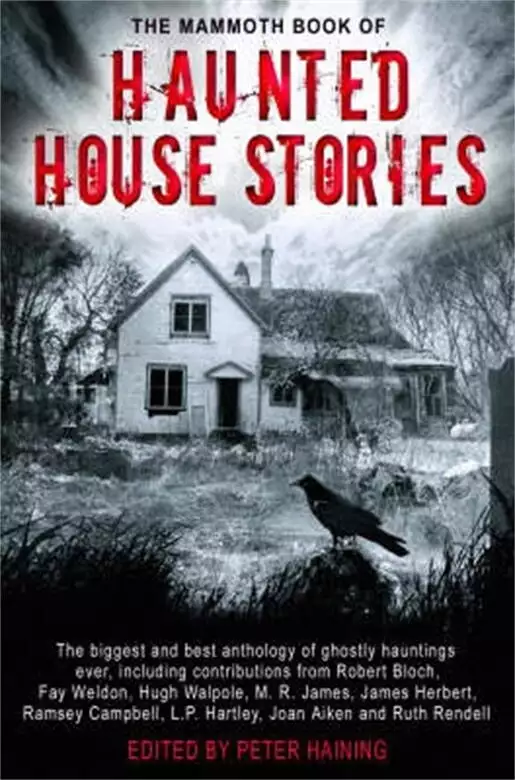
- Book info
- Sample
- Media
- Author updates
- Lists
Synopsis
Expanded and with great new stories, this is the biggest and best anthology of ghostly hauntings ever. Over 40 tales of visitation by the undead - from vengeful and violent spirits, set on causing harm to innocent people tucked up in their homes, to rarer and more kindly ghosts, returning from the grave to reach out across the other side. Yet others entertain desires of a more sinister bent, including the erotic. This new edition includes a selection of favourite haunted house tales chosen by famous screen stars Boris Karloff, Peter Cushing and Christopher Lee. Plus a top ranking list of contributors that includes Stephen King, Bram Stoker, Ruth Rendell, and James Herbert - all brought together by an anthologist who himself lives in a haunted house. closet, in Stephen King's 'The Boogeyman'; An Irish castle holds something truly horrifying in wait, in 'The Whistling Room' by William Hope Hodgson; The lecherous old ghost of a Georgian country house eyes up his latest tenant, in Norah Lofts' 'Mr Edward'; An ancient mansion on a shelf of rock previously occupied by a doomed castle, in 'In Letters of Fire' by Gaston Le Roux; The hunter is hunted in James Herbert's tale of nineteenth-century country mansion, 'The Ghost Hunter'; Psychic phenomena and poltergeists, avenging spirits and phantom lovers - curl up and read on, but never imagine you are safe from a visit...
Release date: July 28, 2005
Publisher: Little, Brown Book Group
Print pages: 160
* BingeBooks earns revenue from qualifying purchases as an Amazon Associate as well as from other retail partners.
Reader buzz
 Please log in to recommend or discuss...
Author updates
The Mammoth Book of Haunted House Stories
Peter Haining
The Mammoth Book of 20th Century Science Fiction
The Mammoth Book of Awesome Comic Fantasy
The Mammoth Book of Best New Erotica 3
The Mammoth Book of Best New Horror 14
The Mammoth Book of Best New Science Fiction 16
The Mammoth Book of British Kings & Queens
The Mammoth Book of Celtic Myths and Legends
The Mammoth Book of Fighter Pilots
The Mammoth Book of Future Cops
The Mammoth Book of Great Detective Stories
The Mammoth Book of Great Inventions
The Mammoth Book of Hearts of Oak
The Mammoth Book of Heroes
The Mammoth Book of Historical Whodunnits
The Mammoth Book of How It Happened
The Mammoth Book of How It Happened: America
The Mammoth Book of How It Happened: Ancient Egypt
The Mammoth Book of How It Happened: Ancient Rome
The Mammoth Book of How It Happened: Battles
The Mammoth Book of How It Happened: In Britain
The Mammoth Book of How It Happened: Everest
The Mammoth Book of How It Happened: Naval Battles
The Mammoth Book of How It Happened: WWI
The Mammoth Book of How It Happened: World War II
The Mammoth Book of International Erotica
The Mammoth Book of Jack the Ripper
The Mammoth Book of Maneaters
The Mammoth Book of Mountain Disasters
The Mammoth Book of Native Americans
The Mammoth Book of New Terror
The Mammoth Book of Private Eye Stories
The Mammoth Book of Prophecies
The Mammoth Book of Pulp Action
The Mammoth Book of Roaring Twenties Whodunnits
The Mammoth Book of Roman Whodunnits
The Mammoth Book of SAS & Elite Forces
The Mammoth Book of Science Fiction Century Volume 1
The Mammoth Book of Seriously Comic Fantasy
The Mammoth Book of Sex, Drugs & Rock ‘n’ Roll
The Mammoth Book of Sorcerers’ Tales
The Mammoth Book of Space Exploration and Disasters
The Mammoth Book of Special Forces
The Mammoth Book of Storms & Sea Disasters
The Mammoth Book of Short Erotic Novels
The Mammoth Book of Sword and Honour
The Mammoth Book of The Edge
The Mammoth Book of Travel in Dangerous Places
The Mammoth Book of True War Stories
The Mammoth Book of UFOs
The Mammoth Book of Vampires
The Mammoth Book of War Correspondents
The Mammoth Book of Women Who Kill
The Mammoth Encyclopedia of Extraterrestrial Encounters
The Mammoth Encyclopedia of Modern Crime Fiction
The Mammoth Encyclopedia of Unsolved Mysteries
Acknowledgments
Acknowledgment is made to the following authors, agents and publishers for permission to reprint the stories in this collection.
“The Haunted House” © 2000 by Elizabeth Albright and Ray Bradbury. First published in this volume and reprinted by permission of the authors.
“A Case of Eavesdropping” © 1900 by Algernon Blackwood. Originally published in Pall Mall Magazine, December 1900. Reprinted by permission of A. P. Watt
Ltd.
“A Haunted House” © 1921 by Virginia Woolf. Originally published in Monday or Tuesday, Hogarth Press. Reprinted by permission of the Virginia Woolf
Estate.
“Ghost Hunt” © 1948 by H. Russell Wakefield. Originally published in Weird Tales, 1948. Reprinted by permission of Curtis Brown and the Estate of H.
Russell Wakefield.
“Dark Winner” © 1976 by Stuart David Schiff. Originally published in Whispers edited by Stuart David Schiff. Reprinted by permission of William F.
Nolan.
“The Toll-House” © 1907 by W. W. Jacobs. Originally published in The Strand, 1907. Reprinted by permission of the Estate of W. W. Jacobs.
“Feet Foremost” © 1948 by L. P. Hartley. Originally published in The Travelling Grave & Other Stories, 1948. Reprinted by permission of Hamish
Hamilton Ltd.
“Happy Hour” © 1900 by Ian Watson. First published in Wheels of Fear edited by Kathryn Cramer. Reprinted by permission of the author.
“The Ankardyne Pew” © 1928 by W. F. Harvey. First published in The Beast With Five Fingers, 1928. Reprinted by permission of Weidenfeld &
Nicolson.
“A Night at a Cottage” © 1926 by Richard Hughes. First published in A Moment in Time, 1926. Reprinted by permission of David Higham Associates.
“The Grey House” © 1967 by Basil Copper. First published in Not After Nightfall, 1967. Reprinted by permission of the author.
“Watching Me, Watching You” © 1980 by Fay Weldon. Commissioned television play in the Leap in the Dark series, BBC Bristol 1980, produced by Michael
Courcher, directed by Colin Godman. First published in Woman’s Own in January 1981 and became the title story of Watching Me, Watching You, 1981. Reprinted by permission of
Curtis Brown.
“The Kisstruck Bogie” © 1946 by A. E. Coppard. First published in Fearful Pleasures, 1946. Reprinted by permission of David Higham Associates.
“Mr Edward” © 1947 by Norah Lofts. First published in At Close of Eve, 1947. Reprinted by permission of Hutchinson Ltd.
“House of the Hatchet” © 1941 by Robert Bloch. First published in Weird Tales, 1941. Reprinted by permission of A. M. Heath Ltd.
“Napier Court” © 1971 by Ramsey Campbell. First published in Dark Things edited by August Derleth, 1971. Reprinted by permission of the author.
“Lost Hearts” © 1895 by M. R. James. First published in Pall Mall Magazine, 1895. Reprinted by permission of the M. R. James Estate.
“A Little Ghost” © 1922 by Hugh Walpole. First published in Red Book Magazine, 1922. Reprinted by permission of Rupert Hart Davis Ltd.
“The Patter of Tiny Feet” © 1949 by Nigel Kneale. First published in Tomato Cain, 1949. Reprinted by permission of The Agency.
“Uninvited Ghosts” © 1984 by Penelope Lively. First published in Uninvited Ghosts, 1981. Reprinted by permission of David Higham Associates.
“Bagnell Terrace” © 1928 by E. F. Benson. First published in Spook Stories, 1928. Reprinted by permission of A. P. Watt Ltd.
“The Companion” © 1978 by Joan Aiken. First published in John Creasey’s Crime Collection edited by Herbert Harris, 1978. Reprinted by permission
of A. M. Heath Ltd.
“The Ghost Hunter” © 1988 by James Herbert. First published in Haunted, 1988. Reprinted by permission of the author and David Higham Associates.
“Computer Seance” © 1997 by Ruth Rendell. First published in The Oldie, 1997. Reprinted by permission of Peters, Fraser & Dunlop.
“The Storm” © 1944 by McKnight Malmar. First published in Good Housekeeping, February, 1944. Reprinted by permission of Willis King Agency.
“The Waxwork” © 1931 by A. M. Burrage. First published in Someone in the Room, 1931. Reprinted by permission of the Estate of A. M. Burrage.
“The Inexperienced Ghost” © 1902 by H. G. Wells. First published in The Strand, March, 1902. Reprinted by permission of A. P. Watt Ltd.
“Sophie Mason Comes Back” © 1930 by E. M. Delafield. First published in Time and Tide, July 1930. Reprinted by permission of PFD Ltd.
“The Boogeyman” © 1973 by Stephen King. First published in Cavalier, March 1973. Reprinted by permission of Ralph M. Vicinanza Ltd.
Every effort has been made to trace the owners of copyright material. The editor would be pleased to hear from anyone if they believe there has been an inadvertent
transgression of copyright.
Foreword
I Live In A Haunted House
The first sensation was of woodsmoke. A curiously acrid but unmistakable smell that became apparent for a few days in the upper rooms of the house and was experienced by each
member of the family. The smoke, which seemed to have no identifiable source and was smelled rather than ever being seen, occurred at a time of the year when there was no longer the need for a
fire to be lit in the house. For a while, there seemed to be no logical explanation of the phenomenon – until the night when something quite extraordinary happened to my wife.
Peyton House, where we live, is a sixteenth-century, three-storey timber-frame building which stands in the middle of the picturesque little village of Boxford in Suffolk. It was once the
grace-and-favour home of the chief stewards to the Peyton family, the local landowners who lived about a mile away in their Elizabethan manor house, Peyton Hall. For the last twenty years, though,
Peyton House has been home to me, my wife Philippa and our three children, Richard, Sean and Gemma. What has happened to us there would seem to have no other explanation than yet another instance
of the supernatural at work.
We had been living in the house for a while before we became fully aware of the manifestation that is repeated each year. This realisation came about because of what occurred late one spring
evening. It was on a night during the first week of June and Philippa was sitting reading in our bedroom, a high-ceilinged room at the front of the house. On the rear wall of this room there is an
interior window which looks out on to the landing. Philippa was engrossed in her book when she was suddenly aware out of the corner of her eye of someone going past the window. She looked up and
caught sight of a figure with long hair passing by. A moment later and it was gone.
Philippa’s first reaction was that it must have been Gemma going along the landing to the bathroom. Then she realised that our daughter was not in the house. Indeed, the whole place was
deserted because everyone else had gone out, too. Curiously, though, this realisation did not make her feel afraid. Only the strong conviction that the figure – whoever or whatever it
was – was quite benign.
It was to be some months later, and as a result of making a number of enquiries in Boxford, that an explanation for my wife’s experience was forthcoming. Tales of a strange visitant in
Peyton House were, it seemed, known to a number of the older residents in the village whose parents and grandparents had once worked as servants in the house. Several of these men and women had
even lived for a time in the attic rooms. All told of experiencing the ethereal smell, and a few had even seen the long-haired wraith. And all at precisely the same time of year. Even stranger, not
one of them had felt there was anything of which to be afraid.
The old house, we were informed, had years ago been surrounded by several acres of land – later sold off for farming and a small housing development long before we arrived – but
during the early years of the nineteenth century, at the time of the Napoleonic wars with France, something terrible and tragic had occurred there. A group of French soldiers who had been taken
prisoner during the conflict had been billeted at Peyton House, where they were kept in the outbuildings and set to earn their keep by working on the land. This was a common practice during this
particular war, and a number of property owners in East Anglia benefited from these gangs of enforced labourers – although there is no evidence that they treated the Frenchmen with anything
other than kindness, as long as they worked conscientiously and did not cause any trouble.
Then, one June day, a fire broke out at Peyton House. Fortunately, the blaze was put out before it could do any serious damage to the building, but one of the PoWs was trapped by the flames and
perished in a smoke-filled room. There is no record as to whether the man was buried locally or his body returned to France. Each June thereafter, we were told, a distinct aroma of smoke was
evident in the house, growing in intensity until the same specific day when it stopped as dramatically as it had begun.
That day was 6 June – the very day on which Philippa had seen the figure on the landing . . .
This account of the Peyton House ghost, which I entitled “The Smoke Ghost”, was originally written at the invitation of Stephen Jones for his anthology of true paranormal
encounters, Dancing With The Dark, published in 1997. The story attracted quite a lot of interest from fellow writers in the supernatural genre, as well as neighbours and friends in
Suffolk. All of them, it seemed, had experiences either at first hand, or from people whose integrity they had no reason to doubt, relating to haunted houses. Clearly, interest in house-bound
phantoms was as intense now as it has ever been.
I knew at the same time, too, that the theme of haunted houses had been a popular one with authors for the past century and more. Yet amidst the veritable library of collections of ghost
stories, very few were solely devoted to this topic. A few day’s research confirmed the fact that there was indeed a wealth of material available – and the result is the book now in
your hands. Making a selection of tales from so many has not been easy, I must admit, but I do believe that here you will find a representative collection covering all the important elements
of haunted houses.
An ideal way of setting the mood seemed to me to be with a group of stories – like that of my wife – based on actual hauntings. The first of these, “The Haunted and the
Haunters” by Edward Bulwer-Lytton may well be the most famous story of its kind and certainly its influence will be evident in all the subsequent tales in the section right up to William F.
Nolan’s contemporary thriller, “Dark Winner.” Nolan’s dangerous little protagonist leads neatly into the second section featuring ghosts with a vengeance where again the
spirit in Charlotte Riddell’s house in Vauxhall Walk is every bit as ancient and malevolent as the evil which haunts the customers in Ian Watson’s tale of the Roebuck Public House
enjoying a “Happy Hour.”
The third section deals with a variety of restless phantoms caught half-way between their world and ours, their stories chillingly recounted by at least two writers, Richard Hughes and Fay
Weldon, not generally associated with the supernatural. Whether the spirit world is as obsessed with sex as our own provides the theme for the Phantom Lovers section with Richard Dehan’s
century-old story indicating that the undead have been interfering with the affairs (if you’ll excuse the pun) of men and women for a great many years – and are still doing so according
to those excellent modern horror masters, Robert Bloch and Ramsey Campbell.
People begin their love of ghost stories in childhood and it should come as no surprise when considering the number of children who die tragically young that they have featured in a number of
haunted house stories. M. R. James, Nigel Kneale and Penelope Lively demonstrate how little darlings can also become little terrors after death. The uncertainty of what lies beyond death has, of
course, promoted a continuing interest in the “Other Side” and the penultimate group of stories take the reader through the shadow lands under the guidance of several knowledgeable
writers including Sir Arthur Conan Doyle, Joan Aiken and James Herbert.
The final section, “Houses of Horror” has been added to this new edition of the book at the invitation of my publishers. During the almost half a century that I have been editing
anthologies of supernatural stories, I have worked on three collections with famous horror film stars – namely Vincent Price, Christopher Lee and Peter Cushing – and researched and
written about four other top names, Lon Chaney, Bela Lugosi, Boris Karloff and Robert Englund. All of them proved to be lovers of ghost stories as well as being familiar with supernatural fiction.
Amongst these actors’ favourite stories, each had one about a haunted house and it is their choices that bring the book to a chilling finale.
For myself, I have continued to live contentedly in my own haunted home, ghost notwithstanding, for over a quarter of a century. I wish you the same enjoyment – and safety – in the
ill-omened and often dangerous properties that now await your visit.
Peter Haining
February, 2005
The Haunted and the Haunters
Edward Bulwer-Lytton
Prospectus
Address:
50, Berkeley Square, London Wl.
Property:
Circa Eighteenth-century, four-storey town house. Plain fronted with tall windows and a narrow balcony on the second floor. The residence
of a former prime minister, George Canning (1770–1827), the house has been much renovated.
Viewing Date:
August, 1859.
Agent:
Edward Bulwer-Lytton (1803–1873) was born in London and despite his noble birth was forced to earn his living as a writer, until he
inherited the title of Lord Lytton in 1866. In the interim, he had become popular with readers for his historical novels – notably The Last Days of Pompeii (1834) – and a
number of stories of the occult and supernatural. Highly regarded among these are his novel A Strange Story (1861) and short stories, “Glenallan” and “The Haunted
and the Haunters”, described by H.P. Lovecraft as “one of the best short haunted house tales ever written”. It is based on reports Lytton had heard about a building in the
heart of London’s Mayfair and effectively launched the genre of Haunted House stories.
A friend of mine, who is a man of letters and a philosopher, said to me one day, as if between jest and earnest, “Fancy! since we last met, I have discovered a haunted
house in the midst of London.”
“Really haunted? – and by what? ghosts?”
“Well, I can’t answer that question: all I know is this – six weeks ago my wife and I were in search of a furnished apartment. Passing a quiet street, we saw on the window of
one of the houses a bill, ‘Apartments Furnished’. The situation suited us; we entered the house – liked the rooms – engaged them by the week – and left them the third
day. No power on earth could have reconciled my wife to stay longer; and I don’t wonder at it.”
“What did you see?”
“Excuse me – I have no desire to be ridiculed as a superstitious dreamer – nor, on the other hand, could I ask you to accept on my affirmation what you would hold to be
incredible without the evidence of your own senses. Let me only say this, it was not so much what we saw or heard (in which you might fairly suppose that we were the dupes of our own excited fancy,
or the victims of imposture in others) that drove us away, as it was an undefinable terror which seized both of us whenever we passed by the door of a certain unfurnished room, in which we neither
saw nor heard anything. And the strangest marvel of all was, that for once in my life I agreed with my wife, silly woman though she be – and allowed, after the third night, that it was
impossible to stay a fourth in that house. Accordingly, on the fourth morning I summoned the woman who kept the house and attended on us, and told her that the rooms did not quite suit us, and we
would not stay out our week. She said, dryly, “I know why: you have stayed longer than any other lodger. Few ever stayed a second night; none before you a third. But I take it they have been
very kind to you.”
“ ‘They – who?’ I asked, affecting to smile.
“ ‘Why, they who haunt the house, whoever they are. I don’t mind them; I remember them many years ago, when I lived in this house, not as a servant; but I know they will be the
death of me some day. I don’t care – I’m old, and must die soon anyhow; and then I shall be with them, and in this house still.’ The woman spoke with so dreary a calmness,
that really it was a sort of awe that prevented my conversing with her further. I paid for my week, and too happy were my wife and I to get off so cheaply.”
“You excite my curiosity,” said I; “nothing I should like better than to sleep in a haunted house. Pray give me the address of the one which you left so
ignominiously.”
My friend gave me the address; and when we parted, I walked straight towards the house thus indicated.
It is situated on the north side of Oxford Street (in a dull but respectable thoroughfare). I found the house shut up – no bill at the window, and no response to my knock. As I was turning
away, a beer-boy, collecting pewter pots at the neighboring areas, said to me, “Do you want any one at that house, sir?”
“Yes, I heard it was to be let.”
“Let! – why, the woman who kept it is dead – has been dead these three weeks, and no one can be found to stay there, though Mr. J— offered ever so much. He offered
Mother, who chars for him, £1 a week just to open and shut the windows, and she would not.”
“Would not! – and why?”
“The house is haunted: and the old woman who kept it was found dead in her bed, with her eyes wide open. They say the devil strangled her.”
“Pooh! – you speak of Mr. J—. Is he the owner of the house?”
“Yes.”
“Where does he live?”
“In G— Street, No.—.”
“What is he – in any business?”
“No, sir – nothing particular; a single gentleman.”
I gave the pot-boy the gratuity earned by his liberal information, and proceeded to Mr. J—, in G— Street, which was close by the street that boasted the haunted house. I was lucky
enough to find Mr. J— at home, an elderly man, with intelligent countenance and prepossessing manners.
I communicated my name and my business frankly. I said I heard the house was considered to be haunted – that I had a strong desire to examine a house with so equivocal a reputation –
that I should be greatly obliged if he would allow me to hire it, though only for a night. I was willing to pay for that privilege whatever he might be inclined to ask.
“Sir,” said Mr. J—, with great courtesy, “the house is at your service, for as short or as long a time as you please. Rent is out of the question – the obligation
will be on my side should you be able to discover the cause of the strange phenomena which at present deprive it of all value. I cannot let it, for I cannot even get a servant to keep it in order
or answer the door. Unluckily the house is haunted, if I may use that expression, not only by night, but by day; though at night the disturbances are of a more unpleasant and sometimes of a more
alarming character. The poor old woman who died in it three weeks ago was a pauper whom I took out of a workhouse, for in her childhood she had been known to some of my family, and had once been in
such good circumstances that she had rented that house of my uncle. She was a woman of superior education and strong mind, and was the only person I could ever induce to remain in the house.
Indeed, since her death, which was sudden, and the coroner’s inquest, which gave it a notoriety in the neighborhood, I have so despaired of finding any person to take charge of the house,
much more a tenant, that I would willingly let it rent-free for a year to any one who would pay its rates and taxes.”
“How long is it since the house acquired this sinister character?”
“That I can scarcely tell you, but very many years since. The old woman I spoke of said it was haunted when she rented it between thirty and forty years ago. The fact is, that my life has
been spent in the East Indies, and in the civil service of the Company. I returned to England last year, on inheriting the fortune of an uncle, among whose possessions was the house in question. I
found it shut up and uninhabited. I was told that it was haunted, that no-one would inhabit it. I smiled at what seemed to me so idle a story. I spent some money in repairing it – added to
its old-fashioned furniture a few modern articles – advertised it, and obtained a lodger for a year. He was a colonel retired on half-pay. He came in with his family, a son and a daughter,
and four or five servants: they all left the house the next day; and, although each of them declared that he had seen something different from that which had scared the others, a something still
was equally terrible to all. I really could not in conscience sue, nor even blame, the colonel for breach of agreement. Then I put in the old woman I have spoken of, and she was empowered to let
the house in apartments. I never had one lodger who stayed more than three days. I do not tell you their stories – to no two lodgers have there been exactly the same phenomena repeated. It is
better that you should judge for yourself, than enter the house with an imagination influenced by previous narratives; only be prepared to see and to hear something or other, and take whatever
precautions you yourself please.”
“Have you never had a curiosity yourself to pass a night in that house?”
“Yes. I passed not a night, but three hours in broad daylight alone in that house. My curiosity is not satisfied but it is quenched. I have no desire to renew the experiment. You cannot
complain, you see, sir, that I am not sufficiently candid; and unless your interest be exceedingly eager and your nerves unusually strong, I honestly add, that I advise you not to pass a night in
that house.”
“My interest is exceedingly keen,” said I, “and though only a coward will boast of his nerves in situations wholly unfamiliar to him, yet my nerves have been seasoned in
such variety of danger that I have the right to rely on them – even in a haunted house.”
Mr. J— said very little more; he took the keys of the house out of his bureau, gave them to me – and, thanking him cordially for his frankness, and his urbane concession to my wish,
I carried off my prize.
Impatient for the experiment, as soon as I reached home, I summoned my confidential servant – a young man of gay spirits, fearless temper, and as free from superstitious prejudices as any
one I could think of.
“F—,” said I, “you remember in Germany how disappointed we were at not finding a ghost in that old castle, which was said to be haunted by a headless apparition? Well, I
have heard of a house in London which, I have reason to hope, is decidedly haunted. I mean to sleep there to-night. From what I hear, there is no doubt that something will allow itself to be seen
or to be heard – something, perhaps, excessively horrible. Do you think if I take you with me, I may rely on your presence of mind, whatever may happen?”
“Oh, sir! pray trust me,” answered F—, grinning with delight.
“Very well; then here are the keys of the house – this is the address. Go now – select for me any bedroom you please; and since the house has not been inhabited for weeks, make
up a good fire – air the bed well – see, of course, that there are candles as well as fuel. Take with you my revolver and my dagger – so much for my weapons – arm yourself
equally well; and if we are not a match for a dozen ghosts, we shall be but a sorry couple of Englishmen.”
I was engaged for the rest of the day on business so urgent that I had not leisure to think much on the nocturnal adventure to which I had plighted my honor. I dined alone, and very late, and
while dining, read, as is my habit. I selected one of the volumes of Macaulay’s Essays. I thought to myself that I would take the book with me; there was so much of the healthfulness
in the style, and practical life in the subjects, that it would serve as an antidote against the influence of superstitious fancy.
Accordingly, about half-past nine, I put the book into my pocket, and strolled leisurely towards the haunted house. I took with me a favorite dog – an exceedingly sharp, bold and vigilant
bull-terrier – a dog fond of prowling about strange ghostly corners and passages at night in search of rats – a dog of dogs for a ghost.
It was a summer night, but chilly, the sky somewhat gloomy and overcast. Still there was a moon – faint and sickly, but still a moon – and if the clouds permitted, after midnight it
would be brighter.
I reached the house, knocked, and my servant opened with a cheerful smile.
“All right, sir, and very comfortable.”
“Oh!” said I, rather disappointed; “have you not seen nor heard anything remarkable?”
“Well, sir, I must own I have heard something queer.”
“What – what?”
“The sound of feet pattering behind me; and once or twice small noises like whispers close at my ear – nothing more.”
“You are not at all frightened?”
“I! not a bit of it, sir,” and the man’s bold look reassured me on one point – viz., that happen what might, he would not desert me.
We were in the hall, the street-door closed, and my attention was now drawn to my dog. He had at first run in eagerly enough, but had sneaked back to the door, and was scratching and whining to
get out. After patting him on the head, and encouraging him gently, the dog seemed to reconcile himself to the situation, and followed me and F— through the house, but keeping close at my
heels instead of hurrying inquisitively in advance, which was his usual and normal habit in all strange places. We first visited the subterranean apartments, the kitchen and other offices, and
especially the cellars, in which last there were two or three bottles of wine still left in a bin, covered with cobwebs, and evidently, by their appearance, undisturbed for many years. It was clear
that the ghosts were not wine-bibbers. For the rest we discovered nothing of interest. There was a gloomy little backyard with very high walls. The stones of this yard were very damp; and what with
the damp, and what with the dust and smoke-grime on the pavement, our feet left a slight impression where we passed.
And now appeared the first strange phenomenon witnessed by myself in this strange abode. I saw, just before me, the print of a foot suddenly form itself, as it were. I stopped, caught hold of my
servant, and pointed to it. In advance of that footprint as suddenly dropped another. We both saw it. I advanced quickly to the place; the footprint kept advancing before me, a smal
We hope you are enjoying the book so far. To continue reading...