
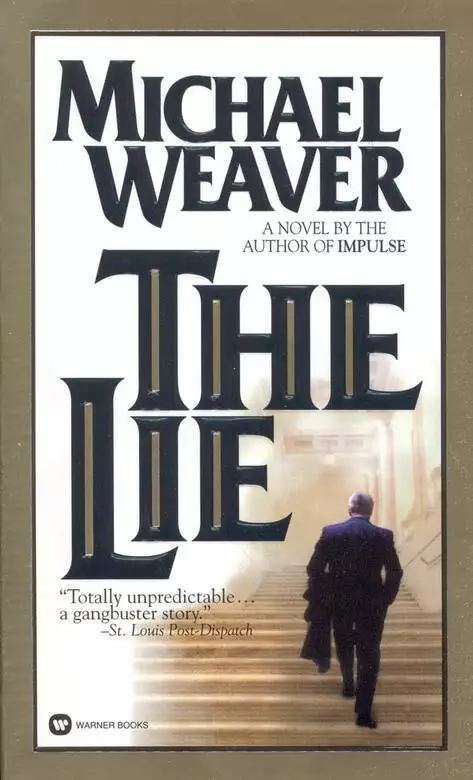
The Lie
- eBook
- Paperback
- Audiobook
- Hardcover
- Book info
- Sample
- Media
- Author updates
- Lists
Synopsis
The U.S. president has decided to turn an international conference on human rights into the scene of his greatest triumph--but instead is taken hostage by a group prepared to kill for world peace. Paul Waters, an intelligence agent assigned to protect the president, joins forces with his lover, Kate Dinneson, to foil the plans of the extremist group and rescue American's leader. But can they stop the fanatics in time? And did the president plan his own kidnapping?
Release date: November 29, 2009
Publisher: Grand Central Publishing
Print pages: 400
* BingeBooks earns revenue from qualifying purchases as an Amazon Associate as well as from other retail partners.
Reader buzz
 Please log in to recommend or discuss...
Author updates
The Lie
Michael Weaver
By that time she had been waiting almost two hours in the deeper part of the surrounding woods, and she would probably wait
another hour before going in. Since she had been waiting eighteen years for what lay just ahead, these last few hours only
added to the anticipation, to the excitement, and to the fear and trembling.
She sat with her back to a tree, feeling the damp earth beneath her and the roughness of the bark through the fabric of her
shirt. The night was warm, with little wind. Patches of mist drifted from the Bay of Salerno off to the west. In the distance,
she saw the lights of a late plane starting its final descent toward Naples.
When the lights disappeared, her hand went to the automatic she carried inside the belt of her slacks. She fingered its butt,
trigger guard, and safety for perhaps the fifth time in the past half hour. It was the only visible sign of her nervousness.
Then she just sat holding the gun in both hands like a supplicant making an offering to a god she could not see but, she knew
with absolute certainty, was out there someplace.
Her name was Kate Dinneson.
Kate made her move at a quarter to two, rising up out of the woods and silently approaching the rear of the house. As she
walked, the slender, delicately put together young woman
in dark shirt, slacks, and gloves slipped on an equally dark ski mask.
The mask was her tacit admission of uncertainty. It was the only sign she gave, even to herself, that she wasn’t totally committed
to any single course of action.
She had done a dry run earlier, while it was still light, so she knew exactly where the wires, alarm, and points of entry
were. Now, working deftly, she neutralized the system in five minutes. Still, when she had finished her face was damp under
the mask and her throat was stiflingly dry.
The few tools she needed were in a small canvas belt bag. She used a glass cutter and rubber suction cup to let herself in
through a basement window.
Inside, she used a pinpoint flash to find the smooth stone stairs and reached the first floor without a sound.
Turning off her light, she stood in the translucent dark of the entrance hall, letting her eyes pick out the shape and placement
of things. She drew the automatic from her belt, flicked off the safety, and climbed the curving flight of steps to the second-floor
landing.
Their bedroom was directly ahead, the door open. They slept curled together in a wash of blue starlight. A nightgown was tossed
across a chair. The sheet lay partly on the floor. A pistol lay on the night table near Peter Walters’s side of the bed. She
knew it would have to be taken care of at once. Walters’s first move on waking would be pure reflex, and she didn’t want to
have to shoot him in response.
Kate reached the gun in two silent steps, slipped it into her belt, and backed off. Then she switched on a small lamp and
waited.
Peter Walters’s eyelids stirred, fluttered briefly, and opened. They were the only part of him that moved.
He looked at the slender, masked figure pointing an automatic at his head. Shifting his glance, he did not see the gun that
he always kept on the table beside him.
Still watching the girl, he reached for and found his wife’s hand. He pressed it to wake her as gently as possible.
“Peg?” he said. “We have company.”
His voice, too, was gentle. He spoke in unaccented English. Although he and his wife had been living in Positano for twenty-seven
years, they were American.
Peggy Walters came awake. Her eyes blinked against the light and she gasped as she saw the masked, dark-clothed figure pointing
a gun. Then she just lay there, gripping her husband’s hand.
“Who are you?” Walters asked in Italian.
Kate Dinneson swallowed twice. “I’m the daughter of Angelo and Patty Falanga.”
Her answer, also in Italian, contained the exact words she had imagined herself saying for as long as she could remember.
Walters stared at the knitted fabric of her mask.
“In case it’s slipped your mind,” Kate said, “eighteen years ago last month you killed them.”
“Who told you I was the one who did it?” Walters asked.
“Someone who obviously knew.”
Walters was silent.
“Do you deny it?”
“Would you believe me if I did?”
“No.”
He sighed and slowly shook his head. “It took you eighteen years to get here?”
“I found out it was you only ten days ago.”
“And now all you want is to kill me?”
“If that was all I wanted, you would be dead right now.”
“What else do you want?”
“To hear your side. If you have one.”
“You mean and then you’ll kill me?”
Kate Dinneson said nothing.
Walters glanced at his wife, who lay white-faced yet composed under the sheet beside him. He was still holding her hand. Then
he looked once more at Kate’s eyes. “May I take my cigarettes and lighter?”
“Very carefully.”
He lifted them from the night table and lit up.
Watching, her gun leveled, Kate pulled over a straight-backed chair and eased into it. Despite herself, her legs were
trembling. She was working hard to remain calm, cool, controlled, wishing she could be dispassionate and afraid she never
would be.
“So what did this person, this someone who supposedly knew, tell you about me?” Peter Walters asked.
He was sitting up in bed now, smoking. The sheet had slipped away from his naked upper body, and Kate saw an incredible number
of welted puncture scars scattered across his chest, abdomen, sides, and arms. Some were from bullets and shrapnel. Others
were from cutting blades. His life history, she thought.
“He told me you had been a contract killer for the United States Central Intelligence Agency. That you did work for them all
over Europe. Do you deny that?”
“No. That’s true.”
“He told me you shot my mother and father in cold blood. He said you killed them as they were coming out to surrender, unarmed,
with their hands over their heads.”
Kate Dinneson felt oddly numb. She wondered what had become of all the anger she had been storing up and carrying for so many
years. This man had robbed her of a lifetime of love. He had stolen her mother and father. He had murdered them, along with
all the good things that were supposed to come to her from them. Yet looking at him now, all she saw was a battered, aging
man, the force in him long faded and gone. Beside him, his aging wife, who had yet to say a word, waited in silence for whatever
was going to happen next.
Peter Walters slowly shook his head. “That part is a lie. It wasn’t like that at all. I’m sure you’ve been told about your
parents,” he said. “You must know who and what they were.”
“I’ve been told and I’ve known all my life. Now I’m waiting to hear what you have to tell me about them.”
Peggy Walters spoke for the first time. “You said all this was eighteen years ago. I can’t see your face but you must have
been just a child. Whatever you’ve heard had to have come from others. Please. This isn’t fair.”
Kate ignored her. “Go ahead,” she told Walters. “Talk to me.”
“Your mother and father were the most deadly terrorists of their day,” said Walters. “They killed hundreds. Innocents. Is
that what you knew about them?”
“They fought for a cause. Sadly, there were sacrifices.”
Walters looked at the ceiling and the walls. “I saw some of those sacrifices. Have you ever seen pieces of children? And as for my killing your parents in cold blood, that just wasn’t so. They came out shooting from behind a
white flag after promising to give themselves up. Three of my scars are from their bullets.”
This was the version Kate had grown up with, this legend of her mother and father choosing a martyr’s death over a prison
cell. She had heard the new story from the one man who had finally been able to name Peter Walters as her parents’ killer.
The romantic in her preferred the original. She preferred it, too, because if she did accept it, she would not feel so compelled
to make payment.
“Why should I believe you?” she said. “Staring into the muzzle of a gun, you would say anything.”
“I wasn’t alone when it happened. I had two men as backup. One of them used a camera to record what was supposed to be a peaceful
surrender. They were both killed when your parents came out blazing at us with machine pistols. But I do have a couple of
pictures of how it was.”
Kate was silent. Peggy Walters stirred in bed, pulling her attention.
“She’s not here to look at your pictures,” Peggy told her husband. “She’s just here to shoot you.”
“Where are they?” Kate asked.
“In a wall safe behind that mirror. If you let my wife out of bed she’ll open it for you.”
Kate saw the mirror hanging over a dresser on Peter Walters’s side of the bed. The pictures might or might not be in the safe,
but there would certainly be a gun waiting there.
“What’s the combination?” she asked.
“Twice around to the right to four… left to ten… right to six.”
“Here’s what I want you to do,” said Kate. “I want you to
carefully get out of bed, take the mirror off the wall, and open the safe without putting a hand inside. All right?”
“Yes.”
“Then I want you back in bed with your hands on your head while I look at the pictures.” Kate paused. “If there are any pictures.”
Peter Walters was silent.
“Are they the only pictures in the safe?” Kate Dinneson asked him.
“Yes.”
“Why did you save just them? What made my parents so special?”
“Because they killed two of my men and almost killed me. Because no one else ever made me look that stupid, and I didn’t want
to forget it.”
Kate stared at him. He might be telling the truth. Some of the tightness went out of her chest and her breathing.
“All right. You can get out of bed and open the safe.”
“I’m naked.”
“I’ll try not to get too excited,” Kate said.
He did not smile. Moving with care, Walters got out of bed, lifted the mirror off the wall, and worked the exposed safe’s
dial until Kate heard a click.
“That’s it,” she said. “I’ll take it from here. Now just get back into bed and put your hands on your head.”
Kate watched as he followed her instructions.
“You too,” she told his wife. “Hands on your head.”
“Are you also going to shoot me?” asked Peggy Walters. “Or just my husband?”
Kate Dinneson stood up and looked at the woman. “Right now I’m not shooting anyone,” she said, and was half turning toward
the safe even as she realized that the woman’s hands were still not on her head. One hand lay at her side, while the other
remained where it had been all along. Somewhere beneath the sheet.
Kate saw the slight narrowing of Peggy Walters’s eyes and the sudden look of terror on her face. When Kate saw her expression
she was terrified too.
The terror made her move, sent her diving off to the left an instant before a gun exploded under the sheet and its bullet
whistled past her ear.
Kate landed on her shoulder and rolled, not holding still for the second shot, which ricocheted off the tile floor. She spun
about until she was able to lift her gun and get off a couple of shots of her own, just barely glimpsing the woman’s face
over the barrel, seeing her eyes widen now as she sat up in bed, holding her suddenly visible pistol with both hands until
her face and eyes seemed to dissolve in a red haze.
Then her husband appeared in her place, his naked body riding the air in a flat-out leap, his hands reaching for Kate’s automatic.
His mouth was wide open, yelling something Kate could not understand.
She squeezed off just one shot, all she had time for, as Peter Walters’s full weight took her squarely in the chest. Kate
fought for breath and they lay there like exhausted lovers.
Straining, Kate worked herself free. Walters’s unseeing eyes were open. Bright arterial blood spurted from a hole in the left
side of his chest.
My one shot.
Kate looked across the bed and saw Peggy Walters lying on her back, her face a scarlet mask. Still in one hand was the pistol
that had started it all. Kate struggled up from the floor, took the woman’s wrist, and felt for a pulse that was no longer
there.
I didn’t want it this way.
She held her forehead for a moment, trying to calm herself. Then she went to the safe that she had turned toward only moments
before and pulled open the steel door.
An automatic lay right in front. The safety was off and it was ready to be fired. At least she had been right about that.
As for the alleged photographs, they were probably nothing but a ploy to let Walters or his wife grab the gun, whirl, and
blow her away.
Kate Dinneson looked anyway, foraging through half a dozen envelopes until she finally opened one and found herself staring
at pictures of her mother and father.
Surprise.
There were, indeed, two pictures. They were both enlargements, taken from good negatives, so that the details were clear and
without distortion.
How young they were, Kate thought, and saw them dashing side by side, machine pistols blazing during what would soon turn
out to be the final seconds of their lives. She saw their sun-bronzed skin, and their white teeth bared in grins that were
not really grins at all, but frightening grimaces in the face of certain death.
Kate wondered what they were thinking during these last seconds before all thinking stopped. Or had they reached the point
where they were functioning purely on instinct?
I wish I could talk to you, she told them. I wish I had been older when you were with me. I wish I had known you better.
What she knew now was that Peter Walters had been telling the truth. He had not shot her mother and father in cold blood while
they were coming out to surrender, unarmed, with their hands over their heads.
Why had Walters’s wife made that crazy move with her gun and gotten them both killed?
Had she perhaps not known about the pictures and thought her husband was just bluffing? Or had she expected that she and Walters
would be shot anyway, so what was there to lose?
Too bad.
Because this slight, masked young woman knew very well by now that if she had not been driven to it, she would never have
shot anyone at all here tonight.
Kate Dinneson lifted the ski mask from her sweated face and took a long, hard look at what she had done.
She felt a chill, and an emptiness, and the total silence of the house. With all her long-held dreams of vengeance, these
two were the first human lives she had ever been responsible for taking.
It was very different from fantasy.
Dear God, yes.
Have you ever seen pieces of children? Walters had asked.
Well, no. She hadn’t. Nor did she ever want or intend
to. Whatever her parents had believed and done had nothing to do with her. They had lived and died marching to their own particular
drummer. She was still straining to hear the first, faint beat of hers.
There was nothing more for her here, but Kate could not bring herself to leave. As though tangled in the shrouds of those
she had killed, she seemed to lack the will to tear loose. What else did she want from them? Absolution? If it was a joke,
she was not laughing. All she did was replace the pictures, lock the safe, and cover it with the mirror.
In the end, Kate Dinneson turned on her tiny light and began drifting through the house like a restless spirit. She went downstairs
and walked the rooms of the newly dead. Chancing on a collection of family photographs, she stopped to punish herself with
them. Along with happily smiling pictures of Peggy and Peter Walters were shots of an unsmiling, dark-haired little boy. More
pictures followed of the same boy grown older. And older still. Until he evolved into a tall, lean, striking young man with
dark, deep-set eyes and a haunting stare. He still had the same determined solemnity, as if not even the camera could coax
him into the faintest of smiles.
On a wall beside the photographs hung a strongly brushed oil painting of the same young man. It evidently was a self-portrait
since he was shown holding a palette and brushes. Scrawled in English across the bottom of the canvas was an inscription:
For Mom and Dad—with love—Paulie.
I’ve orphaned him, Kate realized.
So he was an artist, as his father apparently had been.
A large, skylighted studio offered plenty of evidence. Canvases were scattered everywhere. Inasmuch as it was Peter Walters’s
studio, almost all the paintings were his. But a few were signed by his son, Paulie. Once Kate noticed the first of these,
the others stabbed at her.
How many of this Paulie’s paintings were there? Three? Five? Seven? It didn’t matter. The message remained the same.
Life was better than death, and peace was better than war.
Yet death watched. So if you had a moment of joy, it was
better to conceal it. When your heart beat loudly with hope, you kept that as quiet as possible also.
Curiously, although they were all war paintings, not a single dead body was visible in any of them. Yet it made a rare kind
of sense. War was over for the dead. It existed only in the faces of the living, which was where Paulie Walters had looked
for it—in the eyes and mouths of those in trouble, in the way flesh acted in grief and pain and shock. He had looked for it
too, in the wounded reaching for each other, or giving comfort with the terrible tenderness people can show in the darkest
places. He had found it even in those odd moments of laughter, in the rare joy that is the underside of the deepest anguish.
Kate was stunned.
How had someone so young learned so much?
No wonder he looked so solemn.
Kate Dinneson went back and stood once more in front of Paulie Walters’s unsmiling self-portrait. For several long moments
she felt herself at the absolute center of his thoughts.
I’m sorry about what I did to you here tonight, Kate told him. If I could change it, I would.
She finally left his parents’ house shortly before dawn.
PAULIE WALTERS WAS FOLLOWING a Serbian army staff car through mountains that had once been part of greater Yugoslavia, but whose current ownership was
much less certain. He had been tailing the car for almost three hours, ever since it had left the military barracks in Banja
Luka at two-thirty that morning. He was waiting for it to make its first rest stop.
Only one road ran through this part of the mountains, which allowed Paulie to maintain a good, safe tailing distance of close
to two kilometers. Also, he had the added advantage of knowing exactly where the staff car was going. This in itself let him
feel relaxed enough to watch the sky beginning to lighten in the east.
It was beautiful country even in the dark, with a deep blue haze over the summits, and the shadows falling to purple between
some of the lower pine-covered slopes. Normally, Paulie Walters would have been enjoying the purity of the air while imagining
how he would paint what he saw. He called it mind-painting, something his father had taught him when he was five years old.
But right now his thoughts were on more pressing things.
At best, the operation was risky, delicately balanced. Orders had come straight from the top out of Langley, Virginia, and
once Tommy Cortlandt himself was involved, Paulie never argued or tried to second-guess him. In a line of work where trust
and honesty were in depressingly short supply, he had never known the director to disappoint. Still, given a
choice, this was one job Paulie would have been just as happy to pass on.
His orders were to either set a man free of those holding him or, failing that, to kill him. Perhaps worst of all, the man
in question, Stefan Tutsikov, was one of the few out here in this Balkan charnel house who was on the side of the angels.
Even Cortlandt had been sympathetic. “I don’t like having to stick you with this one,” the director had told him. “But I know
of no one else I’d trust it to, or who could do it as well.”
Unabashed flattery. Yet Paulie had felt himself respond like Pavlov’s dog. Tommy Cortlandt’s face had offered more than his
words. It always did. That marvelous face, with its ice-blue eyes and the look of a born conspirator.
Paulie Walters had never met Stefan Tutsikov, and he had seen him only a few times from a distance. He thought of him now
sitting in that Serbian staff car with four armed guards, and he wondered what he was thinking. All things considered, Paulie
knew his chances of getting Tutsikov away from his guards alive were depressingly small.
Unfortunate.
Unlike most of the other political leaders in the area, Stefan Tutsikov was neither foolish, angry, self-serving, nor simply
bent on age-old ethnic revenge and murder. That covert American support had been behind him had nothing to do with how Paulie
felt. The man was just good. To abandon him to the certain torture and death that awaited him in Belgrade would be a lot crueler
to Tutsikov and far more deadly to those he would surely betray under electric prodding than any bullets Paulie might have
to pump into him.
The pink glow of dawn was spreading over the mountains as Paulie Walters rounded a curve and saw the staff car’s brake lights
brighten in the distance at one of the irregularly spaced rest stops along the road. It consisted of a low, rustic building
with washrooms and a few scattered picnic tables and benches. Drawing closer, Paulie saw three huge trailer trucks lined up
in the parking area: he assumed the drivers were asleep in their cabs.
Reaching under the passenger seat, he lifted out the blue-steel machine pistol he favored when the odds were this much against
him.
He slowed as he made his approach on a long descending grade. The pines stood tall and dark on both sides; the sky was cloudless
and getting lighter and redder above.
All four guards got out of the car and entered the building with their prisoner. Pretty stupid as far as good security went,
thought Paulie, but that much better for him. Tutsikov had walked in with his hands behind his back, so he was handcuffed.
Cutting off the motor, Paulie rolled the last hundred meters and quietly came up alongside the staff car. He heard voices
and laughter from inside the rest room. He glanced off to the right where the three tractor-trailers were parked. Nothing
moved.
Setting the machine gun on full automatic, Paulie draped the sling around his neck and got out of the car. He took a sheathed
hunting knife from his belt and ripped open two of the staff car’s tires. Then he entered the rest room.
A pale white light froze the guards and their captive into a tableau.
Three of the guards stood at the urinals, their backs to Paulie. The fourth guard and Stefan Tutsikov were off to one side,
with the guard busy unlocking his prisoner’s handcuffs.
“Nobody move.” Paulie Walters spoke more than rudimentary Serbo-Croatian.
They turned to look at him. One of the soldiers at the urinals was smoking a cigarette and it dropped from his mouth. They
all wore holstered sidearms. The only naked gun was in Paulie’s hands. He saw that Tutsikov was free of his handcuffs.
“Come over here beside me,” he told him. “The rest of you, facedown on the floor.”
The four guards glanced around at one another. No one wanted to be the first to do it.
Paulie leveled his machine pistol at the three in front of the urinals. “You guys really want to die with your little pretties
in your hands?”
They dropped facedown on the floor together. The fourth soldier quickly followed.
“Get their pistols,” Paulie told Tutsikov. “Be careful. Don’t get between them and my gun.”
Paulie watched as Tutsikov did as instructed. Every one of these soldiers more than half expected a bullet in the back of
his head.
I hope they don’t make me kill them.
He waited until Stefan Tutsikov had collected all the guards’ weapons. Then, moving swiftly, he reversed his machine gun and
swung its butt against the back of each of the four heads lined up on the floor.
Paulie checked. They were all unconscious. No great joy, but better than dead.
“Let’s go,” he told Tutsikov.
Outside, Paulie stopped to rip the phone out of the staff car. The three parked rigs were still quiet. Moments later the two
men were on the road and picking up speed.
Stefan Tutsikov kept looking behind them.
“You don’t have to worry,” said Paulie, speaking English now. “I cut their tires before I went in.”
Tutsikov spoke for the first time. “I was sure you were going to kill them.”
“I didn’t have to.”
“They would have killed you. And worse.”
“I know.”
Tutsikov stared at Paulie Walters. “Who are you?”
“One of your American admirers.”
The political leader gazed off at the growing lightness of the sky. “I know what you saved me from. I’m grateful.”
Paulie drove in silence.
“Would you have shot me if you couldn’t get me away from them?”
“Of course.”
“I thank you for that, too.”
Less than an hour later, in response to a coded signal from Paulie’s radio phone, an unmarked helicopter picked them up in
a small clearing not far from the Serbian town of Kula.
Four hours after that, Stefan Tutsikov was aboard a U.S. Air Force flight from Rome to Washington.
Paulie Walters, after being dropped off in Naples and reporting to Tommy Cortlandt by secure telephone, headed home to Ravello
along the Amalfi coast. Nearing Positano in the early afternoon he turned off the main road to stop at his parents’ house
for a brief visit.
Paulie had been born and raised in the house, a white, flat-roofed, Moorish-style villa in the green mountains overlooking
the Bay of Salerno.
Waking in the morning, his first sight of the day for much of his life had been Ulysses’ fabled Rocks of the Sirens, rising
out of the water about a mile offshore. He had painted the scene many times. This afternoon, the rocks stood golden and shining
in a glassy sea.
Paulie saw the two cars in the parking area, so he knew that both his parents were home. Climbing the long, steep path through
the rock garden, he felt the more than thirty-six hours he had gone without sleep.
When no one answered his knock, Paulie Walters opened the door with his own key and went in.
“Anyone home?”
He called out first in English, then in Italian.
Entering his father’s studio, he saw the current canvas on an easel. No paint-filled brushes were in sight, which meant his
father had not been painting today.
Paulie was curious, not concerned. Nothing appeared out of order. Friends sometimes stopped by to pick up his parents for
a day out on their boat or whatever. More than anything, he was disappointed at their not being home to greet him.
He took a cold beer from the refrigerator and sat down with it at the kitchen table.
His day and a half without sleep suddenly hit him again, and he knew he was not about to get behind the wheel for another
hour of driving to Ravello.
Pushing out of his chair, Paulie Walters started up the stairs. The idea of a nap in his old bed seemed very appealing.
The thought never got further than that.
All he saw at first were his father’s bare arms.
They were on the floor.
Reaching.
Paulie breathed the coppery smell of blood.
He entered his parents’ room and saw it all, saw it in that mix of color and black and white that happens in only the worst
We hope you are enjoying the book so far. To continue reading...
