
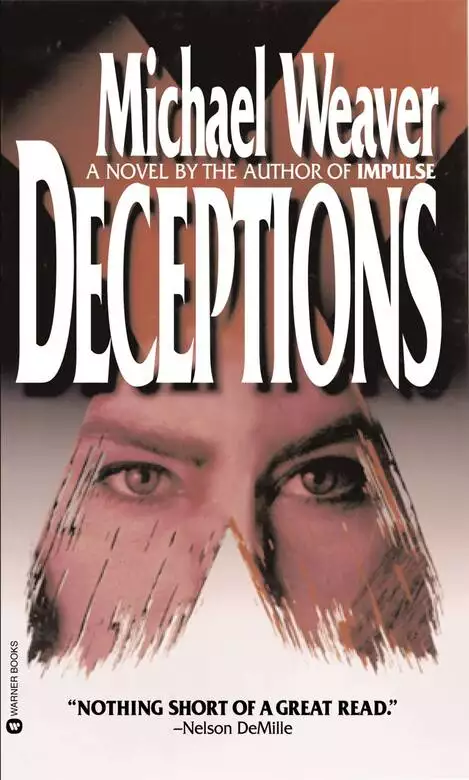
Deceptions
- eBook
- Paperback
- Audiobook
- Hardcover
- Book info
- Sample
- Media
- Author updates
- Lists
Synopsis
When a corrupt U.S. Attorney General unleashes a global network of assassins to hunt down a woman who could destroy both his career and his life, two Mafia-connected men find themselves unwitting protectors of the innocent woman. By the author of Impulse.
Release date: October 31, 2009
Publisher: Grand Central Publishing
Print pages: 464
* BingeBooks earns revenue from qualifying purchases as an Amazon Associate as well as from other retail partners.
Reader buzz
 Please log in to recommend or discuss...
Author updates
Deceptions
Michael Weaver
NOVEL proves that Weaver knows what most thriller fans want—and can deliver it in spades.”
—Publishers Weekly
“DECEPTIONS carries a certain rhythm of motion to it as characters blend fluidly with an unusual plot… Readers will be intrigued…
REACH FOR DECEPTIONS.”
—Neshoba Democrat (MS)
“SUCCESSFUL… so laceratingly tough that the ink it’s printed with might as well be distilled testosterone… Weaver practices
a kind of art brut writing that rings true for his double-butch heroes. IF YOU CANT FIND ANYTHING TO SAVOR IN THIS ONE, BETTER FORGET HOW TO
READ.”
—Kirkus Reviews
“THE BOOK KEPT ME IN THAT RARE STATE BETWEEN SPELLBOUND AND PAGE TURNING. THE DIALOGUE ABSOLUTELY CRACKLES.”
—Nelson DeMille
“A NIFTY TWIST ON THE USUAL ORDER OF THINGS AND A FAST-PACED THRILLER THAT GETS BETTER AS IT GOES ALONG. It’s the stuff of
solid action fiction.”
—Baton Rouge Magazine (LA)
“THIS STORY TAKES NO PRISONERS.… [IT IS] A KINETIC THRILLER.”
—Buffalo News
“A COLORFUL, SUSPENSEFUL CHASE AND ESCAPE NOVEL…. An international thriller that exposes some of the worst aspects of politics
and private ambitions. It does entertain solidly.”
—Calhoun Liberty Journal (FL)
“Michael Weaver [lands] the reader in the middle of a SPINE-TINGLING GOVERNMENT PLOT to murder an innocent woman. Ten years
later, when the U.S. Attorney General discovers the woman is still alive, he tries again. AND THAT’S WHEN THE PLOT THICKENS.”
—Book Browsing
* * *
RAVES FOR MICHAEL WEAVER’S PREVIOUS NOVEL, IMPULSE
“WILL LEAVE READERS BREATHLESS, PROBABIY WITH THEIR THROATS RAW FROM SILENT SCREAMING.”
—James Patterson, New York Times bestselling author of Along Came a Spider
“IMPULSE STARTS OUT LIKE GANGBUSTERS… . What keeps one plowing through the steamy pages is the character of the demon developed by
Weaver.”
—Chicago Tribune
“RIVALS THE VILLAINY OF HANNIBAL LECTER… . WEAVER WOULD SEEM TO HAVE A CAREER IN THIS GENRE.”
—Philadelphia Inquirer
“FIRST-RATE… IRRESISTIBLE… Weaver has pulled off an assured and stunning debut”
—Cleveland Plain Dealer
“A SERIAL KILLER NOVEL WITH A DIFFERENT TWIST… A FIRST-RATE NOVEL”
—Library Journal
MERCILESS… TERRIFYING… A POWERFUL, MESMERIZING PSYCHOTHRILLER, THE KIND OF BOOK YOU JUST CANT STOP READING.”
—West Coast Review of Books
“PERFECTLY PACED VACATION READING.”
—Kirkus Reviews
“SEX, VIOLENCE, AND ACTION… . DON’T READ IMPULSE IF YOU’RE HOME ALONE… . Guaranteed to give you some chilling goose-bumps no matter how hot the summer day… . You’re hooked
for the entire book by page three.”
—Oakland Press
“CHILLING… . A SEARING, CRAFTIIY WRITTEN SUSPENSE STORY THAT WILL LIKEIY HAUNT YOU AS MUCH AS IT ENGAGES YOUR INTEREST AND
ADMIRATION… A sophisticated psychological thriller that deserves its place in the summer reading roster as readily as those
by Ludlum, Grisham, and Throw.”
—Raleigh News & Observer
“A QUICK, INTENSE EXPERIENCE. AN EXCELLENT CHOICE FOR A QUIET WEEKEND.”
—Wisconsin State Journal
“WILL SCARE YOUR PANTS OFF… . READ IMPULSE, BUT NOT AT NIGHT, HOME ALONE. THEN WATCH FOR WEAVER’S NEXT NOVEL.”
—Southbridge News (MA)
“HAUNTING… YOU’LL BE FASCINATED FROM PAGE ONE… . IMPULSE WILL RIVET YOU IN YOUR SEAT.”
—Macon Beacon
GIANNI GARETSKY WAS thirty-eight years old and wearing his first nonrented tuxedo on the night the Metropolitan Museum of Art honored him with
a grand reception.
Distinguished, elegantly dressed men and women smiled at him and he smiled back, although he knew very few of them. Still,
it was a festive occasion, and there was nothing wrong with smiling. As his mother used to say, smiling required fewer muscles
than frowning.
Of course his mother had always said it in her own lyric Italian, which made it a lot more pleasing to the ear. But the meaning
was the same.
Highlighting that night’s tribute was a retrospective of some of Gianni’s earlier work, along with the museum’s first public
showing of Solitaire, his most recent painting. A leading critic had already praised the canvas as a haunting urban landscape that embodied the
kind of stark, poetic imagery for which Gianni had become so justly celebrated.
Gianni himself was unimpressed by the rave. He had too clear a memory of this same authority dismissing him ten years ago
as a naive candy-box painter with no true intellectual theory behind his work and therefore no real force as an artist.
So much for the judgment of experts.
A waiter brought Gianni a fresh drink, and he continued his slow circling of the crowd. Earlier, the Metropolitan’s cu
rator had made a point of introducing him to everyone of possible importance to the museum’s financial and political well-being,
and the artist had shaken hands and exchanged pleasantries with them all. Now it was sufficient to simply smile in passing,
sparing him the need to hear his given name mispronounced with a hard G, rather than with its proper softness of Johnny.
It was a bit past ten o’clock when he saw Don Carlo Do-natti enter the rotunda.
The don carried himself with his usual great presence, an impeccably groomed man of medium height and build who, by the mere
thrust of his jaw and the straightness of his back, managed to project an elemental force.
Glancing past Donatti, the artist picked out the three men who had arrived with him. They were young and sleek haired, and
Gianni had never seen them before. Like the don, they were dressed in the latest in tuxedos. But instead of following him
into the reception area, they positioned themselves at the entry and carefully watched their boss’s casual progress across
the marble floor.
Gianni hurried to welcome the don. He had, of course, sent him an invitation, but only as a mark of respect and affection.
Knowing the range and pressures of Donatti’s commitments, Gianni had never really expected him to attend. Seeing Donatti here
now, knowing how rarely he indulged himself in this sort of lavish, ceremonial affair, the artist was touched.
“Don Donatti,” he said. “You do me honor.”
They embraced and Gianni felt the powerful back muscles beneath the fabric of the Don’s dinner jacket. Gianni had known him
since early childhood, and it was always something of a surprise to be confronted by his seemingly impervious youth and strength,
the dark eyes that glittered like marbles.
Donatti kissed him on both cheeks. “It’s you who does me honor, Gianni. You think I’d miss such an occasion?” He laughed. “For this, I’d have made them carry me here in my coffin.”
“Not even in a joke, Godfather.”
Gianni escorted Donatti to a small, corner table. How eas
ily I slip back into it, he thought. The almost stylized rituals of old-world respect, the affectionate use of the term godfather that custom dictated, the sudden rush of warmth that made him feel not nearly as alone as he had felt just moments before.
Although Gianni’s father had raised him as a Jew, it was by his mother’s Sicilian precepts that he had lived the core years
of his life to date. As had his father. In the end, both his parents had died of them.
At the table, Don Donatti took out a pair of glasses, wiped them clear with his handkerchief, and surveyed the elegant setting
and those in it. Then leaning forward, he gave particular attention to the collection of spotlighted paintings that made up
the retrospective.
Gianni Garetsky considered the canvases along with the don.
Bits and pieces of me.
Yet, there was the wonder, too. I did this? That special sleight of hand. You started with a blank stretch of canvas, ran in some color, and presto! A new world. And
it was all yours. Whatever you wanted to see, you saw. Whatever you wanted to happen, happened. Awesome. Sometimes his brush
trembled, his eyes blurred, his stomach knotted. Whom did he think he was? God? If not God, then at least a sorcerer.
Donatti nodded, as if this slight movement of his head carried his ultimate judgment of everything he saw.
“Too bad, Gianni.”
Gianni looked at him.
“Too bad they couldn’t be with you tonight,” Donatti said softly.
The artist was silent. The anonymous “they” were his mother, his father, and his wife. His parents had been killed a long
time ago, when he was not yet seventeen. Teresa, his wife, had been taken by cancer only recently. So what he was feeling
mostly tonight was cheated.
The don understands this better than most. The thing was, how much did even the best of it mean without those you loved with
you to share it?
A waiter appeared with champagne and filled their glasses. They sat wordless until he had left.
Donatti gazed evenly at the artist.
“It happens, Gianni. In time, we lose our cheering sections. That’s when it’s good to have a friend. So I’m here.”
The don reached for a glass of champagne and slowly brought it to his lips. His eyes were solemn. “And not only for tonight.”
Gianni sat with it.
In time, we lose our cheering sections.
He could put it no better than that.
And for how long had Teresa been cheering for him? Seventeen, eighteen years? Nearly half as long as he had lived. She had lifted him when he was low, had made him feel better
than he knew himself to be, had gone wild over his smallest achievement.
His one love.
Would he ever have another? Gianni doubted it. He knew that in time all things, even grief, finally passed. But he had no
idea what would come to take its place. Here, now, on this special night, Gianni’s mind edged closer to the image of Teresa
he kept like a talisman. He saw her fair hair catching an early light on her pillow, a mouth all too vulnerable to what life
had to offer, the delicate tip of her nose that had always suggested the lift of something in flight, the wide, shining eyes
whose color never failed to surprise.
Then his thoughts drifted to the worst of it, the part he couldn’t bear but which he still held on to like some awful relic
he was afraid to cast away. Which meant he saw her, too, as she had been at the end, with her hair reduced to scrabble, her
flesh wasted, the source of his love staring up from the same pillow while she struggled for the strength to smile. God help
her if she failed to smile for him.
His wife had a way of saying things that he could never come close to matching, wildly extravagant things that would have
sounded foolish coming from him or anyone else, yet seemed absolutely right coming from her. Like saying they’d been made
for each other since the beginning of time and no exaggeration… or how just the way his hands touched her could leave her
breathless… or that when he was probing deep inside her, she was sure he was reaching straight to God.
All this from a devoutly religious girl who had come to him untouched by any other man.
So naturally God had gotten jealous and taken her. While her idiot doctors, unknowing, had called it cancer.
It was close to one o’clock when Gianni paid off the cabbie in front of the converted loft building where he lived.
There was heavy fog and the downtown Manhattan streets were deserted, left to the mist as though the night itself were a public
disaster that the inhabitants of SoHo were wisely avoiding by staying inside their apartments. As the cab drove away, a dark
sedan swung around the corner and stopped at the curb.
Gianni saw two men get out. They were wearing tuxedos, and he remembered seeing them earlier at the museum.
The taller of the two was carrying an attache case. It was he who spoke as they approached. “Federal Bureau of Investigation,
Mr. Garetsky. I’m Special Agent Jackson, and this is Special Agent Lindstrom.”
They took out wallets and showed Gianni their identification. The artist glanced at them by the light of a street lamp.
“What did I do? Put the wrong postage on a letter?”
Their smiles were polite. But they gave Gianni the feeling they had been taught to smile exactly this way in a course at the
FBI Academy.
“It’s no big deal, Mr. Garetsky,” said Jackson. “Could we just go upstairs and talk for a few minutes, please?”
Gianni stood there, unmoving. So if it was no big deal, why were they here at one o’clock on a Sunday morning?
Then he turned and led them through the front door of his building and into an old iron elevator.
They ascended slowly to a dull, clanging sound while Gianni felt the air being sucked out of his lungs. It was as though he
had fallen asleep in a deep wood and wakened to find the trees burning. His mind searched for possible reasons and came up
with none that he liked. It’s nothing, he told himself. Yet he did not believe it for a second. A small hidden part of him
said he had been waiting for this moment for no less than twenty years.
They stood in silence, no one quite looking at anyone else.
Then the elevator clanged to a stop at the tenth floor and they got out.
There was just the one big metal fire door facing them, and Garetsky unlocked it, preceded the two men past the threshold,
and switched on the light.
The loft took up the entire top floor of the building and had once belonged to a manufacturer of men’s clothing. There were
three skylights and a wall of windows at the far end, facing north… which was the studio area. Gianni’s living quarters were
closer to the entrance. There were a few rooms partitioned off for privacy. The rest of the space was open.
The artist saw everything along with the government agents. They all saw the same things, but what he saw was marked inside
him.
The two men stood in the center of the living area, courteously waiting to be told where to sit.
Gianni nodded toward a couch and chose a straight chair for himself. The agents sat down side by side. They were big men and
their bulk made the oversize sectional couch appear small.
“We just need a few questions answered,” said the one named Jackson, a balding, smooth-faced man with blank eyes. He sat with
the attache case on his lap and was evidently the senior agent of the two. “Then we’ll get out of here and let you go to bed.”
“Questions about what?”
“They concern an old friend of yours.”
Jackson opened his case, took out some papers, and shuffled through them.
“I’m talking about Vittorio Battaglia.”
Gianni sat there, his face showing nothing.
“We’d like to know when you last saw him and where he can be reached.”
“Why?”
Special Agent Lindstrom broke in to speak for the first time. “I’m afraid we don’t have that information, sir. Our instructions
are only to locate Mr. Battaglia.”
“Why come to me?”
Lindstrom had an acne-marked face that looked shadowed
in the overhead light. “Because since you were boys together, you’ve always been closer to him than anyone else.”
“That was more than twenty years ago. I haven’t seen or heard a word from Vittorio since we were both seventeen.”
“That’s hard to believe,” said Jackson.
“It’s the truth.”
Gianni saw the two agents exchange glances, and something passed between them.
Lindstrom rose and walked to the wall of windows at the far end of the studio. Then he just stood gazing out at the row of
darkened buildings across the street.
Special Agent Jackson sat in silence. He appeared to be studying the sheaf of papers in his hand. But Gianni understood that
there probably was nothing in those papers that he did not already know by heart.
“A few basic facts, Mr. Garetsky,” said Jackson. “The same year that you and Vittorio Battaglia were busy being seventeen,
both your parents were murdered by a mob enforcer named Ralph Curcio. Who was then shot to death by you in retribution. Two
days later you left the country for Italy under false papers and didn’t come back for seven years. You used a thirty-eight
caliber Smith and Wesson for the shooting, and we still have the gun and your prints as evidence.”
Jackson paused to give the artist his most ingenuous government-issue smile.
“So you see, we have it all on file, Mr. Garetsky. And there’s no statute of limitations on murder. But if you’ll just cooperate
on this little business of Vittorio Battaglia, I’m sure we can work something out on Curcio. Who was vermin anyway.”
Somewhere inside himself, Gianni Garetsky had started to shake, as with a chill. He wondered if it showed. It seemed very
important at that moment that these two men not be aware of what was happening inside him.
Lindstrom returned from the windows. “What do you say, Mr. Garetsky? Is it a deal?”
The artist held himself completely still.
“Don’t be a fool,” said Jackson. “You’re a successful and
famous painter. You have a long, wonderful life ahead of you. Why throw it all away over a nickel-and-dime punk?”
“Even if I wanted to tell you where Battaglia is, I couldn’t. I don’t know.”
Special Agent Jackson sighed. “I don’t think Mr. Garetsky realizes just how serious we are about this. Would you say it’s
time to show him, Frank?”
“Yeah,” said Lindstrom from behind Gianni, “I’d say it’s time.”
Gianni never saw the hit coming. It came over his right shoulder and caught him across the cheek with almost no force. It
was no more than a light, token rap with the knuckles, yet its overall effect was greater than that of a hard punch. For it
diminished him. It made him see exactly what he was worth to these two men. And that was nothing.
Seated in front of Gianni on the couch, Special Agent Jackson still considered him without particular malice, a strong professional
in impeccable evening clothes whose blank eyes offered no hint of what was going on behind them.
“Let’s try again,” he said quietly. “When did you last see or speak to Vittorio Battaglia?”
“Twen… ” Gianni’s tongue groped slowly, almost numbly, and he had to start over. “Twenty years ago.”
This time the blow came over Gianni’s left shoulder. It was as light a tap as the first, but it carried the added weight of
an established order. It told him that he and his flesh were not inviolate, and that this was merely the beginning. The artist
felt the blood rushing to his face. His heart turned. These are not FBI agents, he thought. Until he remembered certain unpleasant things he had seen and heard a great many years ago, and then he was not
so sure.
“Where’s Vittorio Battaglia?” Special Agent Jackson spoke quietly, patiently, a controlled man with plenty of time to do whatever
might be necessary.
“I don’t… ” Gianni shook his head and tried to get himself ready for the next hit from the right.
But this time nothing came. Instead, Jackson took a revolver from his shoulder holster and screwed on a four-inch silencer.
He held the weapon pointing at the floor. To Gi
anni, the silencer was the clearest indication yet of the men’s ultimate intent. Or was it only bluff, a showpiece?
“We have a job to do here, Mr. Garetsky,” said Jackson. “And one way or another we’re going to get it done. So why don’t you
make it easy on us all and answer this one question?”
“Because I don’t know the answer.”
Jackson lifted his revolver until it was aimed loosely at Gianni’s chest. “A few hard facts,” he said. “The credentials we
showed you are false. Which means you can forget about any of the little niceties you might be expecting from us as federal
agents. So either you start talking, or I start shooting.”
Gianni sat there, dry mouthed. “You’d really kill me for this?”
“Killing you won’t tell us where Battaglia is. But a few well-placed bullets might encourage you to talk.”
They stared at each other.
Gianni figured it was time to give them something. He knew about interrogation under threat of physical pain. Finally, you
had to talk. Even if it was only lies.
“Could I have a drink of water?” he said to stall it further. Jackson nodded to Lindstrom, who went into the kitchen and came
back with a filled glass.
Gianni brought it to his lips with less-than-steady hands and they watched him drink.
“When did you last see Battaglia?” said Jackson.
Gianni gripped the water glass with both hands to keep it from shaking. “Three weeks ago.”
“Where?”
The artist took another drink and coughed, still playing for time.
“Where?” repeated Jackson. Hardly seeming to move, he lifted a leg and kicked the glass out of Gianni’s hand. Trailing water,
it rolled along the floor without breaking.
“Chicago.”
“What part?”
“Oak Park.”
“Address?”
Gianni sucked air. He stared into Jackson’s eyes and saw
himself dead. Whoever they were, there was no way they were going to walk out of here and leave him alive. And I’II never know why.
“I can’t remember the exact… ” The artist breathed deeply and seemed to grope for remembrance.
“Address,” said Jackson again. He was beginning to sound bored.
Gianni slowly shook his head. Then he kept shaking it as though he were suddenly an old man from whose brain all detail had
fled.
“I want his address.”
Once more, Jackson lifted his leg. But this time the kick was aimed at Gianni’s groin.
The artist saw it coming. Grabbing the foot in midair, he yanked and twisted until Jackson was off the couch and on the floor,
with Gianni all over him and rolling them both in case Lindstrom had his own weapon out and was looking for a clear shot.
Get the gun or you ’re dead, Gianni told himself.
For a moment everything inside him was calm and slow. He saw Jackson’s smooth face as he stared at him, saw his blue eyes,
cold as glass, and felt an insane joy, as if death at this moment might not really be the worst thing that could happen to
him.
Something exploded in Gianni’s head and he caught a glimpse of a bright red fall that opened like a crack in the earth. Then
there was a shock and things began to spin. But he did not lose consciousness or let go his grip on Jackson’s gun hand.
The next blows came one after another and in such swift succession that he lost count. They caught him in the face and neck
and he choked, swallowed blood, and retched all over himself and Jackson. He knew now that Lindstrom was using a leather covered
lead billy and was good with it. Good enough to do the required damage without fracturing his skull or killing him. Good enough,
too, for the shock and pain to start closing off the light, leaving him awash in all the shameful juices of living.
Then rage took over and Gianni had a brain full of blood that sent his teeth into Jackson’s wrist with such force that
they hit bone and stayed there until the fake FBI agent cried out and dropped his revolver.
In what seemed a single motion, Gianni grabbed the gun, rolled away from the steady pounding of Lindstrom’s billy, and squeezed
the trigger. There was just the soft whooshing sound of the silencer as the bullet sucked in Jackson’s face and turned him
old.
Gianni swung around.
Lindstrom had dropped the billy and was struggling to free his revolver from his shoulder holster, but it had hooked into
the lining of his tuxedo. His acne-scarred face was suddenly terrified. Gianni saw it and was terrified, too. Then he swallowed,
tasted his own blood, and fired twice.
Lindstrom went over backward. Two crimson buds flowered on his white dress shirt. When he hit the floor, he never moved.
Gianni Garetsky lay there.
He breathed the acrid smell of cordite and let the anger drain out of him.
The nausea, the illness, remained.
THE ARTIST ROSE slowly. His head, neck, and back were a single blob of pain, he saw floating spots, and he stank from an assortment of his
own bodily discharges.
Why had they done this to him?
What had Vittorio Battaglia done to them]
Gianni expected no answers. What the questions did was make it easier for him to look at the two men.
The agents lay as they had fallen. They were on their backs, eyes staring up through a skylight as fixedly as if they were
counting stars. And they were dead. There was no question about that. They were certainly dead.
Gianni fought an urge to go into his bedroom, lie down, and fall asleep in the mad hope that when he awoke the two bodies
would be gone and everything in his life would be the way it had been.
Still, he was calm. It was a fragile calm, but he could feel it growing stronger. And he knew that whatever had to be done,
he would finally do.
In the meantime he poured himself a generous shot of brandy, walked to the wall of windows at the north end of the studio,
and stared down at the street ten stories below.
Nothing was moving. But some cars were parked at the curb, and Gianni was able to pick out the dark sedan that Jackson and
Lindstrom had arrived in. The artist had lived and worked on this street for more than ten years. He knew it well. Yet he
suddenly felt himself lost in an alien land.
He glanced at his watch. It was not quite two o’clock. He had arrived home less than an hour ago. The wonder was that it had
all taken so little time.
Gianni carried his drink back to where it had happened. Everything was in place. No furniture, lamps, or pictures had been
damaged or disturbed. Other than for the two bodies, it was a peaceful-enough scene, a quiet setting where a brief encounter
had taken place.
Other than for the two bodies.
Gianni breathed deeply and felt the pain filter through him. Then he tossed off his brandy and tried to see if he could learn
anything.
He went through the men’s wallets and FBI identification, and everything tied together as authentic. Credit and insurance
cards, driver’s licenses, assorted other plastic, all confirmed their stated identities. If any glitch existed, Gianni failed
to pick it out. Which suddenly added to his confusion. Were they real or not?
Jackson’s attache case held its own items of interest… among them, a vicious-looking electrical shock device that would have
been applied to his more sensitive body parts if their other efforts failed to produce the desired answers.
In an envelope was a faded snapshot of Vittorio Battaglia
and himself as a couple of grinning teenagers at the beach, caught and held in a moment of summer sun.
Another photograph showed Vittorio standing beside a beautiful Asian girl who was staring solemnly at the camera with luminous
almond eyes. A name and address on the back of the photograph identified her as Mary Yung of Soundview Drive, Greenwich, Connecticut.
Garetsky wondered if the two alleged agents had been to question the girl before they came to him. If they had, was she now
lying dead or crippled somewhere? He hoped not. He very much wanted Mary Yung to be alive and communicating.
The attache case also contained two computer printouts. One had to do with Mary Yung. The other dealt with him. He read the
girl’s first.
MARY CHAN YUNG (one of several names for MOPEI LINLEY FOO). Born in Hong Kong, U.K., and brought to U.S. as child by parents,
now deceased. Current age, 34. Yung works on and off as a sometime actress, singer, photographer’s model, fashion reporter.
Apparent independent means as parents’ sole heir of record. Unmarried. Yung is known to have had close and lengthy relationship
with Vittorio Battaglia just prior to Battaglia’s disappearance approximately ten years ago. Yung is known to have worked
and traveled throughout Europe and the Far East.
The artist moved on to his own printout.
GIANNI SEBASTIANO GARETSKY. Born N.Y., N.Y. Current age, 38. Single known alias, JOHN CARPELLA. Parents, Maria a
We hope you are enjoying the book so far. To continue reading...
