Muru is not revenge. Muru is about balance. You put your hands on one of theirs and they had every right to take from you and yours whatever they meant to take, short of a life.
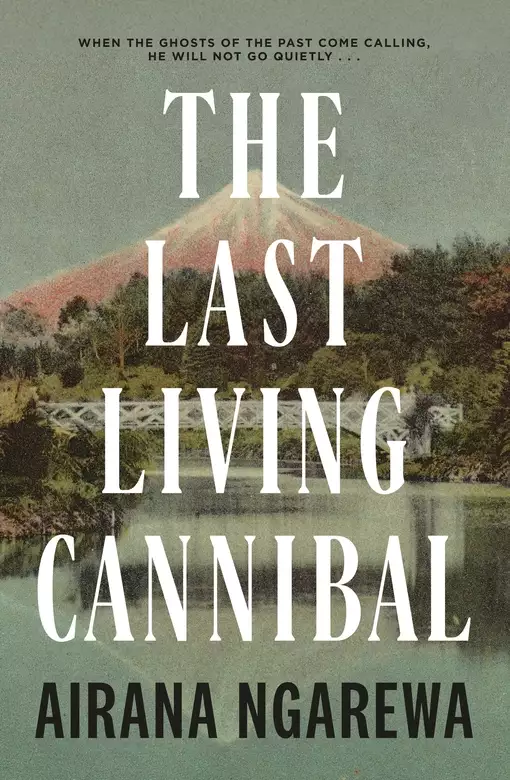
Aotearoa in the 1940s, and the Māori men of Taranaki have refused to join the Māori battalion because of the severity of their land confiscations. Koko is the oldest man in the village, a legend within his community - he's lived through the land wars, Parihaka, imprisonment in Dunedin, and they whisper of him as the Last Living Cannibal. Koko dotes on his grandson Blackie, who has lived with him ever since Blackie's mum left in troubling circumstances years earlier.
But the ghosts of the past are bound to come calling, and when they do, they come with muru in mind.
Richly set in Taranaki during the 1940s, The Last Living Cannibal is the epitome of a classic Aotearoa novel, from one of this generation's most promising writers.
Release date:
September 30, 2025
Publisher:
Hachette New Zealand
Print pages:
304
* BingeBooks earns revenue from qualifying purchases as an Amazon Associate as well as from other retail partners.
AFTER THE SMATTERING of support the blowhards in the House received from Māori during their Great War, it must’ve been a great shock when so many East Coast natives signed up quick smart to fight in their Second World War. And then again, by contrast, when most of us in the West told those men in suits which hole they could stuff their guns up and inside of.
There ain’t a lot nowadays that reminds me much of my time as a young man. But I’ll die well knowing Taranaki was still as stubborn as our mountain was bare in the summer and tall all year round. Those bloody buggers and their neckties could’ve sent us every Māori member they worked with, and they almost did, and the answer would’ve been the same: We’ll give you our best men if you return our best land to bury them on when they return.
On what little we had left, I drank from my cuppa and watched the usual goings-on outside the kitchen window. The sun rising and the kids waking and stuffing their faces and rushing outside in their shorts and baggy shirts to figure what flavour of tomfoolery they favoured today. After the kids had finished their laughing, teasing and crying out there, most of the men would return from the milking sheds scattered across faraway paddocks, and the women would greet them with whatever they had salted, wrapped in newspaper and kept in the cupboards before heading on down to the stream with the washing in their prams.
In her own time, the old lady led the women down the bank behind the Ray family’s house. That darn thing was the same as every other one in the village, just peeling and rusting worse than most. We lived in cottages, really. Corrugated-iron roofs and timber walls painted white. Each was three bedrooms, give or take. The chairs wood and native too. Most had some kind of fireplace. And a small kitchen. And a smaller washroom. And an even smaller outhouse with a long-drop that you hoped you never had to use in the dead of the night.
The Ray family’s house had been empty a while now. The lot of them, grandfather to grandchild, went off to the city ages ago. We’ve never seen those ones since. The old lady was the first in the village to pack the house full of white linen. Took a great deal of pride in having the whitest sheets and the cleanest tablecloths. It was all a ploy, I reckon, to stay away from the house as long as she could justify. To herself most of all. I didn’t mind her going about her own business while I went about mine – watching the morning grow warmer with a cold cuppa tea in my hands.
There was nothing the old lady loved more than being an ear to the wives and the mothers. And then passing the gossip on to the other nannies she spotted around the place. There were no secrets on a marae.
I knew some of the women who were alive at that time better than I knew their grandmothers I grew up with. And I’d overheard more about their husbands than any god-fearing man needed to know about another. Good thing the nannies of my time had long gone off to see Peter at the pearly palisades in the sky and await that great big pōwhiri into paradise. The things they’d surely heard about me were now buried with them on the cemetery on the hill, the dead watching over this village like the birds and the old warrior scouts of the war. That was about everything we had here. Gossip, grim jokes and a graveyard.
And a bigger one now after the flu swept through here. For two years, the village had more burials than birthdays. Now, the lot of them lay up on that hill. Minus the oldest child of the family Foreshore, whose relations demanded they lay her down in their own patch of dirt.
The tribe came in a drove, made the case that the child was better buried in their neck of the woods, and that was that. The girl and her box were theirs. And the village celebrated. There was no higher honour in the Māori mind than two tribes warring over who got the privilege of putting you in the ground.
My own son, Joseph, had only one kid himself before that fool got on the drink, got in a row with his wife and put his hands on her. Before the sun could rise again, she was on her way back to her own people of the Waikato. Home of a hundred chiefs and a king.
‘Good on her,’ the old lady said to our son. ‘If that tribe of hers comes looking around here, I’ll be the first to point them to your doorstep. I only pray they bring their biggest and ugliest to teach you better than I could.’
I didn’t have much to say myself, biding my time ’til those people of the river came on down to take what they needed to take. Such was the tradition. Muru. You put your hands on one of theirs – you dishonoured the sanctity of marriage – and they had every right to take from you and yours whatever they meant to take, short of a life. We had no gaols or gaol cells. But we had our own ways to make a wrong deed right. ‘Every man is an island,’ the old people would say in our ancestral tongue. ‘And every island has an ocean that shapes him. And so, the wrong of one is the wrong of everyone.’ Or in the more modern words of the Māori ministers of the church, No sinner sins alone.
The daughter-in-law’s tribe never arrived. But who knows – maybe they were still on their way. It ain’t like that river of theirs is just round the corner.
If our son considered drowning his misery in the same drink that caused it, the old lady and her partner in crime, the widow Nanny Foreshore, were a step ahead of him. They went house to house and then all the way to Pātea, telling every man and his dog how her son had robbed his child of a mother – how Lamb had taken off in the night. And so, before Joseph could dry the tears from his eyes, the two of them had spread his story to every corner of the village. By the end of the week, the drink was banned entirely.
She was a clever woman, the old lady. Never without a plan. She knew first that the drink did us no good. Getting rid of it was as good as getting rid of the devil. She knew just as well there’d be hell to pay for whoever robbed the men of their merriment. I never found out who gifted Joe that broken nose a fortnight or so afterward, but the whole household knew he’d earned it. It wasn’t muru, no evil deed paid in full, but it was a heck of a good start.
Our grandchild moved in with us after that, the old lady determined to teach the young’un better than she’d taught her own. And once he’d done most of his grieving, Pumpkin Joe moved in too. Because of the size and shape of his head, that’s what the old lady had called Joseph from the very day he was born. She said she named him so because it was funny to her, but I reckon otherwise. He’d wreaked havoc on her body and this was her own kind of muru. More gossip and grim jokes.
After his wife followed that famous trail of tears Ruapūtahanga had laid between Tainui and Taranaki, the old lady’s eyebrows would come together, and her forehead would wrinkle whenever she said his name. ‘No wonder his head is so frickin’ big,’ she whispered to me. ‘There are more bones in there than brains.’
There was a time when there was no better description of our dear boy. He was five foot eight with a belly and his skin was the same shade of brown as the bark of the pōhutukawa. Same as that tohunga tree too, his head turned red in the summer, long days in the sun bleaching the mess of hair on top. Even when he was little, the local seers would say the whitebait was off-limits ’til Joe took the red hair of the Irish – one of many reasons those delicious little critters still run thick through the rivers here. Naturally, by his own peers he was known as ‘Danny Boy’. ’Least ’til he started working as a teenager and filled out a bit and got to cussing out the other boys who hadn’t the heritage to call him names.
We came from a long tradition of warriors. Righteous and covetous. And like the rest of his tribe, Joe had a bit of both in him. Back in my day we had a clear enemy. Someone we could point to. Swing the thick end of a taiaha at. No-one nowhere in this country had warred as well as we warred against the Queen and her soldiers. Had laid down as many of her men in a single battle as we had on these lands. Had pushed her back as far as we did.
It’s a harder time to be a man now. Hard to tell the toetoe from the pampas grass. Friend from foe. Still, no reason to put your hands on a woman. I can only hope she’s better off with her own people. And she trusts her boy is well looked after here. When I asked the old lady what we could do to make it right by the poor thing, she told me not to worry the few hairs still growing on my head. And so, I left it alone. Duchess was never without a plan.
‘Good morning, Koko.’
‘Morning to yah.’
‘Wanna ’nother cuppa?’
The young’un’s skull was as thick as his father’s. Still, I played along with him, nodding my head.
‘Want me to start a new kettle of tea too?’
‘What’s wrong with the one I got?’
‘All the other grown-ups like fresh leaves better.’
‘Like who?’
‘Like Dad.’
‘Well, I reckon your dad’s head is filled with hāngī stones.’
The young’un laughed.
‘And yah know what’s worse than that?’
‘What’s that, Koko?’
‘They ain’t the good stones either. They’re smoky and cracked. That’s why everybody says your dad’s brain’s gone bad.’
‘Who says that, Koko?’
‘You’re telling me you’ve never heard no-one say that about your old man?’
‘No.’
‘Good grief. Maybe it’s just this ol’ fulla then.’
I winked at the young’un and he laughed, collecting the mug and teapot in front of me and racing to the sink in the kitchen. He ran the water for half a second and filled its bottom. The boy then fetched the still-warm kettle, where the twice-used tea-leaves had long settled on the base, and tipped it sideways, filling the rest of the mug. It was an art at this point, his second nature. The young’un couldn’t see the mug or the tip of the kettle. But he had a good sense of it by weight alone.
On the way back he spilled a little, the tea ebbing and flowing ’til it flowed right over the top and onto his hands.
‘Lucky your koko doesn’t like boiling water like the rest of them, aye?’
He placed the mug down in front of me.
‘Koko?’
I put my cuppa to my lips. ‘Mmhmm.’
‘Can I ask you something?’
This might as well’ve been the custom at this point. Greet your koko and offer to help him with something. Then only afterward, once you’ve earned some goodwill, ask him what you really wanted in the first place.
I drank some down and put my cuppa back on the table. ‘Only if I can ask yah something first?’
‘Okay, you start.’
‘I didn’t think the tide was out ’til midday.’ The young’un tilted his head sideways and I smiled, having discovered a trick I hadn’t yet played on him. ‘So what in grief’s good name happened here?’
I pointed to my cuppa, only three-quarters full, and the young’un smiled and called me silly.
‘Can I ask you my question now?’
‘Go on, then.’
‘Can I go down to see Mama Carlyle’s new lambs?’
‘Depends. Who’s going with yah?’
‘Just the pā boys.’
‘And the girls?’
‘They’re already there.’
‘Rightio then. You clean up that spill you made, and I’ll drink my cuppa as fast as I can. By the time you’re finished, I’ll be finished too, and we can both go down together.’
The young’un nodded and raced off again, the rest of his buddies camped on the other side of the fence, doing their best to read whether or not Blackie had got the answer he wanted. I took a sip of my tea and the young’un returned with a dirty towel from the washing basket. He threw it on the floor and danced on top of it, sliding backward and forward ’til the floor was a little less wet, then raced off again to return the towel from where he found it. Soon enough, he was back, standing there, silent. Staring at me. Waiting. Hurrying me with his eyes. And then, when his patience ran out in the very next second, his mouth.
‘You nearly finished, Koko?’
‘Very nearly.’
‘How many more sips you have left?’
‘Not many.’
‘What if you took big sips like this?’ He took a swig from the imaginary mug in his hands, gulping it down his gullet like a seabird.
‘Be careful, my boy. You’ll make another spill.’
‘So you’re mostly done now, aye?’
‘Mostly.’
‘Like two big sips, maybe?’
‘Maybe.’
I put my cuppa to my lips and, before I could drink from it, the young’un counted. ‘That’s one.’
I looked the young’un in his pāua-shell eyes and placed the mug back on the table. ‘You’re not gonna let me enjoy this one, are yah?’
Blackie shrugged his shoulders.
I turned to check the rest of the pack outside and their smiles shone brighter than the sun behind them. Then I checked my shoulder, to see both Blackie’s thumbs high in the air.
‘By the look on their faces, kiddo, someone has already told the pā boys I was on my way. I wonder who that might’ve been?’
‘Dunno.’
‘If this were a horse race, I know who I’d put my money on.’
‘Who’s that?’
‘The same young’un who spilled half my cuppa so I’d finish it quick smart.’
‘That was just an accident.’
‘Snapped yah,’ I said with a wink. ‘So it was you. Well, no good mucking around now. Let’s get a move on. Those lambs won’t be lambs forever. Any luck and they’ll be in a hāngī soon enough.’
Blackie ignored me and rallied again with the young’uns outside, the lot of them punching and kicking the air, the littlest one breaking into an impromptu haka, slapping his thighs and chest. I reckoned that boy must be the Putis’ youngest, a family famous for their haka. Singing, though, was another story. Fair to say that the women from that lineage were made for the back row.
They were not not beautiful; they just sang like cats fought. An octave or ten higher than a good harmony demanded. All Taranaki women were stunning. Tainui were known for their many chiefs and Poutini were known for their greenstone; Taranaki were known for the beauty of our women, the prosperity of our gardens and men who’d been beaten every which way by the ugly stick. My younger cousins were a living testament.
The first two gave every reason in the past for the tribes from the North to come and chat. The last meant they left their best warriors and their best weapons at home. What Māori tribe would be dumb enough to stare down two hundred ghouls and goblins in a haka and still run it straight up the guts?
I gave Joe a nod as I left the house, the bugger pushing one of those new mowers the village had bought in front of the big house. It was a clever purchase, really. The village lawns were a mammoth task – the ātea alone was about the size of a rugby field. Add the rich soil found in the village and you had grass that was a tougher task to tackle than rats in the pantry in the winter.
My son kept his head down and pushed on with the job. The rest of the adults were away working or keeping themselves busy in one way or another. This was half the reason the kids were outside playing: one of their parents or grandparents had told them to get out of their hair and see what their cousins were up to. Related by blood or not, every kid here was a cousin to the rest of them. Even Blackie, who was really their uncle, given how long it had taken for his old man and this old man to plant our seed.
Me and the pā boys were off fast on our adventure. The girls were trusted to be down on the farm by themselves but the boys weren’t allowed to leave the village without an adult, ever since the eldest O’Donald boy accidentally put a homemade taiaha through his little brother’s foot in the Mākaka. Dumb enough without even considering how clear the water runs in that single stream.
Still, it was just another afternoon for the toerags round here. Although, to give the devil his due, I couldn’t say us older ones got up to any better in our own day. Plenty of failed rope swings and branches high up in the trees that shouldn’t have been trusted.
The pā boys and Blackie led the way, marching down the dirt track, then climbing a shaky number-eight-wire fence that bordered the road that turned off toward the highway, a few miles west. The first pair of fields were owned by different families from the village, a couple of them with a paddock or two of their own but most of them with shares. The clever ones made sure their paddocks were stocked with goats and sheep. They kept back the gorse. The rest of the locals leased theirs to dairy farmers. No good for the land and especially no good for the waterways. But so it goes. Kids to feed and train tickets to pay for.
Farmers and their stock – cows and bulls mostly – didn’t like the natives tracking through their paddocks. And we didn’t like them farming where we’d buried our ancient bones. But after all those years of fighting way back when, we’d learned to tolerate each other. Half those farms wouldn’t run without us working on them anyhow, so there was good reason for us to get along. We made them rich. And they kept our electricity on and the water running through the pipes – polluted though most of it was.
The pā boys ran ahead and I shuffled on and took a break and leaned on a fence and caught my breath, massaging my chest. And peed. My legs weren’t built like they used to be. And God must have thought it funny to make an old man empty his bladder every five minutes, only for the man to get his Johnson ready to go, pull it out in the cold, then find the pee taking its . . .
We hope you are enjoying the book so far. To continue reading...

 Please log in to recommend or discuss...
