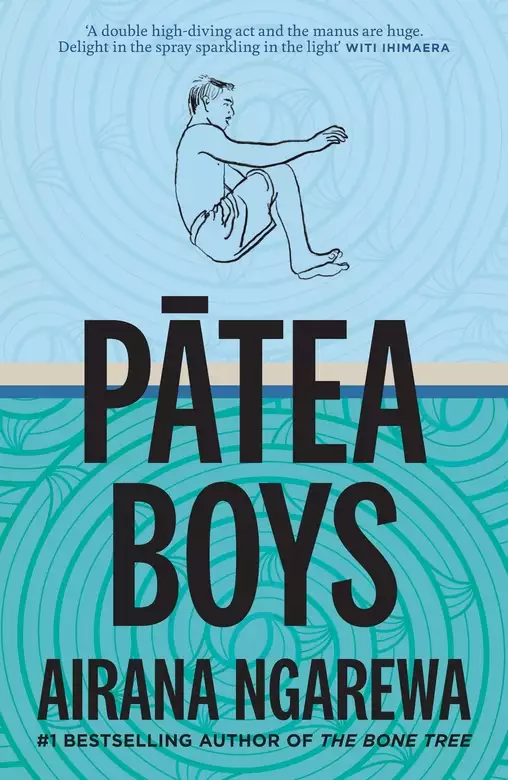
From the bestselling author of The Bone Tree comes a lively and playful bilingual collection of stories about growing up in Pātea.
Interlinked and full of recurring characters, these stories are about growing up in small-town Aotearoa - sneaking away during cross country or doing bombs while the lifeguard isn't looking. The collection is designed to bridge a gap between children's books in te reo and full-length literary works. With each story featured in both English and te reo Māori, it's the perfect resource for those on their reo learning journeys as well as for readers who enjoyed The Bone Tree.
Release date:
August 27, 2024
Publisher:
Hachette New Zealand
Print pages:
304
* BingeBooks earns revenue from qualifying purchases as an Amazon Associate as well as from other retail partners.
A boy is posted on the side of a pool, his feet fixed to the top of a pair of rusted handrails, an empty water bottle in his hands, his weight balanced, his face zen, his knees bent, the lifeguard distracted, one of his mates watching her, and the rest egging him on. ‘You got this, bro.’ ‘Leshgo!’ ‘Hurry, ow, ’fore she turns ’round.’ The day is late, the sun settling and the boys well sun-burned – not that they’ll know until the morning. A wee girl in an oversized t-shirt is doggy-paddling in the deep end, ready to duck her head underwater when the young boy leaps, waiting to hear the full glory of the manu. She likes listening more than she likes doing her own; you can never hear your ones, she reckons. Feel them, yeah, but never hear them.
A symphony of nineties hip hop blasts over the sounds of play: splashing and yelling and kids ducking the others kids’ heads underwater and laughing. The Panasonic speaker distorts whenever the bass kicks, but the boys know no different. They figure that’s just how they made music back then, over there, in the States. A duo of older boys, teenagers, are laid out on the concrete, drying off, their backs unburned but peeling, one of the few favours dark skin offers here in their homeland.
There are tall spotlights on the third of seven concrete steps; they haven’t shone in years. For the boys, they are nothing more than a landmark, a thing to measure their manus against. The top step is a concrete table for eleven siblings sharing four scoops of chips with white bread and margarine and tomato sauce, the thick scent of deep-fried oil catching the breeze, mixing and marrying with the all-over smell of sunscreen and chlorine. ‘Want some?’ ‘Nah, you’re all good. I had a feed at mine.’ Six girls are playing touch in the middle pool, waist-deep, their legs thrashing and the water pooling over the sides, nobody having scored a try, the game impossible to win. A young mum splashes a toddler in the paddling pool, the toddler giggling as he pours tiny buckets of water over his own head, his Finding Nemo nappy sagging, a size too big.
The young boy leaps, the muscles in his legs tensing and twisting as he lifts from the handrail, his league shorts (up the Wahs) soaked through and glued to his skin, his whole frame soaring skyward, his hands – the empty water bottle – reaching for the heavens, his face still zen: he’s done this before. In truth, today is his first day back since the last time he did it. This is the only rule the lifeguard here upholds: a three-day ban for anybody caught doing bombs – she calls manus bombs – from either the handrail or the wooden bench. Too many accidents, she reckons, too many pretty children rushed off in ambulances. The boys think she’s lying. And they’re right. This place is small. Any time an ambulance comes and goes, the whole town knows before the end of the day. This was true even before Facebook, the community page, before the kui here learned to write their passwords in the token red A5 always kept beside their laptop.
The lifeguard charges fifty cents at the gate. Rumour has it the pools are built on an old pā that was confiscated by the Crown after the Taranaki Wars and that’s why they’re public and ‘nobody should be charging nothing’. Everybody’s heard this, because of course everybody has, but nobody knows for sure. This doesn’t stop the crowds from coming, paying, fifty cents placed either in the lifeguard’s hand or the sliced lid of an old ice-cream container, the fancy kind: Tip Top, cookies and cream. A couple of water-rats live next door, just over a rusted tin fence at the top of the steps. They show up every day, sun shining or rain raining, and never pay, always jumping that rusted tin thing when nobody’s looking. The lifeguard must know – she has to: they’ve done it too many times when the pool is quiet and even when they’re the only ones there. Maybe it’s sympathy that stops her from calling them out or maybe she can’t be bothered kicking up a fuss over a fifty-cent coin those water-rats surely don’t have.
Only the young boy’s mates and a few less-than-subtle admirers watch him sail through the air. Everybody else has seen it before – too many times to count. This is most true of the drying-off-on-the-concrete pair of man-boys who have long graduated to doing bombs off the bridge when the tide is in, their acrobatics a sight that never fails to inspire uncertainty, fear, relief and awe. The young boy manus from the rusted handrails mostly as an act of rebellion, for the thrill of breaking the one rule you’re not allowed to break and the risk of getting banned again and the props he gets from his peers and the girls. The latter is mostly imaginary: the girls are too clever to cheer the boy for something as unremarkable as disobeying the local lifeguard, a relation to many of them, a cousin or an aunty or a nan.
The boys’ changing room is plastered with shorts, towels, hoodies, schoolbags and singlets, none of which hang on the steel hooks lining the weathered timber walls; the girls’ changing room is much the same, plus the odd bra or bikini top. The toilets are steel and have no lids; the shower runs cold and the soap dispensers have long stopped dispensing soap. Whole thing is a bombsite. Not that any of the boys and girls here mind. Keeps the rich kids away, they reckon. ‘Let them have Hāwera. Pātea pools are ours.’
For a moment, the young boy is floating. Time has stopped as if to love him, his body long, his hands still stretched to the heavens, ready to fold as gravity rips him back to the earth, to the wavering pool of water he means to unsettle and send towards the late sun, that old god above that dared burn him three days ago the last time he was here. Waves of admiration and envy wash over his mates. ‘That boy’s got hops, eh.’ ‘I could manu way bigger than him if I could jump that high.’ ‘This one will be mean as.’ His arms come down and his elbows tuck to his ribs and his hands pull over his chest, palms facing each other, nursed gently around the lip of the empty water bottle, his legs lifting and his body folding into a V.
All the boys here wear the OG skuxx cut, dark hair with long streaks of yellow (sometimes orange), a sort of hood mullet, long on the top and back and short on the sides, straightened and styled with Dax wax whenever it’s dry. Nobody knows who started it, they all just had it one day. The same is true of the side ratty: a longer-than-the-rest strip of hair braided and kept together using either a hair tie or a jelly bracelet – double points if they’re borrowed from a sister, a cousin, or a crush.
The young boy breaks the water with the base of his back, his body folded tight, his knees hugging his chest, his body ready to kick out, his whole figure opening, his grip loosening, the pool shooting up in a jet of water – Behold, our lord, Tangaroa – the empty water bottle shooting up with it, clearing the top of the spotlights. ‘Far out!’ ‘Chur.’ ‘Told you it’d be mean. Turi’s always been the man at manus.’ The bottle dances in the air, flipping and turning, then comes down hard, narrowly missing the heads of the teenage boys not watching on. They don’t budge. The wee girl surfaces with a smile bigger than her own head: That sounded like a bomb.
The lifeguard appears from out of nowhere, the lookout forgetting her job in the hype of it all. She stands over the edge of the pool, grabs the young boy by his ears and pulls him from the water. ‘These things just for decoration, boy? Bloody hell! Can’t look away for one second without you water-rats doing something reckless. How many times I told you ’bout the kid who cracked his head open bombing off those rails? Jesus Christ, boy. Go on, grab your gears … You’re out for good this time.’
The teenagers shake their heads, the group of girls looking on try to hide their smiles, while his mates crack up laughing, holding their stomachs, almost crying. The young boy rubs his ear and asks if it was big.
‘It sounded huge,’ the wee girl says.
‘Shot, sis; catch you at home. And you too, Nan,’ he says, winking at the lifeguard.
‘You’re a bloody toerag,’ she reckons.
The boy checks his shoulder as he walks out the gate, taking one last look before he leaves, winking at his mates and seeing the man-boys laid out on the concrete. Like the atua before him, Turi knows it is time for this Tangaroa to take on a new name. Tangaroa-tiketike. A god of great heights. He knows it is time to try to bomb from the bridge.
I thought for the longest time I was the only kid in Pātea without a connection to the Pātea Māori Club. My cousins across the bridge are the moko of Nanny Hui. And our aunty from the Prime whānau are the composer’s sisters. She told us they used to tour the country with him in a band called The Fascinations. I’d never heard of them. Never even heard Aunty sing. But everyone tells me it’s true. Tells me they were the real deal, touring the country and the world. They must’ve been the only Māori doing that back then. Them and ol’ Howard Morrison and that song he sang about how great God is.
Back in the day, searching for a connection, I asked Koko if he or his siblings ever joined the Pātea Māori Club. He told me nah. He said he can haka with the best of them. And he can too, I’ve seen his pūkana. He just can’t sing. Not him, his sisters, his brothers or his children. He reckoned they wouldn’t even let him through the front door. One of the men put his hand on his chest when he tried to trial back when they were the Māori Methodist Club. They told him to hit the road. Koko said no hard feelings. Said he sang then as well as he walks now. I cracked up laughing. Koko was always making jokes about him and his walking sticks.
When we first got wifi, I used to blast ‘Poi E’ all the time. Before going to school. Before going to the pools. Before going to the beach. It got me pumped up. Made me proud to come from Pātea. Proud to be Māori. The music was gangster but I loved the music video more. Got to see all the koro and kui when they were young. And there was even a shot of the front of our marae. Pariroa Pā. Our family might be the only Māori in Pātea who can’t sing. But at least our marae is world-famous.
One day I was watching the music video on the house computer in the living room. Must’ve been later in the day than usual because Dad was already home from the milking sheds, his overalls and front-facing cap still covered in cow poo. He asked me where Mum was and I said she was out back, in the garden. And then he asked me where my older sisters were and I said they had biked down to the domain to play touch with their mates. Then he asked me why I was watching ‘Poi E’. I told him it was an OG – old but gold. ‘True,’ he said. ‘You know I’m in that video, eh?’
‘You can’t sing,’ I said.
‘Yes, I can.’
‘The sisters already told me you can’t. They said you sing as well as your head grows hair.’
He smiled, took his cap off and ran his hands over his kina-baldy.
‘They ain’t wrong, son. Play it from the start and watch it anyway. I’ll show how we did it in my day.’
I restarted the music video and it opened with a shot of Taranaki Maunga in the summertime, when it was barely covered in snow. And then the birds started and the video cut to the carved man on the big house. Then my favourite part, Nanny Hui opening the song with a kind of karanga and the camera pulling away to show the whole of our marae. And the women, all really old ladies nowadays, going hundy with the poi.
I joked and pointed at the shortest lady in the lot and asked if that was Dad.
He shook his head and said, ‘That nanny is seventy years old now, a whole foot shorter and still taller than you.’
‘Yeah, but I’m only nine.’
‘More like ninety-nine problems in my backside.’
The music video played on – a pā dog stole a pā girl’s poi and then it cut to the pride of Pātea: Aotea waka carved from concrete standing in the middle of town. On top of it, an off-brand Māori Michael Jackson cut some shapes. I looked at Dad, ready to make another jab at him and Dad said don’t you even.
‘If you had moves like that, Dad,’ I said, unable to help myself, ‘maybe we’d have seen you by now.’
‘That fella was pretty popular in town. With moves like that, he might be your real father.’
I laughed and Dad told me not to tell Mum he made that joke or he’d be sleeping on the couch like the last time we got carried away.
Next minute, Uncle Dalvanius, his body the only thing in Pātea bigger than the song he composed, was in the back seat of a car driving by, sticking his tongue out the window. Then it was a man with a thick moustache and pants so tight they looked painted on, rolling around on rollerskates, and another fella doing body rolls in a silky shirt. I’ve always loved this video but this was the first time I’d paid so much attention to all the out-of-it gears they were wearing. Then I wondered what Dad dressed like back then and I looked at the bar at the bottom and it said we were coming up to three minutes. Still, no sign of him.
The video continued and more weird stuff went on. Men braiding poi into their hair and a fella doing the robot and the Māori Michael Jackson jumping into the air and landing in the splits. Then there were more poi and more moustaches and children clapping as they watched their aunties and uncles go hard.
As the music video rolled into the last ten seconds, Dad told me to hit pause. On a stage at what must’ve been the Pātea Area School hall, a group of curly-haired women were standing with their hands on their hips.
‘Can you see me?’ Dad asked, his chest puffed, as proud as a wood pigeon, cow pee dried on the front of his overalls and cow poo on his right shoulder.
‘Look at their hair and look at yours. There’s no way.’
Dad winked at me and said, ‘Not on stage, son. In the crowd.’ He pointed to a man in the farthest row wearing a pair of white shorts so short they might as well have been undies.
I almost peed myself laughing.
Then, unembarrassed, he asked how it felt having a famous dad.
I told him his legs looked whiter than his beard looked now.
He smiled.
Then I said, ‘You should probably shower before Mum finishes outside.’
He smelled the poo on the shoulder of his overalls and told me I was probably right. Not a minute later, the shower was running and Dad was singing ‘Poi E’ as loud as his lungs would allow him.
‘Poi ē. O tāua aroha. Poi ē. Paiheretia rā. Poi – taku poi ē!’
I used to think that fella who put his hand on Koko’s chest when he tried to join the club was a bad guy. Then hearing Dad sing, I knew that fella did everyone a service that day. Saved Koko the embarrassment. And saved our whānau the bad reputation of ruining Pātea’s only number-one hit.
A young girl slips through the palisades and dances through the trees, her feet soft upon the forest floor, not a single branch breaking beneath her, every new step as precise as her last, even the timing of her breath keeping pace with the howl of the wind. She is the forest. The forest is her. A pair of fantails guide her forward, the whites of their beards catching the moon and glowing in the darkness. They will take her no farther than the last tree. From there, she will have her wits alone.
The eyes of her ancestors disappear into the new morning, a red light lifting from the horizon. Another omen. She will have to hurry. The girl sprints through a clearing, her arms pumping as fast as they can pump, her eyes fixed on a nearby swamp, her legs leaping a post and rail fence. She hits the ground hard and stumbles, falling on her hands and knees. In her periphery, she sees an old man take aim, his lips unmoving. He does not want his presence known. Again, she sprints. The old man and his musket track her as she goes. Her eyes stay three steps in front of her, ensuring every new step meets the trough of every second ploughed row. A bead of water runs down her cheek. Sweat or a tear, she doesn’t know. She knows only the responsibility she has been tasked with. And what a musket ball might do to stop it.
The village leaders gather together when the night is at its darkest (for who knows who could be watching in daylight?) and debate what is to come. Each has seen the ruru perched in the trees and none has heard its call. Anxiety rolls across the natives like the sea upon the shore, the voices of the old people ringing in their ears. Kia tūpato. Beware the owl who has lost her tongue. She is the daughter of Tū.
‘It’s only been a half-day. She may yet sing.’
‘And what of the dogs who do not heed our calls, little brother? And the scent that carries in the night?’
‘Neither is unheard of.’
‘Hika mā. Deny the sun and he still shall rise.’
‘She’s so small.’
‘But her feet are soft and her will strong.’
The day grows warmer and the morning grows older. The old man withdraws his aim, the new sun revealing the shadow sprinting across his farm to be a native girl. Tribes of them are dotted all over this place. He supposes she is up to something. Even so, he cannot justify his shot. She is unarmed and will soon clear his paddock anyway. Will soon be somebody else’s problem.
A peep of pūkeko pōwhiri the girl onto their papakāinga, the patriarch calling her forth with a single crow, his babies guiding her into the heart of their wetland home. There is a puddle in the shape of a spear: reeds, weeds and flax nurse the weapon. Bird and land know as well as the village leaders that their survival depends on the girl. If her mission is not completed, they will all be displaced. (Eventually, . . .
We hope you are enjoying the book so far. To continue reading...

 Please log in to recommend or discuss...
