‘So pacy and addictive. Just brilliant!’ – Claire Douglas, author of The Couple at No.9
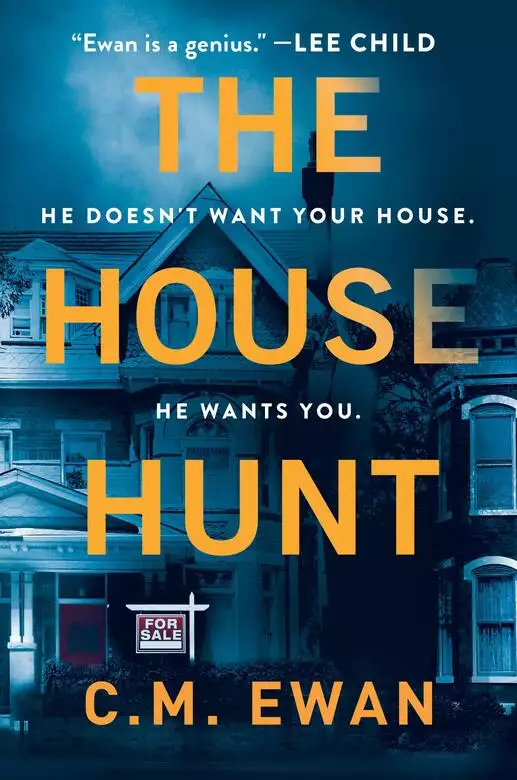
The House Hunt is a heart-pounding, claustrophobic thriller from C. M. Ewan, acclaimed author of The Interview, A Window Breaks and the half-a-million-copy bestseller Safe House.
Your estate agent calls.
She’s running late and needs you to show a man around your home.
You let him in and begin the tour.
But something about him feels wrong. . .
You ask him to leave and he refuses.
Then he tells you something about you. Something inconceivable.
And then you realize. . .
He doesn't want your house. He wants YOU.
What authors are saying about The House Hunt:
‘The tension mounts with every chapter in this edge-of-the-seat, tense and twisty thriller. Don't miss it!’ – B. A. Paris, author of The Therapist
‘Truly impossible to put down’ – Chris Whitaker, author of We Begin at the End
‘Be prepared to put everything else on hold until you've finished The House Hunt, because once it grips you it doesn't let go’ – Jane Casey, author of Let the Dead Speak
‘Nobody does heart-thumping, dry-mouth, claustrophobic thrillers like C. M. Ewan. The House Hunt is exceptional’ – Sharon Bolton, author of The Pact
‘Unbearably tense, effortlessly plotted and packed with twists’ – Tim Weaver, author of No One Home
What readers are saying about The House Hunt:
‘WOW WOW WOW !! The twists in this story had my head spinning. I had no idea where it was leading. What a brilliant book’
‘I lost so much sleep reading this book but it was so worth it. Brilliant!’
‘The twists and turns are superb and the ultimate unravelling very satisfying. I loved it!’
Publisher:
Grand Central Publishing
Print pages:
364
* BingeBooks earns revenue from qualifying purchases as an Amazon Associate as well as from other retail partners.
Paranoia stalks me when I’m vacuuming the house and Sam is out. I get spooked that I’m not alone—convinced a stranger is creeping up on me when my back is turned.
My spine prickles. I tense.
And then I turn.
I always turn.
Even though I know nobody is there, or can be there, because I watched Sam leave, heard him lock the front door behind him, waved him goodbye when he paused and smiled back at me from the gate at the end of our path.
And there never is anybody there.
It’s always just me, on my own.
And so I go back to the vacuuming and the cycle begins again. The deafening roar of the vacuum. The tingles down my spine. The niggling fear that if I don’t look, well…
It’s not rational. I get that. And I’ve talked it through with Sam, of course. Not that he’s in any way surprised. We’ve spoken about what happened to me so many times—too many times, I sometimes think. Sam likes to joke that it’s an occupational hazard for him.
I stopped the Hoover. Held my breath. Straightened my back—and yes, checked behind me again—then sighed with relief and glanced up at the skylight overhead.
I was in the rear attic bedroom, which was one of my favorite rooms in the house. It was nearly always flooded with light, even on a dreary and windy day like today. And with the off-white walls and the thick, pale carpet, I felt like I could think better up here. It gave me a sense of calm and clarity I couldn’t always find.
A safe space.
Shaking the nerves from my body, I tucked the vacuum away into its spot in the cupboard under the eaves before taking my phone from my jeans pocket and checking the time.
I was planning to go to a nearby cafe while the viewing was on. I’d take my book, order an Earl Grey tea with lemon, try to relax. When the viewing was over, Bethany would call and tell me how things had gone. If we were lucky, maybe today would be the day when we received an offer we could accept.
That’s when I saw the voicemail that was waiting for me, and a twist of anxiety corkscrewed inside my gut.
Even before I dialed, I had a bad feeling about it, and when I listened to Bethany’s message, it grew worse.
I hung up, a sticky flickering in my throat, my hands beginning to buzz and hum.
Easy, Lucy.
Fifteen minutes until the viewing.
I couldn’t cancel now.
Or maybe I could, I supposed, but it would be rude and I knew we couldn’t afford to put a potential buyer off.
My mouth had gone dry. I pressed the heel of my hand to my head and tried to keep the panic at bay.
Our debts were spiraling. There were the loans Sam had taken out to cover the renovation costs, and when those capped out, the credit card bills that increased every month. Sam hadn’t been sleeping because of it. And there was so much more wrapped up for both of us in the idea of selling this place and leaving London for good. A clean slate. Starting again.
Bethany.
I liked her, even if she was your typical estate agent in most respects. She could be pushy and brash, and she’d lie as easily as breathing, but at least she was open about it, which was a kind of honesty in a way.
At night, when Sam tossed and murmured and I listened in the ringing darkness to the brittle click of the lock on a bathroom door—the metallic rasp of an unknown voice—what saved me was remembering the way Bethany had arrived at our house that very first time in her expensive coat and statement spectacles, sweeping inside to talk valuations, telling us how tastefully we’d decorated and how desirable we’d made No. 18 Forrester Avenue.
I trusted her—inasmuch as it’s possible to trust any estate agent—and lately I’d found myself hoping that we might stay in touch after we’d sold our house, but it was hard to shake the suspicion that she could have warned me earlier that she was running late; that she’d ambushed me knowingly.
And? You have to make the best of it now.
Hurrying downstairs, I rushed along the first-floor landing and down again into the main living area, my gaze darting around, searching for anything I’d overlooked.
The lights were on throughout the house. I’d brought home fresh lilies from our local florist and arranged them in a ceramic vase on the marble coffee table. The honey-colored floorboards gleamed. Only this morning I’d dusted every single blade of the pale wooden shutters we’d fitted in the bay window.
OK. All good.
I spun and looked toward the kitchen area, which was sunken and lowered by several steps. I hadn’t brewed coffee. Bethany had warned us it was too much of a cliché. But I’d made sure everything was spotlessly clean.
During the renovation process, we’d knocked through most of the downstairs walls to create one large, open-plan space that ended in a set of industrial-style glass doors giving access to the modest back garden. We’d done nearly all the work ourselves, swinging sledgehammers, plastering walls, but the kitchen had been professionally installed and it was sleek and high-end. Expensive cabinetry, top appliances. The granite on the countertops and the expansive kitchen island had cost as much as a new car.
It’ll be worth it, Sam had told me, looking up from his spreadsheets with red-rimmed eyes and a coating of dust and grime matted in his wayward hair. At the time, I hadn’t been sure which of us he was trying to convince. It’s expensive now but it’s what buyers of a place like this will expect. It’s the best way to protect our investment.
My head swam.
I wondered what Sam would say now if I could tell him I was considering showing a stranger around our home by myself. He’d probably fall silent, think carefully, then wrap me in a gentle hug, rub my back and tell me that perhaps it was time to confront my fears.
Not that I could ask him. Sam would be finishing up a lecture and getting ready for his support group. His phone would be switched off.
And anyway, Bethany had said she was definitely on her way. I wouldn’t be on my own for long.
I chewed the inside of my cheek and glanced at my coat and scarf—I’d draped them over the back of the green velvet sofa, ready for my exit—then swept them into my arms, carried them upstairs and hung them in the walk-in wardrobe we’d carved out of what had previously been the spare room next to our bedroom.
When I stepped out, I drifted toward our bed, smoothing my hands over the pleated throw I kept to one side especially for viewings. There were multiple pillows and cushions at the top of the bed, resting against the oversized headboard I’d upholstered as part of a days-long project.
The headboard was bolted to a privacy wall that shielded the en suite bathroom, and taken together, it created the impression of a fancy suite in a boutique hotel. I hoped it looked like a restful and calming place to sleep, even if it hadn’t always been that way for us.
Please be the one. Please be the one.
I caught sight of my reflection in the full-length mirror by the doorway. A pale, undeniably frazzled woman in her early thirties. Hair loosely tied back. Baggy Aran sweater and comfortable jeans. Worry lines around my eyes and mouth.
Perhaps I should change, give a different impression?
But before I could act on the impulse, the doorbell rang.
He was early.
Not by much, but it was enough to throw me.
The doorbell app on my phone pulsed and buzzed.
I could dismiss the notification from the app. I knew that. I could go downstairs, open the front door and welcome him inside with a forced smile.
But instead I hesitated, took my phone out of my jeans pocket and stared at the image of the man on my doorstep.
My fingers trembled. A coppery taste flooded my mouth.
I couldn’t see him clearly because his face was down. All I could really see was the crown of his head—he had wavy gray hair, neatly styled. The collar was up on his dark woolen overcoat. His hands were loosely clasped together in brown leather gloves. He had broad shoulders and looked athletically built.
I wish I could see his face.
I glanced toward the shutters, which were tilted open in front of the windows, then made a quick decision and hit answer on my phone.
“Hello?”
I said it as casually as I could, as if I was expecting a parcel delivery, and the man looked up into the doorbell camera with an easy smile.
Not someone I recognized, though that hardly helped.
He was handsome in a roguish way. A prominent brow over startlingly blue eyes. Jaw shaded in stubble. He had on a fawn turtleneck jumper under his coat.
He looked a little jaded, and for a second it made me think of him as a lounge-room singer, tired and possibly hungover after a long night of crooning.
“My name’s Donovan.” The skin around his eyes crinkled as he moved to one side and motioned toward the “For Sale” sign in our front yard. It had been fastened to the painted metal railings running along the top of the low side wall we shared with the neighbor to our right. The rest of our front yard was shielded by the formerly scrappy box hedge we’d tamed and kept for privacy, itself hemmed in behind more barbed metal railings. “I’m here for the house viewing.”
“One second.”
Snapping a hasty picture of him on my phone, I quickly attached the image to a message to Bethany.
Just checking this is the man who made the appointment with you? Mr. Donovan?
I knew Bethany would probably think it was a strange, possibly neurotic, thing to do, but right then I didn’t care. I needed reassurance if I was going to show him around by myself.
Three dancing dots appeared, and while I waited for Bethany’s reply to reach me, an anxious ache bloomed inside my chest and I swiped back to the video feed from the doorbell again.
The man had stepped back and was leaning sideways, inspecting the stonework around our bay window, glancing up toward the roof.
Behind him, I could see a fish-eye view of Forrester Avenue. The terrace of painted and redbrick Victorian villas opposite our own. The wizened old plane trees that lined the road. Cars and tradesmen’s vans were parked bumper to bumper along both curbs with drifts of autumn leaves scattered across them. Nearly all the cars were BMWs and Range Rovers. A few were Porsches.
There was no passing traffic but a young girl in the red and gray uniform of the local primary school was rolling along the nearside pavement on a scooter, pursued by a woman in a raincoat, who was striding after her while staring at her phone, the girl’s schoolbag banging against her hip.
Bethany’s reply popped up at the top of my screen.
Yum! Donovan is his first name. Feel free to mention that I’m single and… enjoy!
I let go of a lungful of air as I tapped out a fast reply.
OK, thanks. How long until you get here?
But this time, she didn’t respond.
Slipping my phone away in my pocket, I closed my eyes for a dizzying second and told myself I could do this, that everything would be fine, then I curled my hands into fists and moved toward the stairs.
I was halfway down when I heard the shriek from outside.
I opened the door to find that the man who’d introduced himself to me as Donovan had vanished.
But only for a second.
When I slipped on some shoes and ventured beyond our box hedge, I found him kneeling on the pavement in front of our house. His back was to me. I moved closer, and that was when I spotted the schoolgirl lying on the ground.
She’d fallen off her scooter and she was howling in pain. Her scooter was toppled over on its side nearby, its wheels still spinning.
“Hey,” Donovan said to her softly. His voice was deep and gruff. “Hey, it’s OK.”
He was gently cradling the girl’s wrists in his gloved hands. She’d skinned one palm and the bloodied graze was pebbled with grit, her upper body shaking. One knee of her gray school tights had been torn through and her shoe had come off. Her face was a tangle of tears, eyes huge and mouth trembling.
“Where did you learn to do a stunt like that? Because I have to tell you, that was impressive.”
She blinked up at him, lips wobbling, breath hitching. The air was so damp and chill that her breath formed misted plumes.
“Oh, darling,” cooed the woman crouched beside them, whom I took to be the girl’s mother. “I told you to be careful.”
I wondered if he was a doctor. Close up, his eyes looked puffy with fatigue, his movements slack and weary. Perhaps he’d just finished a shift at Charing Cross Hospital, or Queen Mary’s. Maybe that was why he was hoping to buy in this area.
He must have sensed my presence because he looked up at me with a slow but spreading grin and I felt myself blush.
“I’m from number 18.” I pointed toward my open front door. “Lucy.”
“Hi, Lucy.” A flash of concern crossed his face as he looked at the girl again. “I don’t suppose you have a clean cloth, or some tissues, or…?”
“Of course. Let me fetch something.”
I hurried inside and removed the first aid kit from under the sink, taking out a couple of wrapped antiseptic wipes and a sticking plaster. By the time I was back outside again, he was fitting the girl’s shoe back onto her foot and the woman was thanking him profusely, placing her hand on his arm, fixing him with a lingering look.
“Here.” I thrust the wipes and the plaster at her and she took them, seemingly irritated by the interruption.
She had long blonde hair, recently styled. Immaculate makeup. She was slim and fashionably attired in a close-fitting dress over knee-high boots. I’d seen a lot of women dressed just like her dropping their kids at the school gates, driving by in luxury SUVs.
Not for the first time, I felt mismatched with the area—out of keeping with the otherwise wealthy residents of Putney.
Sam had inherited the house we lived in from his grandparents on his mother’s side. There was no way we could have afforded to live here otherwise. We’d had to stretch ourselves and dig perilously deep to modernize the place for sale.
As the woman tore open one of the wipes and used it to swab the girl’s knee, I folded my arms across my chest and looked up at our house. It was three stories high with a mansard roof and a pair of French doors set into one of the dormers on the top floor that opened onto a small balcony concealed behind a triangular parapet. The brickwork was painted lemon yellow, the windows a crisp white. The front door was a deep, glossy red.
“Thank you again,” the woman said to Donovan. Her voice was husky and soft. “You’re incredibly kind.”
“It’s nothing, really.”
Donovan helped the girl to her feet and righted her scooter, and as she hopped and winced, he stepped clear, cupping a hand to the back of his head, suddenly sheepish.
“Well, take care.”
“Oh, we will,” the woman said. “It was so lovely to meet you.”
We watched them go—the woman still hadn’t really acknowledged me—and as she glanced back at Donovan one more time, the awkwardness built between us until he finally broke it by saying, “Sorry about that.”
“No, you did the right thing.”
He gazed closely at me, as if my opinion genuinely mattered to him, and for a second I felt the full force of his charm, his looks, everything.
“You’re the owner?” he asked.
“My boyfriend is.”
“Ah.” Another slow smile. “And is Bethany inside?”
I frowned. “She didn’t call you?”
“About what? Oh no!” His eyebrows shot up and he patted his coat pockets, as if searching for his phone. “Has she canceled on me? Have you already accepted an offer?”
“No, it’s nothing like that,” I told him, and then I explained about how Bethany was running late and had asked me to begin the tour in her absence.
There must have been something in the way I said it—some hint of my reticence or the discomfort I was trying to conceal—because he paused, then angled his head to one side.
“And are you OK with that?”
“I’m—”
“Because if you’re not, I can wait. I don’t mind. I should probably warn you, though, that I have to be on my way in about half an hour. Did Bethany mention how long she’d be?”
She hadn’t. And my phone hadn’t pulsed with a reply to the text I’d sent her. I hoped that meant she was almost here, but it was getting late in the afternoon, the October light was beginning to dim, and I knew that traffic in the area could be bad.
Instinctively, I went up on my toes, as if I might spot her racing our way in her branded company Mini, and that was when I felt a twinge in my chest.
There were two other “For Sale” signs on our street. Sam and I had looked both properties up online the moment they’d come on the market. The first house had a fancy glass extension. The other had an extra bathroom and was competitively priced. There were also a number of other houses surrounded by scaffolding and plywood screens where teams of builders and tradesmen were at work. It was an easy guess that some of them would go on the market before long.
I sensed Donovan tracking my gaze, perhaps reading my thoughts, and in that moment I knew what I had to do.
“No, don’t wait,” I told him. “Please. Come inside.”
The distance from No. 18 Forrester Avenue to the London School of Economics—located between Covent Garden and Holborn—was close to six miles. It was possible to walk there in a little under two hours, though today Sam had taken the Tube. The District Line from Putney Bridge to Temple. A ten-minute stroll after that. He’d delivered his foundation lecture on perception and memory to a group of half-awake and semi-interested first-year undergrads and now here he was, contemplating the four strangers seated in front of him.
The first-floor seminar room was unremarkable in most ways. It had the same gray hard-wearing carpet, whitewashed walls and suspended ceiling tiles as nearly every other seminar room in the university complex. There was the same interactive whiteboard. The same stained whiteboard eraser and pens. The same U-shaped arrangement of tables and chairs.
With two main differences.
The first was outside the room, where beneath the number fitted next to the door—22A—was a small screen on which Sam had input the words PRIVATE MEETING.
The other was inside the room, where Sam had placed six chairs in a circle in the middle of the space. Six for now, because there was no predicting how many more people might respond to the ads he’d posted online and around the university complex.
Do you have a crippling fear or phobia?
Would you like to talk about it in a
supportive group environment?
“How is everyone feeling about being here?” he asked.
The strangers smiled nervously, exchanged hesitant looks, glanced down at their hands. A short silence passed before a stylish woman in a denim smock, colorful necklace and dark leggings broke the ice.
“A bit nervous?”
“I’d have to say it’s the same for me,” agreed the tall, muscular young man dressed in athletic gear who was seated next to her. He had a cut-glass accent, excellent posture and a full head of curly blond hair. The long-sleeved training top he had on over a pair of gym shorts and leggings featured the insignia for the LSE rowing club over his left pectoral.
“I’m just hoping for some help,” said a willowy girl with dark eyeshadow, purple lipstick and jet-black hair, whom Sam guessed was probably a final-year student. There were multiple piercings in her ear, a ring in her lip. The black leather bag on the floor next to her was open, with binders and textbooks spilling out.
“I don’t really know what to expect.”
This last answer, spoken almost inaudibly, was from the gaunt and bug-eyed guy in the slim-fitting V-neck jumper and skinny gray jeans who hadn’t stopped fidgeting since he’d arrived. Sam recognized him and felt a tug of sympathy. He’d seen him working behind the main counter in the university library, although it was no surprise that he’d removed his staff lanyard before coming here today.
“OK, good.” Sam nodded and smiled, as if they’d said exactly what he’d expected them to say. “The first thing I want you all to know is that this is a safe space. You’ll have submitted your consent forms, which I myself don’t see, and you don’t need to tell anyone here your names. You don’t need to give any identifying details.”
Aside from the crippling anxieties and fears you’ve come here to share.
Because, let’s face it, Sam could recognize the signs. The edgy restlessness. The dry skin and haunted eyes and cracked lips. The pained smiles and the wary reluctance to meet his gaze, as if they were each burdened by something shameful.
This wasn’t the first support group Sam had organized. Over the past three years he’d run similar groups that had helped him to meet the community engagement requirements the university imposed on all academic staff, as well as offering him an opportunity to give back.
And—being honest—the groups had also uncovered some interesting research opportunities, which is where Sam’s real passions lay. With the way his career had begun to stall, not to mention his heavy teaching load, his opportunities for pure research were getting fewer and fewer, and that was one of the reasons he could feel a frisson in the air. The neat thing about phobias was you never quite knew what you might be presented with. And if some of the participants here today were willing to cons. . .
We hope you are enjoying the book so far. To continue reading...

 Please log in to recommend or discuss...
