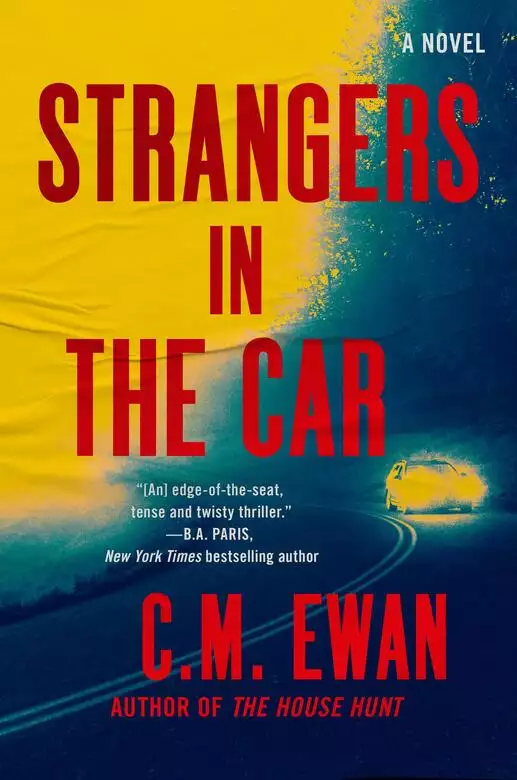
“As wild and terrifying a ride as any thriller reader could want,” Strangers in the Car is a heart-pounding thriller from C. M. Ewan, acclaimed author of The House Hunt and the half-a-million-copy bestseller Safe House (Ian Rankin, New York Times bestselling author).
Abi and Ben are driving home down foggy country roads, arguing about having had to cut short their weekend away when they take a wrong turn. Abi is behind the wheel, but her eyes leave the road for a moment as she says something to Ben – just as he gasps. A man is in the road, waving a torch. Abi swerves to avoid him.
Ben tells her they should stop and go back, but Abi refuses. It’s dark, the roads are isolated and they don’t know this stranger. But, as Abi continues on, they see a broken-down car. Every instinct is still telling Abi to drive by, but then she notices the woman holding a car seat with a baby in it.
Abi can't bring herself to leave a mother and baby stranded in the middle of the night. But offering them a ride might take them down a dangerous road, a road from which they may never return
Release date:
November 4, 2025
Publisher:
Grand Central Publishing
Print pages:
364
* BingeBooks earns revenue from qualifying purchases as an Amazon Associate as well as from other retail partners.
Samantha Clarke knew the moment they reversed out of their space in the hotel parking lot that something was wrong.
Not that it came as a surprise. She’d been living on her nerves for weeks, her senses attuned to the slightest threat. And there had been a lot of warnings. Some big, others small. Some had been so subtle and insidious that she might almost have missed them, until she didn’t.
And now? What was it she was sensing?
Samantha looked across at her husband, Paul, freshly showered and shaved, redolent of the cheap deodorant he’d doused himself with (in a failed attempt to mask his stress-and-fear pheromones), dressed smart-casual in his weekend dad attire of a zip-neck jumper over a blue Oxford shirt, dark trousers, dress shoes. He appeared almost normal—a glimpse of the before Paul—if you didn’t look too closely at the rash on his neck from shaving too hastily, the bagged pouches under his eyes, or the strained, faraway gaze he’d adopted lately.
But nothing Samantha saw twitched her fight-or-flight antennae. Which meant this wasn’t about Paul.
Lila, then?
A cramping in her chest as she whirled around to gaze at their baby girl strapped into the child seat behind them.
But no, it couldn’t be Lila because Samantha could see her giggling happily and kicking her feet in her lemon-yellow onesie, her tiny hands grasping for the diamonds of winter sunlight being reflected by the circular mirror strapped to the headrest above her.
But it was undeniably something. A low hum of disquiet. An awareness that things were out of kilter or off balance in some hard-to-pinpoint way.
She almost had it then. It was—
“The diaper bag!”
Paul hit the brakes. “What?”
“We left Lila’s changing bag in our room. Unless you put it in the trunk?”
Paul’s face was ashen and drawn, and there was a blood blister on his bottom lip from where he’d been chewing it. His spectacles were askew, one lens smudged by a wayward thumbprint.
“Didn’t you?” he asked.
“No, I forgot.”
Paul closed his eyes and seemed to swallow something sickly; then he checked all around—through the windshield, in his mirrors—before unclipping his seat belt and popping his door.
“I’ll go back and get it,” he said.
“Should we come, too?”
A pained glance at Lila, and Paul shook his head, no. But as he slipped out of the car and gauged the distance to the hotel entrance, he seemed to flinch and then freeze, like a man who’d heard the deadly click of a land mine he’d accidentally stepped on.
“Paul?”
“It’s OK,” he told her, in a voice that sounded a very long way from OK. “Lock the doors after I’m gone. And sound the horn if anyone comes near. I’ll be as fast as I can, I promise.”
“I don’t like this.”
I was talking about the driving conditions. It was late on Saturday night and we were surrounded by darkness and thick fog. Visibility was poor verging on terrible. The road we were traveling on out of Fowey was unlit and narrow.
But my boyfriend, Ben, misunderstood me—or maybe he understood me much too well—and bit back a sigh.
“It’s my job, Abi,” he muttered. “I couldn’t say no. You know I couldn’t.”
For the record, he could have said no. He could have said it as easily as he’d said no to the two of us finishing our weekend away together.
Only, I wasn’t going to tell him that. It would be crazy for me to tell him that. Because if I did, then we’d finally have the argument we’d been avoiding since he’d taken the call from the partner at his law firm in the middle of the morning, before pretending he hadn’t taken the call, before owning up to me half an hour later when we were sitting with our feet dangling in the spa swimming pool in our hotel and—
“You could have said no,” I told him.
Ben groaned, thumping the back of his skull against his headrest.
I kept my gaze fixed ahead, my body clenched up behind the steering wheel, peering blindly through the windshield at the dank murkiness outside. We were climbing a steep gradient, but I had no way of seeing when we’d reach the top. The engine of my crappy old Volkswagen Polo whined so fiercely I could feel the vibrations through my hands.
I’d inherited the car from my grandparents—Grandpa had died five years earlier, my granny was afflicted with dementia in a care home—and, while it had passed its most recent MOT (just barely) and I’d paid for new tires the previous winter, I drove it in the constant nervous awareness that (a) if something major went wrong, it would likely be terminal, and (b) I could no longer afford to fix even the most minor fault, anyway.
“Are we really going to do this?” Ben asked me, faking indifference from the dimness of the front passenger seat.
I didn’t look at him because I knew what I’d see if I did. The wounded expression. The feigned surprise.
Ben was good at acting blameless. He was twenty-nine—the same age as me—but he looked younger, with his neat, side-parted hair, clean-shaved face, and preppy clothes. Tonight, he was wearing a branded gray hoodie over tan chinos and smart sneakers.
“I’m just telling you what you already know,” I told him.
“Unbelievable.”
But it wasn’t unbelievable. Not anymore.
And yes, we’d talked about it. Sometimes calmly, sometimes not. But nothing had changed. I was finally beginning to understand that it wasn’t going to change. There would always be last-minute calls from his office, aborted weekends, ruined plans. For a long time I’d tried to accept it, adapt to it, but I was no longer sure I could.
“What do you want me to say, Abi? Do you want me to tell you my career isn’t important to me? Because it is. This is about our future.”
“Going into the office tomorrow is about our future?”
“Yes.”
“Getting out your laptop and working all this afternoon. Interrupting our holiday—”
“It was a weekend away. Don’t exaggerate. You always exaggerate. It wasn’t a holiday. It was a quick trip to Cornwall, that’s all. And if I want to get ahead, I have to work when they need me to work. The partners pay attention to this stuff. You know they do. There’s time pressure on this deal. I have to turn this contract around by Monday.”
I counted to ten in my head, squeezing the steering wheel tighter. We must have crested the rise because the road dipped away into even denser fog, the dank vapor pressing in from all sides. It didn’t eddy. Didn’t drift. Peering into it reminded me of walking into our cramped bathroom back at home after Ben had spent too long in the shower.
I flipped the headlights to full beam, then dipped them again. With the lights on full, the fog seemed somehow worse, radiating back at us, blaring in the dark.
Shouldn’t we have reached the turn by now?
The windshield was pebbled with moisture and the wiper blades thumped from side to side. I rubbed my eyes and reached for the cloth in my door pocket, scrubbing at the condensation that was encroaching from the corners of the windshield. I could feel the cold from outside penetrating the glass and bathing the backs of my fingers. The readout on the dash told me the nighttime temperature was close to freezing.
My stomach tightened. I felt nauseous.
“This is dangerous,” I murmured. “We should have listened to that travel warning.”
We’d caught the tail end of the local radio news as we were packing up to leave our hotel in Fowey, the heavy sea mist pressing in against the windows of our room. The police were advising against travel unless your journey was essential. We hadn’t passed another car since we’d set off, so most people must have paid attention.
“You heard that receptionist. It’ll clear up if we go via Par.”
I had heard the receptionist. Ben had made a big deal about asking her advice before we’d left. She was young and pretty. Maybe seventeen or eighteen. She’d flicked back her hair and told us she’d driven into work from Par only an hour before to begin her shift, and that the road “hadn’t been too bad.” To go that way, we just needed to take a left at the first fork in the road we came to instead of bearing right. Following the route she’d suggested would make our journey a bit longer, but hopefully it would be safer.
“How far until this turning?” I asked Ben.
“Let me check.” He leaned forward and zoomed out on the satnav that was fitted in the central console. “Shit,” he said, turning and looking behind us. Not that he could see any better out the back than the front.
“What is it?” I asked him, my heart sinking.
“We missed our turn.”
“Are you serious?”
“Yes. A ways back, I think.”
“How?”
“The volume was on low. I’ve upped it now, but I think maybe when we were arguing…”
“Ben!”
My eyes strayed to the satnav. It wasn’t even showing the route to Par behind us any longer. All that lay ahead was a winding country road.
“What do we do now?” I asked him.
“Up to you.”
I stared at the fog, feeling a rising panic about missing the turn we’d been told to watch out for. I could barely see more than a few meters ahead of us, and what I could see was hazy in the extreme. The road we’d accidentally taken was narrow with tall hedgerows on either side. We’d driven in this way the previous evening when visibility had been better, but even that had been hairy.
“I don’t think I can turn around here.”
“I don’t fancy your chances of reversing back as far as we’d need to go, either.”
“Well, that’s just brilliant, Ben.”
“Hey, at least this way is faster. It might be better to just carry on.”
“Only if I don’t crash,” I muttered.
“Look, it’s no big deal.” He reached over to take the cloth from me, wiping at his own side of the windshield. “We’ll be on bigger roads soon and this fog won’t last forever.” A pause. “I could drive, if you like?”
“Good one.”
Because Ben couldn’t drive. Or not legally, anyway. He’d taken a bunch of lessons, but after failing his test for the second time just over two months earlier, he hadn’t got around to booking a new test. He claimed he was too busy with work, though secretly I thought he was embarrassed about failing, especially as I’d passed the first time. I’d taken him out for a driving lesson myself exactly once, and we’d argued so much we’d never tried it again.
Usually, it wasn’t a problem. On most days, Ben walked or jogged to and from work, and if we went anywhere outside Bristol, he had me to drive him, especially lately when I hadn’t been working. Most of the time I preferred it that way. I’d never enjoyed the feeling of being a passenger—not in my car, and least of all in my life.
Tonight, though, everything felt different, more precarious. And not only because of the awful fog and the late hour, or the change to our plans, but because all I really wanted was to be back in the bed in our hotel room, burrowed under the covers, listening to Ben’s sleep sounds as I battled to block out my racing thoughts.
“Are you OK?” Ben asked me.
“I’m fine.”
“Really fine? Or really pissed off with me about working tomorrow?”
“Ben, please. I’m trying to concentrate.”
“OK, I’ll stop. In a second. But can I just say a super-quick thank-you, first?”
I hesitated. “For what?”
“For waiting to bite my head off about it until we were driving home. I had a few podcasts lined up, a bit of music, but I wasn’t sure they were going to entertain us the whole way home.”
My turn to groan. “You’re such a dick.”
“But you love me. And I love you. And it’s only one Sunday. We’re going to have so many more of them together.”
I should have let it go then. I should have let us both move on. But I could feel the tears building against the backs of my eyes, a pang of hurt deep inside.
“No,” I told him. “It’s another Sunday.”
“Abi…”
“I’m serious.” I fixed on him quickly, feeling a tiny piece of my heart break loose and float away when I saw that he really wasn’t getting it. “This is about you being there for me when I need you to be there for me. It’s about me knowing you’ll be there.”
“I am there for you.”
“You’re not, though. Not really. Today, I needed…”
I trailed off, unsure if I could say what needed to be said, aware that now probably wasn’t the time.
“You needed what, Abi? What is it you—”
But as Ben glanced out of the windshield, his eyes went huge and he reared backward, raising his crossed arms in front of his face.
“Look out!”
There was a man standing in the foggy road, waving a flashlight in an overhand grip.
I yelped and stamped on the brake pedal, wrenching the steering wheel to my right, watching the man slide closer as the suspension compressed and we skated across the greased tarmac toward him.
He was tall and striking-looking, neatly groomed and smartly dressed in a soaked tan raincoat over dark trousers and leather shoes. His fair hair was slicked against his scalp and his pale skin gleamed wetly in the sudden headlamp glare.
He looked a lot like a city-dweller who should have been standing on a train platform on the outskirts of London but had somehow, inexplicably, found himself in the middle of the road in front of my car.
For a split second he froze without lowering his flashlight, his spectacle lenses flashing brightly. Then his mouth hinged open and he lunged sideways, leaping for the steep hedge lining the road.
I didn’t think he was going to make it. I was terrified we were about to flatten him.
But then the tires bit and gripped and we lurched to the right, fishtailing wildly as I sawed the wheel in the opposite direction, veering for the fog-blurred hedge on the other side of the road before the car shimmied and straightened out.
“Did we hit him?” Ben yelled.
“No, I think we missed him.”
“Can you see him?”
I looked up into the rear mirror with my heart in my mouth.
The man was no longer in the hedge. He’d stepped back into the road and was standing sideways in the swirling fog, looking after us with the beam of his flashlight angled down at his feet.
“I can just about see him but I’m not stopping,” I told Ben.
“It looked like he wanted our help.”
“No way. We’re in the middle of nowhere here.”
Ben’s silence was testy. When I looked at him, his face was bloodless. He seemed shocked.
I flicked my eyes to the rear mirror again, my chest aching, temples throbbing. By now the man and his light had been swallowed entirely by the fog but I had the unsettling feeling that I could somehow still see his darkened silhouette punching a hole in the mist.
Biting the inside of my mouth, I drove on slowly. The fog hurtled toward us, streaking through the cones of yellow light arcing out of the headlamps, tumbling against my windshield.
“We should go back,” Ben said.
“We can’t. You know it’s not safe to reverse. It’s too narrow to turn around.”
“You could pull in.”
“No, Ben. Someone could drive right into us.”
A vision appeared in my mind of a vehicle rear-ending us; the Polo collapsing, concertina-style, crushing us mercilessly.
I pushed it away and plunged on into the fog, feeling guilty about not stopping, unsure if I’d done the right thing.
What had the man been thinking?
My insides contracted as I flashed again on how close we’d come to colliding with him. Then I glanced across as Ben ducked and squinted through the windshield.
“Er, Abi?”
A set of brake lights and hazard lights were shining in the gloom.
I slowed down a bit more. The lights were over to our left, glowing hazily from the rear of what looked to be an estate car that had pulled over in a turnout.
The car’s outline was indistinct—blurred and shrouded by the hanging mist—but I could see that it was a red or maroon Mercedes. The windows were darkly tinted. At the front the hood was raised.
“Breakdown,” Ben muttered.
My headlamps lit up a middle-aged woman who was standing outside the driver’s door in the vaporous air, watching our approach.
Her shoulder-length, chestnut-brown hair was damp and bedraggled underneath a woolen beanie, her neck and chin wrapped in an elaborate scarf. She was bent partly forward from the waist, her shoulders hunched against the cold in a long, quilted jacket, the sleeves stretched over her hands as she balanced the molded plastic handle of a baby car seat in the crook of her arm. The hood was up on the car seat, the corners of a blanket draped over the sides, and she instinctively drew it inward to her body in a protective gesture as we got nearer.
I locked eyes with the woman for a brief second and the look she gave me was so stricken and lost that I felt an immediate tug of sympathy.
“Pull over,” Ben said.
“We can’t.”
“There’s space farther up.”
I squinted. The turnout appeared to continue on beyond the estate car, and I couldn’t spot any other vehicles parked there. Perhaps, on better days, it was a viewpoint of some kind.
“I’m not pulling over, Ben.”
“Seriously? She looks really worried. We should check she’s OK.”
I pulled my gaze away from the woman as I began to accelerate.
“Abi!”
“What?”
Ben lunged for the steering wheel, tugging it to the left.
“Are you insane?” I yelled.
“Pull over now, or stop and let me out,” he shouted back. “Your choice.”
I could see how much Ben meant it. He was practically vibrating, his eyes boring into me. And he was still clinging to the steering wheel, making it difficult for me to drive on.
Maybe it was the lawyer in him. He’d always had a keen awareness of right and wrong, an overdeveloped sense of civic duty. In the past, he’d signed us up to help with city litter picks. He volunteered for a homeless charity on alternate weekends. I knew he wouldn’t let it go if I didn’t stop.
Veering into the end of the turnout, I braked hard with gravel crunching under my tires, then pushed him away. After wrenching the gearstick into neutral, I cranked on the handbrake and fumed as Ben twisted in his seat and gazed out of the rear window, my breaths coming hard and fast.
I didn’t say anything, but I was pretty sure Ben knew what I was thinking. If we hadn’t taken a wrong turn, we wouldn’t be here.
“That was stupid,” I told him, switching on my hazards, checking on the woman in my mirror at the same time.
She looked almost ghost-like in the dismal fog, but I could just about see that she was standing on tiptoes and peering our way, her posture stiff and guarded.
“Ben?”
The wiper blades swooped from side to side in the stillness. The radio burbled. The fog and darkness pressed in.
“Can we go now?”
“Not yet. Let me talk to her first.”
“Are you serious?”
He was just reaching for the door lever when I made a grab for his wrist. I must have squeezed too tight because he winced, then pulled his arm away and rubbed his skin with a hurt expression.
“What about the man I almost hit?” I hissed.
“He’s back down the road. This will only take a second.”
Ben got out before I could challenge him any further. I stayed where I was for a jangling moment, trying to get my nerves under control, the foggy air streaming in through his open door like a torrent of cold water. Then I grabbed my phone from my handbag and stepped out of the car, hugging my arms around myself against the damp and the cold.
I didn’t have a coat on. It was in the trunk, along with my suitcase. For now, the turtleneck sweater I was wearing would have to do, but I could already feel the frigid air permeating my leggings and the canvas of my battered Converse.
I hadn’t turned off the engine and it rumbled behind me as I ventured after Ben. I loved him, but sometimes his insistence on doing “the right thing” could be infuriating.
“Do you need some help?” Ben called out.
The woman seemed to withdraw from him, and for a second I got the impression she was considering locking herself and her baby inside her car for safety, until I leaned out and waved at her. The moment she glimpsed me she seemed to relax a little bit.
“Oh,” she said. “Thank you for stopping.”
She waded through the fog to take up a position in front of her car, with the baby car seat bumping against her thighs and her breath forming misted plumes. The back glow of the car’s sidelights cast her partially in shadow.
“What happened?” Ben asked.
“Ugh. It’s this stupid hire car.” She had a refined accent and her coat and leather boots looked like designer items. Her hair was frizzy and mussed from the fog, but I thought that she had expensive extensions fitted. It also didn’t escape my notice that a Mercedes was a high-end choice for a hire car. “There was this awful grinding noise as we were coming over the hill and then a terrible crunch, and after that the engine and the power steering just completely failed on us and all these warning lights came on. We were lucky to get off the road. You’re the first people to come along.”
“Would you like me to take a look?” Ben offered.
“Do you know much about cars?”
“Well, no, not really.”
That was an understatement. I wasn’t sure Ben even knew how to check the oil or fill up a windshield washer. He’d have no chance fixing a mecha. . .
We hope you are enjoying the book so far. To continue reading...

 Please log in to recommend or discuss...
