
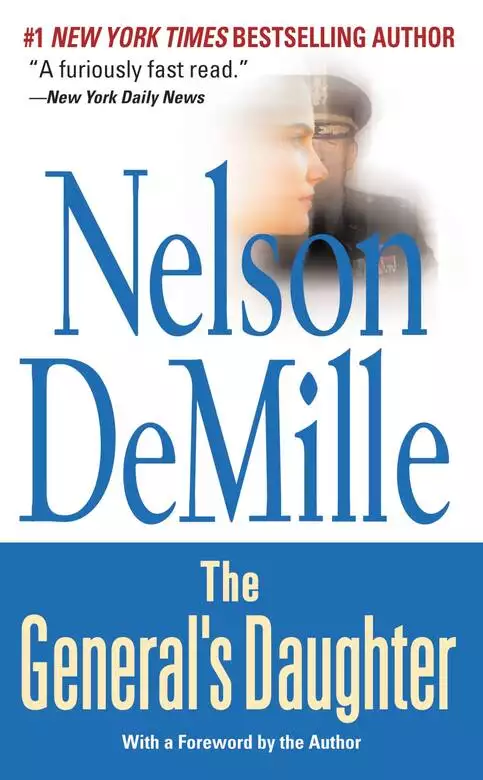
The General's Daughter
- eBook
- Paperback
- Audiobook
- Hardcover
- Book info
- Sample
- Media
- Author updates
- Lists
Synopsis
Captain Ann Campbell is a West Point graduate, the daughter of legendary General “Fighting Joe” Campbell. She is the pride of Fort Hadley until, one morning, her body is found—naked and bound—on the firing range. Paul Brenner is a member of the Army’s elite undercover investigative unit and the man in charge of this politically explosive case. Teamed with rape specialist Cynthia Sunhill—with whom he once had a tempestuous, doomed affair—Brenner is about to learn just how many people were sexually, emotionally, and dangerously involved with the Army’s “golden girl”. And how the neatly pressed uniforms and honor codes of the military hide a corruption as rank as Ann Campbell’s shocking secret life.
Release date: April 1, 2001
Publisher: Grand Central Publishing
Print pages: 454
* BingeBooks earns revenue from qualifying purchases as an Amazon Associate as well as from other retail partners.
Reader buzz
 Please log in to recommend or discuss...
Author updates
The General's Daughter
Nelson DeMille
Pointed dialogue and gritty humor make THE GENERAL’S DAUGHTER a fast read.”
—Washington Post Book World
“A FURIOUSLY FAST READ, GENUINELY PERPLEXING, INVOLVING MYSTERY AND AN IMMENSELY LIKABLE ANTIHERO. THANK YOU, MR. DEMILLE.”
—New York Daily News
“DEMILLE IS A MASTER OF THE UNEXPECTED.… With THE GENERAL’S DAUGHTER, DeMille continues to prove himself an accomplished and incredibly versatile storyteller.”
—Cleveland Plain Dealer
“DEMILLE’S NARRATIVE ENERGY IS UNFLAGGING.”
—Boston Globe
“HIS NOVELS ARE TIMELY, AUTHENTIC, AND FILLED WITH CONVINCING CHARACTERS. Nelson DeMille is one of the few writers who consistently
takes chances and consistently succeeds. Each thriller is different in scope and texture.”
—Baltimore Sun
“COMPELLING… INTENSE… it’s a pleasure to read a novel that speaks about important issues while holding us in thrall. Nelson
DeMille is an intelligent and accomplished storyteller who’s written a good book.”
—Miami Herald
“A KNOCKOUT. DeMille’s done it again… immensely skilled… a deductive novel of unwavering excellence.”
—Kirkus Reviews
“A SPELLBINDING STORY… a superlative murder mystery that combines the plotting brilliance of a P. D. James whodunit with the
disturbing overtones of a Ruth Rendell psychological thriller… The characterizations are splendid.”
—Buffalo News
“A FAST-PACED PROCEDURAL MYSTERY.… DeMille is a great storyteller, and this one is filled with intrigue. He also creates very
believable characters and has thought up a convincing—and very strange—plot.”
—The Veteran
“TERRIFIC… this book is a real page-turner but the style and language elevate it to literature.”
—Los Angeles Features Syndicate
“WRITTEN WITH AUTHORITYAND ASSURANCE.”
—Chattanooga News-Free Press
“A PAGE-TURNER.… Once again, DeMille jolts readers with a story of murder.… He also creates a fascinating set of characters.”
—Ocala Star-Banner
“DEMILLE’S PLOTTING IS SOPHISTICATED, BUT THE PARTICULAR JOY OF THE GENERAL’S DAUGHTER IS ITS DIALOGUE. Brenner is a man of honor as well as a cynic’s delight and a reader’s joy. DeMille, who found his fans with
The Gold Coast, will keep them happy with this one.”
—New York Daily News
“RAISES THE READER’S ADRENALINE LEVEL.… DeMille is a very gifted author who keeps his readers fascinated and guessing until
the very end. Even then the conclusion is a shocker.”
—Riverside Press-Enterprise (CA)
“GRIPPING… will have you biting your nails down to the quick… you won’t be able to put it down.”
—The Magazine, Baton Rouge
“A CAREFULLY CRAFTED NOVEL OF SUSPENSE.… Full of characters with depth and imagination, and the story is a great one.”
—Wisconsin State-Journal
“A SUPER OUTSTANDING BOOK… a convincing and impressive novel.… You’re in for a suspense shock.”
—Macon Beacon
“HITS THE MARK.… DeMille sustains our interest as he deviously weaves a web of suspicion around the many characters before
revealing the killer in the smashing climax.”
—Florida Times-Union
The Book & The Movie
The Book
This book, on its most basic level, is a murder mystery that happens to be set on an Army post.
But on another level, it is a story about the unique subculture of the military, about military law, and about women in the
military, and how all of these elements come together on a hot, steamy Georgia military base.
The Uniform Code of Military Justice is the law under which all the branches of the military—Army, Navy, Air Force, Marines,
and Coast Guard—operate. The UCMJ, as it is called, is based on American Constitutional law, but it is tailored to take into
account the ironic fact that men and women in uniform, who are sworn to defend the Constitution, do not enjoy all the rights
and safeguards they are defending. Military law also addresses military virtues, such as duty, honor, and loyalty—concepts
which are rarely or never addressed in civilian law.
Thus, as we see in this novel, military law is more than law—it is the whole legal, social, professional, and even psychological
matrix into which all members of the armed forces fit, or don’t fit, as the case may be.
The General’s Daughter begins with a murder and apparent rape, and from the beginning, we see that this is not only a crime against an individual
or against society; it is also a crime against the institution of the United States Army, a crime against good order and discipline,
an affront to the concepts of honor and loyalty, and to the military maxim that “All the brothers are brave and all the sisters
are virtuous.” In fact, the murder of a female officer is the trip wire that causes an explosion that rocks the Army to its
foundations.
I wrote this novel partly as a result of the Persian Gulf War of January and February 1991. Specifically, I was impressed
by the role that women played in the war, and in the military in general. Like most Vietnam veterans, however, I was a little
surprised and a lot annoyed at how the news media reported this war, as opposed to my war. Needless to say, the military came
off looking a lot better in the Persian Gulf than they did in Vietnam. The reasons for this are too numerous to go into here,
but one reason for this was the visible presence of women in the armed forces.
The military, consciously or unconsciously, put the media in a quandary; journalists look for dirt, for government bungling,
for military incompetence. But here you had a situation where the military was at the forefront of a politically correct movement—equality
of women.
The media personalized the Gulf War with endless interviews of women doing men’s jobs. This hype, I think, helped set the
tone for the positive reporting of the war in general.
Of course, many male soldiers, sailors, and airmen felt a little left out, and certainly veterans of my generation felt totally
disenfranchised and retroactively snubbed and unfairly portrayed.
Be that as it may, the net result was a “good war,” as opposed to a “bad war.”
Regarding the “bad war,” I served in the United States Army from April 1966 to April 1969. During that time, I took my basic
combat training at Fort Gordon, Georgia, my advanced infantry training and leadership school training at Fort Dix, New Jersey,
and attended Infantry Officer Candidate School at Fort Benning, Georgia. After training troops at Fort Benning, I went to
the Jungle Operations Come at Fort Gulick in the Panama Canal Zone, then shipped out to Vietnam and served as an infantry
platoon leader with the First Air Cavalry Division.
My three years in the Army were very much a male/macho experience, as you can imagine, and I did not interact with too many
female soldiers. In fact, the number of females serving in the military during the Vietnam conflict was fewer than the number
who served in World War II.
In Vietnam, aside from military nurses, there were virtually no women serving in the war zone, except civilian Red Cross volunteers,
known in the sexist jargon of the day as “Donut Dollies.” In any case, the American women in Vietnam were in the traditional
roles of caregivers, and they were no threat to the men.
In 1969, my last year of service back in the States, I began to see female officers assigned to staff jobs that were traditionally
male-only postings. This was an experiment that had mixed results. The feminist movement in America was in its early stages,
and there was little pressure on the military from any source for gender equality or gender integration.
But the military was actually in advance of the social and political movements of the day in regard to gender integration,
just as it was years ahead of the nation in racial integration when, in 1949, the armed forces ended racial segregation, albeit
by presidential order.
The point is, the armed forces has a mixed, but mostly positive record in all areas of equality. This is partly a result of
the nature of the organization. By that I mean, if you’re going to ask a black man to fight and perhaps die, then you can’t
treat him as a second-class citizen. If you’re going to ask a woman to serve in a close-combat support group (but not in combat
itself), then, again, you have to extend to her all the rights, privileges, and opportunities that accrue to the man serving
beside her.
Some men, of course, would say, “We don’t need women in the military at all.” Others might say, “Women in the military are
okay, but only in traditionally female jobs.”
But I believe we’re past those attitudes, and only two questions remain: Should women serve in direct combat roles? And, Should
women be subject to the draft as men are?
Those are difficult questions, and they are not directly addressed in The General’s Daughter, though there is a sub-text in the book that raises these questions of full equality.
When I set out to write this post–Gulf War novel, the first thing I decided was that this novel was not going to be a polemic.
It was going to be as fair as possible to the men and women who serve in our military, it was going to be fair to the Army,
and fair to the concept of a gender-mixed military. But it was not going to be a politically correct paean where all the sisters
are terrific and all the brothers are male chauvinist pigs.
At about the time this novel appeared in the fall of 1992, the Tailhook scandal was rocking the nation. This was good for
the book, but it wasn’t good for a sane, impartial dialogue on the complex subject of a gender-integrated military. Most of
the news and entertainment media who interviewed me for this book wanted me to make some connection between The General’s Daughter, a novel, and the ongoing Tailhook scandal, which was turning into an hysterical witch-hunt.
The incident in question—a party that got out of hand—was all of a sudden offered as proof that the entire military culture
was corrupt and sexist. The fact that some men acted badly was never in doubt. But lost in the uproar was the fact that some
men acted honorably, and some women acted badly. The same military that was idolized by the media in the Gulf War was now
being pilloried.
The Tailhook incident was not typical, and the Navy brass should have made that clear and should have stood up for the Navy
and prevented the good name and reputation of its entire corps of fighter pilots from being dragged through the mud because
of one bad night that involved a relatively small number of individuals.
But the political climate in Washington, and the social climate in America, precluded any thought of fairness or truth or
rational discourse. Instead, heads rolled, careers were ruined, and the male-female divide got about ten miles wider.
But long before Tailhook, I set out to write a novel that addressed the questions and problems of men and women serving together
in the new Army. It was my hope not to pander to or exploit these headline issues; I wanted a novel that would deal with the
more universal and timeless issues of men and women: jealousy, sex, honor, truth, and the human capability to love and hate,
often at the same time. I’ve set all of this on an Army post, just to make things more complex and interesting.
This story could happen anywhere, anytime—in fact, you may find some similarities in this story to a Greek tragedy. But what happens in The General’s Daughter couldn’t happen quite like this, except on a modern American military base.
The Movie
The movie rights for The General’s Daughter were bought by Paramount Motion Pictures before the book was published in 1992. Sherry Lansing, the studio head, liked the
novel and saw it as a story that dealt with important issues in modern American society. At the same time, the story line,
plot, and characters in the novel were easily adaptable to the screen.
The screenplay went through several rewrites, as seems to be the case in Hollywood, and eventually morphed into a highly competent
draft by Christopher Bertolini, with some smart doctoring by the always brilliant William Goldman, and a final excellent polish
by Scott Rosenberg.
I’m often asked if I have any input into movie scripts adapted from my novels. The answer is, no. Screenwriting is not at
all like novel writing, and a screenwriter has to work with a novel that takes ten to sixteen hours to read, and turn it into
a screenplay for a movie of about two hours’ length. Obviously, something will be lost in the adaptation, and it’s difficult
for a novelist to cut this much from his or her own magnum opus.
I do, however, read the screenplays that have been written of all my novels, in their many drafts, and I offer suggestions.
In the case of The General’s Daughter, the final drafts stayed true and close to the substance and intent of my novel.
The first part of the movie was shot in and around Savannah, Georgia, which acted as the setting for the fictional Midland,
Georgia, in the novel. My fictional Fort Hadley somehow became Fort McCallum, and Ann Campbell, who is the general’s daughter
in the novel, became Elisabeth (Lizzie) Campbell in the movie. It’s not worth wondering about these small changes, and the
author is grateful that the movie didn’t become a musical comedy titled Lizzie!
When a film adaptation of a novel gets off to a bad start, it usually stays on that path and ends up as an instant video rental
or a video-club giveaway. The General’s Daughter, however, started strong with good support and good ideas from Sherry Lansing, and from Karen Rosenfelt who is an executive
vice president of production at Paramount. Next, a producer was chosen—Mace Neufeld. Mace, with his partner, Bob Rehme, have
adapted Tom Clancy’s novels to the screen, and Mace himself has many successful films to his credit.
Ironically, Mace Neufeld had read The General’s Daughter when it first came out and made a bid to option it, but was outbid by Paramount. But now Mace and The General’s Daughter have been reunited, so to speak, through Paramount.
The next step was the screenplay, which I’ve mentioned, then came casting, and finding a director. The director chosen, Simon
West, made the hit movie, Con Air. He was not considered a natural choice for this kind of movie, but like most creative people, he wanted to do something different.
He said, “I really wanted to find a project that was a bit more serious. When The General’s Daughter popped up, I read the book, loved it, and jumped on board.” Simon shared everyone’s enthusiasm for the project, and the results
show.
Often, a movie sinks or soars on the choice of the leading man. The character of Paul Brenner in the novel is a wisecracking
and slightly smart-assed Irish-American from South Boston. I pictured Bruce Willis for the part and so did a lot of people
at Paramount, but Bruce Willis wasn’t available. Then one day, my agent, Nick Ellison, called me and announced that John Travolta
had signed for the part. John Travolta? as Paul Brenner? John Travolta is incredibly talented, but I couldn’t see him as the
character that I’d created, or even as the character that the scriptwriters had created. But I soon learned what it means
when they say that an actor or actress has range and depth.
I recall many years ago that when I heard that Marlon Brando had been picked to play the title role in The Godfather, I thought it was a bad choice. So did a lot of other people who’d read the book. But now, for all time and for all people,
Marlon Brando is The Godfather.
The role shapes the actor, and the actor shapes the role. So it is with John Travolta as Paul Brenner. Travolta is Brenner.
John Travolta brought with him his longtime manager, Jonathan Krane, who became the executive producer. Travolta and Krane
became involved with the script and also in the casting of the movie.
The leading lady presented a problem of scheduling, and the entire movie had been cast before Paramount was fortunate in signing
Madeleine Stowe who starred in The Last of the Mohicans. As with Travolta, I did not picture Stowe as Cynthia Sunhill (now Sara Sunhill) or Sunhill as Stowe. But once again I was
pleasantly surprised at how a talented star can mold a part so that it seems a natural choice.
The supporting cast is nothing short of spectacular. James Woods was born to play the part of quirky psychiatrist Colonel
Charles Moore, Timothy Hutton is the uptight provost marshall Colonel Bill Kent, James Cromwell, who plays the general, “Fighting
Joe” Campbell, told me he was an antiwar activist during the Vietnam War, but he acts like he had been an Army general once,
and Clarence Williams III as the general’s aide, Colonel Fowler, is so convincing that you believe he and James Cromwell served
together in the military. The alchemy among all these people is every director’s dream.
Last but not least, Leslie Stefanson, who plays the title role of the general’s daughter, is a newcomer to feature films,
but the performance she turns in makes her look like a seasoned actress. This is a young woman who has a great film career
ahead of her.
I don’t often picture any specific actor or actress playing a part I’ve created in a novel, but I had an eerie feeling when
I saw Woods, Hutton, Cromwell, Williams, and Stefanson on the screen. These were the people I’d created, right down to their
physical appearances and mannerisms. This is not to say that they didn’t define and expand on the characters and the roles—they
did. But they also seemed as if they’d stepped out of the pages of the novel.
The movie was shot during the summer and fall of 1998, and I chose not to visit the set in Savannah during the hot and difficult
summer shoot, but I did, with my agent, Nick Ellison, visit the set in October, when the shooting had moved to Los Angeles.
I should point out here that the Department of Defense was not involved with this movie. Mace Neufeld has a good relationship
with the DOD from his past films, but he felt that he should not seek government cooperation for this film. He said, “Over
the years, I’ve worked with many wonderful people from the DOD who’ve played an invaluable role in certain projects, but I
also know when the project is inappropriate and when to back off. It’s a relationship of mutual respect.”
My book was not antimilitary, and neither was the screenplay. But both book and movie raised controversial and sensitive issues
that perhaps would make the military uneasy. In any case, shooting a movie about the military without military cooperation
can be a little more difficult, and a little more costly. But it also has a liberating effect, both creatively and practically.
This is not to say that there are any glaring lapses of verisimilitude in the movie. In fact, Paramount hired a number of
military advisors to ensure military accuracy. I met several of these advisors on the set, and they seemed pleased that their
suggestions were acted upon by Mace Neufeld and Simon West.
The chief military advisor was Jared Chandler, a longtime associate of Mace Neufeld’s and a career reserve Army officer. Jared
worked on Mace’s Flight of the Intruder and Clear and Present Danger, and was always available on the set of The General’s Daughter when questions of verisimilitude arose. Veterans, like me, who like to pick apart Hollywood’s version of the military, should
find little to complain about in The General’s Daughter.
Regarding my visit to the set, these visits can be unhappy occasions. There are legendary tales of East Coast novelists visiting
Hollywood—tales that go back, probably, to the days of F. Scott Fitzgerald in the 1920s. Some novelists, like Fitzgerald,
are seduced by Tinsel Town and stay on long enough to ruin their careers. Most novelists come, look, and run back to their
relatively normal existences.
The movie business is like no other business on this planet, and Los Angeles is like no other city in America. Having said
that, I will say that no novelist should miss the opportunity to see his or her novel made into a film.
If fish and houseguests stink after three days, then novelists on a movie set stink after two. I spent two full days on the
set, and I was warmly welcomed and just as warmly sent on my way. It was a great visit.
One afternoon, Nick Ellison and I sat with Mace Neufeld and watched about a half hour of cut and edited scenes of The General’s Daughter. As the first scene came up on the video screen, I was anxious, skeptical, and New York cynical. I was prepared to wince.
Perhaps even have a cardiac episode. But from the first few minutes, I realized I was watching an exceptional production.
The performances from all the members of the cast were enthralling, and the interaction between the actors and actresses was
pure magic. When the lights went on in the small viewing room, Mace, Nick, the engineer, and I were all smiling. We had a
winner.
The movie, The General’s Daughter, is not the novel, The General’s Daughter. It is an adaptation. It’s easy for a novelist to complain or get angry at how his or her book was treated or mistreated.
In too many cases, these feelings are justified. The egos in Hollywood are big, and the story conferences are many. Studio
heads, producers, directors, and screenwriters engage in a collaborate effort that the novelist neither comprehends nor desires.
The result of collaborative efforts and compromises often lead to the proverbial committee-designed racehorse becoming a giraffe.
This process is inherent in the motion-picture business and will never change.
Sometimes, however, the moons, the planets, and the stars all line up, and many visions become a thing of magic. As I write
this, I have not seen the fully cut and edited movie, nor have I heard the musical score or the sound effects, or seen the
ending of the story. But I liked what I did see, on the screen and on the set.
The most common and frequent complaint of moviegoers who see a movie based on a book is this: The book was better than the
movie. One rarely if ever hears that the movie was better than the book, or that the novelist’s story and characters were
changed for the better. And you’re not going to hear that now. But what I can say is that the essence of my novel was captured
and conveyed on the screen through excellent acting, sharp and funny dialogue, and through the use of visual settings that
even the best novelist can’t convey on paper.
Regarding the visuals, executive producer Jonathan Krane said, “The look of this film is almost supernatural. It’s the most
staggeringly spectacular film I’ve ever seen.” A bit of hype, maybe, but the point is made that visuals are what American
filmmaking does best. When you couple this with great acting and a great screenplay, you have a real movie.
As important as being true to the book is the often overlooked notion that the movie should be entertaining. The movie version
of The General’s Daughter is entertaining. I was entertained, and if I was entertained, everyone else who sees it should be entertained.
My Hollywood experience may be atypical, and I may not be as lucky or fortunate on my next close encounter with Hollywood,
but this time, the heavenly bodies did align.
Is this seat taken?” I asked the attractive young woman sitting by herself in the lounge.
She looked up from her newspaper but didn’t reply.
I sat opposite her at the cocktail table and put down my beer. She went back to her paper and sipped on her drink, a bourbon
and Coke. I inquired, “Come here often?”
“Go away.”
“What’s your sign?”
“No trespassing.”
“Don’t I know you from somewhere?”
“No.”
“Yes. NATO Headquarters in Brussels. We met at a cocktail party.”
“Perhaps you’re right,” she conceded. “You got drunk and threw up in the punch bowl.”
“Small world,” I said. And indeed it was. Cynthia Sunhill, the woman sitting across from me now, was more than a casual acquaintance.
In fact, we were once involved, as they say. Apparently she chose not to remember much of it. I said, “You threw up. I told you bourbon and Coke wasn’t good for your stomach.”
“You are not good for my stomach.”
You’d think by her attitude that I had walked out on her rather than vice versa.
We were sitting in the cocktail lounge of the Officers’ Club at Fort Hadley, Georgia. It was the Happy Hour, and everyone
there seemed happy, save for us two. I was dressed in a blue civilian suit, she in a nice pink knit dress that brought out
her tan, her auburn hair, her hazel eyes, and other fondly remembered anatomy. I inquired, “Are you here on assignment?”
“I’m not at liberty to discuss that.”
“Where are you staying?”
No reply.
“How long will you be here?”
She went back to her newspaper.
I asked, “Did you marry that guy you were seeing on the side?”
She put down the paper and looked at me. “I was seeing you on the side. I was engaged to him.”
“That’s right. Are you still engaged?”
“None of your business.”
“It could be.”
“Not in this lifetime,” she informed me, and hid behind her paper again.
I didn’t see an engagement ring or a wedding ring, but in our business that didn’t mean much, as I’d learned in Brussels.
Cynthia Sunhill, by the way, was in her late twenties, and I’m in my early forties, so ours was not a May–November romance,
but more May–September. Maybe August.
It lasted a year while we were both stationed in Europe, and her fiancé, a Special Forces major, was stationed in Panama.
Military life is tough on relationships of all kinds, and the defense of Western civilization makes people horny.
Cynthia and I had separated a little over a year before this chance encounter, under circumstances that can best be described
as messy. Apparently neither she nor I had gotten over it; I was still hurting and she was still pissed off. The betrayed
fiancé looked a little annoyed, too, the last time I saw him in Brussels with a pistol in his hand.
The O Club at Hadley is vaguely Spanish in architecture, perhaps Moorish, which may have been why Casablanca popped into my mind, and I quipped out of the side of my mouth, “Of all the gin joints in the world, she walks into mine.”
Either she didn’t get it or she wasn’t in a smiling mood, because she continued to read her newspaper, the Stars and Stripes, which nobody reads, at least not in public. But Cynthia is a bit of a goody-goody, a dedicated, loyal, and enthusiastic soldier
with none of the cynicism and world-weariness that most men display after a few years on this job. “Hearts filled with passion,
jealousy, and hate,” I prompted.
Cynthia said, “Go away, Paul.”
“I’m sorry I ruined your life,” I said sincerely.
“You couldn’t even ruin my day.”
“You broke my heart,” I said with more sincerity.
“I’d like to break your neck,” she replied with real enthusiasm.
I could see that I was rekindling something in her, but I don’t think it was passion.
I remembered a poem I used to whisper to her in our more intimate moments, and I leaned toward her and said softly, “ ‘There
hath none pleased mine eyes but Cynthia, none delighted mine ears but Cynthia, none possessed my heart but Cynthia. I have
forsaken all other fortunes to follow Cynthia, and here I stand, ready to die if it pleases Cynthia.’ ”
“Good. Drop dead.” She stood and left.
“Play it again, Sam.” I finished my beer, stood, and walked back to the bar.
I sidled up to t
We hope you are enjoying the book so far. To continue reading...
