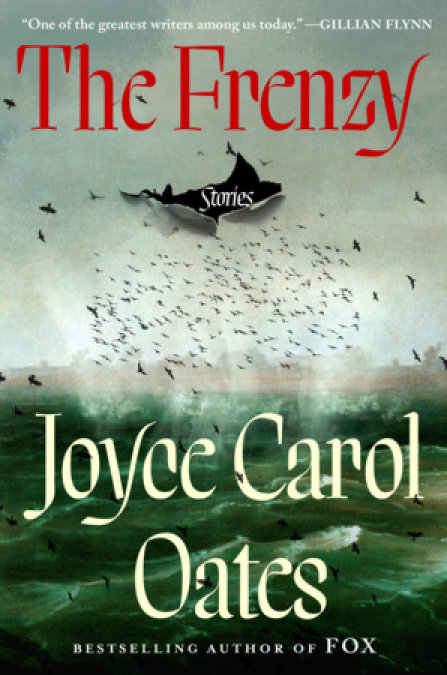
A gripping collection of propulsive, psychologically suspenseful stories by the legendary Joyce Carol Oates “who is surely on any shortlist of America’s greatest living writers” (The New York Times Magazine)
“A genius in the truest sense of the word.”—Rebecca Makkai “One of the greatest writers among us today.”—Gillian Flynn “Haunting . . . masterfully orchestrated . . . Oates’s best work is simmering and remorseless.”—Vogue “Astounding . . . Oates imbues this entire book with psychological suspense and high stakes.”—Harper's Bazaar
“Already one of our most accomplished and, yes, prolific living writers, Oates is on a thrilling winning streak with her third stellar work of literary fiction in two years. Call it the JCOaissance. Or maybe don’t. But definitely pick up this collection.”—Publishers Weekly (Pick of the Week)
A MOST ANTICIPATED BOOK OF THE YEAR: Vogue, Haper’s Bazaar, Publishers Weekly, Library Journal, Lit Hub, AARP
Frenzy (noun): a temporary madness; a violent mental or emotional agitation; intense usually wild and often disorderly compulsive or agitated activity
Joyce Carol Oates is a master of the short story and one of the legends of the form. Her collections of short fiction have twice been finalists for the Pulitzer Prize and have won numerous awards, including the O. Henry Award and the PEN/Malamud Award for Excellence in the Art of the Short Story. In The Frenzy: Stories, Oates plunges us into the lives of her characters at moments of crisis and confusion, when much of what they understand about themselves and those they love comes undone.
A young woman on a supposedly romantic weekend trip to Cape May, New Jersey, turns the tables on her older, married lover. A freak bicycle accident on a bridge haunts one family for decades. A girl jealous of her popular cousin discovers she is the lucky one. A widow waits at her riverside house for her dead husband's return. A young man hiking in the woods comes upon a couple in a heated, possibly violent argument—should he intervene?
Suspenseful and psychologically astute, Oates's short stories enthrall and captivate as they dissect her character's deepest fears—revealing our own in turn. "Literature is a texture of words," says Oates of her short fiction, "evoking life in the most vivid ways—psychologically, physically." These new stories blazingly evoke life at its most vivid and perilous, when fate and free will intersect, and one ominous encounter or bad choice can be the difference between an ordinary day and the point of no return.
Release date:
June 16, 2026
Publisher:
Hogarth
Print pages:
336
* BingeBooks earns revenue from qualifying purchases as an Amazon Associate as well as from other retail partners.
Is the irrevocable, unforgivable act behind him, or ahead? Early afternoon driving south on the Ocean Highway with the girl beside him. Passing Point Pleasant, New Jersey. Passing exits for Toms River. Something haphazard in his driving today which is unlike him.
Wind from the Atlantic rocking the Subaru Forester so he feels a thrill of, what is it, a tug like a tug of wills, invisible hands on the wheel which is his wheel so his reaction is to correct against the intrusion like the subterranean pull of sleep when he wakes in the morning in the dark before dawn stunned and exhausted by dreams.
Still, he is feeling reckless. Young.
“Is something wrong?”—the girl asks sharply.
How like this girl—(this girl to him, though she has a name)—to register the nuance of a moment, a half-moment when he’d (almost) lost control of the car.
Affably he tells her no, not a thing is wrong. Just wind.
Resenting the question, one of the girl’s rude-child questions. Not that he will indicate resentment, his manner with the girl is more bemused, placating.
Leaving the Garden State Parkway for the Ocean Highway she’d asked if they could please not talk for just a while?—the view is so special, she doesn’t want to be distracted.
The coastal view is special. Wintry Atlantic churning, frothing, glittering like a gigantic skin shaking itself, great galleon-clouds passing overhead torn and tattered by winds.
Still he’s feeling rebuffed. Rebuked. Please don’t spoil things by talking.
Wanting to protest: she has set things back into motion, not him. Calling him the night before, clandestine call at twelve-twenty a.m. when she’d known that he would be awake and his wife would be asleep because this is an intimacy he has shared with the girl to allow her to know how admirably she differs from the wife.
At the time she’d called he had (in fact) been lying in bed. Beside his (sleeping, oblivious) wife. Lying in bed and thinking of her, the girl, the teenaged mistress, what he would do with this girl or to this girl if they were alone together in some neutral space, an impersonal and unnamed space, a very private place, high-ceilinged luxury hotel room without windows or even a door; a floating kind of place, an off-shore kind of place, soundproof.
Making his way barefoot and unerring through the familiar dark of the bedroom to an adjacent room where his cell phone was charging like a heart detached from its body.
Hand shaking?—no, his hand was not shaking.
In the bedroom his wife slept unknowing.
In their rooms his teenaged children slept unknowing.
That giddy-drunken sensation of giving in, sinking, as if boneless, will-less, to which he was becoming addicted.
And now, next day, next afternoon driving south on the Ocean Highway along the Jersey coast with the girl beside him. Thrilled, exhilarated. Some kind of miracle. Never have predicted, for each time they’d said goodbye it has seemed to him the final time, the (sensible) (final) time.
But no, think again. For here he is, and Brianna is beside him. In that fraught period before Christmas when his life is about to shatter and re-organize itself.
In his elated state driving at just above the speed limit. Keeping to the right lane, letting others pass. Enormous trucks, impatient SUVs. No hurry about the drive, they will arrive at Cape May well before dusk.
He, so often impatient on the turnpike. Not impatient now.
As if, the girl beside him, he has all that he requires. So long as they are alone together, and she is in his custody, so to speak. His vehicle.
Through swaths of bright blinding sunshine punctuated by flitting shadows of storm clouds.
Brianna has been sitting forward in the passenger’s seat, taking pictures with her iPhone. Marveling at the view. The boulder-strewn shore, wind-buffeted ocean waves. Light shivering and rippling to the horizon dissolved in mist. It is not, to Cassidy, an extraordinary ocean view but it is the Atlantic Ocean, a welcome change from the thunderous Jersey Turnpike and numbingly banal small cities, suburbs strewn out beside it.
Brianna’s concentration appears to be genuine, unforced. He envies her this childlike enthusiasm, so different from her frequently sulky, peevish mood.
Teenaged mistress! What else can you expect.
In fact, Brianna is (nearly) twenty years old.
Her birthday is next month, January. Zodiac sign Capricorn (she’d told Cassidy).
Should a year’s difference matter? If/when his wife discovers
the liaison, if/when he decides to reveal it to her, an affair with a twenty-year-old seems slightly less reprehensible than an affair with a teenager.
In fact, a teenager known to the family, daughter of friends in Fair Hills.
Cassidy winces, considering. Feels like a thorn or thistle in his throat, isn’t sure if he needs to cough, or to laugh.
Bastard, what the hell are you doing? Why’s it feel so good?
Waves glittering to the horizon, pewter-colored, hypnotic. Cassidy is reminded of how he’d once purchased a ticket for a chartered boat out of Provincetown, taking passengers on a five-hour excursion out into the Atlantic. Fifteen miles from land? Fifteen knots?
Open ocean, immense sky, rocking boat, no sight of land. Mild sensation of panic.
After three hours the guide summoned passengers to hurry to the railing, the Provincetown Princess was cutting through a plankton path: a wide swath of ocean stretching out of sight where fish were feeding, thousands of fish, millions of fish, writhing silvery bodies in the dark water, savagely feeding, frenzied activity of a kind that Cassidy had never seen before, that left him appalled and shaken.
It was explained to observers that a concentration of plankton had drawn swarms of small fish to the area, in the millions; the concentration of small fish attracted larger fish, which devoured the smaller fish; and these predators attracted larger predators, to devour them. The popular term was feeding frenzy.
We hope you are enjoying the book so far. To continue reading...

 Please log in to recommend or discuss...
