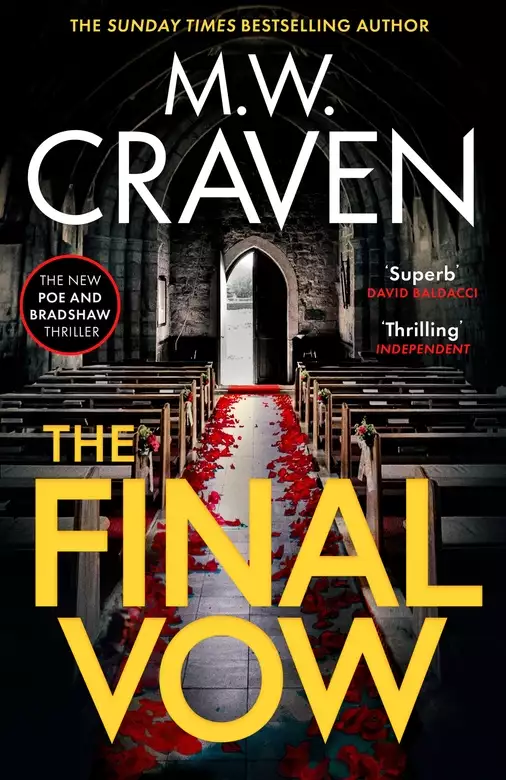
The next unmissable novel* in the Sunday Times bestselling, multi-award-winning Washington Poe series. Poe and Tilly fans: be prepared for the most twisted thrill-ride so far . . .
An invisible killer with a 100% success rate. No one is safe. Not even those closest to Washington Poe . . .
A shooting at Gretna Green. A bride is murdered on her wedding day, seconds after she slips on her new ring. It's brutal and bloody but she isn't the first victim and she won't be the last. With the body count now at 17, people are terrified, not knowing where the sniper will strike next.
With the nation in a state of panic, the police are at a loss and turn to Washington Poe and Tilly Bradshaw - the only team who just might be able to track down a serial killer following no discernible pattern and with the whole country as his personal hunting ground. Can Poe and Tilly stop an unstoppable assassin, who never misses his mark and never makes a mistake? Or will he find them before they find him...
*Previously listed as The Third Light
EVERYONE LOVES M.W. CRAVEN:
'Washington Poe is a brilliant creation from one of the finest and most inventive crime writers of today' Peter James
'Mesmerising, macabre and magnificent. Poe and Tilly are unstoppable' Chris Whitaker
'If you haven't read any M.W. Craven yet, fix that immediately' S. A. Cosby
'I've been following M.W. Craven's Poe/Tilly series from the very beginning, and it just gets better and better ' Peter Robinson
'Poe and Tilly books are a joy' Steve Cavanagh
'In Tilly and Poe, M.W. Craven has created a stand-out duo who are two of the most compelling characters in crime fiction in recent years' Fiona Cummins
Release date:
August 14, 2025
Publisher:
Little, Brown Book Group
Print pages:
100000
* BingeBooks earns revenue from qualifying purchases as an Amazon Associate as well as from other retail partners.
There were twelve people in the police media room and that was ten too many.
Only the man and the woman needed to be there. The other ten were as welcome as professional mourners at a funeral.
The woman looked at the man, saw the grief on his face. She made a decision. ‘Everyone out,’ she said quietly.
She didn’t need to raise her voice. She never did. The room went silent. The only sound was the crack of knuckles as the man clenched and unclenched his fists. He didn’t know he was doing it.
‘We have just as much right to be—’ one of the ten started to say before being nudged into silence by a colleague. He pointed at the woman’s expression. It said: Don’t mess with me. Not today.
They left their seats and trooped out of the room. They glared at the man as they passed. One of them, a guy called Peter Jameson, deliberately shoulder-barged him. Stared, willing him to react.
The man didn’t. Jameson was angry. They were all angry. The man didn’t blame them.
Jameson tried again. ‘This is your fault,’ he said. ‘She’s dead because of you.’
The man continued to ignore him. Didn’t even glance in his direction.
‘Out!’ the woman snapped.
Jameson left the room, slamming the door. The room fell silent again. The woman took a moist towelette from her bag and wiped the back of her neck. She passed a fresh one to the man, but he made no move to take it.
Despite the brutish heatwave the country was experiencing, the police media-room windows were closed. Heavy drapes covered them. It was how it was now. People suffered the discomfort. Put up with the heat. Over the last three months they had got used to it. Keeping your windows closed and your curtains drawn was the new normal. As were untended gardens. Tarpaulin screens at petrol stations. People walking in zigzags instead of a straight line. No one went outside unless they had to.
Not any more.
The man had sweated so much his suit was as wet as a sponge. He was unshaven and had red-rimmed eyes. It looked like he hadn’t slept for weeks. His cheeks were shrunken, gaunt. His face was monstrously calm. Detached, almost. If he’d returned from a war zone, he’d have been described as having a thousand-yard stare. The only sign of his rage was the clenching and unclenching of his fists.
‘It’s on,’ the woman said. She reached for a remote control and unmuted the television that was mounted on the wall. It was already on the right channel – Sky News. The anchor was called Finlay Scott and the carefully worded statement he was about to read had been drafted by the woman not forty-five minutes earlier. It had been released to the media to catch the two o’clock news. It would be repeated on the hour and be the lead story on the six o’clock and ten o’clock shows that night.
Finlay Scott cleared his throat and began reading. ‘I have breaking news – police have just released the name of the twenty-first person to be killed by the sniper who is terrorising the country. The woman, who worked for the National Crime Agency’s Serious Crime Analysis Section, has been named as civilian analyst and the youngest-ever recipient of the Fields Medal, Matilda Bradshaw.’
At the back of the room, Stephanie Flynn, the woman holding the remote control, stared at the screen in silence. Like she couldn’t believe she’d heard what she’d known she was about to hear. As if there was a disconnect between writing the statement and hearing the statement. A single tear ran down her face. She wiped it away with the towelette.
The man with the thousand-yard stare didn’t look at the TV. Nor did he stay silent. That wasn’t in his nature. He was an apex predator and he had never felt the urge to hunt more. He wanted, no he needed to be outside. The sniper wasn’t in this room. He was in the hills, and he was in the woods. He was on the top of buildings, and he was underneath cars. He was everywhere the man wasn’t. But they’d be in the same place soon. The man with the thousand-yard stare could feel it. He knew it. He could hear the beat of the sniper’s heart, smell his fear. No one else was going to die. It was almost over.
So instead of staying quiet, the man threw back his head and screamed.
That man was Washington Poe.
But perhaps this isn’t the best place to start.
Maybe we need to go back a few weeks . . .
A few weeks earlier
Gretna Green
The bullet that killed Naomi Etherington was a .50 BMG fired from a McMillan TAC-50 sniper rifle. It was shot from a cold barrel at a range of 1,200 yards. The sniper was using a Schmidt & Bender 5-25x56 PM II telescopic sight. The bullet was the colour of a penny and, at 42 grams, was five times the weight of the wedding ring Naomi had just slipped on her new husband’s finger.
It entered her back at 800 metres per second, cut through vertebra C5, severing her spinal cord, then deflected off her ribs down into her heart. After shredding the aorta, the left atrium and the left ventricle, the bullet tore through the lower lobe of her right lung then smashed its way in and out of her liver and pancreas.
Later, the forensic pathologist would note that the entrance wound in Naomi’s back was the size and colour of a fresh cigarette burn. There was no exit wound – the solid knot of the hipbone had flattened and stopped the bullet.
People still get married at Gretna Green. Three and a half thousand couples a year. It’s a nod to the runaway weddings of the past when an eighteenth-century English law forbade anyone under the age of twenty-one to marry without their parents’ consent. Gretna Green was an accident of geography, the first village English couples reached when they crossed the border into Scotland. Overnight, a thriving wedding economy sprang up, and businesses keep the tradition alive today. It’s romantic, a lovely way to start your new life together.
But when Naomi collapsed into her husband’s arms, her life’s egg timer was almost out of sand. A bridesmaid, thinking the heat and the heavy white dress had caused her friend to faint, went to help. Then she saw the blood. Lots of blood. She screamed. And then it seemed like everyone was screaming. It was a full minute before anyone thought to dial 999.
It wouldn’t have made any difference. By the time the paramedics arrived, Naomi had been dead for seventeen minutes.
The man in the ghillie suit didn’t make mistakes.
Cabinet Office Briefing Room C, Whitehall, London
The murder of Naomi Etherington was the man in the ghillie suit’s third victim in eight days. In the last six months, he’d shot and killed seventeen people. He had a 100 per cent success rate. No one had survived. There was no one in hospital, hanging on, full of tubes and hooked up to twenty machines. Every one of his victims had died where they’d been shot.
Even if the sniper terrorising the country hadn’t been negatively affecting the economy, the prime minister couldn’t sit on his hands. He had to do something. He had to lead. And when the country looked to Number 10 for leadership, the quick-win, easy-to-arrange gesture was always the same – COBRA. It sounded like the PM was on top of the situation. That high-level coordination and decision-making was happening, and he was overseeing it. That when the country needed him, he was a hands-on prime minister. He was their guy. The public’s image of COBRA resembled the White House’s Situation Room. Screens on the wall, satellite links to the nuclear subs. Men in shirts, ties loosened, sleeves rolled up, toiling away day and night. That COBRA was an acronym for Cabinet Office Briefing Rooms – the media added the A to make it sexier – didn’t seem to bother anyone. COBRA sounded fast. It sounded decisive. It sounded like it had bite. Like an actual cobra.
The reality of COBRA was that the prime minister was rarely present at the meetings. He might occasionally dip in and out, but that was more of a cosmetic thing. In case he was asked by the press or by the leader of the opposition at PMQs. COBRA meetings are mostly attended by the people who need to be there.
Cabinet Office Briefing Room C was typical. It was functional. Utilitarian. Nothing in it that didn’t need to be there. It looked like any briefing room anywhere in the world. A table, some cheap chairs, and tough, hardwearing carpet tiles.
The seven previous meetings convened to discuss the sniper murders had been attended by representatives of the police, the Home Office, the Office of the Prime Minister and a bunch of civil contingency experts. The usual suspects.
And they were there now. Still making notes, still out of ideas. But this time someone new was in attendance. He’d been in the wings, ready for the call. Patiently waiting for the sniper to be redesignated as a threat to national security. He was called Alastor Locke, and although he looked and dressed like Snidely Whiplash without the top hat, he was one of the UK’s most senior spies. Locke had listened to what was being discussed in the meeting without commenting. The sniper was a police matter. He wasn’t sure there was a role for the security services yet. He’d made some notes but that was more out of habit. Locke didn’t attend meetings unbriefed.
The chair was called Timothy Spiggens and he was a junior minister in the Home Office. Not the best politician Locke had ever met, not the worst. He had just reached the last agenda item – AOB. Any Other Business.
‘Alastor,’ he said. ‘Can you bring everyone up to speed on what the security services have been up to?’
Fat chance, Locke thought but didn’t say.
‘The usual,’ he said. ‘Monitoring chatter, speaking to our friends, gross invasions of privacy, that kind of thing.’
‘And?’
Locke shrugged. ‘If he’s a bad actor, he’s working alone. No one is claiming responsibility. One of our more excitable far-right groups thought it might have been one of their fringe players, someone who disappeared a year ago, but I know for a fact they’re wrong.’
‘How?’
‘Because he’s dead. Drug overdose. His body went unclaimed and he was given a pauper’s funeral three months ago.’
‘But if you knew . . .’
‘If we knew who he was, why did his body go unclaimed?’
‘Yes.’
‘We’re the security service,’ Locke said. ‘Keeping secrets is what we do. And it suits our purposes if certain groups believe we still do black sites and extraordinary renditions. It keeps them in check.’
‘It’s not terrorism then?’ Spiggens said.
‘It isn’t.’
Spiggens put his head in his hands for a moment. Terrorism would give the government a target. Someone to fight. A lone wolf gave them nothing. And Mason Dowbakin, the Right Honourable Member for Preston East, was already making waves. Goading the centrist PM, forcing him to move to his right. His latest column in the Telegraph said he was only helping the PM – who he admired greatly blah blah blah – return to his core values, but everyone knew he was setting himself up as the next cab off the rank should there be a leadership challenge.
‘This is a disaster,’ Spiggens said. He opened a slim file and removed a single sheet of paper. ‘These are the most recent figures. Working-from-home requests are up by six hundred per cent in the last two weeks alone, commuting is down by almost the same. When people do come into work, they don’t leave the building until they go home as soon as they finish, so the lunch and early evening economy is tanking. The public are cancelling hospital appointments so the pandemic backlog, instead of shrinking, is getting bigger.’ He put the sheet back in his file then picked up a copy of the Daily Mail. ‘A woman collapsed in Brighton yesterday. She lay on the pavement for over an hour before someone found the courage to go to her assistance. Eighty-seven years old and she died of heatstroke in one of the most advanced countries in the world.’ He slammed the newspaper on the table. ‘This is absolutely unacceptable!’
‘This isn’t a newspaper Mrs Locke has delivered,’ Locke said. ‘May I see it?’
Spiggens slid it across the table. Locke picked it up and spent a few seconds scanning the front page. It was a detailed account of Naomi Etherington’s murder in Gretna Green. He tilted his head. ‘I know a man who lives near Gretna Green. He doesn’t always play well with others, but he may be able to help.’
‘What? Who is he?’ Spiggens said. ‘Get him on the next train, man!’
‘The approach will have to come from someone else, I’m afraid. The last time we had contact there was considerable . . . unpleasantness.’
‘How unpleasant?’
Locke cleared his throat. ‘He said if he ever saw me again, he’d, and this is verbatim, “Take those stupid glasses off your head and stick them up your bony arse.”’
‘My word,’ Spiggens said. ‘That is unpleasant.’
‘And truthfully, it was not undeserved,’ Locke said. ‘We did treat him rather badly.’
‘Perhaps he was exaggerating.’
Locke smiled at the thought. ‘This is not a man given to hyperbole, Timothy.’
‘What will he want?’
‘Knowing him, a crate of beer and some good-quality butcher’s sausages.’
‘Alastor,’ Spiggens warned. ‘The PM wants positive news – what will he want?’
‘I really have no idea,’ Locke said. ‘He’s whimsical.’
‘Who is he?’
‘Detective Sergeant Washington Poe.’
Cabinet Office Briefing Room C went from quiet murmurs to stunned silence so quickly it was like there’d been a power cut.
‘Good grief,’ Spiggens said eventually. ‘Is he still a police officer? I thought he’d married the Marquess of Northumberland’s daughter.’
‘Not yet.’
‘But they are engaged?’
‘I really have no idea, Timothy,’ Locke said. ‘I certainly haven’t received a wedding invitation.’
‘Washington Poe,’ Spiggens said, wondering if the PM would consider this good or bad news. ‘I’m not sure, Alastor. We got into a lot of bother the last time he worked with us. All that stuff on the golf course.’
‘True,’ Locke replied. ‘But he was right.’
‘Yes, I know he was right. He also caused a major diplomatic incident. My counterpart in the US didn’t return my calls for almost a year.’
Locke hid a smile. Unsuccessfully.
‘It’s not funny, Alastor!’ Spiggens snapped. ‘We called you in to get your take on this horrible situation and the only thing you’ve come up with is an unmanageable misanthrope from the far north of England.’
Locke said nothing.
‘I’m not sure he’s the type of person we want, Alastor.’
‘Maybe not, but he is the person we need. He has a knack for this kind of thing.’
Spiggens sighed. ‘If I take this to the PM, can you control him?’
‘Good Lord, no,’ Locke said. He thought about it for a moment. ‘But I know someone who can.’
‘Who?’
Locke told him.
‘Get her on the phone then.’
Locke removed an ornate notebook from his pocket and found a number. He pressed the speakerphone icon and dialled. His call was answered immediately.
‘Modern Slavery and Human Trafficking Unit, please,’ he said.
There were a couple of clicks while his call was redirected.
‘Good morning, Chief Inspector, this is Alastor Locke. Have I caught you at a bad time? And before you answer, I’m in Whitehall and you’re on speakerphone.’
‘What do you want, dickhead?’
Locke chuckled. ‘I’m thinking of putting the band back together.’
Flynn paused. Then she said, ‘It’s about fucking time.’
HMSLancaster , the smallest, leakiest tug in the Royal Navy, somewhere in the Atlantic Ocean
Washington Poe smelled of fish.
Not just his clothes. Him. It was a hard thing to admit, but he did. He smelled of fish. One of the stinkiest things you could smell of. Even fresh fish honked. If he were to compile a list – and he frequently did – of the worst things to smell of, fish would be number two. Only an actual number two was worse.
Cruellest of all, there didn’t seem to be anything he could do about it. And he’d tried, God how he’d tried. The second he got home his clothes were off and in the washing machine. He would then scrub himself in the bath for an hour. He’d use the harshest soap he could buy, and the hottest water he could stand. And within five minutes of stepping out, he smelled like he’d used fish stock as bathwater.
His fiancée – soon-to-be wife – Estelle Doyle, didn’t help. The second he was out of the bath she would say something hilarious like, ‘I don’t know why, but I fancy kippers for tea,’ or ‘We had a double-glazing salesman round earlier. He said he could do the whole house for a thousand pounds. I told him to go away . . . it seemed fishy.’ And Poe would laugh because it was Doyle who’d said it and he loved her. She also had the kind of voice that would make a bowel cancer diagnosis sound sexy.
But still, he wished he didn’t smell of fish.
And the reason he smelled, no stank, of fish was because he was being punished. His last case with the National Crime Agency’s Serious Crime Analysis Section, the UK’s only dedicated serial killer unit, had involved people who had been stoned to death. It had almost killed him. Literally. It had left him scarred and battered and with PTSD. He was still seeing his trauma therapist, and although he was getting better, the little things were still making him angry. Shops without cashiers. People who said ‘holibobs’. The chip shop closing early. Flies. Adults who wished their dead relatives a ‘happy heavenly birthday’. People who put LOL on text messages. People who said LOL. His line manager wanting regular updates on the criminal activity of drug smugglers. Raisins masquerading as chocolate chips in biscuits. Adults who said ‘forever homes’ and ‘fur babies’. The Police and Criminal Evidence Act. The phrase ‘wild swimming’. The usual shit.
He’d been temporarily reassigned to the training wing until he was assessed as being fit for fieldwork. In hindsight, or maybe it was foresight – you never knew who was pulling whose strings when these things were arranged – it was a role for which he was singularly unsuited. He’d been there for less than a month when he’d had a fistfight with another instructor, an over-educated fast-tracked idiot called Jake Burnham. Poe couldn’t remember what the fight was about, but he thought an unattended Pot Noodle might have been involved. However, Burnham had also been at fault, and because he was the son of an assistant chief constable in Police Scotland they couldn’t sack him. Which meant they couldn’t sack Poe either. Instead, they did the next best thing: they reassigned him – again – to the stupidest inter-agency task-force ever dreamed up. His boss at the training unit had assumed he’d hand in his notice there and then, but he hadn’t understood how contrary Poe could be.
So now he and three other misfits spent their working days on the smallest, leakiest tug in the Royal Naval fleet on an intelligence-led stop-and-search programme of fishing trawlers.The half-baked idea was that the combined might of the Royal Navy, Border Force and National Crime Agency would prove a formidable weapon in the fight against drugs. Poe knew it was a half-baked idea because he was on the taskforce. Poe didn’t know anything about fish. He didn’t even like fish. He would tolerate cod if it was wrapped in crispy batter. Even then he’d give most of it to Edgar, his gluttonous springer spaniel. Not the batter, though. That was all his.
But lack of knowledge of the UK fishing industry aside, he wasn’t the biggest buffoon on HMS Lancaster. The ship, which had started life as an inshore survey vessel, was skippered by the boatswain Isaac Scoplett, surely the drunkest man in the Royal Navy. He reminded Poe of a less sober Uncle Albert from Only Fools and Horses. Poe had no idea what Scoplett had done to get the same punishment posting as him, but he suspected gross incompetence was a big part of it. He was the only sailor Poe had met who said left and right instead of port and starboard.
If anything, the two chuckleheads from the Border Force were worse. At least Scoplett tried – not to fall overboard, mainly – whereas Amer Anwar and Clancy Bright seemed to rejoice in their stupidity. As well as that, they were mean, lazy and misogynistic. Poe had received an email from an old contact in customs. It was just their names in the subject line and ten rows of laughing emojis.
Their new line of attack was that Poe had a therapist. They thought that was funny. They didn’t know why he had a therapist, but that didn’t seem to matter. They’d been making snide comments for days, trying to get a rise, but Poe wasn’t playing. He barely listened to them. It would come to a head at some point, but he wasn’t ready yet.
Because, as stubborn as he was, Poe was getting tired of it all. He was tired of smelling of fish, and he was tired of the commute. Of the nights at sea. He missed his fiancée, and he missed his friend, Tilly Bradshaw. His best friend. When the last case had concluded, the dream team was split up. He had been sent to the training wing, SCAS’s boss, DI Stephanie Flynn, had been promoted to DCI and gone to a Modern Slavery unit, and Bradshaw had been seconded to the security services; doing what, she wouldn’t say. He knew she was as miserable as him, though.
So, in secret they’d been making a plan . . . It was a great plan and he was tempted to put it into action soon.
But not before he’d kicked the shit out of the Border Force guys.
The boat they’d just boarded was called the Aurora II. It was a 14-metre trawler and it had been chugging its way back to Cornwall when they’d boarded it. It had taken Scoplett four attempts to bring HMS Lancaster alongside. Everyone had found somewhere else to look as he kept messing up what was a basic naval task. He was less Captain Cook, more Captain Pugwash.
But eventually, with the help of a lucky swell, he’d managed to get close enough to tie up and board. Scoplett nodded. Job well done. He removed his hip flask, took a swig then offered it around. No one accepted.
The Aurora II’s three-man crew, a father and his two sons, were sullen but cooperative. They were big men, bearded with scarred hands. Thick Cornish accents. Sounded like Worzel Gummidge. Work strong, not gym strong.
Clancy Bright asked to see their paperwork. He was smiling. Bright loved to order fishermen around. Loved to abuse the tiny bit of authority he had. Poe was surprised he hadn’t used a German accent. He thought Bright would have been an enthusiastic Nazi.
Everything seemed to be in order. The father provided an up-to-date fishing vessel licence, the boat had all the required safety equipment, and Poe didn’t need to weigh their catch to know it was under their quota.
But it was halibut and that was a problem.
‘Cuff them,’ he said.
‘You’re not in charge of me, Poe,’ Anwar said. ‘You fucking cuff them.’
‘Actually, this is now a live crime scene, so I am in charge. If you don’t cuff them, I’ll assume you’re part of whatever this is and, as I’m outnumbered, I’d be within the law if I belted you around the head with this fishing gaff.’ He picked up a metal shaft. It had a wicked-looking hook on the end.
Anwar and Bright scrambled to get out their cuffs and it wasn’t long before the three fishermen were in custody. Poe read them their rights. They didn’t seem overly concerned.
‘You mind telling us what the hell’s just happened?’ Bright said. He picked up a halibut. Held it by its gill and rubbed off some of the ice. It was about a metre long, all fleshy and fat. Looked fresh. ‘Because these guys have a catch to land.’
‘This boat is fitted out for purse seining,’ Poe said. He looked at their blank faces and sighed. He hadn’t known anything about fishing when he’d started, but he’d learned what he needed to. It was a shit job but that didn’t mean he wasn’t going to do it properly. ‘Come on, guys, you can remember this.’ He waited. Sighed again and said, ‘Purse seining works by drawing a vast net around a shoal of fish. The bottom is weighted, and the top is buoyed by floats. When the shoal is in the net, the bottom is closed – or pursed – like a drawstring bag and the fish are trapped.’
‘Yeah, we knew that,’ Anwar said. ‘So what?’
‘So, purse seining is used for midwater fish like mackerel and sardines. The halibut is a flatfish and that means they live on the bottom of the sea. They’re caught with trawler nets, not purse seines. In any case, even if they had found a way to catch a bottom-dwelling fish with a midwater net, they have no way of getting their catch onboard. That winch hasn’t been used in months by the look of it.’
The father burst out laughing. ‘Is that it?’ he said. ‘You’ve arrested us because you think a fish that swims on the bottom of the sea stays on the bottom of the sea? Let me ask you something, Mr Policeman. What do halibut eat?’
‘They’re predators,’ Poe said.
‘Yes, they are. And they’re ravenous. And in the waters we fish, halibuts are at the top of the food chain. That means they can venture up to feed. So yes, purse seine nets are used to catch them.’
‘Your winch?’
‘Yes, the winch is knackered and I haven’t got the money to replace it. It’s why I have my boys with me, dickface.’
Behind him, Poe could hear Anwar and Bright sniggering.
‘Hey, Brighty,’ Anwar said. ‘Maybe they didn’t catch them. Maybe there’s a serial-killer conger eel down there. Maybe these guys aren’t fishermen. Maybe they’re crime scene cleaners.’
Bright laughed so hard, snot came out of his nose. When he’d cleaned himself up, he said, ‘Just as well we have the great Washington Poe on the case then.’
‘No, no, he doesn’t do that any more, remember?’ Anwar said, a nasty smirk on his face. ‘Because he’s sooooo depressed.’ He clutched some imaginary pearls and Bright brayed like a donkey. He said, ‘Now, can we let these poor men go? It’s getting dark and I want to go home.’
‘And he’ll want to get back to that woman he’s stringing along,’ Bright said.
‘Got his feet right under the table with Miss Snooty Britch. . .
We hope you are enjoying the book so far. To continue reading...

 Please log in to recommend or discuss...
