
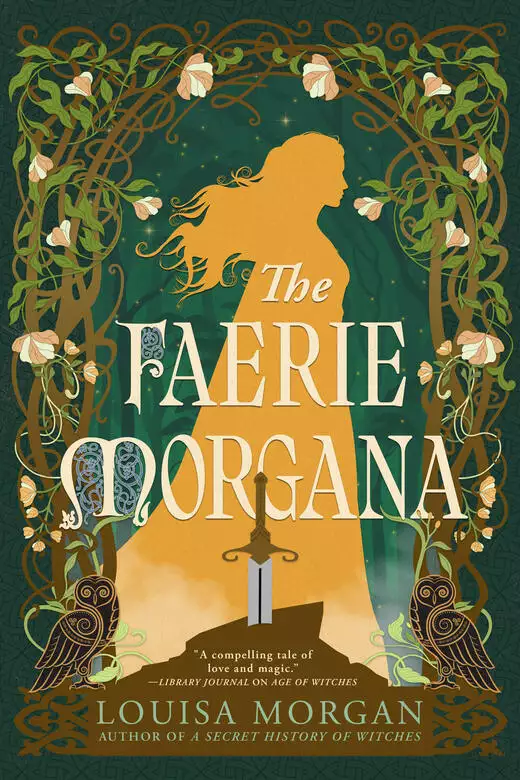
The Faerie Morgana
- eBook
- Paperback
- Book info
- Sample
- Media
- Author updates
- Lists
Synopsis
In this atmospheric and bewitching novel, Louisa Morgan reimagines the story of Morgan Le Fay, one of the most enigmatic and powerful women in Arthurian legend.
To the other priestesses of the Nine, a powerful council at the Lady’s Temple, Morgana is haughty and arrogant as she performs feats of magic no human should be capable of. Rumors start that she must be a fearsome fae.
To King Arthur, Morgana is a trusted and devoted advisor, but his court is wary of her and her prodigious talent at divination. But his wife sees Morgana as a rival and a malevolent witch.
To Braithe, Morgana’s faithful acolyte, she is simply the most powerful priestess Camelot has seen.
Morgana doesn’t know why she’s so different from everyone else, and she doesn’t much care. But when she aids Arthur to ascend the throne before his time, she sets off a series of events that will change everything Morgana believes about her power.
Release date: September 16, 2025
Publisher: Orbit
Print pages: 496
* BingeBooks earns revenue from qualifying purchases as an Amazon Associate as well as from other retail partners.
Reader buzz
 Please log in to recommend or discuss...
Author updates
The Faerie Morgana
Louisa Morgan
Morgana measured her growth by the stone. When she first crossed Ilyn to the Isle of Apples, the top of it was level with her four-year-old shoulders, and the great sword’s hilt loomed above her head, its single jewel shining like a red eye peering down at the little girl. By the time she was ten, the stone reached her breastbone, and if she stood on tiptoe, Morgana could have reached the hilt of the sword with her fingertips. She grew swiftly after that, so that when she was fourteen the stone reached no higher than her hip. She could have gripped the hilt without stretching her arm.
She did not. Proud though she was, daring and headstrong and brash, she knew the sword was not for her.
Morgana continued to grow. When she became one of the Nine, she was the tallest priestess in the Temple, though the youngest. She was even taller than the Blackbird, though she suspected that if he would stand properly, lift his shoulders and straighten the hump of his back, he would equal her in height.
But perhaps the Blackbird no longer cared about standing tall. He had lived an unnaturally long life, as long, some said, as one of the fae, who were no more in the world. The Blackbird’s existence was one of the great mysteries of the Temple, even of Lloegyr. They called him the Black Mage when he was not present. When he was, no one called him anything.
Morgana had a lifetime ahead of her still, and she always stood as tall as she was able. She was long of arm and leg and neck, and she could reach higher, run faster, see farther than anyone.
Not that her sister priestesses ever reached very high, nor did they run, nor exert themselves unduly if they could avoid it. They dispensed potions and remedies and charms to the supplicants who found their way to the Isle. They performed the rites of the Temple precisely as they had learned them. They taught the acolytes to recite the stanzas by rote, without examining their content.
It irritated Morgana to hear the acolytes’ high, sweet voices reciting the words blankly, with no sense of their meaning:
The few retreat into the shadows of time. Who will recall?
Wisdom fades in darkness,
But the one who remains will remember.
Who were the few? Who was the “one who remains”? None of the priestesses seemed to know, or care. If any had ever known, they were long gone.
As a very young acolyte, Morgana had asked what it all meant, but her teachers scowled and told her to be quiet, to sit still, to concentrate, to be obedient. She scowled back, impatient with their elderly ways, with the weakness of their remedies, the failures of their charms, the shallowness of their devotions. The other acolytes mocked her for her refusal to behave, but she couldn’t help herself. Morgana was not good at sitting still, nor at being silent when there were so many questions to be asked. Not until the Blackbird took over her instruction did she find satisfaction in her studies.
Passing through the sanctuary now, the adult Morgana lingered beside the ancient stone, tracing the patterns in the granite with one long forefinger and wondering. Wondering when the Blackbird would finally trust her with its secrets. Wondering, indeed, if the Blackbird would ever speak to her again.
Her sister priestesses bowed when they passed the stone. Morgana did not. When Preela had pressed her about it, Morgana gave her a cool glance. “It is just a rock now, Priestess. The great sword is gone.”
Preela protested. “It’s not just a rock! It’s sacred!”
“It no longer has any power,” Morgana said. “Surely you feel that.”
“That is not the point.” Preela’s tone was sour and resentful. “Morgana, a bit of humility would ease your way in the world.”
“I know, Priestess. You have said so often enough.” She laid her palm on the stone and mused, “I have learned more than you realize.”
“Well,” Preela said, wrinkled lips pursing. “Thank the Lady for that.”
“Oh, yes. Thank the Lady.” But Morgana didn’t feel thankful. She felt defeated. Sad.
She wended her way down the slope from the Temple to the herb garden that spread at the foot of the gentle hill. Scraps of snow still lay under the shrubs and in the shade of the holm oak. The wintry sun made them glimmer, jewel-like, and gave her a stab of homesickness for the keep of Camulod and its sparkling courtine. Despite the cold and the dormancy of the herbs, she could smell the muted scent of lavender, its branches gone gray with winter. The rosemary was still strong, and she took a sprig in her hand to sniff. The thyme, thriving whatever the weather, smelled muddy. It needed the snow cleared around it, and its earth tilled to allow it to breathe.
She wouldn’t mention it, though. She would let Niamh, the elder priestess, with her sun-spotted face and fingers perpetually stained with earth, instruct the acolytes on the proper care of the herb garden. The acolytes tended to be nervous and tongue-tied around Morgana. They would forget anything she said to them.
She was standing beneath the holm oak, gazing up into the snow-iced cloud of mistletoe clinging to its branches, when she heard his voice. She blinked, doubting herself, then turned to see that it was indeed the Blackbird.
She had not seen him since the coronation, but he had changed very little. Perhaps he was a bit more stooped, and leaned more heavily on his staff. Certainly the rim of his battered black hat drooped lower over his face, and the hem of his brown robe trailed on the ground behind him as he hobbled down the slope to meet her. His long beard was more white than gray now, but his eyes, peering up at her from beneath wrinkled lids, were as bright with life as ever.
He spoke as if they had parted only that morning, instead of years before. He pointed a knotty finger up at the mistletoe and said in his creaking voice, “Most powerful herb in the garden.”
“You have no need to remind me of the powers of mistletoe, sir.” Morgana’s own voice was deep and carrying, like the ringing of an iron bell. “I learned them from you when I was barely ten years old. I remember the day very well.”
“Do you indeed?” He leaned on his staff as he fixed his gaze on her. His beard had grown so long it caught in the belt around his waist and tangled around the sigil of the Lady dangling from his neck.
“I do. Do you?” Morgana responded.
He blinked owlishly, as if the slanting afternoon light dazzled his eyes. “I remember the lecture. Not the day.”
“It rained.”
“That’s what you remember?”
“I think you know, dear sir, that I remember it all.”
“Tell me, then.” He didn’t smile, but his beard twitched, rather like the tail of a cat stalking a bird. She understood him, perhaps better than anyone still living, and she knew he enjoyed this sort of exchange.
She said, “The waning moon hung in the sky after the rain cleared.”
His beard twitched again. “Did it?”
“Yes. The full moon was a week past. The ripples in the lake had subsided, and the mist lay on smooth water. You and I left the shelter of the sanctuary and walked here, in the garden. You mentioned the power of thyme to ease congestion, and rosemary to reduce inflammation. You spoke of the soothing effects of eucalyptus on the chest, and how difficult it is to grow. And you told me that mistletoe must be measured carefully, because it is dangerous if overused.”
“Your recall is impressive, Morgana.”
“My recall is perfect, sir.” He snorted at that, but he didn’t argue. Morgana never forgot anything. Could not forget anything, even if she would have preferred a memory to fade. She would like to forget how cruel Preela had been to her when she first arrived at the Isle as a small, homesick girl. She would be content not to remember how Iffa had mocked her for crying into her pillow at night. It would be better for them all if she no longer recalled the slaps and pinches and braid-pulling of the older acolytes, all things that had hardened her heart against them, taught her to gloat when she bested them in their studies. They soon learned that her remedies were swifter than theirs, her potions stronger. She surpassed them all in scrying and in her deep sight, but her gifts made her no friends. She was the perpetual outsider. She had no confidant, no one to listen to her troubles, no one to laugh with or whisper with or even just to walk with. Her work was her only comfort. She had grown stronger than any of them, but still, though they could no longer abuse her, every blow, every insult lived on in her mind.
Sometimes her memory was part of her gift. At other times it was part of her curse. And at this moment, when the Blackbird was about to speak to her at last about what had happened at Camulod, she wished she did not already recall the event with agonizing clarity.
On the day Morgana turned four, her mother sent her away. The day was dark and wet, the most miserable day of a miserable season. Storm clouds hulked above the keep of Camulod, as they had done for weeks. Wind drove the rain slantwise and soaked the scarlet banners that hung, sodden and limp, above the courtine. Little Morgana clutched at her mother’s hand until the brown-robed man with the long gray beard and stooped shoulders tugged it free.
Ygraine stood preternaturally still, a slender statue, beautiful even with her yellow hair dripping rain and her blue gown bedraggled by it. She watched without a word, without a tear, without even a wave as the old man pulled her child away. There was no kiss, no embrace. Morgana looked back as she stumbled behind the brown-robed man but saw no hint of regret or sorrow in her mother’s stance, or any more emotion than a statue might have had. When the baby, Morgana’s new half brother, began to wail from inside the tower, Ygraine turned. Neck stiff and back rigid, she disappeared inside before her little daughter was out of sight.
“Never mind,” the old man said, in a voice that cracked with age. Morgana had not yet learned his name. “You will soon forget.”
The child Morgana had no idea if that was true. She barely grasped that she was leaving her home for good, that she had to go with the graybeard whether she wanted to or not. Numb with confusion, she let him pull her along the path through the woods toward the lake.
She twisted her neck to steal one more glance at the castle where she had lived all her short life. Rain-washed and massive, Camulod perched on an enormous promontory of rock, like a great ship cresting a huge wave. The castle’s towers and gates, the courtine that shielded the keep, all seemed to grow organically from the gray stone, as if they had always been there. As if they would be there forever.
Morgana understood, even at her tender age, that Ygraine had chosen her infant son over her daughter. Ygraine had sacrificed her first child to placate the domineering man she had married after Morgana’s father died.
“I need a husband,” Ygraine had said to her sister Ylaine. “I cannot hold this kingdom without a man by my side.”
Morgana had been huddled behind a wardrobe, listening, every word recorded forever in her prodigious memory. She heard Ylaine answer, “You will have your pick of men, Ygraine, but take care how you choose. Their lust for the crown makes liars of them all.”
Ygraine had not heeded her sister’s advice. Widowhood had confounded and confused her, and she had accepted the suit of Uther Dragoun in haste. Uther had been gentle in his wooing and ardent in his lovemaking, but once he and Ygraine were wed, everyone at Camulod learned how harsh a man he was. He was cruel to servants and children and jealous of his wife. He wanted nothing around to remind him that he was not Ygraine’s first husband, that he had not earned his crown but obtained it only through his marriage. It was at his command, not to be disobeyed on pain of a blow from one of his hard fists, that Morgana be sent away. Eventually, she would know that Uther could have simply had her killed, had he so wished. She would not have been the first to suffer such a fate.
But at four, bewildered and bereft, she didn’t know this. Her throat ached as she watched her mother disappear inside the tower, letting the heavy door close behind her. Morgana lagged behind the brown-robed man, making him tighten his grip on her hand. Once, she tripped on a tree root and fell to her knees. She would have fallen headlong except for the support of the graybeard. As he pulled her to her feet, she looked up into his face for the first time, hidden until now by the drooping brim of his black hat. It was not an unkind face, but it was remote, as if he had withdrawn from the world, as if he could no longer be touched by what other people felt.
He urged her on through the rain, and she had to force her short legs to move faster to keep up with him. They wound through the trees and down the slippery bank of the lake to where a simple rowboat waited at the dock, its bowline tied to an ancient wooden bollard. Raindrops peppered the surface of the water as Morgana stepped down into the boat, and the graybeard seated her on a plain wooden bench. He draped a hooded cloak over her before he shipped the oars and began to row.
She twisted on the bench to try to see where they were going, but the rain was a curtain, parting only when the prow of the boat pushed through it. Her vision blurred with tears, and she swiped at her eyes with her little fingers. When she dropped her hands, she gazed blindly into the shimmering curtain of mist that lay ahead, beyond the rain, and without knowing what she was about to do, she scried for the very first time.
There would be thousands of other such events in her life, but she was yet to learn what they meant.
She perceived an image of another place, another time, a scene she could not have imagined. It seemed to be painted upon the gray mist. Her mouth fell open as she stared, and wayward raindrops moistened her tongue. She pressed her palms to her temples, struggling to understand what she saw.
Ygraine lay motionless on a bier. Her blue skirts fell over the sides to sweep the ground, and her yellow hair spilled across the funeral pillow. Six men carried the bier away from the castle and toward the woods, where the flames of a funeral pyre already towered in the dusky sky. The child Morgana had seen funeral pyres from her window in the castle, and she understood that in this scene, this image that had sprung into being against the silvery mist, Ygraine no longer lived, and the bier that carried her was destined for the fire.
Mercifully, Morgana did not comprehend that this was a true vision, a spontaneous one, born from her nascent gift of deep sight. Nevertheless, she remembered it always, as she remembered everything, absolutely and in detail. When she recalled it in later times, she tasted the rain in her mouth once again, and felt its cold drops sliding down her neck. She heard the rattle of the oars in their locks and the splash of the blades in the lake water. She smelled the tang of the hood draped over her head, a scent left by whoever had worn it last, and she heard the rasp of the graybeard’s breath as he rowed.
With rain streaking her cheeks and spilling over her chilled hands, little Morgana felt a tearing in her breast, a sensation she had never before experienced. It was the shock of the vision, the disbelief at being rejected by her mother, the soul-deep sorrow of being torn from her home, her bedchamber, her nurse. No one had told her where she was going, or what she would do there, or if anyone would care for her. No one had promised she would soon return to the home of her heart. It would have been a lie, but it might have comforted her.
It would be many years before she returned to Camulod. She never saw her mother again.
Braithe had known, since very soon after she came to the Lady’s Temple as a child, that she would never be one of the Nine. She had no deep sight, not then, and not now when she was twelve, an age by which her teachers said any who possessed the gift would have shown evidence. She was clumsy with potions. She was an attentive student, an obedient child, and a pretty girl, but her tinctures were weak, her salves runny, and her potions cloudy. She had an excellent memory for the stanzas she and the acolytes had to learn, but except for that, she had no special gifts.
Except loyalty. Loyalty Braithe possessed in abundance.
When eight-year-old Braithe had disembarked from the rowboat that brought her across Ilyn, through the curtain of mist to the dock below the Temple garden, she hardly looked back at the older brother who had delivered her to the Isle. He called a farewell that she barely heard. She was staring, open-mouthed, at the wonderland that was the Isle of Apples.
Everything about it seemed magical to Braithe. The trees surrounding the Temple were tall and dark, beribboned with sheets of moss in a green so dark it was nearly black. The sky above seemed bluer than it had above her home, and the fascinating scents of unfamiliar herbs, plants that didn’t grow on her mother’s croft, tickled her nose. Flowers of every description bloomed in sunny patches where the shade didn’t reach. Butterflies abounded, and the birds seemed to sing enchanted songs. Rabbits peeked from beneath the undergrowth, pink noses twitching at the little girl gazing back at them. Squirrels danced along tree branches and fled up the trunks, their fluffy tails aloft.
Braithe trudged up the hill, past a stone bench, on through beautifully tended garden beds, until she could see the Temple. It was huge. Its doors stood open to the summer air, so Braithe could see the thick pillars that held up the roof, and the floor of flagstones set into packed earth. A large stone rested in the center of the space, and beyond it stood a semicircle of tall chairs with elaborately carved backs and wide armrests. Braithe counted them on her fingers. Nine. They were empty at the moment, but she knew what they were for. All the common folk knew about the nine priestesses of the Lady’s Temple.
As she tiptoed closer, barely breathing for awe, she saw that what she had taken for pillars were standing stones, like the ones in the field near her mother’s cottage. She couldn’t imagine how these great thick fingers of rock had come to be on the Isle. They had to be heavier than any ten men could lift. And what boat could bear their weight?
All of it spoke of magic and mystery, and Braithe thrilled to it. Surely the Isle of Apples was every bit as wondrous as the White City of the fae was said to be!
What struck her most, not only in the Temple but in the buildings attached to it, was the abundance of space. She had just left a cottage where far too many people lived in one cramped house, where she felt she could hardly breathe, and this—this grand building—was so spacious that her entire family, mother and siblings, their cow, and all their sheep could have fitted inside and had room left over.
A woman in a black robe appeared at the crest of the little hill and beckoned to her. Braithe transferred her rapt gaze to the gray-haired, beak-nosed woman, not knowing how to behave with her. Was this one of them? One of the priestesses? The sense of magic intensified so that she barely remembered to close her mouth as she approached her. The magical feeling dissipated the moment the woman spoke. In a voice as shrill as the caw of a crow, she snapped, “Name?”
Braithe, seized by a sudden spasm of nerves, stammered, “B-B-Braithe?” as if her name were in doubt.
“Do you have a purse?”
Braithe blinked. “A—a purse?”
She had never had a purse. She didn’t think anyone in her family had ever had one. What would they put in it? She had never, in all her eight years, held a coin in her hand, or bought something from a vendor. They were cottars, her mother, her siblings. They only ate food they grew or caught. They labored every day in the fields, and their reward was a place to sleep. She wore clothes that had been worn by older sisters, and would be worn again by younger ones.
A purse? No.
The beak-nosed woman snorted. “Another one begging the Temple’s generosity!”
Braithe said nothing. She had no idea what the woman meant. She had been sent by her mother because there were too many hungry mouths at home, and the local headman had advised giving Braithe to the Temple as tribute.
The gray-haired woman seized Braithe’s hand and pulled her away from the view of the Temple and toward a low, windowless building that sprawled to their left. Braithe trotted alongside the woman, her cheeks burning with embarrassment as other girls, mostly older, certainly taller, stopped what they were doing to stare at her.
They went into a long room where dozens of pallets stood in rows. The woman took Braithe’s bag and tossed it onto one of the pallets. “That’s yours,” she said. “One of the acolytes will bring you a robe.” She paused, hands on her hips, wrinkled lips pursed. She peered down her impressive nose at Braithe, who gazed back, her eyes stretched wide with confusion. The woman snorted again as she turned away. “Let us hope you’re brighter than you look.”
Braithe had no idea if she was bright, and it had never occurred to her that she might or might not look as if she were. She had spent the scant years of her life until that moment worrying about whether she and her siblings would have enough to eat, or clothes warm enough to fend off the fierce bite of winter.
She soon learned that at least she would have plenty to eat on the Isle of Apples. She also learned that the woman who had brought her to the dormitory was Priestess Iffa, and she picked on all the acolytes. It was not just Braithe who Iffa thought had no promise, but most of them. There was only one acolyte who stood out, who exhibited special gifts, and Priestess Iffa resented her with as much energy as she despised the others.
Braithe, once she accepted that she herself had no magic, attached herself to that one.
Everyone believed Morgana was destined to be one of the Nine. She was four years older than Braithe. Tall and lean, with straight black hair that gleamed blue in the sun, she had knowing eyes that were as much gold as brown. They slanted slightly upward at the corners, like those of a cat.
Braithe admired her from a distance, as most of the younger girls did. Morgana seemed to be always solitary, walking alone, working alone. Everyone assumed she preferred it that way. Morgana was so far above them all, so remote and mysterious, that Braithe was startled to find her at her shoulder one morning in the workroom.
Braithe had been staring helplessly at the goldenseal and mint she was trying to crush with a small mortar and pestle. It lay in a crumbly mass in the bottom of the mortar, and no matter how she tried to wield the pestle with her short fingers, the leaves and stems would not give way.
Feeling the presence of someone behind her, she dropped her head to hide the tears building in her throat. It would surely be Priestess Iffa, always quick with a scathing remark, or it could be one of the instructors, less sharp-tongued but still critical. Braithe didn’t think she could bear another dressing-down in front of all the acolytes laboring at the worktables. They would add the moment to the many things they teased her about: her country accent, her freckles, her unruly curls, which she could never pull a comb through.
When she heard Morgana’s deep voice, Braithe startled and dropped her pestle with a bump. “Come now, little one,” Morgana murmured. She reached past Braithe with her long arm, picked up the pestle, and nestled it back into her fingers. “Let me help you.”
Braithe hardly breathed as she felt Morgana’s long fingers wrap around her own, guiding the movement of the pestle in a circular motion, pressing and grinding, stirring, then pressing again. As if by magic—or perhaps, as it was Morgana, it was truly magic—the stubborn herbs dissolved into the paste they were meant to become.
Braithe’s tears never fell. She let Morgana’s hand guide her, and when it was lifted, she gazed in wonder at the perfect paste in the bottom of the bowl. Shyly, she lifted her face to the older girl. “Thank you,” she whispered. “I don’t know why it’s so hard.”
“It is just new to you,” Morgana said. She didn’t smile—Braithe had not seen her smile—but her cat’s eyes glowed with warmth. “Next time will be easier.”
Morgana was right. The work did get easier, but Morgana herself had everything to do with that. Braithe felt the envious eyes of the other young acolytes on her as Morgana showed her how warm a syrup should be, how much wine a tincture needed, how lumps and crumbs could be smoothed out of a remedy. Braithe wasn’t sure why Morgana had singled her out, but it was the greatest gift she could have given her. Braithe’s confidence grew, and her courage swelled. She began to take the teasing of her comrades in stride, dimpling, laughing without embarrassment.
She began to make friends, even to feel affection for some of the other acolytes, but those feelings were nothing compared to what she felt for Morgana. She was deeply, passionately devoted to the older acolyte, and when one of the other girls tried to tease her about that, she did not laugh.
When Morgana put her special touch on a potion, its power intensified instantly. Her salves were the smoothest and strongest. Her tinctures were clear as water but always effective.
Braithe often watched her settle a cork onto a jar without touching it. A spoon Morgana wanted flew up into her fingers before she reached for it. Braithe gasped when she saw a candle wick burst into flame, tweaked between two of Morgana’s long fingers.
To Braithe, there was no one, not even any of the Nine, who could compare to Morgana of the Isle. Morgana was all magic, and Braithe would not be mocked for admiring her.
Four years after Braithe arrived at the Isle, the boy from Camulod was admitted into the Temple sanctuary, the first male to do so in Braithe’s memory. Someone said King Uther had once tried to get in but had been turned away. She didn’t know if that was true. There were always tales spinning through the dormitory, and most of them were just rumors.
On this day, though, the boy—the prince—was welcomed with ceremony by the priestesses themselves. The acolytes, eyes bright with excitement, were allowed to join the Nine to observe. On their knees, they clung together, whispering, watching everything, thrilled at this deviation from their daily routine.
Braithe knelt beside Morgana, so close to the stone she could have touched it, had she possessed the courage. The nine priestesses in their black robes sat in their ceremonial bogwood chairs, long sleeves draping over the armrests to skim the flagstones of the floor. Above their cowled heads, the chair backs rose in intricately sculpted shapes, leaves and grasses and boughs, all symbols of the Lady. Ordinary knives couldn’t carve iron-hard bogwood. The chairs had been shaped long, long ago, and everyone understood there was magic in the work, the kind that could only have come from the fae.
The Blackbird led the boy into the Temple, and to Braithe’s surprise, the Blackbird nodded to Morgana as he drew near the stone. As she rose, she laid the flat of her hand on Braithe’s shoulder to indicate she should remain where she was.
Morgana stood a full head taller than the boy. He was younger, perhaps Braithe’s age. Morgana wore undyed robes, without any discernible style, but elegant on her long body. The prince wore a fine tunic of blue, the color of royalty, and sleek lambskin leggings. His hair was as yellow as the tansy that grew on the riverbank, his smooth cheeks pink with youth.
He was the most beautiful boy Braithe had ever seen.
The lad turned to stare at Morgana as if he was unsure who she was. His eyes slid to the Blackbird’s wrinkled face, then back again to Morgana, and he caught his lower lip between his teeth as if to stop himself from asking. No one spoke. The Temple fell silent, so quiet Braithe could hear the lake water lapping the shore, even the creaking of the rowboat that had brought the boy to the Isle and which bobbed now on the limpid waves washing the dock.
The Blackbird gestured to Morgana with his gray-bearded chin. She took up a position near the stone, opposite the niche from which the sword protruded, while the Blackbird stood to one side. The boy, whose name had not been spoken, took two tentative steps that led him to the sword. He stood gazing at it, still chewing so fiercely on his lip Braithe feared his mouth would bleed.
The Blackbird said quietly, “Now, my lord.”
The lad’s eyes, blue as lake water, bright as a spring sky, flashed up at him, then back to the sword. The hilt was barely within his reach, the pommel broad and heavy. He stood on his tiptoes to take hold of the grip, wrapping his fingers awkwardly around it. The blade was all but invisible, thrust deep inside the carved niche of
We hope you are enjoying the book so far. To continue reading...
