
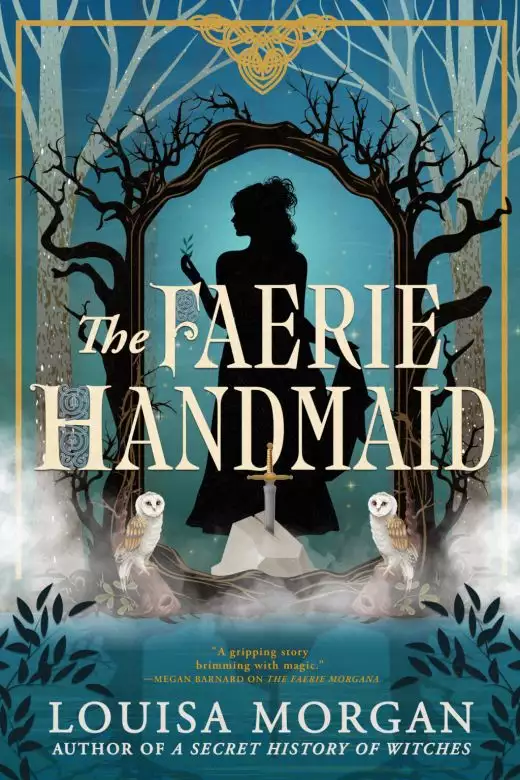
The Faerie Handmaid
- eBook
- Paperback
- Audiobook
- Book info
- Sample
- Media
- Author updates
- Lists
Synopsis
When Braithe was left as an acolyte on the Isle of Apples, she never dreamed she'd become handmaid to Morgana, the most powerful priestess in all of Camelud, but now she is content to live out her days in service to the Priestess. But when a powerful mage comes to Morgana and Braithe with concerns that the new king of Camelud is being cursed by powerful magic, the two must journey to the White City deep in fae country to investigate.
The magical city is nothing like Braithe imagined and the fae are cold and callous toward humans and quick to bewitch. Despite the constant threat of danger, Braithe just may be the key to discovering who is cursing the king, but to do so she will have to step into her own power.
Release date: September 15, 2026
Publisher: Orbit
Print pages: 416
* BingeBooks earns revenue from qualifying purchases as an Amazon Associate as well as from other retail partners.
Reader buzz
 Please log in to recommend or discuss...
Author updates
The Faerie Handmaid
Louisa Morgan
There had been a long line of supplicants in the Temple anteroom that day. The boats that had carried them here to the Isle had just departed to ferry them back across the lake. As always, Braithe’s heart still resonated with their needs and griefs. It was her nature to feel the emotions of others, particularly in their moments of stress. As she grew older and worked longer at Morgana’s side, that empathy had grown deeper, her intuition sharper, and both occasionally left pain in their wake.
The requests of the petitioners today had not been unusual, but Braithe still needed time to let the sensations they engendered in her breast subside.
The worst had been a woman whose son had been wounded by a Roman spear. After weeks, the wound had grown worse rather than better. She was the simplest of country women, and she had to describe it for them as best she could, since men were not allowed in the Temple. Braithe felt her mix of revulsion and fear and heartbreak, and knew the wound must be in terrible shape. She also knew Morgana would recommend a paste of yarrow and honey. When Morgana asked for it, Braithe had the jar ready in her hand, winning one of the priestess’s rare smiles.
The best of the day had been a young woman, very plain and thin, who begged for a love philter, saying she was caring for her younger sisters after their parents had died, but she needed a husband’s help on the farm. When asked if she had a man in mind, she admitted she did, but that he was so shy he could not bring himself to propose to her. Without parents to arrange the match, she had all but given up. It had been a joy to watch Morgana magick a little jar of potion for her, and to see the relief and hope on the girl’s face. Braithe gave her instructions with a light heart, confident Morgana’s magic would solve the problem.
There had been others, though fortunately not so dramatic: a salve for a persistent rash, a syrup for an infant’s cough. The one that took the most time and kept other petitioners waiting on the uncomfortable benches of the anteroom was a potion for a woman desperate to conceive lest her husband put her aside. It would be effective, Braithe had no doubt, but the creation of it left Morgana weary, with supplicants still waiting, and Braithe felt the priestess’s weariness added to her own.
Now, at the closing of this long day, Braithe felt oddly restless, despite her fatigue. Something had been nagging at her for hours, and it had drawn her here, to the shore of the lake.
The gentle push and pull of Ilyn’s waves usually soothed her. She always savored the faint smell of fish and the chatter of night birds waking to the long summer twilight. On this evening, though, calm eluded her. She felt an insistent tug just beneath her breastbone, and it wouldn’t let her rest. She paced the short beach, peering out into the mist, then up at the cool stars flickering to life. A dove cooed, then another. A nightjar gave its chuckling cry, and from the woods beyond the garden, a fox barked. Braithe hugged herself, wondering what was wrong.
It had been four years since the death of King Arthur and the beginning of the reign of the boy king, Mordred. Sometimes, to Braithe, it seemed like yesterday that she and Priestess Morgana had borne Arthur’s body to fae country for safekeeping. Other times, she felt as if it had all taken place in the distant past, in another life, when she had been a different person. Younger. More tender. Softer.
She was no longer so soft. She had seen too much, and it had toughened her in the way a lighthearted lamb grows into a wary ewe.
She didn’t know if she would need to be tough in this moment. She stood at the water’s edge, her sandaled toes lapped by Ilyn’s gentle tongue as she gazed out over the lake. The answer was there, somewhere past the mist’s glowing folds. Something was coming. Someone was coming, she suddenly realized, and in that moment, the tug beneath her breastbone became a fist of alarm.
By the time the boat appeared out of the fog, its prow carving smoothly through the darkening water, Braithe was not surprised. With her deepening intuition, she had sensed his presence before she saw him. But why this wave of anxiety? She had no reason to fear the old mage.
She hurried along the beach to the dock, and as soon as the boatman climbed out to tie up to the ancient bollard, Braithe reached down to give the Blackbird her hand. “Sir. It has been far too long since you’ve come to us.”
He peered at her from beneath his hat, which was so battered she marveled that its threads still held together. “Braithe,” he croaked. “Well met.”
As she helped him step up onto the dock, she saw there was a third person in the boat. The Blackbird pointed to him. “This is Idhri, boatman’s apprentice,” he said. “Idhri, Braithe of the Lady’s Temple.”
Braithe lifted her hand to the newcomer. “Welcome to the Isle.”
Idhri was lanky, with the thinness of adolescence. He had black hair that he wore in a thick braid falling over one shoulder. He raised a hand in greeting but ducked his head without speaking.
Braithe felt his discomfort. Whether it was simple shyness or awe at being on the shore of the Isle of Apples, she couldn’t guess. He wore a tunic far too big for him and leggings that were too short. He moved with a slight clumsiness, as if he had not yet grown into his body. He reminded her of a foal she had seen once in the keep at Camulod, its thin legs too long for its torso, its eyes wide with wonder at the world. She had wanted to stroke it, but it had shied away from her hand and hidden behind its big-bellied mother.
Braithe offered the Blackbird her arm to lean on as they made a slow progress along the dock and onto the beach. No one on the Isle knew just how old the mage was. Braithe suspected he didn’t, either. She was glad of her own strength and sure steps as she supported him up the slope and through the garden. The boatman trailed after them, with young Idhri just behind, his arms full of traveling bags.
All of them matched their steps to the Blackbird’s as they skirted the sanctuary of the Temple, where the massive pillars and flagstone floor were shadowed by the gathering dusk. They passed on to the low-roofed building that was the residence of the Nine Priestesses. A chamber was always kept ready there for the Blackbird.
They were almost at the residence door when Priestess Morgana appeared. Starlight gleamed on her thick silver braid, and though her face was drawn with fatigue after the long day, her golden eyes shone with pleasure at seeing her mentor once again.
She came forward, her arm outstretched, and the Blackbird reached up to take her long-fingered hand with his own spotted one. Braithe released him into Morgana’s care and stood back to watch them greet each other. They didn’t embrace, but they looked into each other’s eyes in the direct way made possible only by long association.
Braithe and Morgana could gaze at each other the same way. Their association was not nearly as long, but they had fought a great battle together to protect Lloegyr and the Temple, and an unbreakable bond had formed between them. Braithe knew Morgana’s secrets. Morgana knew hers. They were hardly equals, Morgana a priestess of the Temple, and Braithe merely a country girl from a northern croft, but Braithe felt neither resentment nor envy. Watching Priestess Morgana assist the Blackbird up the step and into the residence, she felt only pride. Morgana, tall and lean and prodigiously gifted, was the most worthy of mistresses. Braithe was pleased and proud to be her handmaid.
When the door of the residence closed behind Morgana and the Blackbird, Braithe looked back to ensure the boatman and his apprentice were being taken care of. Dafne, always prepared, was leading them to the quarters beyond the dormitory that were reserved for the occasional boatman who stayed the night on the Isle. Such men were forbidden to interact with the acolytes or to enter the Temple, of course. Braithe trusted Dafne to recite the rules to them, and she called her thanks.
Dafne smiled, something Braithe had not yet gotten used to. It was a restrained one, still needing practice, but it was a smile nonetheless. “Happy to help,” Dafne responded. Braithe was not accustomed to hearing Dafne’s voice, either, which had been silenced for so long. It was low, and a little rough from lack of practice, but it was good to hear her use it.
Braithe started toward the back of the residence, where she had her own small chamber near Morgana’s. She would go along to the kitchen for a solitary supper. She could chat with the Blackbird later. It would be a pleasant way to pass the evening, and perhaps it would ease the disquiet she had been suffering all day.
“I dare to hope,” Morgana said, “that your visit is a social one.” She poured a bit more ale into the Blackbird’s cup and pushed it closer to his hand. He was having his delayed evening meal, soup and bread and a few greens.
The Blackbird tilted his head and gazed at her from beneath his thick gray eyebrows. He had aged greatly in the past four years, Morgana thought. Truthfully, it hadn’t seemed he could age much more and still fulfill his commitment to the boy king, but apparently he was managing. In any case, despite his years, his black eyes glowed with hard-won wisdom. He said, “Not like you to practice self-deception, Priestess. I believe you are aware I do not make social calls.”
She sighed. It had been an exceedingly long day in the anteroom. It was rare, these days, that supplicants were content to see another priestess. It was always the fabled Morgana they wanted, and that meant her workload never eased. She leaned back in her chair and forced herself to relax her hands in her lap and to bestow a fond gaze upon her mentor. “Yes, sir. I am aware. Things can change, though, can they not?”
He combed crumbs from his long beard with his fingers. His beard had gone white and was in dire need of trimming. “Things can indeed change,” he said. “That has not.”
“Do you require more soup? Perhaps some cheese?”
“No, I thank you.”
“Very well. Perhaps you can enlighten me, then. Not that I am not always glad to see you.”
He shook the last crumb from his beard. “I have come to ask for your help.”
“I could have guessed.”
“You probably did.”
She made a gesture with one hand, and he nodded. “My worry is for King Mordred.”
“Are things not well with him? The supplicants tell us he is liked well enough.” Most of what the inhabitants of the Temple knew about events beyond the Isle of Apples came by word of mouth from the petitioners.
The mage said, “He’s a kind lad, Priestess. People like that.”
“But kindness does not keep the Romans from our borders.” It was not a question. In the anteroom she heard many tales of Roman attacks and the Saxon raids that took advantage of weakened outlying farms or hamlets. All too often the festering wounds in need of her intervention had come at the point of a Saxon sword.
“No. It does not.” The Blackbird picked up his cup and drank deeply, sighing with enjoyment. “The Isle always has the best ale in Lloegyr.”
“That’s the acolytes’ doing. They practice their skills when brewing it.”
“I send them my thanks.” He set down the cup with a trembling hand, and a thrill of fear awoke in Morgana’s belly even before he said, “There is something wrong with King Mordred.”
“Is he ill?”
“No. It’s not physical, nor even in his mind, as far as I can tell. It seems—external.”
“External?”
“Yes. Whatever is wrong is outside him, beyond his control. Things he orders go awry. Requests he makes do not materialize. Sir Lancelin does his best in training the knights and their lackeys, and so do the horsemaster and the swordmasters, but somehow there is always a problem. A flaw, as if the order of things is confounded. It’s as if everyone is walking in a fog. They are confused. They forget. They make bad decisions.”
“And responsibility is laid at the king’s door?”
“Responsibility is always laid at the leader’s door, king or queen, child or adult.” He blew out a long breath that made his drooping mustache ripple. “When Sir Lancelin leads on his own—a war party, for example, answering one of the Roman incursions—things go better. He’s a fine leader, and the men respect him. But when the king is involved, as he must inevitably be, success is elusive.”
“Do you wish me to come to Camulod?” Morgana held herself very still as she waited for the answer. She did not want to go there, not with Lancelin present. They had said their goodbyes, and it was better for them both to leave things as they were. Still, the old warmth rose in her breast. She had worked hard to convince herself those feelings were in the past, faded and forgotten. She set her teeth to breathe the sensation away and tried not to think of how good it would feel to see him again.
Naturally, if the king had need of her in some way, she could not refuse. In honor of her half brother Arthur, if for no other reason, she would always serve the cause of the kingdom of Lloegyr. She would simply have to deal with the temptation of Sir Lancelin as she had once before. She had the unsettling feeling it would not be easier a second time.
The Blackbird’s canny gaze fixed on her, and she knew he understood. She had not broken her Temple vows, but meeting Sir Lancelin of Camulod had taught her how easy it would be to err in such a way.
“No,” he said gently. “I am not asking that of you. I have only come to beg you to help me discover what’s wrong.”
“You scried, I presume?”
He blew another long sigh that rattled alarmingly in his chest. “I have scried over and over again, and come up with nothing. I fear I don’t have the power anymore.”
“Perhaps if we work together?”
“That is my hope. That is what I came to request.”
She leaned forward to lay her hand on his arm. “This request will be an honor to fulfill.”
A light rap sounded on the door to the bedchamber. Morgana called, “Come in, Braithe,” making the Blackbird chuckle.
“You at least are at the height of your power,” he said. She had no need to answer, as Braithe came in with a plate of sliced early apples in her hands.
“Sir, it’s so good to have you here on the Isle,” Braithe said. “These apples are from our own orchard, the first of the year. Do try one.”
“My appetite is unpredictable these days, Braithe, but I will taste one to please you. It’s good to be here with you both, but the circumstance is not a happy one. I fear our war is not yet won.”
Idhri and his master had eaten their supper in the quarters reserved for boatmen. It wasn’t much of a room, with just a small table, two chairs, and four cots with pillows and blankets folded and ready, but it was every bit as comfortable as their cottage outside the walls of Camulod. The servingwoman, called Dafne, had told them the rules of their visit, but Idhri barely listened. His master’s rules were the ones he needed to observe. Master Hugh had told him they were bringing the Black Mage to the Isle of Apples, that they were not allowed to go into the Temple, being men, nor into the dormitory, where the acolytes lived. That they were not allowed to go anywhere, in fact, except to their quarters.
Idhri would have liked to wander around the grounds of the Temple, go down to the lake, perhaps explore the orchard and the woods, but he would never defy Master Hugh’s orders. After they finished their meal, they went together out to the privy set aside for them, where there would be no chance of encountering one of the acolytes. Idhri heard the girls’ voices chattering and laughing from the dormitory, and he quenched the wave of envy that threatened to swamp him. He had no need to envy anyone their friendships, after all. He had Master Hugh and his wife Emma. Hugh was strict, as a master should be. Emma, soft-spoken and indulgent, was kindness itself. Idhri knew he was fortunate in his apprenticeship.
As they walked back to their chamber, they caught sight of the tall priestess and the young woman who was apparently her attendant. Idhri was rather frightened of the priestess, with her silver hair and her yellow eyes that tipped up at the corners, like a cat’s. Her voice was deep for a woman, and she carried herself with the authority of a noblewoman, though she wore a simple black robe.
The young woman walking beside her was a different matter. She was petite and plump, with a long tangle of curling fair hair and deep dimples in her cheeks. He could see the dimples even when she wasn’t smiling. Her robe was plain and brown, tied at the waist with a sort of rope. When she had greeted him, he had been afraid to answer her. His voice embarrassed him of late, breaking from high to low and back again. He hoped she understood. She seemed like the sort who would.
If he could have a sister of his own, he would choose one just like that woman, with her bright blue eyes, the exact color of the summer sky. He thought her name was beautiful, too. Braithe. It made him think of sweet breezes and spring flowers. It was a laughing sort of name, perfect for a sister.
It was possible he did have a sister, but if so, he had no memory of her. Indeed, he had no memory of anything before the day Master Hugh found him wounded and bleeding, wandering in the woods that surrounded Camulod. It had been a kindness for the master to take him on as apprentice and for Emma to treat him as if he were the son she had never borne. Idhri tried hard to be grateful to both of them and not to admit to himself that rowing to and fro over Ilyn sometimes bored him.
He often lay in bed at night striving to remember who he was, why he had been wounded, or how he had ended up in those woods. He tried to cast his mind back two years, past the spring afternoon when Master Hugh had found him. He tried to remember even the morning of that day, but it was as if his searching thoughts encountered an immovable black curtain, and he could neither see through it nor pull it aside. It completely blocked his seeking mind. Behind that curtain, he supposed, were the details of his life before this, hidden away from him. It had to be some fault in his brain, but neither Master Hugh nor gentle Emma ever pressed him about it. Hugh thought work was the answer to every problem. Emma invariably prescribed tea and biscuits, which Idhri much preferred.
He hoped Braithe didn’t know his shame. He only had a name because Emma had given him the one she had hoped to bestow on a child of her own. He only had a home because Hugh and Emma were good-hearted, generous people. He had nothing of his own, neither home nor family nor history.
He was, literally, no one.
The Blackbird declared he meant to begin their work that night. Braithe exchanged an anxious glance with Morgana, knowing how weary she was, but the Blackbird had made it clear he considered the matter to be urgent. Morgana said, “Very well, sir. At least the anteroom will be empty at this time. We can go now.”
Braithe walked a little ahead of them as they left the residence to go to the Temple. The starlit evening was warm. The three of them walked through the sanctuary, past the menhirs that held up the roof, circling the great stone where the sword of power rested once again, then on into the anteroom.
The starlight didn’t reach into the windowless space. Morgana tweaked a candlewick between her fingers, and it sprang to life, driving back the thick shadows. Braithe had always thought the Temple should improve the anteroom. Its benches were hard and its walls hung with sheets of drying moss that made the room dark and strange. The moss was full of various insects that flitted near the ceiling. Morgana liked that, as she loved all nature’s creatures, but the moss made Braithe feel itchy. The anteroom was intended to be a daunting place, which she supposed it was. It was where the unworthy came to beg magic from their betters, and where the heavier their purses, the stronger the magic would be.
It was all illusion, though, as she had come to understand. The reality, at least if Priestess Morgana sat on the dais, was that every supplicant was treated the same. Their tribute, large or small or nonexistent, meant nothing to Morgana, and it was one of a thousand reasons for Braithe’s devotion to her. When a country woman approached the dais to beg for help, eyes wide with fear of the mysterious magic swirling around her, trembling hands holding whatever she could afford for tribute, Braithe thought of her mother.
Her mam had struggled to raise a too-large brood on a too-small croft, which was why Braithe had been sent to the Temple. Braithe’s sisters, country women all, probably had babes of their own by now. It comforted her to know that if they needed help and could find their way to the Temple, Priestess Morgana would provide assistance without demur.
Braithe helped the Blackbird up onto the dais, where he sat in one of the priestesses’ carved bogwood chairs. Morgana settled into another. Braithe handed her the cup of divination stones and cleared a space on the low table so Morgana could throw them. The Blackbird leaned forward to watch, his spotted hands braced on his knees, and Braithe knelt beside the table, ready to assist.
Morgana took up the cup of stones, held it in her hand for a moment, then spilled its contents onto the table. She leaned forward to read the pattern. The Blackbird did the same.
Braithe did, too, although she was shy about it. She had little luck seeing the patterns on her own, but sharing in Morgana’s magic often allowed her to see them, even occasionally to interpret them. In this instance, the air hummed with the combined powers of Priestess Morgana and the Blackbird, and Braithe’s bones tingled with it. It was a sensation that had frightened her when it first happened but now was welcome. It was an indication that she perceived its presence, despite her lack of the gift.
Threads of magic ran through the Temple, accessed to varying degrees by the priestesses and occasionally an acolyte. No one seemed to know for certain how magic had first come to the Isle. Some believed it had been left behind by the priests of old, long gone from Lloegyr. Others were convinced it was the Lady who had endowed the Temple that bore her name with her own legacy of fae magic. Priestess Niamh had some magic. Priestess Olfreth did, too. There had been a young priestess, Joslyn, whose magic showed great promise, but she had not lived long enough to fully develop it. And of course, there was Priestess Morgana, who had more magic than anyone on the Isle—more than anyone in the world, Braithe supposed.
What Braithe wanted most of all, had craved since she was a young acolyte, was to have magic of her own. Real magic, not the borrowed kind that came from being near Morgana, but magic she could wield at will. Magic she could depend on. She knew it was pointless to wish for it, simple country girl that she was, but she did, just the same.
The quiet in the anteroom was nearly absolute, as dense as the shadows in the corners. Not even the chatter from the acolytes’ dormitory reached there. For Braithe, the pungent scent of moss and willow branches festooning the walls had come to be synonymous with the work performed here. She closed her eyes to allow herself to soak in the atmosphere as she waited.
It seemed a very long wait. Usually Priestess Morgana’s deep sight brought swift answers, but apparently this was not one of those times. When Morgana sat back, grunting in frustration, Braithe opened her eyes.
Morgana rested for a moment while the Blackbird sat with arms folded, head drooping so that his hat brim hid his face. Braithe knew he wasn’t asleep. It was an attitude he often adopted.
After a time, Morgana stirred and reached for a saucer and a handful of herbs. There was mistletoe, always vital in divination, and thyme and lavender and a bit of burdock from one of their foraging ventures. She tore the leaves in pieces and dropped them into the saucer. When she snapped her fingers above them, a thin tendril of smoke curled into the air. In a short time, the herbs turned into fragrant ash.
Braithe inched closer as Morgana stirred the ashes with her forefinger. The Blackbird lifted his head to watch. “Nothing,” Morgana said, her deep voice rumbling against the flagstones. “You are right, sir. Something is wrong.” She turned to Braithe. “We need the scrying bowl from my bedchamber.”
Braithe scrambled to her feet and hurried out of the anteroom. She came back with the wide, shallow bowl under her arm and a small pitcher in her hands filled with rainwater collected by the acolytes. She set the bowl down and poured the clear water into it. It shimmered against the black lacquer surface, as reflective as any mirror.
Braithe knelt once again, as close to the scrying bowl as she could get, her bones thrumming in anticipation.
Morgana had to ignore the impatience of her companions as they waited for her to begin. She was aware of the mage’s intent regard, hidden beneath the brim of his disreputable hat. Braithe barely kept herself from bouncing with excitement, despite the gravity of the moment, clearly hoping she would see what Morgana did.
The tension in the anteroom grew as Morgana leaned her head against the high back of her bogwood chair. The sculpted leaves and grasses and boughs carved into it were symbols of the Lady. She felt their hard outlines against her scalp, reminders that there was witchery in the work that could only come from the fae. One would need a knife constructed in the White City to carve bogwood. And one would need to be fae.
Morgana had no inclination to carve, but she could have. She was fae, although that truth was a carefully held secret. Outside of the White City, only Braithe and the Blackbird knew. Morgana, already set apart from her sister priestesses by her special abilities, had no intention of adding awareness of her true nature to the many things that made her different and caused resentment. There was great prejudice against the fae on the Isle of Apples and in Camulod, indeed throughout Lloegyr, and there was good reason.
None of these were the things holding her back from the task ahead, though. Her failures with the divination stones and the ashes alarmed her more than she wanted her companions to see. She had always been confident in her power. Confidence made her stronger, her thoughts clearer, her outcomes more reliable. Only in one instance had her personal magic been blocked by another’s, and she feared it was happening again. The sense of being held back felt alarmingly familiar. If she tried to scry and failed a third time, it would imply terrible things for the boy king, for Camulod, and for the Temple.
She pressed her palm against the Lady’s sigil that hung at her breast, leaned forward in her chair once again, and addressed herself to the scrying bowl. The Blackbird bent forward, too, although he had already declared his failure in the matter. Braithe sat still, her hands clasped before her, gazing into the water with an intense expression on her freckled face. The anteroom had been silent before. Now it seemed there was no sound in the world besides their own breathing. No bird sang beyond the walls. No acolyte laughed in the distance. It seemed the whole Isle fell into a reverie as Morgana began this new work.
She gazed into the surface of the water, made reflective by the black lacquer beneath. She breathed slowly in, and even more slowly out, pursing her lips as she concentrated. For long moments nothing appeared, although the water shivered with tiny ripples, despite the air being perfectly still. Then, little by little, an image emerged, as if it were being painted there, stroke by stroke.
It was a city, pale stone streets, paler stone walls, glimpses of orderly parks and gardens here and there. If there had been any doubt which city it was, the hundreds of tiny lights glimmering in the dark streets would have removed it.
It was the White City, the only city of fae country. Arthur’s tomb was near it, built many years ago by priests of ages past. The White City was the home of the Royal Council that governed the fae. It was led by Councillor Emerlyn, the representative of their queen. Although it appeared she had no love for Morgana, upon their one and only meeting Emerlyn had accepted Arthur’s body from her hands and sworn to keep it safe. She also had managed to refrain from insulting Morgana, as the other fae had. Morgana had long ago put their encounter out of her mind, intending never again to visit the White City.
But there was no question that it was the White City she saw in the scrying bowl. Morgana glanced down at Braithe and
We hope you are enjoying the book so far. To continue reading...
