
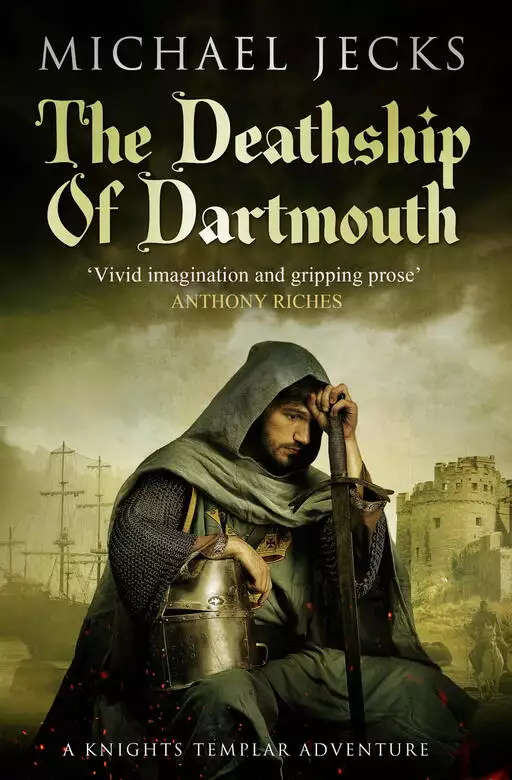
The Death Ship of Dartmouth
- eBook
- Paperback
- Audiobook
- Hardcover
- Book info
- Sample
- Media
- Author updates
- Lists
Synopsis
1324: a disastrous autumn looms large. As the leaves begin to fall there are those who wish to bring the kingdom down as well.
In Dartmouth, a man is found lying dead in the road. Dismissing his death as a drunken accident, the locals turn their attentions to more worrying matters—piracy. Rumours abound that spies are being sent to the great traitor Roger Mortimer. If this is true, civil war in England is inevitable.
The kingdom’s most powerful and ruthless men demand that Sir Baldwin de Furnshill and Bailiff Simon Puttock uncover the truth, and quickly. Fail and they will be executed. Succeed and there will be others ready to silence them forever....
Release date: February 27, 2014
Publisher: Soundings
Print pages: 512
* BingeBooks earns revenue from qualifying purchases as an Amazon Associate as well as from other retail partners.
Reader buzz
 Please log in to recommend or discuss...
Author updates
The Death Ship of Dartmouth
Michael Jecks
Danny would remember that night for the rest of his days.
He was heartily sick as the wind came up and a powerful gale started blowing from the south-south-west. Only a boy, he had been put on this ship after his father had died. He was an orphan, along with his older brother Moses. Their mother had been gone these last three years, and their father went down a month ago when his little fishing boat was caught in a storm.
There was a crack, and he felt the ship heel over. The shock was enough to stir him from his bleak mood.
This was an older ship. The decking was loose board to give quick access to the hold beneath, and the open deck was where the crew slept, under heavy canvas awnings, hoping that the weather and spray would not persecute them too much. From all Danny had experienced so far, that was a forlorn hope. At the rear of the ship was a castle, underneath which was the solitary cabin where the ship’s master would normally sleep.
Even though he was so young and on his first voyage, Danny could tell that the ship was suffering greatly. The mast was groaning, the canvas taut and straining, while all the sheets hummed with the wind. At the top of the mast, the great flag snapped and curled like a whip with every change in wind direction. It was reassuring that the older hands like Vincent and Odo were not overly troubled. Or if they were, they didn’t show it.
The men ran to the ratlines, clambering aloft and spreading out over the yards, and when Odo gave the order, they began hauling the sail up, in an attempt to tie it off and stop the hectic wind from ravaging it.
That was when they had the first disaster of the long night. Even as Danny stood, trembling with weakness and nausea, there was a scream, and one of the younger sailors slipped from his position near the mast itself.
The seamen depended on their horny feet maintaining a firm footing on the rope that ran under the yard, bellies hooked over the top as they hauled up the sail. This lad was one of the new young members of the crew; his feet were less hardened, and his foot slipped. As the ship swayed beneath him, he lost his balance and fell. One hand clutching wildly at a rope as he toppled, at last he grasped it. But it was a near-vertical sheet, and as he plummeted to the deck the palm of his hand was rasped away, leaving a smear of blood all down the hemp. There was a scream, followed by a crunch like a lettuce being hit by a mallet. Then, silence.
If the lad hadn’t died, perhaps the men could have reefed the sail, but as they stared in horror, it was too late and disaster struck them all. The sail flapped loose and then tore in half. In moments, the two halves were shredding, and now a tattered medley of flags were curling overhead. Long strips detached themselves and flew off ahead, chased by the wind that drove the ship on – and that was when Danny knew he must soon die. He scarcely noticed the door opening to the master’s cabin. He was staring at the boy’s body as it flopped about on deck with the ship’s roll; in that corpse, he saw himself.
Without a home, or any family apart from Moses, who was nine, the seven year old would have starved, were it not for the charity of the Church and the kindness of his benefactor. Master Paul Pyckard had sometimes used his father as crew on his ships, and when he heard of the two boys’ plight, he had his men seek them out. Before long, Adam, the sailor with the enormous beard, had tracked him down and taken him in, and the lad had been thankful for the offer of a warm cot for the night. To his delight, there was a fire in the morning, and bread and dripping to eat, washed down with as much ale as he could hold. At the time, still weak after the years of famine, and without food for almost three days, other than scraps from the church, young Danny had scoffed so much, he had promptly brought it all back up, but from that day he began to recover. Now, a month later, he was still weakly and feeling alone and vulnerable, but so much better than before.
Adam had become his closest friend. Reliable, always cheerful, he was Pyckard’s most trusted lieutenant, and just as it was only natural that Danny should pay his way by serving on Pyckard’s ships, it was as natural that he should want to serve with Adam. Moses had been taken in to live with Master Pyckard, and was settling in happily, learning the work of a servant.
Usually Adam would not have been on this craft, an older cog of some twenty tuns called the Saint Rumon, but she was strong enough, else Master Pyckard would never have let his most valued possession, his beautiful French wife, travel in her.
Madam Amandine was as sweet as a sister to Danny. He could admire her beauty, with the juvenile appreciation that noted perfection of form without lust. Amandine was slender and pale-skinned, with a slight peach tone to her cheeks. Her eyes were set wide apart under a high, intelligent brow, and her oval face was regular and unmarked with signs of pox or scurvy, so rare in these years of starvation. She was kind and gentle, and Danny worshipped her, as did the other men on board; she was respectful and attentive even with the lowliest sailors. And when, as now, she suffered from the dreadful consequences of a not-strong belly and vomited, the crew fought to take her little tidbits which were ‘guaranteed to settle her gut’ as the men all believed. It had taken some persuasion from Adam to make them leave the poor woman in peace after their ministrations began to make her feel even worse.
Rather than leaning over the sheer with him, she remained in her cabin with a bowl. Even over the wind, he could hear her wretchedly moaning. He joined in, spewing and retching as the ship lurched and rolled, men up at the yard attempting to replace the sail, until it grew clear that they could achieve nothing. It seemed to last the whole night. And then there was another, greater shuddering and wrenching, and men began to scream. Danny could hear the panic in their voices, and in the naked terror in the men’s eyes, he saw death. They would drown. He would drown.
He had no fear. His father too had been killed in a storm. It was the way for a man to die when he spent his life at sea. No, Danny had no fear, but he did think regretfully of the life he would lose, just as he was beginning it with Master Pyckard.
There was another slamming shock and the ship seemed to settle.
‘She’s on the rocks, boys!’
Over the monstrous howling of the wind, Danny could hear a new noise. No, not hear: he could feel it through the soles of his feet. It was the crackle and shriek of a dying vessel as the water poured in through joints and seams, forcing timbers apart. He clung to a set of oaken planks that suddenly reared up from the loose decking, and lay on them as the ship began to break. Adam was at his side, a hand on his shoulder, peering at him with concern, and then he saw men running from the mast to the sides, desperate men who couldn’t swim and who had nothing to cling to. Adam raced to the master’s cabin, but as he went, Danny saw the door burst wide, and then the wall of the cabin fell away; he saw the green sea thundering through it, sweeping table, benches, pots and cots from inside. And in among it all was Amandine, with blood on her hands and legs as the timbers of the dying Saint Rumon flew about her.
And then a giant wave tossed him overboard, and all he knew was the searing pain of saltwater in his lungs and a roaring sound in his ears.
Devon, September 1324
Her tears stayed with him all the long night after he left her, but there was nothing he could do to dry them. Not now. Probably not ever.
Sieur Pierre de Caen would have taken her with him. He longed to. But she would have none of it. She was a woman of honour, and the shame of fleeing the realm with him would have been too much, even if the alternative would cost her life. It was a price worth paying, she said.
No! He had tried to reason with her, to show that she was mad to think of staying, and he toyed with the other possibility, of capturing her with hired men, and taking her away by force . . . but that would have made her hate him, and he couldn’t bear the thought of her reproach.
Escape would have been so much easier from London. He could have joined a ship to leave for France, if there were any vessels from his homeland in port. If not, he had money enough to bribe his way on a small craft . . . But he wasn’t in London. He had been with her in the household at Taunton when they had heard the news.
A man had to protect himself, and sometimes, just sometimes, he had to protect those who were dearest to him by leaving them. That was the truth, and he was glad he had chosen to flee. With luck, she would be safe, and he could take news of the King’s actions – or Despenser’s, if the truth be told – with him back to France.
There was a rasping sound behind him, and his heart began to pound. All the long journey here, he had feared betrayal and pursuit. He dared not turn, because to do that would prove to any hunter that the suspicions about their quarry were right. No one could see his face and doubt that he was guilty.
Yes, had he been in London, this journey would have been so much easier and safer, for a man in the Queen’s favour could still, just, gain immunity from the devils who obeyed the King’s advisors, an immunity that was entirely lacking at a distant town like Taunton. There were too many places in the countryside where a man could be waylaid, with no one the wiser as to his name or title, let alone his position as a noble knight from the Queen’s own household. Isabella had little authority in the land now.
There was another noise from behind him – the clatter of a heavy boot slipping over cobbles – and he smiled to himself grimly. It had taken him so long to lose the men he was sure would be following, he hadn’t thought that others could catch up with him again so speedily, but everyone was so fearful of upsetting the King or his favourites that mouths could be opened without bribes. The mere threat of the King’s displeasure was enough to make any peasant confess to what he had seen: a rider clad in dark blue and scarlet, riding a powerful black stallion.
So instead of making for the nearer coast, up to Bristol as they’d have expected, he’d thought it wiser to escape to the south, to Dartmouth.
At the time it had made perfect sense. Better by far to hurry south and seek a quiet little port which had reliable sailings. Dartmouth was not among the largest, where the King’s officers would have too much control and interest in foreigners, but nor was it the smallest, where any stranger would stand out. He had been here before, and knew that the port had a deep haven from which ships could always sail with ease.
It was the delay in Exeter which had given him the problem. While he walked the streets of the old walled city, prayed on the hard stone floor of the Cathedral, or rested in a tavern near the Close, someone had seen him and sold the news of his arrival. Since Exeter, he had been sure that his steps were dogged. Well, it was no surprise. The King was convinced that Pierre was his sworn enemy. All because Pierre had fallen in love.
The shame of it! To know that he had won the heart of a nobleman’s wife, a man to whom he owed his livelihood and fortune, that was appalling. There was no more contemptible crime than petty treason, but now he was guilty of it in his heart. And as soon as the opportunity provided itself, they were guilty of it in fact.
He hurried along the darkened street, then down a side alley, and thence back up to Lower Street and to a second alley. This he bolted down at full speed, hoping against hope to rush the man from behind. He would have managed it, too, if some lazy householder hadn’t left a pile of trash lying in the middle of the alley. He saw it at the last moment and tried to leap it, but his foot caught, and he was sent sprawling. The noise wakened a dog, and he heard it barking furiously. Footsteps hurried towards his alley, and he made a swift decision to go on, racing at full pelt back up to the top road.
At the alley’s entrance, he stood panting, his sword already in his hand as he cautiously set his shoulder to the wall and peered round, but there was nothing.
The silence was broken by rumbustious singing, and he saw a group of tattily dressed sailors half shuffling, half rolling in that curious manner they had when on firm land. They were all plainly more than a little drunk, from the songs they were singing and, as they passed him, Pierre was assailed by a gust of warm, ale-sodden breath. He thrust the sword back in its scabbard and slipped in behind them, trying to copy their gait. As they passed by the entrance to an inn, he left them and walked inside.
It was a poor enough place, with the thin scattering of reeds on the floor barely covering the packed earth. In the middle sat a smoking fire, with a trivet set over it, while at the farther end of the room were five barrels of ale.
Pierre made his way to the host, who stood with a thick apron over his enormous gut, and asked for a pint of ale. While he fingered a few pennies, he enquired whether there was a room available.
These Englishmen were pigs! In France, a man of quality might assume that if an innkeeper had no single room adequate that was free, a lesser fellow would be evicted. Here, he was told, and the man kept a straight face while he said it, there was only one room with two large beds, and all the clients could use them. However much Pierre fiddled with his cash, increasing the sum eventually to a shilling, the response was the same. It was unnerving to find a man like this innkeeper prepared to challenge a knight’s instruction. Heaven forfend that such arrogance could come to the French peasantry!
It was surely a reflection of the trouble between France and England. A war made for bad manners.
He had hoped for a quiet room alone, but if that was impossible, he had other options. He agreed loudly to the room, paid up the full sum and then wandered to a table, his ale in his hand, and waited.
Three men soon entered one after the other. The first, clad in faded green tunic and worn hosen, with a knife hanging from a cord about his neck, was so plainly a sailor, from his horny hands to the weather-beaten face and grizzled beard, that Pierre could disregard him instantly as a spy. A paid assassin, perhaps, but not a spy. The second looked more the part: he was oddly clad in a good red jack over a fine woollen tunic, with a hood sitting far back on his head to show an eye with a devilish squint. Short and hunched, he looked desperate and dangerous, but as Pierre eyed him covertly, the newcomer roared sociably in welcome at a group of men near the bar and was soon engaged in raucous conversation.
The third seemed unlikely to be a spy. He wore a thick leather apron like a joiner or mason, and Pierre heard several men mutter something that sounded like ‘paviour’. He strode past Pierre without a glance in his direction, to a table at which two others sat, one older, one apparently an apprentice.
Pierre was beginning to wonder whether he had been followed at all, for here it was at least thirty miles from Exeter alone, and surely he would have noticed someone on his trail . . . when a fourth man appeared in the doorway. He was an older fellow, and well used to rough living from the look of his shabby hosen and jack.
‘Ho, Cynegils, are you coming in?’ the host called over. ‘You want an ale?’
It was plain enough that the man was a local, and a regular here at this inn, but although he nodded and grunted at the landlord, he remained on the threshold studying the room. When his eyes fell on Pierre, the Frenchman saw the flash of recognition in them, and knew he was lost.
With a poor display of casualness, Cynegils left the room and disappeared, strolling back in a few minutes later with a nonchalance that would not have deceived a blind beggar. He went to the bar with the host and sat down facing Pierre.
If Pierre had entertained any doubts about the man, the way the host peered at the newcomer was enough to dispel them.
‘What you up to, Cyn?’ he asked suspiciously.
‘Nothing. Just get on and serve me, will you?’
There was a hurried discussion, and the landlord shot a confused glance at Pierre, but seeing the Frenchman’s fixed stare, he hurriedly moved away to draw a jug of ale for Cynegils.
Pierre gave an elaborate yawn, stretched, and drained his pot. Rising, he made his way to the rear door which gave out to the sleeping chamber, so he understood. He stumbled slightly, like a man unused to strong ale, and shut the door before darting along the passageway and out into the inn’s garden. There was an overwhelming stench of piss there, but at the moment Pierre cared nothing for that. He stepped behind the door, waiting.
Soon enough, he heard the door from the hall open quietly, and the sound of steps making their way down the passage, where they stopped.
Pierre debated whether to launch himself in through the door and tackle the man, but decided that if he did so, the fellow might scream to warn his companions, and they would be sure to come to their friend’s defence. This Cynegils was known here. No, better that he wait here until the man had checked the bedchamber, and then hurried out to the garden to see how Pierre had made good his escape. Except he wasn’t going to escape. He would hide here, catch the man and learn who had sent him.
But then suddenly there was a sharp knocking sound, then a rush of feet, and Pierre had to move away in alarm, as two men came barrelling out, a third held between them. The two looked at Pierre. It was the apron-clad workman and his older companion.
The apron-clad man looked Pierre up and down, then hawked and spat. ‘This one was going to knock you on the head, I reckon.’
‘You stopped him?’ There was some doubt in Pierre’s mind. These men had apparently helped him, but perhaps they were good at feigning. There had been a third at their table, he reminded himself. Where was he? Fetching the man who had paid this Cynegils?
‘You want him or not?’ the older man demanded. ‘Personally I couldn’t give a—’
‘Calm down, Bill. He’s just been close to having a blade through his back, and he’s probably wondering about us. That’s fine.’ The man with the apron was eyeing Pierre with a knowing expression.
‘Friends, I owe you my thanks.’
‘Someone’s watching for you,’ the man said speculatively. ‘I’d reckon you should find somewhere safer to stay the night.’
‘I know one man,’ Pierre said. ‘But I don’t know where he lives.’
The other nodded his head towards the back of the garden. ‘If I was you, I’d be out of here now. There’s a big gap in the wall, over there. The landlord’s been trying to persuade me to get it fixed for him on the cheap. You can slip out there easy enough.’
Pierre needed no urging. He ran to the bottom of the garden and found the tumbled section, just as the man had said. Vaulting over it in an instant, he stood debating with himself, fear making him pant, and then he set off quickly but quietly round to the front of the inn again.
Further up the road, he noticed a paviour’s trestles set up. The roadway was being repaved, he guessed, and that was his last thought as the blade settled on his back just behind his kidney.
The appearance of the cog as she sailed into Dartmouth’s harbour was so peculiar that the men found their eyes drawn away from the corpse at their feet. Even Hamo, who was no sailor, found himself distracted and turned to stare into the haven with all the others.
‘Christ Jesus and all His saints,’ he murmured.
Everyone had seen ships which had been knocked about in foul weather, but from the look of her, this was no simple disaster of wind and wave. Some other fate had overcome her, and Hamo had an idea he knew what it was. The timbers looked more black than pitch alone could have made them; the rigging, even to the cooper’s untutored eye, was odd, as though it was all freshly replaced, and that in a hurry, while the mast was much too short.
In front of the cog was the Christopher, John Hawley’s ship, and the sight of it made Hamo’s lips twist into a grin. Yes, if Hawley had seen a rich prize like this, he would do his best to rescue her, in the hope of being able to keep her. Never a man to turn his nose up at a profit, was John Hawley.
‘Wake up, you churls!’ bawled Ivo le Bel, the local sergeant. ‘Let’s get this over with. Hamo, I know you want to get down there and sell some barrels, but that can wait, by God’s pain! Sweet mother of Christ, look at his head!’
Hamo glanced back at the corpse just as Ivo le Bel clambered out of the hole. The sight made him swallow hard to keep his breakfast down. At his side, the scruffy stranger with his leather apron was making a fuss.
‘What’s he doing here in the road?’ he whined. ‘I just don’t . . . Ach, if a man has to fall and kill himself, why should he wander up the road until he finds my hole and falls into that? Aren’t there enough damned wells around here to fall into?’
Ivo le Bel shot him a look. ‘Shut up, Paviour. There’s nothing to be done about this, least of all whining. We’ll have to get the Coroner here as soon as possible.’
‘Good. Is there one in this borough?’
‘Here?’ Ivo gave a loud chuckle. ‘No, we’ll have to send for one. We’re not big enough to justify our own down here.’
‘Oh, no! I’ve got to get cracking with my work, or I’ll be late. This is going to take days!’
Ivo shrugged. ‘You can do what you want, man. It’s no affair of mine. But if you try to move this body, I’ll tell the Coroner and the Sheriff. There’s no getting away from it. This poor fellow fell into your hole last night and brained himself on the rocks.’
Hamo the cooper peered down again. The trench here was quite deep, it was true. Alred, the paver, was here with his apprentice and labourer to mend several stretches of roadway that had begun to fall apart in the last few years; the burgesses were sick of the complaints from people saying that their carts couldn’t travel up here any more. A sum had been agreed, and this Alred Paviour contacted. The man had travelled all the way down from Exeter. If anyone could mend the roads hereabouts, it was a professional like this Alred.
However, it had to be admitted, he had left the road here in a state last night. The street was in constant use, and yet he’d lifted a large area and left only one wooden trestle at each side to stop people from falling in during the hours of darkness. That was plain foolish, when there were so many taverns along this stretch. Look – the Porpoise was only a matter of yards away!
His eyes went back to the strange ship in the harbour. He saw the enormous splash as the anchor dropped into the water, even as a rowing boat started off from the shore. It headed for the Christopher, at the same time as a boat was launched from John Hawley’s cog. Hamo could hear shouting, for noise always travelled clearly over the water here, but his ears could not discern any words. The little boats rocked on the gentle swell, men discussing the damaged cog, no doubt, and then the Christopher’s rowing boat lurched forward to the shore, while the second began a leisurely perambulation of the strange ship.
‘It’s not my fault,’ the paver was grumbling on. ‘The fool should have seen the barrier.’
‘What barrier?’ Ivo demanded.
‘I had trestles and timber set up to stop anyone falling in – I’m not stupid!’
Ivo glanced about them. ‘There’s only the one trestle, so far as I can see. Where’s the rest of the stuff, if you were so careful to put it all up? Because if you can’t produce it, the Coroner’s going to assume that you are lying, and that you put this man’s life in danger.’
‘Someone must have stolen them!’
‘Really? I wonder if the Coroner’s going to believe that. If no one else saw them, you’ll be fined heavily.’
‘I saw them, Sergeant.’
Ivo snapped his head around, but Hamo was already grinning to himself. He recognised that voice.
‘Ah. Morning, Bailiff,’ Ivo said warily.
The Saint John was sound at the waterline and below. That much was clear enough. The flames hadn’t caught hold completely.
Henry Pyket was a good shipwright, and he had experience of rescuing cogs which had been badly damaged either in battle or foul weather. First, and most important, was to view the exterior and see whether the vessel was still seaworthy. His concern was to have her beached quickly for safety if necessary, but if she was not too badly damaged, and he could have her looked over at leisure, then so much the better. He was busy with other work to complete just now.
Henry was the first shipwright on the scene, by good fortune. As soon as the ship had started up the river towards the haven, one of his carpenters had called him to look at her, and he had realised that there could be money in a job with this one. He’d shouted for a rowing boat and two men and was leaving the jetty even as Hawley’s cog, the Christopher, dropped anchor.
Hawley was in his own boat and on his way to meet Henry in a few moments. As soon as they were within hailing, Hawley gave a shout and his four oarsmen lifted their oars and drifted. The nearer man glanced over his shoulder to gauge the distance, and then let his oar drop to push Henry’s boat gently away before they could collide.
‘We found this cog floating without a crew,’ Hawley called. ‘Can you give her a good look-over? I don’t want the cargo lost.’
‘At once.’
If there was any risk of her sinking, Henry needed to get the ship out of the water as soon as possible so the cargo could be saved. On a cog this size, there could be enough to make a good profit for all involved in the salvage.
From this initial glimpse, he reckoned that she was safe enough. The smell of burned pitch and scorched wood was very strong, though, and he wrinkled his nose as well as his brow as he rubbed his chin reflectively. ‘Take us nearer.’
As the oarsmen heaved, Henry opened his jack. The breeze was cool, fresh off the sea, but the sun was blazing down on them from between the clouds, and he was feeling hot. He pulled off his cowl and scratched at his thin, lank hair, idly pushing his head into his cowl again as they slowly encircled the ship and he could see her from every angle, until he snapped an order, and they rowed in to the ship’s sides. There, he studied the strakes closely, peering at the caulking, reaching out and feeling for himself how well she was coping. When he nodded to himself, he heard a snigger from behind him.
‘You concentrate on your oars, Jankin.’
‘She’s riding low. Must have a good cargo aboard,’ Jankin said, ignoring him.
‘Perhaps.’ Henry couldn’t be bothered to argue with his son today. Better that he should concentrate on the cog herself.
A small ship, this. But then few ships in this part of England were large. There were none of the great vessels which a man could see down south in Castile or even over in Yarmouth on the east coast. Some there were at least 200 tuns, using the standard measure. All ships were assessed in terms of how many standard Gascon ‘tuns’ they could carry. Each of the enormous wine barrels weighed somewhere in the region of a ton, and they provided a handy measure against which to assess ships.
From the look of her, this ship would hold twenty or so tuns. Master Hawley’s ships were all about forty tuns, like the Christopher here, but Master Pyckard, another local merchant and shipowner, liked smaller ones that could navigate the smaller ports, saying that they could hurry over the seas, empty themselves speedily, and return. He had three of them, the Saint John, the Saint Simon, and the Saint Denis. There had been one more, the Saint Rumon, but she had sunk some fifteen years ago, when there had been a sudden squall.
Poor old Paul – he had lost his treasure, his beautiful young wife Amandine, in that freak storm. Never been the same again since, really.
‘Master Hawley did say she was carrying a lot,’ Jankin persisted. ‘Look how low she is in the water, Father.’
The young man’s voice held that hint of greed familiar to all those who eked a living at the coast. While they lived in fear of the sea, they depended upon it too, and although sometimes it could rise up and destroy them, at other times it would bring them a generous harvest. A single shipwreck could supply enough to maintain an entire community for months. Here, safe in the haven, they rarely found wrecks from the sea, but when a good seaman like John Hawley captured a prize, the effects would ripple through the town.
‘I heard him. Let’s just make sure she’s safe first,’ Henry said, eyeing the sheer above his head and shaking his head. It made no sense that a man would attack a ship, kill the crew, and then leave the valuable craft with all her cargo aboard. What kind of a fool would do that?
Henry Pyket was a heavy-set man of almost forty, with a great pot-belly, his tanned face square and kindly, with oddly gentle eyes. Few men in charge of a good-sized shipbuilding business were known for their generosity and charity, but Henry had always been different.
Taking a grappling iron, he swung it contemplatively in his right hand, the one which was missing two fingers, before hurl
We hope you are enjoying the book so far. To continue reading...
