"Touching, infuriating and painfully true, Strange Girls is a superlative novel by one of our most perceptive writers. Sarvat Hasin is an artist whose work demands to be read." —Julia Armfield, author of Our Wives Under the Sea
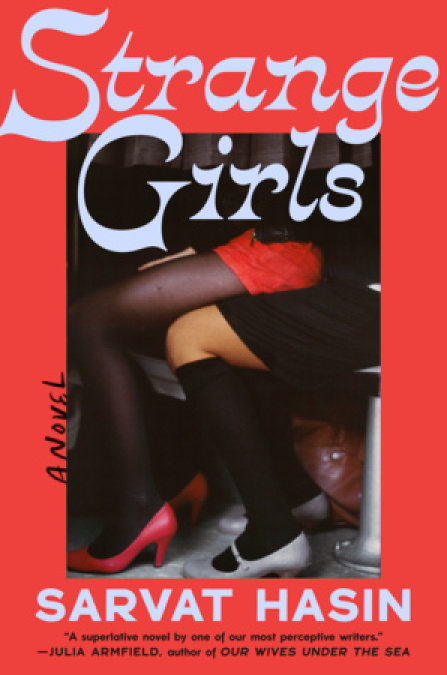
An award-winning international author’s stunning US debut about two estranged friends who reunite over one feverish weekend and reckon with the choices that tore them apart
A decade has passed since Ava spoke to Aliya. During the years of silence, Ava's life has remained at a standstill, while Aliya got the one thing they both wanted more than anything: a book deal. Forced back together at a mutual friend’s bachelorette in London, Ava returns to Aliya’s doorstep, desperate to unpack the truth of their shared history—and what they meant to each other.
When the two first met in the halls of their historic campus, their connection was electric. Aliya and Ava created a world of their own through the stories they wrote, influencing and borrowing from each other’s work. But when the end of college loomed, the real world began to pull them in opposite directions. Was their bond ever truly as strong as Aliya thought? And what would become of the stories they told themselves about each other?
Weaving together the friends’ past and present, Strange Girls is an ingenious portrait of a fraught friendship, and an exploration of the ties forged in the intensity of the college experience, and the scars left when they break.
Release date:
March 10, 2026
Publisher:
Dutton
Print pages:
320
* BingeBooks earns revenue from qualifying purchases as an Amazon Associate as well as from other retail partners.
CAUTION: This email originated from outside of Penguin Random House. Please be extra cautious when opening file attachments or clicking on links.
1
There are stories where a shadowy specter from the past arrives on a young couple's doorstep, dredging up secrets that have been long buried. Things do not usually go well for the young couple in these stories.
They do not usually go well for the specter either.
No one answers when I knock.
Arriving at Aliya's door on a Thursday afternoon, sticky with heat, I did not want to think about how long it had been since we had spent any meaningful time together or what it would be like to see her.
In the stained glass roses in Aliya's window, I look very much like one of these specters. The pull of skin around my mouth, circles pressed under my eyes. My face is a fun house mirror. The sun is shining behind my head and it feels wrong. I forget that London can get like this in the summer. Overheated and squishy like spoiled fruit. The cotton of my T-shirt tight against my skin, the unbearable weight of my jeans. On the Tube, I'd stood between a pair of Australian backpackers, taller than me, their arms reaching up to the handrails, confronted with their inescapable ripeness, regretting everything. A rare heat, I never think of London this way. My memories of the city are a jumble: Hugh Grant with orange juice on his shirt, Iris Murdoch novels, images of drenched streets, pressing damply into the corners of pub windows with wet jumpers and umbrellas that both did and didn't belong to me.
Why does it feel like a returning to come here? I have never stood on this street, this little crescent of small houses in North London. Inside is a life that has almost nothing to do with mine anymore.
Aliya said she'd come meet me at the train station if I liked-she could take the afternoon off work. I'd declined. Somehow it was less daunting to come straight here. I had embarrassing visions of us not being able to recognize each other among the crush of people-ridiculous, as we have not aged so much, no plastic surgery disguising our faces. And of course I have seen her: for every year that has gone since we last spoke, there have still been the pictures that filter through, available to scroll in the light of my phone, late at night when I'm on the bus back from a shift or sitting on the toilet in the pitch-black mornings.
Aliya at her master's graduation, a cap and gown, her mother's arm thrown proudly around her; Aliya with a bad dye job, smiling miserably into a new friend's camera; Aliya at hen parties, gigs, dinner parties, other people's weddings. And finally her own. Aliya as a bride with the shape of a groom slotted in beside her, muscles rounding out his suit jacket, teeth like a shark. Aliya's mouth stretched wide and red, her skin glossed into something unlike itself. I felt if I reached into it and rubbed a finger along her face, it would come away greasy and her face would smudge under my touch like an oil painting. She didn't look especially older. She just didn't look like any version of the person who belonged to me.
I consider the window, its stained glass pattern, and a creature appears in it. A black-and-white face, peering out at me mockingly. I sleep in Aliya's bed. I'm her best friend. She feeds me every morning while she drinks her coffee, it seems to be saying to me. I crouch and hiss at it. It hisses back.
I check the weather, the news, my texts, as I wait.
I am plonked on the front of her doorstep like an uncollected package. A man walks across the green with a small, long-haired child, chocolate on his T-shirt. They both regard me with curiosity as they come up the front path. I try to make my face look less approachable in case they try to speak to me. The child does not want to anyway; he has a ball under his arm, and his insistent pull of his father's hand implies he wants to be back running circles in the triangle of grass and getting hit in the head with it. The dad smiles at me as he unlocks the front door, and I nod back. He hitches the child up into his arms and takes him upstairs.
We’ll say hello, probably hug. I remember Aliya’s hugs, the evolution of them. The reluctant, almost retiring lean as if it was a social custom she couldn’t quite understand and then the squeeze as if she didn’t want to let go.
We won't say we've missed each other. We'll make small talk: the weather, the wedding, impersonal things. It will be awkward at first, as it is when people who were once close meet again, but perhaps we'll pick up the thread. I have heard there are relationships like that, that go dormant for years but come alive, restored to their former vibrancy just as they were before, as if a slip of time has opened to let you through to the last moment of intimacy. Perhaps this will be us-as if only yesterday, we were lying in my bed, drinking coffee at midnight, watching The Thin Man, the halls beneath us reverberating with bass, knowing the party would never be as good as being with each other.
Except there will be a man in the room, scratching in the corner, his arm around Aliya's shoulders, his hand in the bag of crisps, the smell of his aftershave hanging in the air, his machismo killing the singular joy of Myrna Loy's diction.
I plan to stay in this flat with its stained glass windows for the rest of the weekend. My train back is on Monday night. Three days to make chitchat with her husband, to learn if he takes milk in his coffee, if he's the kind of man who leaves tea bags on the kitchen sides and just walks away from them. I've never lived with a man before. The idea that the longest I will spend under the same roof as an adult man will be with her husband is a little upsetting. Mostly in that Aliya has a Husband. He is a Thing I cannot imagine, despite having zoomed in on his pictures to check the quality of his skin, the bags under his eyes, the stain on his shirt that turned out to be a smudge on my screen.
The dad comes back down.
"You waiting for the Nasims?"
My head pulls up in shock. That Aliya might have changed her name hadn't occurred to me. I am surprised to find how much I judge her for it. It's not something we explicitly discussed, but then we never thought of ourselves as the types who would marry. It is insulting to think of her so permanently marked by some stranger, his stink on her.
"I'm a friend of Aliya's," I tell him. "She's late."
Aliya has a habit of not showing up to things at the right time-either too early or too late. She used to call it Pakistani time, but I have since learned it is more erratic than that.
"Well, if you wanted, you could wait upstairs. Get out of the sun."
I squint up at him, haloed by the day. There is a fuzziness to him-something soft on the edges, dad-ish, gentle rather than sleazy, and yet. I pause, with my lip between my teeth. I pull the T-shirt from where it sticks to my belly and blow gently down the neck of it.
"I have a spare key as well," he says.
"That would be perfect."
"I mean, I should probably call them-"
As if on cue, the phone trembles in my pocket. I pluck it out and flick my eyelashes up at Dad-ish.
"I'm so sorry," Aliya says.
"Yes, you're late."
It's been a long time since I heard her voice. Having an audience makes it easier. I don't feel the need to smooth it over, to make it okay that I've arrived and Aliya is not here to greet me.
"So, so sorry. I got stuck in the line at the bank. I'll be there asap. The thing is-Ben upstairs has a spare key-"
"Well, he's here with me now. So as long as you can convince him I'm not an axe murderer, I can rest my weary little behind inside your house."
"Give him to me."
I hand over my phone. The man makes a chuckle at whatever explanation Aliya offers and then he hangs up. He doesn't pass it back to me to finish the call. We don't say goodbye. We haven't even said hello.
I wait while he deposits his son and retrieves the key. A finger of sweat crawls down my back. He opens the door into a small hallway, busy but neat. Things begin to feel a little close, like he is standing too near me. The walls squeeze in. With the bag in my hand, I push into the kitchen. It is yellow, a color that looks left behind, chosen by a former occupant who thought it might be cheerful or perhaps watched Amélie one too many times. I press my back into the counter and find the dad still in the doorway.
"Thank you," I say.
"No problem." He twists the keys in his hands and looks around. I wonder how many times he's been in here, if they are familiar enough to pop around and borrow sugar or coffee. There is a cup out on the counter with a lipsticked rim, and I have the sudden urge to put my mouth to it. I remember at university, the house with the broken toilet door, a small paved garden with dead plants and an ashtray, how Norah would say that you'd know if Aliya had been there because the coffee cups and cigarette butts were tipped in red. "Like a noir heroine walked through a film set," she said once. We were smoking in the evening with the windows open, and I looked up at Aliya's face and she laughed like she was embarrassed to be talked about.
It is difficult to breathe with him still there, with his smell and his hands and the weight of his body in the room.
"I'll be okay from here."
I hear how rude it sounds.
"Oh yeah, okay."
"I mean, I don't want to keep you."
He lingers in the doorway. I can tell I've been brusque but feel no impulse to soften it.
"If you need anything . . ."
"I'm sure Aliya will look after me."
After he leaves, I fiddle around. The kitchen is a safe place to snoop. There is always the excuse of fetching water or tea. The kettle is blue with a silver handle. The cups all match: no Sports Direct mug, no quirky jokes, no his and hers, just white ones covered in roses. There’s a bar cart with lace doilies and a tea set in the hall. The teas are rooibos and Yorkshire and loose-leaf and opera blue and jasmine, green and chamomile. They are stacked in a neat pile, unopened, decorative. The fridge is well stocked, vegetables in the crisper, freshwater salmon, a whole shelf of condiments. When we lived together, we ate canned tuna in pasta mashed with cheese and mayonnaise, cold rotisserie chickens that we’d rip up with our hands into pre-packaged salads. Our beds were routinely covered in crisp and cereal and popcorn crumbs, anything we could shove into our mouths by the handful as we stayed up till early in the morning, the streetlight hanging in the window like our own personal moon.
The kettle hisses in the background. I sit at the kitchen table trying to imagine what it might be like if this mug were mine, if I'd cracked it along the rim against my teeth laughing too hard at something my wife said while unloading the dishwasher one Sunday morning, rain heavy on the open window, something corny on the radio, the day stretching in front of us without urgency, her hand on my wrist, saying come back to bed, and the promise of this-cat wrapped up on our feet and warm under the duvet with our books.
When Aliya turns the key in the door, I freeze, stay seated. I let her find me. Her arms are heavy with bags, herbs spilling out the rim of a tote. There is a moment where I can see her in the hallway before she can see me, untangling the keys from the arm of her bag, her hair falling in her face. It is long again, a spitting of gray at the root. She is dressed in soft-colored clothes that look expensive, a long blue shift that goes down to her ankles and the kind of shoes that could be slippers. When she looks up, I feel like a stalker.
"Hi, hi. I'm sorry."
"I made myself at home. Kettle's still hot if you want something."
I lift the mug to her the way men in old movies lift a glass when a dame walks in the door.
She laughs nervously like she's afraid of me.
"Thanks for putting me up," I say.
We haven't hugged yet. I wonder now if we will. I could shake her hand, but it seems depressingly formal, and then the moment has passed and we haven't hugged or touched and I remain on the barstool in her kitchen and she in the doorway. Her dress swishes around her, its long tentlike shape, as she begins to unpack the groceries.
"It's good to see you," she says, addressing it to the can of chickpeas that is going into a cupboard overhead.
"Well, when Norah summons . . ."
"Sure."
"Thanks for putting me up," I say again. "I'm sure I could have scrounged a sofa-surf situation from the dregs of my phone book."
This isn't true, but I feel compelled to say it, to lay the words between us.
"No, don't be silly. We have the guest room for a reason. It's for guests."
She says it automatically, as if in reflex, as if it is the thing she says to all the people who come through her door and sleep in her sheets. She puts the jars down and turns to me.
"Of course," she says, "it's lovely to have you, it gives us a chance to hang out. I didn't mean-"
"No, I-"
"More tea?"
"Coffee, please."
I watch her make it. The shuffle of her body around the kitchen, the light on the back of her head. She uses a moka pot now. It is tall and beautiful and shaped like a curvy woman. I can see the gold of her rings flicker in its reflection, little twinkling promises of love. We used cafetières when we lived together, a tall French press that we bought from a charity shop and filled to the brim.
We hope you are enjoying the book so far. To continue reading...

 Please log in to recommend or discuss...
