
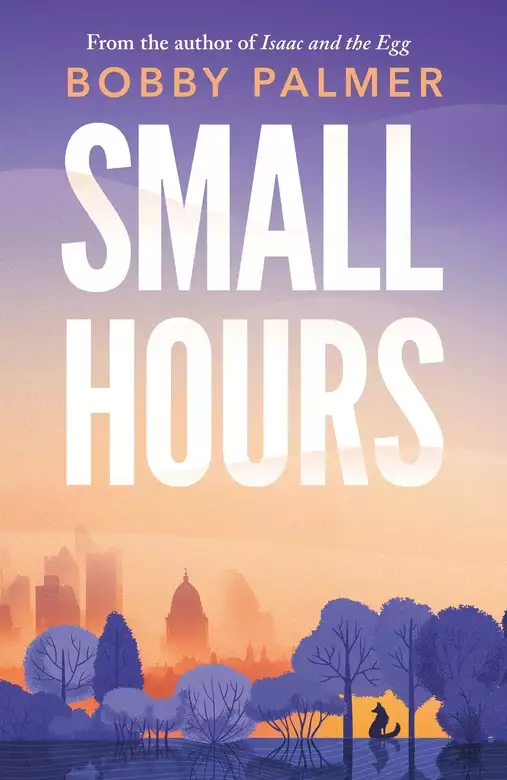
Small Hours
- eBook
- Audiobook
- Book info
- Sample
- Media
- Author updates
- Lists
Synopsis
The eagerly awaited new novel from Bobby Palmer, author of the critically acclaimed debut Isaac and the Egg.
-
If you stood before sunrise in this wild old place, looking through the trees into the garden...
You'd see a father and son, a fox standing between them.
You wouldn't know that Jack has returned from the city, still determined to be the opposite of his father. Or that Gerry would rather talk to animals than this angry man back under his roof.
You wouldn't imagine that neither is quite who the other remembers. That someone irreplaceable is missing. That one conversation might change everything.
If you met them in the small hours, you'd begin to piece together their story. It's about connection and belonging - and how the world comes alive when you stop to take it in.
PRAISE FOR ISAAC AND THE EGG
'Truly one of the most beautiful stories you will ever read' Joanna Cannon
'Unique, tender and funny' Pandora Sykes
'A future classic' Clare Mackintosh
'Like nothing I've ever read before' Stylist
'An arresting debut novel about grief in the most wonderfully oblique way' Reverend Richard Coles
'Just magic' Kate Sawyer
'Quirky and raw' Grazia
(P)2024 Headline Publishing Group Ltd
Release date: March 14, 2024
Publisher: Headline
Print pages: 400
* BingeBooks earns revenue from qualifying purchases as an Amazon Associate as well as from other retail partners.
Reader buzz
 Please log in to recommend or discuss...
Author updates
Small Hours
Bobby Palmer
one
‘Sorry, I think I’m hearing things.’
Jack hadn’t been paying attention. In his defence, there was a squirrel jumping from branch to branch in the tree outside the window of the meeting room.
‘No, you aren’t hearing things.’
Jack allowed his vision to blur, the acrobatic squirrel becoming an indistinct smudge of fur, yanked this way and that like a puppet on a string. His eyes refocused, taking in the two men opposite. The man on the left’s brow was furrowed, the man on the right’s mouth tightly pursed. I wasn’t ignoring you, Jack wanted to say. There was a squirrel.
‘Sold,’ he said, instead. He turned the word over in his mouth. It had a bad aftertaste. ‘Wait. Sold?’
Across the glass-topped table, Hugh looked at Hugo. Hugo looked at Hugh. Hugh laced his fingers before him on the tabletop. Visible through the glass, one of Hugo’s chino-clad knees began to jiggle. Jack looked from Hugh to Hugo, Hugo to Hugh. To most people, they’d be indistinguishable. But up close, Hugh’s hair was mousy brown, Hugo’s a dirty blond. Hugh tended to smirk, while Hugo preferred a sneer. They both stared at him with inscrutable expressions now, as if they might break character at any moment and admit it was all a joke. Jack was the first to break eye contact, looking down at his legs. His own knee was jiggling now, no matter how hard he tried to stop it.
‘Yes,’ said Hugh.
‘The company is being sold,’ said Hugo.
Not ‘We’re selling the company’, as that would suggest some agency on their behalf. And to come to a decision like that at an agency like this, they would have had to tell their third-in-command. Jack handled the money side of things. And though Hugh and Hugo had begun to take more of an interest in the company accounts of late, asking him to produce extensive financial records for mysterious third parties, Jack had been stretched so thin that he hadn’t had the time to question their motives. He’d been silently optimistic, hoping that there might be new backers on the horizon. He’d been obliging, as per usual. He rarely asked questions.
Jack’s eyes flicked over the mug in front of him, the company logo on the side, the black coffee sitting untouched. He wondered if it would seem strange to take his first sip now. He wondered if it had already gone cold. He wondered if he was so sweaty because, on a warm day like this, he’d opted for smart wool trousers and a button-down shirt. He’d known he had an important meeting this morning, but he hadn’t expected it to be about this. Jack clenched his fists, unclenched them, set his palms flat on the tabletop. He moved them again, transferring them to his lap, leaving a sweaty smear on the glass. He looked up at Hugh and Hugo, avoiding the brown envelope that lay on the table between them.
‘Sold to whom?’
The pair shared a glance.
‘Multiple buyers,’ one said.
‘Sold off, really,’ added the other.
‘Stripped for parts.’
‘Gutted.’ A pause. ‘Like a fish.’
Jack didn’t know what to say. He tended to avoid conflict, so he wouldn’t say what he wanted to say, which was: how could you? And how am I only now hearing about it? Instead, he stole a quick look at the envelope. It was thin. A redundancy pay-off would be thicker. Wouldn’t it? Working things out was Jack’s forte. And Jack had worked out, a while ago, that he could make himself into someone indispensable. He never took time off. He worked harder than anyone else. Redundancies happened to other people, people less integral to the operation, people who didn’t want it as much as he did. Even as his bosses’ spending became ever more erratic and the company found itself in ever-choppier waters, Jack had assumed that he could fix things. He’d thought that he alone could turn this ship around.
He hadn’t considered that Hugh and Hugo might have been making their own plans behind his back. Now their lifeboat was disappearing into the distance, and here he was, clinging to a glass tabletop to keep from drowning. There were beads of sweat forming on Jack’s hairline. He was beginning to think it wasn’t just his clothes. He was beginning to think he’d made a miscalculation.
‘So, we keep going?’ Jack said, though his voice betrayed him. ‘With new backing?’
Silence.
‘We’re actually going to be stepping back,’ Hugh said, eventually, reluctantly.
‘Stepping back?’ Jack blinked at one of them, then the other. ‘What about me?’
‘That’s the great thing,’ Hugo said. ‘The world’s your oyster.’
Hugo and Hugh both looked down at the envelope. They both looked back up at Jack. In perfect unison, they frowned. The effect was unnerving. There was a sound from outside the meeting room, and Jack glanced over his shoulder, as if expecting to see someone holding up a placard with instructions. Frown. But, no. Just two of his colleagues, weeping. Jack watched as one of them put his arms around the other, gently manoeuvring her out of the way of two removal men shimmying past, carrying the coffee machine. He’d imagined offering to mentor these two, both junior to him, next year. He’d hoped that he’d be good at it. He’d hoped that he’d have more time. Jack had barely ever spoken to them, beyond weekly team meetings and hurried budget reports. He’d never been a shoulder to cry on.
Jack’s eyes returned to Hugh and Hugo. He wanted to say, surely there’s something we can do to fix this. Surely at least I can stay.
‘We all wanted to make it work,’ said Hugo.
‘We’re all gutted,’ said Hugh, sliding the envelope slowly across the table.
‘Gutted,’ Jack murmured. ‘Like a fish.’
His eyes went to the window again, but the squirrel was gone. He felt the sharp corner of the envelope pressing against his solar plexus. He took it, slid it under the table, let it sit unopened on his lap.
‘We’re going to the pub in a bit,’ said Hugo.
‘For a swiftie,’ said Hugh.
‘Or four.’
‘The parting glass.’
Jack knew it would be odd to open the envelope right now, just as he knew it would be odd to drink his coffee, now definitely cold. He knew he couldn’t grab both Hugh and Hugo by the collars of their clean shirts and slam their heads into the
thick glass below, though the twitching of his hands made him feel like he just might. Bile rose in his throat. His vision was edged with black clouds, with sparkling lights. He needed to be somewhere, anywhere, else. Abruptly, he pushed back his chair and stood up. The metal legs clanged against the glass wall of the meeting room. Jack gulped, holding tightly on to the envelope as if they might try to take it back. Tell them what you really think, he thought.
‘Thank you,’ was what he said, forcing his mouth into a smile.
‘No,’ they both replied, smiles unforced. ‘Thank you.’
The glass door of the meeting room wobbled pathetically as Jack closed it behind him. The door of the office building was quieter, the click of it shutting behind him barely audible over the howling sirens and tutting bicycle spokes, the beep-beep-beep of a reversing truck, the hyena-like laughter of a passer-by on the phone. And the hollow sound of Jack’s own, thudding heartbeat, which now filled his ears at such a deafening volume that he felt as if it might knock him off his feet. Jack found himself, lost, on the pavement. For the first time in over a decade, he didn’t have a clue what came next.
———
To Jack Penwick’s logical brain, his career had been like a computer game. Everything was laid out in levels to be completed, with high scores to be achieved if he only worked hard enough. Jack was a numbers guy, and nothing had ever added up so easily. For the best part of the last fifteen years, he had progressed diligently from stage to stage. In his late teens, while his schoolmates deferred university places and planned gap years, he landed work experience in the city with their uncles and godfathers. He got himself on a good course at a good university, scored an even better placement in his third year, beat out competition for the best graduate scheme going when graduation came around. Finance felt like a calling, the ultimate equation to be solved. But as the numbers grew bigger, the levels got harder. And as the hours got longer, the friendly faces became fewer and further between. If it became more difficult to come up for air, to look around and wonder what he actually wanted – and if this was actually it – then that email from Hugh a couple of years ago came at just the right moment to stick a plaster over the opening wound. Jack and Hugh had known each other since university. Now, with Hugh’s contacts and the financial backing of his friend Hugo’s father, they were starting their own business. They shook his hand. They offered him equity. They showed him the numbers, and the numbers looked good. When they told him that the company was going to be a unicorn, Jack had swallowed it hook, line and sinker. Like a fish.
Jack now sat beneath a tree, on a bench on the common, unsure exactly how he’d ended up there. Leaving the office had been like stumbling, bloodied, from a battlefield, P45s billowing out of printers and shreds of sensitive documents raining from roaring shredders. He remembered, of course, that he’d been on the pavement outside his office, then on a bus. He’d disembarked at his usual stop, taken the usual, direct route home across the common. But his memory of these events – and the mechanics of how they’d led here, to this particular bench – were hazy. He supposed he’d needed a rest. He supposed there wasn’t much point going any further. Jack had no one to come home to, no one to tell. And the spacious two-floor flat which had once been a towering monument to his sizeable earnings already seemed like a gaping void into which he was throwing an income he no longer had.
It was game over. How had Jack not seen this coming? And even if he’d had an inkling, how had he not been smart enough to stop it? He’d thought of himself as a startup Svengali, a Doctor Dolittle for the age of digital disruptors. He might not have been the boss, but he’d thought he had a handle on things. He’d at least assumed there would be more conversations before that one, the final one. He reflected on the open-plan loft office that had cost four times what the company could afford, the ingoings and outgoings that were uneven, even to him, the guy who was supposed to make it all add up. Hugh and Hugo never listened. They fobbed him off with the same things they said to all the app developers, to the event organisers, to the angel investors with deep pockets and short attention spans. Don’t focus on the numbers. Focus on the feeling.
Jack didn’t feel good. From the glances he was getting, he looked even worse. His hair had become lank in the heat, his exhausted eyes ringed by welts of purple. His face was stuck in a grimace, though that wasn’t just a today problem. Jack had spent £4,000 having his teeth whitened and straightened a couple of years ago, and for what? Smiling still didn’t come naturally. He massaged his jaw, catching the concerned eye of a woman pushing a toddler in a pushchair. Jack looked down at the box he was clutching. It had been the only empty container left in the almost-empty office, one last humiliation on his way out. A huge, gold-ribbon-wrapped gift box, now filled with the sparse remnants of his former life. A notebook, a laptop, a vape pen. One phone charger, one vape charger, one laptop charger. One charging case, containing one pair of wireless headphones. One small desk plant, proven to boost office productivity. One small bottle of CBD drops, proven to reduce work stress. The woman with the pushchair was smiling now. She probably thought it was his birthday.
Jack scowled, then opened the box and took out his vape, which he inhaled from as if it were an oxygen supply. As steam billowed from his nostrils, he surveyed his surroundings. The lunchtime sunbathers with their picnic blankets had moved on, leaving only a few stragglers. A couple of teenagers were snogging on the next bench along. A greyhound zipped back and forth across the dry grass, chasing squirrels it never managed to catch. Jack thought of the brown envelope in the box, of what might be inside. He didn’t know what he’d do without a job. He didn’t know how he’d cope, who he should call. His family had never understood the importance of his work, and he’d never been much good at maintaining friendships. Above his head, a pair of bright green parakeets leapt from a branch and took flight over the common. Jack thought about crying. He’d never been much good at that, either.
Jack’s shoulders were rigid, his upper lip stiff as ever. But as he sat on the bench and stared out across a hazy expanse of yellowing grass, he felt something begin to give. It started with a jiggle in his left leg, then a slight twitch in his right eyelid. Then, pain, both physical and metaphysical. He clenched his fists, clenched his jaw, rocked slightly back and then slightly forth. He wondered if it might
be a migraine. He’d been plagued by them all his adult life. It felt like there was always one hiding in his peripheral vision, crouching just out of sight behind his eyes. They seemed to creep up on him from nowhere. He could pinpoint all of the triggers: screens, stress, screens, too much socialising, too many screens. Was it normal to always feel this tired? To be thirty-three years old and exhausted in every bone in one’s body, at every hour of every day? Creatine was a plaster, caffeine a crutch. And though Jack kept himself going with six black coffees a day, he was really surviving on adrenaline alone. When a migraine did finally break against the walls of his brain, all he could do was crawl to his bedroom, close the blinds and ride the crashing wave with his head under a pillow.
He wanted to crawl there now, back to his bed, and envelope himself in darkness. He closed his eyes, tried to shut out the ever-familiar nausea and that excruciating pain that seemed to slice like a cleaver through his cranium. This time, there was a noise attached to the pain. Something tinny. Not the wheeze of distant traffic or the squeal of playing children, but a scratch, a scrape, a high-pitched, hollow moan. Like the sound of an old radio, tuning in.
Jack rubbed his eyes, then the back of his taut neck. He thought of his empty bed, in his flat on the other side of the common. He thought of Hugh and Hugo, back in the office on the other side of a glass table. And as he sat there on the bench, plagued by that awful sound scraping itself along the back wall of his skull, the still-functioning part of Jack’s brain beat against the confines of his throbbing head. He held on to his seat as if he were battling seasickness, tried to find a fixed point on the horizon. To focus on something, anything.
There, in the distance. Something moving, slowly, across the grass. Jack steadied his breathing, felt some of the tension dissipate. It was a dog, he thought. But then, it didn’t seem to have an owner. And it wasn’t moving like any dog he’d seen before. His heartbeat picked up again. The dog-like creature was limping, loping. Jack leaned forward, frowning. There were two black dots behind it, jumping about, not leaving it alone. With his eyes almost closed, the creature looked like a lit match, a tiny sun with two black planets in its orbit. With his eyes wide open, it looked like what it really was.
A fox. An injured fox. A half-dead fox, stalked by crows.
two
Did you know?
On Alderney, the hedgehogs are blonde.
If he stood in a particular clearing in a wild, old place and he opened his eyes, he’d see this.
Through the clearing he’d see the trees, and through the trees he’d see the woods.
Through the woods he’d see the bracken, and through the bracken a hedge which turns into a slope which turns into a garden.
And there’s a type of shrew that only occurs on the Isles of Scilly.
The lesser white-toothed shrew, it’s called.
Looking further still, he’d see what the garden holds. A disused shed, a peeling set of patio furniture, the rotting husk of a half-built treehouse.
Beyond the patio furniture, a building. The lower half mossy brick, the upper half weathered white clapboard.
It’s the only shrew that lives on a beach.
Imagine that.
Tiles tumble from the roof, ivy creeps up from the ground.
The woods seem hungry to swallow the house up.
The forest wants it back.
One unassuming little ancestor sneaks on to a boat.
Causes a genetic schism.
He’d look, keep looking. A window in the brickwork, the frame painted apple green years ago, then left to the elements.
Through the latticed panes a woman would stare, a half-empty mug in her hand.
Seated at the table behind her, there he’d be.
Now you’ve got blonde hedgehogs.
And your shrews fall asleep to the sound of the sea.
Looking at nothing and thinking of nothing more, his palms flat on the table, his marmalade-on-toast untouched in front of him.
He’d turn to his wife, look as if he might be about to say something. He’d look beyond her, instead.
His eyes would find the window. Through it he’d stare.
Isn’t the world wonderful?
He’d stare through the glass, stare further, through the garden. He’d stare through the bracken and the woods and the trees. He’d stare into the wild.
Something would be staring back.
three
‘Hello?’
Jack had dialled the number automatically, right after he’d automatically crossed the common to reach the fox. He’d stood up from the bench, pointed and looked around him, but there’d been nobody to confirm what he was seeing. Just him, a fox, and a hundred yards between them. So, although Jack Penwick wouldn’t have thought he was the sort of person who’d rush to rescue an injured animal, rush he did. He told himself he just needed a closer look. To make a calculation. Now he stood here, the fox swaying in front of him. Jack was swaying, too. He’d made the call without thinking. Someone from an animal-rescue charity was asking questions on the other end of the line.
Hello there. Can I start by taking your name, please?
Around the fox’s ears and down its scruff, bright orange fur blazed like the head of a comet. By its bony shoulders the fire dwindled. Somewhere around the fox’s midriff it sputtered out entirely. The fox was almost bald on its lower back, its dry skin crackling like dying ashes in a grate, its tail and skinny hind legs curled like paper thrown on to a hearth. The animal had its head bowed towards the earth, scarcely registering Jack’s proximity. Its snout drooped, its eyes with it. It limped forwards a couple of steps, tottered, its twisted legs barely able to touch the ground. It was those legs which the hungry crows tried to peck, each jab only narrowly missing. Jack had always been squeamish, couldn’t abide the sight of blood. But even as he averted his eyes from the fox, his conscience surprised him by putting its foot down. When we see an animal in pain, it said, we don’t just look the other way.
‘Jack. My name is Jack.’
The fox tilted its head slightly, as if listening. Slowly, its body followed. It lolled to one side, caught itself, quivered with the effort. Foxes were a familiar sight around here. Jack sometimes fed them loaf crusts or end-of-night fried chicken, when he was sure that no one else was looking. But to see one in broad daylight, so brazenly out and about, felt jarring. It was so orange. Jack blinked rapidly. His eyes were dry. His head was hurting again, the pain now lodged just behind his brow.
‘I’ve found a fox.’
A fox?
‘An injured fox.’
The radio-tuning sound was back, too. It whirred in and out of Jack’s brain, as if someone was turning a dial at the base of his skull. The cawing of the crows below sounded like someone dragging open a heavy door on creaking hinges. It sounded like laughter. Jack was hit by a wave of nauseous confusion. Why was he out here? Why wasn’t he in the office? He looked from the crows to the swaying fox, aware that the voice on the other end of the phone was still asking questions, aware that he was somehow managing to answer them.
What’s wrong with the fox?
Where to start? It looked like its back half was already dead, waiting for the front half to catch up. The crows may as well have been tying napkins around their necks.
‘It’s . . .’
The fur diminished the further down the fox it got. It made its orange head look so large, its purple body so small. Its tail was as bald as a rat’s, its shoulders mottled grey and hunched like a hyena’s. The white apron beneath its throat was limp and dirty, its black ears drooping, its eyes screwed shut. The fox kept trying to sit, but its hind legs seemed so painful that it winced every
time its rump brushed the ground. There was a railway running along the edge of the common, to the left, the direction from which the fox had limped. Perhaps it been caught on the tracks.
‘It looks burnt.’
Although, no. Its skin wasn’t scorched, its fur far from singed. It wasn’t so much baked as blistered. Peering closer, Jack could see that the fox was covered in sores, travelling up its bony legs and jutting ribs and along the ridges of its hairless spine. It looked like it had scratched off half of its fur.
‘Fleas,’ said Jack. ‘No. Mange.’
That’s how they’d describe it on TV. Mangy. A mangy animal.
Mange?
‘It looks pretty mangy to me.’
Jack suddenly felt unclean. He took an almost-involuntary step back, the fox’s head moving ever so slightly with him.
Where exactly are you?
Taking his eyes off the fox, Jack scanned the common, the slope down to the railway, the line of trees on the opposite side. Beyond that, the busy road. Beyond that, a scattering of cafés and shops. Beyond even that, his street, his apartment. He suddenly felt exposed. What if one of his neighbours saw him, skiving from work, stuck between a dying fox and some carrion crows? Would they wonder why he was out here, in the middle of the day? Jack refused to consider the fact that no one would recognise him, that none of his neighbours even knew what he looked like.
‘I’m on the common,’ he said. ‘In the middle of the common.’
He squinted, gave a road name. Squinted harder, searching for another. He could hear the operator’s fingers clacking on a keyboard.
And is it moving?
‘The common?’
The fox.
The creature had grown still, save for the odd shudder and the occasional twitch.
‘No.’
And does it stay still if you approach it?
‘Approach it?’
Yes, approach it.
‘I haven’t tried.’
The fox had raised its head slightly. Jack avoided its gaze.
I’m going to need you to approach the fox, said the operator. If it’s able to run away, there’s no use getting someone out to try and help it.
‘What if it bites?’
It shouldn’t bite.
‘Shouldn’t?’
You could use a broom.
‘I don’t have a broom,’ said Jack. ‘I’m on the common.’
A pause on the other end of the line. You could use a branch.
‘I don’t have a—’ Jack’s eyes, still downcast, alighted on something lying on the grass. ‘OK, I have a branch.’
As Jack crouched to pick up an unwieldy stick left behind by a long-gone dog, he could feel the fox’s eyes on him, burning into him. One hand firmly on the branch, Jack looked up. The fox was doing its best to watch him, though it couldn’t quite raise its head high enough. Its eyes were somehow more orange than the fur around them, so bright that they blazed against the dirty, greying fur along its snout. There was something livid about them, as if its head was being squeezed by some unseen force, as if the effort with which it was
staring at Jack might cause its eyeballs to pop right out of its skull. Help me, those eyes seemed to say. I need your help.
‘It’s going to be alright,’ Jack said, in a voice which didn’t sound like his.
And, despite everything, he almost believed what he said. He suddenly felt calmer than he had all day. The radio tuning had stopped, as had the throbbing pain in his forehead. In a world that was completely silent, a world that contained only himself and the fox, Jack held up his hand like a lion tamer, palm facing the wild beast. With the branch held like a spear in the other, he approached. The fox just watched him. Jack thrust the branch forwards, scaring away the crows. The fox didn’t flinch. Even when Jack waved the stick directly under the animal’s snout, even when he was so close that he could have reached out and stroked its matted fur, the animal didn’t move an inch.
‘It’s not running away.’
Even when you get close to it?
‘Even when I get close to it.’
And is it contained?
‘Contained?’
As in, could it run away if it wanted to?
‘It’s not going to . . . Shit.’
The fox was running away. With surprising agility, the creature darted around Jack, limping through the line of trees and across the path to the edge of the road. Jack followed it, swearing and tripping on the discarded branch as he went.
‘Stop that fox!’
On the street, the fox was already causing problems. It had rushed out in front of a bike, which had screeched to a halt. The bearded, Lycra-clad rider was half-heartedly attempting to obey Jack’s order, using his bike wheel to block the fox’s escape across the road. This only made the fox more desperate. It peered through the spokes of the wheel like the bars of a cage, its hackles raised, its neck twitching this way and that, its ugly, hairless tail flicking about like a fresh-caught eel. The fox feinted one way, throwing the cyclist off balance, and quickly fled in the other direction. Jack gave chase, dashing across the road in the wake of a bin lorry, through a heavy fog of exhaust and a hot flurry of newspaper scraps. He extended his palms and mouthed rushed apologies at the drivers. Horns beeped, tyres screeched. Post vans and courier scooters clipped by, none of them flattening the fox, some of them very nearly flattening Jack.
Are you still with the fox?
‘Hold on,’ Jack said, to the operator. ‘Hold on,’ he said, to the fox.
Exhausted after its bid for freedom, the fox was now limping slowly along the pavement, using only one of its shrivelled back legs for support. Jack, out of breath, followed. The chase had taken it out of him, too. The fox rounded a corner. Jack rounded the corner as well. Seeing no sign of the fox, he felt more panic than relief. Then, a flicker of movement beneath a parked car. Legs. Two strong and blackish orange, two weak and purplish grey. Jack peeked underneath a gleaming Jaguar and spotted the fox, sequestered in the driveway
of an imposing townhouse. The animal looked closer than ever to collapsing, desperately trying to sit down, but standing for all the agony. It looked like it was going to fall asleep on its feet. Jack knelt on the pavement, closed his eyes, raised the phone to his ear again.
‘The fox is contained.’
Where?
‘Driveway.’
Jack was panting, sweating, furiously taking stock of the fox’s potential escape routes. One narrow gap between the car and the house, one narrow gap between the car and the brick wall on the other side. It was trapped. Jack shook his head, gathered himself up, stretched out his lower back. He gave the operator the street name, the house number, gulping in air between sentences.
OK, we’re going to get someone out to you. Don’t go anywhere.
As if he had somewhere to go. The clicking of spokes getting louder alerted Jack to the approaching cyclist, walking his bike down the road. Jack averted his gaze, plotted his own escape route. His flat was only two streets along. He could simply leave. Yet one glance back at the fox, its forehead grazing the brick wall, its snout grazing the concrete driveway, told him he had to stay. He put his phone back in his pocket, checked the time on his smart watch. The afternoon was melting away, but he had no one else to spend it with.
‘Did we get him?’ said the cyclist.
Jack shifted uncomfortably, kept his eyes on the watch. ‘They’re sending someone out,’ he said.
The cyclist craned over the car bonnet to get a glimpse of the fox. ‘Poor little guy.’
Jack didn’t look up. Neither did the fox. The owner of the house twitched her curtains at the two young men loitering next to her Jag.
‘You really don’t need to worry,’ said Jack, eventually, to the cyclist. ‘I can manage this on my own.’
The cyclist, for a moment, looked hurt. Then he shrugged. ‘If you say so.’
Spokes clicked away. The curtains twitched once more, then fell still. Jack and the fox were once again alone. For a moment, Jack stood, staring at his watch. He checked the window of the house, saw no further sign of movement. He looked up the street, then down it. No passers-by. He frowned. Then he pulled a plastic ice-cream tub from a nearby recycling bin, filling it with water from the tap on the side of the house. He squeezed down the gap between the shiny car and the brick wall, placing the makeshift bowl in front of the thirsty-looking fox.
‘There you go,’ he said softly. ‘Drink up.’
Jack returned to his spot on the pavement, his back to the car and the fox behind it. The crows from before had settled on the fence to his right, still cawing and eyeing the fox hungrily. Jack regarded them with disdain, then glanced over his shoulder at the two quivering points of ears just visible behind the car. Jack’s phone was buzzing in his pocket, but he ignored it. He just closed his eyes and
waited. His head was empty. He was almost dozing. Then a van door was opening, and someone was asking him questions again.
‘Jack?’ the man said. ‘You called about a fox?’
Jack nodded, went to speak, but the fox man had already gone round to the back of the van and opened the doors.
‘What might be wrong with it?’
The fox man didn’t answer at first, simply kept rummaging through the contents of his van. Then he brushed past Jack, assumed an ungainly crouch on the pavement and peered around the side of the car. Jack stood awkwardly by the van, unsure whether to follow or leave.
‘Sarcoptic mange,’ said the fox man, after a while. ‘It’ll make them tear their own skin off.’
Jack glanced in the direction of the fox, screwed up his face, scratched his forearm. ‘What will you do with it?’
The fox man turned to Jack now, his expression softening a little. ‘Take him to the vet, see if they can treat him,’ he said. ‘Then, who knows? He’s got his whole life ahead of him.’
Jack looked back at the space behind the car. The ‘if’ hadn’t gone unnoticed.
‘He seems pretty old,’ Jack said.
‘Old beyond his years, maybe,’ said the fox man. ‘He’s about two, three at a push.’
Then the fox man was gone, crashing about in the back of his van once more. The fox remained frozen, its eyes almost closed, its forepaws firmly planted on the ground, one twisted back leg hovering above the concrete. It didn’t seem to have touched the water.
‘Right, then.’
Jack turned to the sight of the fox man pulling on an outlandishly long pair of thick, red gloves, then depositing a rusted white metal cage on the pavement. He rubbed his hands together, the muffled rasp of dirty suede.
‘Let’s get him.’
Instinctively, Jack stepped back as the fox man squeezed his burly body down the narrow gap between the car and the wall. The fox disappeared from view. The fox man did, too. For a moment, there was nothing. The crows didn’t even caw. Then the fox man emerged holding the fox. One hand cupped the filthy white fur of its chest, the other held the cracked and hairless rump in such a solid grip that the gloved fingers seemed as if they might break the fragile skin.
Jack raised a hand to intervene, but stopped himself. The fox’s teeth were bared and it wriggled slightly, but it didn’t put up much of a fight. It didn’t seem lucid enough. Carefully, holding the fox up high as if he were wading through deep water, the fox man advanced on the open cage. He placed the fox in it, removed a latch, closed the lid. Jack released his breath, which he hadn’t realised he’d been holding. He unclenched his fists, which he hadn’t realised he’d been clenching. Behind the white bars, the fox appeared passive once again, head bowed, eyes closed.
‘All done,’ said the fox man, lifting the cage as if it weighed nothing and placing it in the back of the
van.
The whole thing seemed to be over before it had even begun. And now that the fox was out of sight, Jack could feel his nerves jangling again, that same dull ache rising behind his eyes. Jack turned back to the fox man, but he was busy writing in a notebook, and Jack didn’t have the energy for small talk, anyway. So he decided to check on the fox instead, creeping over to the back of the van, the doors of which were still open. Checking that the fox man wasn’t watching, Jack leaned in and placed one hand on the bars of the cage. The fox barely twitched.
‘Good luck,’ Jack whispered, then felt stupid. ‘I mean, I’m sorry.’
Jack shook his head, sighed. He looked back down the street, wondered what he’d do after this. Then, as he heard the fox man coming over to shut the doors, he looked back down at the fox. Instinctively, a sharp intake of breath. Jack took his hand off the bars. The fox hadn’t moved, not really. It still stood on one injured back leg, the other twisted around it, still supporting its weight on tired forepaws. But though its back was still arched and its shoulders still hunched and its body still ravaged, it had managed to raise its head and look through the bars. It was looking right at him. Inches away from his face, the fox’s golden stare burned into him with a melting intensity. Its pupils were like black holes, the irises around them blazing like twin suns. They were eyes which held Jack’s, eyes which bored into Jack’s skull, eyes which sent a shock down Jack’s spine and ignited every nerve in his nervous system. Eyes which told Jack that it knew, the fox knew, it knew, it knew, it knew, and if it knew, perhaps Jack wasn’t on his own. Jack stared back, unblinking, unbreathing. He placed his hand, once again, on the bars of the cage. And the fox, which hadn’t once looked down, bared its fangs and licked its cracked, black lips. Then it spoke.
Thank you, said the fox.
Before Jack could react, the van doors were slammed shut in front of him and the fox was gone. The fox man was saying his goodbyes, then he was gone, too. And through it all Jack was left standing, slack-jawed and alone, swaying on his own unstable legs with all sense of sense and sanity crashing down around him. In his pocket, his phone started ringing again, and Jack wasn’t sure his shaking fingers or his trembling larynx would be able to take the call. How was work? His stomach lurched. He’d lost his job. Why does your voice sound like that? His legs began to tingle, the tendons in his forearms twitching. He’d met a fox on the common. A fox that could speak. The van was already halfway down the street, slowing to let an approaching car past. Jack pulled out his phone, but only in the hope that the fox man might be calling because he’d forgotten something, that he might be about to turn back. He hadn’t. It wasn’t him. And it wasn’t any of the usual suspects, not his mates nor his now-ex-bosses, though the two groups weren’t exactly mutually exclusive.
‘Charlotte?’
His sister never called. She wasn’t a caller.
‘Jack,’ came Charlotte’s voice on the other end of the line. ‘It’s Mum.’
Jack was distracted. The van was disappearing into the distance in a puff of white smoke, and the fox behind its doors was already faltering in his memory like a figment of his imagination or a half-remembered dream. Jack couldn’t bring the fox’s voice to mind, though he could hear his own voice, in the meeting room, thanking Hugh and Hugo for the opportunity of having the whole life he’d built flattened into something which could fit into a thin, brown envelope on a thick, glass tabletop. He twitched at the memory, felt like there were fleas in his hair, ticks on his skin.
‘Mum?’ he said. His voice was as distant as an echo. ‘What about Mum?’
Jack conjured an image of his mother, standing at the bottom of an old oak tree. Smiling, eyes crinkling in the sunlight, the legs of her dungarees rolled up to stop them getting soaked with river water. Then his father stepped into the way, blocking out the sun. He loomed, and as he loomed, he cast a shadow which obscured Jack’s mother, obscured everything. Jack squinted after the van, but it was long gone. He turned around. At the top of the street, the common had emptied out, the road just as busy but, somehow, silent. It was like the sound of the traffic had been switched off, as if all of that was happening in one place, and this was another. Jack was left standing on an empty road near an empty common, two streets away from an empty flat, listening to the disembodied voice of his sister on the other end of the line.
‘She’s gone,’ said Charlotte.
And suddenly, a talking fox didn’t seem so absurd after all.
The fox knows many things,
but the hedgehog knows one important thing.
Who said that? What’s the thing?
The hedgehog wonders, from the bracken,
as it leaves the forest and crosses the lawn,
soundlessly arriving lightly treading
trundling sniffling and snuffling
reaching the patio with a puff of relief.
Every crossing, road or lawn, is a risk.
The hedgehog’s reward: a bowl of cat food,
left out especially. No cat lives here.
If it did, the hedgehog wouldn’t come,
treading lightly arriving soundlessly
snuffling and sniffling trundling
returning to the forest, to the undergrowth,
just as a young man opens the garden gate.
Who is he? What does he want?
The fox lurks in the shadows, licking its lips,
but the hedgehog is too preoccupied to notice. ...
We hope you are enjoying the book so far. To continue reading...
