- Book info
- Sample
- Media
- Author updates
- Lists
Synopsis
NO KING CAN RULE THEM ALL.
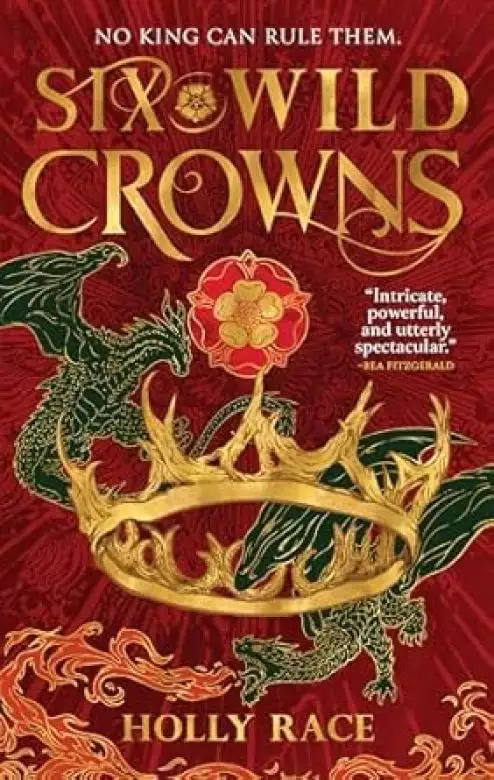
From a major new voice in epic fantasy, Six Wild Crowns is a breathtaking epic fantasy of dragons, courtly intrigue, sapphic yearning, and the wives of Henry VIII as you've never seen them before.
As tradition has it, the king of Elben must marry six queens and magically bind each of them to one of the island's palaces or the kingdom will fall.
Clever, ambitious Boleyn is determined to be her beloved Henry's favorite queen. She relishes the games at court and the political rivalries with his other wives. Seymour is the opposite - originally sent to Boleyn's court as a reluctant spy and assassin, she ends up catching Henry's eye and is forced into a loveless marriage with the king.
But when the two queens become the unlikeliest of things - friends and allies - the balance of power begins to shift. Together, they uncover a dark and deadly truth at the heart of the island's magic. Boleyn and Seymour's only hope of survival rests on uniting all six of the rival queens - but Henry will never let that happen.
Release date: June 3, 2025
Publisher: Orbit
Print pages: 432
* BingeBooks earns revenue from qualifying purchases as an Amazon Associate as well as from other retail partners.
Reader buzz
 Please log in to recommend or discuss...
Author updates
Six Wild Crowns
Holly Race
She had the seamstresses cut the bodice low on the shoulders, so it looks as though it could be pulled down her frame with one strong tug. The tailors avoided each other’s gaze as they pinned the silk and measured the trim, but she didn’t care. She is determined to make the most of her long neck and the dips above her clavicles, the places the king likes to kiss when they’re alone and, sometimes, scandalously, when they’re not.
They tried to fleece her on the train. “I want it to flow down the aisle,” she had told the seamstress. The seamstress claimed she had measured the length of High Hall’s sanctuary, and presented her with a receipt for thirty yards of velvet, but she knew, as soon as she saw that figure, that the woman had guessed at the length. That, or she was deliberately disobeying her. She had measured it herself, after the king proposed. The Royal Sanctuary is forty yards long, so she made the seamstress buy an extra twenty. Let the train flow out of the door, so they have to keep it open. So anyone passing by can see the two of them, and see how much the king loves her.
Even here, in the queen’s chambers of the largest building in Elben, the train can barely be contained. Elben’s monarchs are always married at High Hall – the one palace in the kingdom that is the king’s alone, unshared with any of his consorts. She has been here a handful of times, and even then she was only permitted in the lower levels – the halls and galleries reserved for lesser nobility. To be here, on the third level, to now have her own wing of the palace, is a sign of how very far she has climbed.
Her sister fusses around her hair.
“Boleyn,” she says, “You must have it up. I’ll fetch my maid – she can braid it very beautifully.”
“No.”
“It’s not right to keep it down.”
“I said no, Mary.”
Henry loves her hair loose. It reminds him of that first hunt, when her hood snagged in a branch and was torn off, and she kept riding anyway. The hunt where she caught not just the finest stag on her father’s estate, but also the king’s eye.
Mary chews her lip but relents, stepping back to let Boleyn’s maid finish brushing the dark locks. The girl fetches a bottle of oil and rubs a little on her fingers before smoothing them over Boleyn’s hair, paying particular attention to the ends. The smell fills the chamber – marjoram and something warmer – clove, perhaps. Sweet with a sting. The scents seep into the ancient beams that arch over her, carved with whorled figurines and roses. They even flavour the fire.
She thinks: this is the smell of my wedding day. I will remember this scent for the rest of my life. Suddenly, Boleyn feels as though she can’t breathe. The room is stuffy, too full of bodies.
“Make them all leave,” she tells Mary, and a moment later the maids fussing around her train and polishing the coronet are shepherded out. Boleyn goes to the window and inhales the draught. From here she can see the wild gardens and fishing lakes of High Hall and, beyond them, the distant Holtwode that blankets most of Boleyn’s future territory. She cannot spy the coast, or the towers of Brynd, but if she looks hard enough she thinks she sees, on the horizon, the bruising flicker of the bordweal: the god-given cocoon that protects the island from its enemies. Her chest loosens. She is going to be part of that cocoon. Part of Elben’s saviour, part of its legacy.
Mary returns, gentler.
“Don’t be nervous,” she says. “The king adores you.”
“Of course he does.”
Mary tugs Boleyn’s hair. “Shall I let George and the others in?”
“No. Let it be just us, for a moment longer.”
“All right, Your Majesty.”
“Berevia, mun ceripucun.”
Thank you, my pretty maid. The allusion to the Capetian queen’s nickname for the sisters when they served under her makes Mary laugh. They both used to bridle at the pejorative implied in maid, for pucun can mean both virgin and servant.
Mary leans over Boleyn, so her head is resting on her sister’s, and they stare into Boleyn’s mirror together. Two pale faces stare back – one full-cheeked and framed with gold; the other all shadows. One all honeysuckle sweetness; the other cedar wood and smoke.
Boleyn runs her hands over the crystals on her bodice, each one worth more than her entire dowry would have been had she married a man who required one. Silently, Mary fetches the coronet from its pillow and settles it on her head. It’s heavy for such a slender object, but Boleyn’s dark hair offsets the silver. Boleyn watches her sister, dressed in her widow’s black, in the mirror, and even though Boleyn is so, so happy and so, so in love, a sadness creeps across her. Mary has been her companion since childhood. The sun to her moon. Soon Boleyn will be swept up in her royal duties, and no matter how much favour she bestows upon Mary and her children, a growing distance is inevitable.
“Well, I suppose I’ll never be as beautiful as Queen Howard,” Boleyn says to fill the void.
“You don’t need to be,” Mary replies, smoothing the hair that has rucked up beneath the coronet.
Mary’s right. Boleyn has her hair, her neck, and her mind, and Henry fell in love with all three. The rest of her – thin lips, thin body, skin that never seems to hold any colour – will never be considered beautiful on this island. But she doesn’t need to be the most beautiful Queen to hold the king’s attention. Haven’t the last few months proved that?
A servant peers round the door. “My lady, it’s nearly time.”
“Are the ambassadors waiting?”
“They are all here.”
“Let them come in.”
The servant opens the door fully to reveal a packed antechamber, full of courtiers who have travelled to the centre of Elben to pay their respects to the newest queen. Mary busies herself with Boleyn’s train, pulling and heaving at the fabric to show off its length. Their family is waiting eagerly. Dearest brother George, bouncing on his tiptoes as he talks to his spouses, Rochford and Mark, and their parents, more reserved. Their mother smooths her dress, which is far finer than the gowns she’s used to wearing back at home, and their father puts an arm on her waist, muttering reassurances.
Boleyn ignores her family for now, instead paying attention to the five veiled women before her. Each one accompanies a gift – some small and wrapped in finely embroidered silk, and one so large it is carried by four servants. They curtsey in unison. Boleyn could so easily have been one of them. Before her engagement, she matched their rank – the almosts, the good but not the best. The ladies-in-waiting. In waiting.
Boleyn has never been good at waiting.
The first lady, dressed in the silver tulle of Queen Howard, offers Boleyn her queen’s gift and steps back, her hands coming to rest over her stomach. The tulle doesn’t suit this woman, and the poor thing knows it. She would have been better served in the subtler linen of Queen Parr, whose fashion would flatter this lady’s curves. Howard’s style is unforgiving.
“Oh, queen to be, I bring you a gift from Queen Howard of the Palace of Plythe. She wishes you great joy in your marriage to our king.”
Boleyn has been drilled in the correct reply. “I, Boleyn, soon to be consort of the Castle Brynd, thank Queen Howard for her gift and her wish, and hope to be a proper sister to her hereafter.”
The lady-in-waiting curtseys again and Boleyn passes the gift to Mary, who opens it on her behalf. Inside is a lute, with strings made from the vocal cords of the whales that patrol the river below the Palace of Plythe. Boleyn is impressed. Everything she’s heard about Queen Howard is that she’s an unthinking, flighty woman. The lute is frivolous but far from thoughtless.
The other ladies-in-waiting take their turns to step forward, offer their queen’s good wishes and a gift – a book of healing herbs from Queen Parr, the cover made from iridescent dragon leather; a jewel-encrusted headdress from the ailing Queen Blount of the Palace of Hyde; and, in the crate borne by servants, a dragon with a coat of silver from Queen Cleves. No annoying little lap dragon, this, but a guard dragon about the size of a greyhound. Boleyn thanks them all, and reckons she sounds very noble doing so.
Last comes the chosen ambassador of Queen Aragon, the first of Henry’s queens, married mere weeks after his ascension to the throne, twenty-four years ago. Aragon dresses all her ladies in heavy fabrics, the kind the Boleyns use as curtains. This lady looks as though she is buckling beneath the weight of her gown. If she’d only stand straight, she would tower over Boleyn, but her shoulders are curved in a constant apology. Boleyn can’t get a good look at the face beneath the veil, but when the woman curtseys, one hand resting over the other in her lap, she notices how the pale pink of her fingernails stands out against the tan of her skin. The lady isn’t holding a gift.
“From Queen Aragon I bring you the wish of friendship,” the woman says, her voice barely above a whisper.
Others have noticed her lack of gift too. No one knows what to do. This is unprecedented. The Queens of Elben are rarely friends but they do have to observe the customs. Boleyn refuses to show that she’s thrown by this, raising her chin and pasting on a smile as she considers Aragon’s reasons for such a snub. It can’t be her family’s status – Aragon and Cleves are the only two queens who come from royal blood themselves. The other three queens were raised from lower-born families than Boleyn’s. Is it Boleyn’s association with Capetia? Aragon, a Quistoan princess by birth, is naturally inclined against Capetia, but surely not enough to merit such a publicly hostile declaration.
Boleyn realises, with a glow of triumph, what this must mean – that of all the consorts, Aragon sees her as a true threat, and means to put her in her place. Well, she’s equal to that.
“I thank Queen Aragon for her wish, and desire that you should choose whichever of my gifts here that you think she might enjoy the most. It saddens me that a queen of such rich lineage should be unable to fulfil a tradition. It must hurt her greatly, and I wouldn’t wish to see our oldest and first of sisters brought so low.”
Boleyn doesn’t need to look to know that her brother, George, is smirking. The other ladies-in-waiting fidget in embarrassment, or excitement.
“Careful, B.,” Mary whispers. Boleyn knows she’s skirting the edge of decency, but this is all part of the game of court – knowing how to turn a phrase so that those listening can construe it in different ways. She learned the art in Capetia and regards it as the most precious part of her education. Played well, it can make you feared and admired. It can even make you queen.
“Oh,” the lady says. “My apologies, Your Grace. Queen Aragon did send a gift. She sent me.”
Boleyn stares at the mouse. “You?”
“She says…” The woman pauses, trying to recollect the exact words. “She says that the queens of Daven and Brynd should be the closest of sisters, and in recognition of this she sends you her most loyal attendant.”
“I see.” Boleyn’s theory was correct. Aragon does see her as a threat. “How very thoughtful. A new friend is the best and greatest of gifts. I welcome you into my household…?”
“Seymour,” the woman says, curtseying again.
“Lady Seymour.”
So, she’s going to have a cuckoo in her household. If this Seymour is Aragon’s spy, she must be made of stronger stuff than she looks.
Seymour’s brothers have always claimed that they can smell her monthly blood. They have a litany of ways to describe it: musty, putrid, mouldy; like a damp tapestry or a fresh kill. She wonders if the other ladies here can smell it too. The wad of fabric tied between her thighs feels as claggy as the sweat beneath her armpits. Usually she loves the beautiful, embroidered fabrics of Queen Aragon’s uniform, but when she’s bleeding she wants to peel them off and run breezy in her shift. That’s what’s going through her mind when she steps forward and bungles what she’s supposed to say.
She should have included the fact that she was the “gift” – and what a poor gift she makes – from the start, so Lady Boleyn wouldn’t think that Queen Aragon had slighted her. The way Boleyn tightened should have made her realise immediately, but as usual she’s slow on the uptake. She has her suspicions as to why Aragon decided to gift a lady-in-waiting to Boleyn. What perplexes her is why Aragon has chosen her. Why not choose one of her inner circle? A daughter of one of the women who came with her from Quisto, perhaps. At least choose someone with intelligence, then mistakes like this would not happen. Or maybe the act of giving Boleyn her most uninspiring of ladies is the insult.
After the gift-giving, Seymour moves to the side of the chamber and watches, which is the one thing she’s passably good at. The formalities over, other members of Lady Boleyn’s new household are permitted to approach her. From beneath the veil, Seymour can look at her as much as she likes. There’s not a person present whose gaze isn’t drawn to her. Seen objectively, Lady Boleyn should be one of the last women in the room to be noticed. No artist would choose her as their muse – she’s too narrow and her features are too sharp. Her magic lies in her living. The grace with which she moves and speaks; the way she is so solidly present in her body. When she looks at someone, she gives them her entire attention. It is a rare and bewitching trait.
Boleyn’s brother and sister surround her, touching her bodice and bolstering her train, making a grand show of admiring her and, what’s more astonishing, meaning it. For all that Boleyn shines brightest, there is an open, easy complicity between the three siblings that brooks no disdain or jealousy. George’s spouses approach and are absorbed into the circle of confidants. Seymour has noticed Rochford around High Hall – she is always restrained, always watchful, in contrast to her husbands George and Mark, who have a reputation for being raucous.
“You must insist on it,” Boleyn’s sister says. “A fortnight. Nothing less.”
“Mary, you’re being too much,” Rochford says. Mary. A name purely for her, not like Boleyn or Seymour or Rochford, the brands of the first-born daughter to make sure everyone knows who their fathers are even after they take their husband’s last name.
“It will depend on how the war with Alpich goes,” Boleyn says, looking past her siblings to the gardens beyond the window. “He may need to return to his army. He must serve the kingdom.”
George places his hands on his sisters’ shoulders. “Cynn æ hredsigor.”
King and victory. The Boleyn family motto, as though their ancestors had foreseen this day.
The new queen reminds Seymour of a bow, the arrow already fitted: taut, dangerous, elegant. She wears her wit the way Seymour wears her veil. Comfortable armour. But there’s also something blunt about her. It must come from her time in Capetia, because it is certainly not Elben behaviour. It’s undoubtedly part of what makes her so interesting, but Seymour wonders whether such entertaining audacity might become tiresome after a while. It must be exhausting to perform.
In the very centre of High Hall, a bell tolls. It’s followed by the sound of music – a choir of young girls singing the traditional royal wedding madrigal. It’s so faint that it could be birdsong, heard on the brink of wakefulness. Seymour likes it at this distance – heard close the song is too aggressive for her liking.
Without instruction, Seymour and the other four ambassadors move to their appointed spots along Lady Boleyn’s train. It’s grotesquely long, Seymour doesn’t know what she or her seamstress were thinking. She tries not to catch the eyes of the others in case they all descend into laughter. Boleyn herself seems momentarily to be aware of how ridiculous it is, especially when she almost trips over the fabric. She regains her composure, and glances at them. Ambassadors are generally chosen for their tactfulness, so they play their parts perfectly. Eyes downcast beneath their veils, hands cupped over their stomachers. Boleyn turns at the door to address the room behind her and the crowd assembled in the antechamber outside.
“Shall we get married?” Boleyn says. Her voice is higher than normal, her hands fingering the objects on her pomander. There’s a brightness to her features though – these aren’t the nerves of a reluctant bride.
Another clot pushes its way into the cloth between Seymour’s legs as they process through the palace. Boleyn’s consort chambers are in the north-east wing, in accordance with her station as the queen-to-be of Castle Brynd. The Royal Sanctuary is situated on a higher floor, just beneath the king’s rooms at the very apex of High Hall. The procession must pass through the centre of the building – the series of halls and chambers that make up the spine of the palace. Each one contains a different assortment of courtiers – politicians, knights, artists and performers. Some of them are loyal to a particular queen, some to a political persuasion and some to one of the empires across the sea.
The other ladies-in-waiting begin to amass coteries. Foreign ambassadors and courtiers flock to Howard’s lady because, as the youngest queen, she is most likely to bear an heir. Seymour knows that this is why she and Cleves’s lady are largely left alone – Aragon is now past childbearing age, and with the new, Capetian-allied queen in the ascendant, Aragon’s Quistoan heritage makes her favour a gamble, and it is well known that the king rarely visits Queen Cleves. Even simpletons like Seymour understand the fundamental rule of Elben: without a male heir, the bordweal fails. Without a male heir, foreign powers invade. Without a male heir, Elben is lost. What puzzles her, though, are the lack of attendants to Queen Blount’s ambassador – Blount is still young, still in the king’s favour, or so she had thought.
Soon even the few courtiers keeping pace with Seymour drop away. Seymour is thankful for it. Queen Aragon still possesses some power, due to her royal lineage, but they’ve realised that Seymour is in no position to wield it. She watches anxiously for her own family, and with every chamber they pass through, she feels lighter. Maybe they’ve decided to stay away from High Hall today, or maybe they’re too busy scheming elsewhere.
The procession mounts the central staircase to the floor above. These higher floors are the domain of god and king and decorated according to the king’s taste. Initials are carved into the panelling – those of the monarch and his wives, entwined. In every window hangs an ornamental birdcage, from which canaries and nightingales warble, and the candles have been replaced by expensive lantern dragons that scamper around their cages in perpetual motion. The birdsong combines with the choir’s melody, which is louder now. The design of High Hall – a domed skep with six sides and a crowning turret – is such that the acoustics make distances ephemeral. When Seymour was a child, her nurse told her that the original architect designed it so there is a single spot in the king’s chambers from which he can hear the whispers of the quietest servants in their lodgings six floors below. Before Seymour came here, she thought it was superstition, like the myths of the sunscína – the fabled mirrors that permitted royalty to communicate across vast distances. Now, though, Seymour can well believe it. This is a building that is made for ears, whether by design or otherwise.
As the procession passes into another gallery, Seymour spots one of her brothers and feels her shoulders curling further inwards. Edward’s eyes land on her like a hawk on a sparrow. Seymour keeps her own on Boleyn’s naked hair. Unbidden, she imagines Boleyn winding it around her neck and pulling it tight, like deadly silk. The hairs on her arms stand on end.
Edward falls in beside his sister, so close that she can smell the hog he ate for lunch.
“Bare hair,” he comments, his eyes raking Boleyn’s back. “How common. Do you think she showed him her other hair to get him to the altar?”
“Shhh. People will hear,” Seymour says. She wants to shout at him to be quiet, but she’s never been able to stand up to either of her brothers. Besides, she’s still shaken by that image of Boleyn’s hair, by the way it shifted something in her stomach. She’s no prude, but an infatuation with the new queen would be excessively inconvenient.
“Blount’s on her own again,” Edward says, looking over at the third queen’s ambassador, a matronly woman in a deep grey veil. “The rumours must be true.”
“What rumours?” Seymour asks.
“She’s ill again,” Edward replies, making a slicing motion across his throat.
As if she’s heard him, Blount’s ambassador looks at Seymour across the expanse of Boleyn’s train. Her unhappiness is resigned and Seymour finds herself pulling back. So this is why she had so few attendants. For all that she will never be the brightest light at court, Seymour can sense a lost cause. It’s primal, especially in Elben where the death of a queen signals instability and the threat of invasion.
“They’re saying Gkontai warships have been spotted off the coast of Hyde,” Edward mutters. “They must be waiting. And the war in Alpich is going badly.”
“Remember what Thomas says about listening to rumours, brother,” Seymour says.
“Remember what Father says about women offering advice. Like a dog trying to write.” Edward reaches over and casually pinches the skin on the back of Seymour’s hand. She swallows her justifications and awaits what he is inevitably about to say. She’s stupid, but anyone who knows Edward can tell what his next scheme will be.
“I’d have preferred Plythe if we could be rid of Howard, but if Blount’s dying, Hyde would be better than nothing. You put yourself in his way, you hear?” Edward says. “Or don’t bother speaking to me again.”
They pass through a narrow gallery, and the sound of the choir becomes clearer. The doors at the end are already open. Beyond is the Royal Sanctuary, where the choir of angelic girls is assembled. Beyond them, at the head of the altar, waits King Henry in cloth of gold and purple, his eyes only for his new bride. How could he have eyes for anyone else? How could anyone? And how on earth is Seymour supposed to draw his attention when Boleyn is in the room?
Another clot slides into her cloth as Edward delivers his parting shot: “By the by – you stink.”
Every movement at court is a performance. This is the first thing Boleyn remembers learning, and the only knowledge that she reminds herself of daily. The Royal Sanctuary commands a display with its gilded formality. But when she sees Henry standing there, Boleyn forgets her mantra. She forgets the representatives from Capetia that she has been entertaining. She forgets the five ladies-in-waiting, the disdain and awe and jealousy she senses through their veils. She even forgets her own family, and all their practice. They had timed her walk to make sure she would reach Henry at exactly the right swell of the choir. But as soon as she sees him she flies up the sanctuary’s aisle, her hands outstretched for his.
It’s only when she stands opposite him – those eyes that always seem to be laughing, the soft waves of his hair, the whisper of divine magic that ripples across his skin – that Boleyn realises that despite the impropriety, it was absolutely the right thing to do. Henry’s grinning down at her: Not very ladylike, Boleyn. Desperate to make me yours, are you?
She tilts her head at him, silently replying: No more than you’re desperate to make me yours.
His grip tightens. Beneath his linen shirt, his arms tense. How she longs to push up those sleeves and run her hands along the ridges of his muscles, across his chest and down the tautness of his stomach, to revel in the hot balm of his magic as it plays across her skin as well as his. Yes, she wants to make him hers, as a dragon desires blood. She will always be hunting him, and he her. It was the way their courtship began, after all.
Slowly, the pews in the sanctuary fill. The royal family comes first – a handful of Henry’s cousins, his two sisters being abroad – followed by Boleyn’s family. After them are the high-ranking courtiers with their sable-trimmed doublets, and then the lower ranking nobility in crimson or blue damask. Boleyn clears her throat, turning away from her audience and towards Henry. In the silence that follows, she feels curiously aware of the space around her. The chapel is small, intimate, the huge stained-glass windows that line one side of it doing nothing to make it feel more spacious. It is busy, even without the mass of bodies filling it – every wall, every object is decorated or filigreed. In any other room, it would feel gaudy, but there’s a solemnity to the faded gold, the sad smiles of the statues looking down on them from the pillars. The only space that does not feel cluttered is the wall behind the altar, which is dominated by a pair of antlers, stark white and big as a man, that hangs from iron brackets.
Bishop More steps onto the dais. A chain, devoid of gems, seems too heavy for his slender frame. His cap hides a thick mane of dark hair. He avoids looking at either the king or the bride. He’s a well-known acolyte of Queen Aragon, despite his see lying in Boleyn’s new territory of Brynd. She wonders if Aragon is trying to pinch her between Lady Seymour and the bishop, to make her feel uneasy on her wedding day. If that’s the case, Aragon doesn’t know that Boleyn grows sharper with every such move. Behind More, two servants place a cage containing a ceremonial dragon about the size of a goat, pearl-scaled and meaty, on the altar. It is submissive, drugged with tincture of pypas, ready for the bonding.
More raises his arms to frame the giant antlers on the wall behind him. When he speaks, his voice is sonorous. “We are gathered here today, beneath His antlers, to celebrate the binding of the King of Elben to this honoured woman, the Lady Boleyn.” Boleyn stares into Henry’s eyes. It can’t have only been a few months since they met, since they fell in love beneath hazel trees.
The bishop turns to the antlers behind the altar, and raises his arms once more in supplication.
“Haehfaeder upyrdum, besiroth tusenunga debryd,” he intones. Highfather above us, we seek your blessing on this union. Old Elbenese is too guttural for Boleyn’s taste – she prefers the cradle-rock lilt of the Osharan languages – but More’s reverence lends the words a certain beauty. He turns back to the assembled guests, returning to the modern tongue: “Our precious island of Elben, the confluence and gem of the three oceans, has long been coveted by those who would strip it of its riches.”
Boleyn does not look away from Henry. She doesn’t want to see the Capetian ambassador scowling on a day when she – and he – should be victorious. She doesn’t even wish to see the discomfort of the Quistoan representatives. It may be tradition to tell the story of how Elben’s queens came to be, but More is being needlessly heavy-handed. Henry rubs his thumb across the back of her left hand. It will pass, he is telling her. It matters not.
“There came a time, in Elben’s youth, when it seemed as though our island might be overwhelmed and lost. Our verdant forests burned, our glittering mines turned to dust, our livestock and people slaughtered. The king, strong and fearless though he was, could not hold off our enemies.”
There is a rustling of satin and velvet as the foreign ambassadors shift in their pews. Boleyn knows precisely what they are thinking. It was the one point of contention between her and her hosts during her time in Capetia. No country likes to believe that their shared god favours another.
More opens the cage and the servants help him to lift the ceremonial dragon, still slumbering. Its scales wax cream and silver beneath the sanctuary’s candlelight. The only mark on its hide is a thin scar at its throat, where its vocal cords have been removed. The bishop brings the dragon to the altar, where the servants bind its feet and wings.
“In despair and hope,” More continues, “King Aethelred journeyed to the sacred mountains of Hyfostelle, and there he made a sacrifice before the great god Cernunnos.”
A servant brings More a plain, golden dagger. More raises it so that all can see, then stands over the sleeping dragon. The air in the sanctuary congeals around Boleyn.
“Beteoth tufolgestaella, Haehfaeder!” he calls, his voice echoing around the chamber. Protect your people, Highfather. More brings the dagger down upon the dragon’s stomach. The beast rears from its stupor, writhing. Its jaws stretch open in agony, but the only sound is the clanking of the chains against the marble altar.
It is the first time since entering the sanctuary that He
We hope you are enjoying the book so far. To continue reading...