- Book info
- Sample
- Media
- Author updates
- Lists
Synopsis
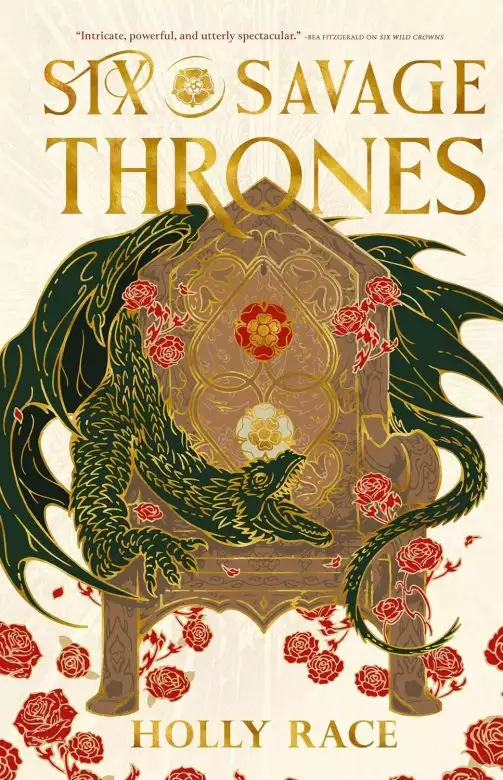
From a major new voice in epic fantasy, Six Savage Thrones continues the Queens of Elben trilogy, a breathtaking epic fantasy of dragons, courtly intrigue, sapphic yearning, and the wives of Henry VIII defying their destiny.
DIVIDED HE WINS, UNITED HE FALLS.
The kingdom of Elben is in turmoil. One of its magical palaces lies in ruins at the bottom of the ocean and the king is on the hunt for the traitor Queen Seymour. He will not stop until he brings her to her knees.
No one would ever suspect Queen Howard of treachery or spy craft, but she is no longer content to be the king's songbird. She will see to Henry's downfall. But there is a new gentleman at court, one who seems to know more about her true motives than he should - is he friend or foe?
Queen Cleves has already survived a war. She knows what she must do to protect herself, but now she finds herself fighting a longing for another queen that is so fierce it might swallow her up.
Amidst the turmoil, King Henry's sister Cecilia vies for the power she has been denied. But the queens will soon learn they must work together to break the bonds that tie them to the king. For Henry is delving deeper into strange old magics, ones that could birth a monster.
Release date: June 16, 2026
Publisher: Orbit
Print pages: 432
* BingeBooks earns revenue from qualifying purchases as an Amazon Associate as well as from other retail partners.
Reader buzz
 Please log in to recommend or discuss...
Author updates
Six Savage Thrones
Holly Race
Cecilia is taking great care over a new piece when her confidante Lorena Consego arrives, striding into her room without even the most perfunctory knock. The tapestry is intended for Lorena’s bedchamber – when finished it will cover the wall opposite her bed so that she can see it before she falls asleep and as soon as she wakes. The woman in the piece is unmistakably Cecilia: each hair picked out with long threads of gold; the same pale body, constellation-freckled with beads, long-limbed and round-stomached.
“You are ruining the surprise,” Cecilia says. Lorena’s hair is bound in two long, black plaits knotted tightly around her scalp, revealing skin so richly brown it makes Cecilia quite jealous. There are fine wrinkles around her eyes and forehead that make her look a few years Cecilia’s elder, even though they are of an age.
“My apologies, Your Highness,” Lorena says, barely glancing at the cloth. Cecilia does not like that. She thought it would elicit a reaction from Lorena: either disapproval at the hint of bare leg on the portrait, or at the very least false gratitude.
“What is it?” she says, trying to keep the petulance from her voice.
“A letter from the bishop. I thought you would want it immediately.”
Cecilia does not like this either. Lorena knows her too well.
“Read it to me,” Cecilia says.
She selects a new needle – a thicker one, designed to give height – and loops deep pink thread into the tapestry, directly above the line of the gown. A hint of nipple, standing erect and proud from the canvas. Surely this will shock Lorena. She is tempted to lick it, but that is going too far, even for her. Besides, it wouldn’t taste nice and she makes a point of not putting anything in her mouth that she doesn’t find pleasant.
Lorena has not seen the addition yet; she is too busy breaking the wax seal – the two horns of Cernunnos indicate the letter comes from a religious man. Bishop More is the only man of God who would ever write to Cecilia.
Lorena clears her throat.
“Your Highness, dear Cecilia,
“Your most recent missive gave me great joy, and I must admit made me smile – it is rare to hear so quickly from you. While I do not condone your interest in worldly gossip, it is difficult to resent it if it means our correspondence is more frequent.
“Your shock is understandable – while it has been several months since the death of the Boleyn traitor and the disappearance of the Seymour girl, the reverberations of their actions are still felt across your home country. Your brother, I believe, takes it very hard. As you know, he is a great romantic and the betrayal of two loves has been a heavy blow. I can only be thankful that Lady Boleyn perceived her end was inevitable and made the choice to take her own life – in that at least she spared Henry the pain of executing her. May she and her lover be tormented for eternity by the wælcyrge of hell. To commit treason for the sake of a poor and, if I may say so, barely talented poet is unthinkable to me.
“But enough of my verbosity. I can picture your expression at this moment: you will be rolling your eyes. ‘Enough moralising, you tiresome old man!’”
Cecilia snorts. She lays her needle just so next to the others, then straightens, cracking her aching shoulders. She goes to the fireplace and throws another acelath rock into the cold flame. A chill gust blows around the room, leaving icy patterns on the marble walls as Lorena continues:
“The king has this very day returned from Capetia with Queen Parr. I believe his discussions of an alliance between the two countries was fruitful – your brother could charm a fairy from its nest if he set his mind to it. And I bear further news still. Indeed, this is news that may pertain directly to you, if you are so inclined. I do not think that Lords Cromwell or Wolsey shall mind me sharing this with you (whichever of their servants are reading this letter – is it you, Oswald? Or is it Nicholas this time? – I direct you to send it immediately to the Lady Cecilia, and if your masters take issue with the contents, I pray you direct them to me).
“My news is that the surviving traitor, the Lady Seymour, is rumoured to be travelling to Perfugi. The king, as you can imagine, is keen to see her arraigned for her crimes. As to her motives for coming to Perfugi – who knows? But if you are the same girl I once knew, full of curiosity and spark, who caused me so much trouble before you married your late royal husband, I think you will be just as eager to find the Lady Seymour as your brother. You must know that the reward and gratitude of the king would be great indeed should you manage to find her.
I would only warn you that she may have with her a great beast: a black panther, which is large and dangerous. Be sure that you do not fall foul of the creature, for I would never wish to see you harmed.
“Yours, in fondness,
“Bishop Thomas More of Pilvreen.”
Cecilia thrums her fingers on the mantelpiece. The cold fire makes her gown – thin silk, unlike the heavy articles worn in Elben – move like water.
“So she is alive after all,” Cecilia says.
Lorena passes the letter to her with a dipped curtsey.
“I wonder how she has survived for so long,” Lorena says.
“The Feorwans, I imagine,” Cecilia replies, examining More’s handwriting. “They helped her to escape Elben. They must have been helping her all this while.”
“Your brother will not like that.”
“No.”
This explains the tales she has heard of Elbenese raids upon the Feorwan Isles. She rarely pays attention to matters of international politics, which are too broad and impersonal to hold her interest, but that she did find curious. The Feorwan Isles have been under Elbenese rule for a century or more, and it is unlike her brother to exact punishment needlessly. Now it makes sense – Henry is ensuring their loyalty.
Lorena edges closer to Cecilia. “Would you like me to rub your shoulders? You have been long at your work; your back must be aching.”
“Do not fuss over me,” Cecilia says, striding past Lorena and sitting back in front of the tapestry, tossing her hair over her shoulder. She throws Lorena her most scornful look. “You are being a mother. You know what I did to my mother.”
“Yes, Your Highness,” Lorena says.
“What did I do to my mother?”
Cecilia wants to hear her say it.
“You killed her, Your Highness.”
“I did. I killed her.”
Lorena bites her lip. If she says what Cecilia knows she wants to say – you were a baby, she would not resent you her life – Cecilia will drive the needle into Lorena’s arm. There is a litany of pinprick scars across Lorena’s skin from many years of displeasing her queen. Cecilia would rather like to see whether there is a point at which Lorena will break. She has not found it yet. One day. One day, when she no longer desires her company, she will find that point.
Cecilia picks up her needle once more. Her shoulders are aching.
“You may rub me, I suppose,” she says.
Lorena stands behind her, studiously not looking at the tapestry. She begins to rub Cecilia’s shoulders, just the way Cecilia enjoys. Cecilia sighs, then she groans, knowing the sound will make Lorena uncomfortable.
“Would you like me to engage the doctrini?” Lorena says.
“Six.”
“So many for one woman?”
“Are you ignorant? Do you not recall what More said about the panther?”
Lorena increases the pressure on Cecilia’s shoulders.
“I am a little afraid for her,” she says.
“You know as well as I that people are far better weapons than swords. In my hands, at least.”
“And now I am very much afraid for her.”
Cecilia holds up a hand. Lorena stops and moves to one side so that she can be seen.
“You have not commented on your present,” Cecilia says, angling her head towards the tapestry. Lorena looks reluctantly, and Cecilia takes the opportunity to reach out and flick the embroidered nipple, watching Lorena’s reaction all the while. Nothing. Even worse – a flash of boredom.
“It is beautiful work as always, Your Highness. I am fortunate indeed to be the recipient of such generosity,” Lorena says.
Heat rises in Cecilia. “You are in my space,” she says. Lorena steps backwards and sinks to the floor. “Forgive me, Your Highness.”
Anyone else and Cecilia would have cut off their hands, or hobbled them. But then Lorena has always known how to appeal to Cecilia’s softer instincts; has done ever since Cecilia met her on her first night on foreign soil, days before her wedding to the strange, ailing king of Capetia. He had gifted Cecilia seven ladies-in-waiting, and Lorena with her purring accent, not quite Capetian, not quite Perfugian, had understood immediately how to wrestle with Cecilia’s wit. Lorena, the widowed Duchess of Giralve, with her voice like steel and her posture like the ancient oak trees that line High Hall’s pathways.
Cecilia flicks her wrist, dismissing the woman. Lorena backs out, her eyes lowered. By the time she reaches the door, Cecilia has thought of another way to needle her.
“Send your brother to me,” she says.
The ploy works, no matter how hard Lorena tries to conceal it. In the little flash of her eyes, Cecilia reads hatred, disappointment, fear and resignation. But Lorena only says, “Of course, Your Highness,” before excusing herself.
Cecilia examines the tapestry. Days of work, and now when she looks at it, all she can see is Lorena’s boredom. She selects the one knife in her collection of needles. She punctures the tapestry in silence, first the face, then the nipple and the hint of bare leg. It isn’t enough. Her stabs turn to slashes, until the whole piece is fluttering ribbons.
By the time the boy Florin slides into her room and bows, she has worked up an appetite.
She is far too busy to attend to the artist. A queen’s territory is like the innards of a clock: intricate, each part relying on the other to work correctly. And the queen must be at its centre. So it is with Cnothan: her pile of correspondence is extensive.
The artist sighs.
She has another letter from Ezzonid: I am already at the docks, cousin, so there is no point in telling me to turn around. Your missives will not reach me. With a fair wind, I shall reach your little castle…
She bites her lip to keep from swearing. Any guest, even family from her homeland, is unwelcome. She does not need people scurrying around her castle peering into her business. She sets the letter aside, since it requires no reply, and casts her eyes over the next.
I have something of a cough at present, and have been forced to take to my bed. I find my mind wandering to the past as I lie here…
Lady Paston – her first and, for a long time, only vulnerability. She must give her response proper thought.
The artist sighs again.
Cleves pulls her glasses from her nose and leans back in her chair, observing the man who sits with charcoal-sooted fingers in the corner of the room.
“Is my pose not to your liking, Master Holbein?” she says.
The man smiles apologetically. “I simply cannot draw you flatteringly at such an angle, Your Majesty.”
“And what makes you think that I would concern myself with flattering angles?”
“Everyone prefers to show the best of themselves, do they not?”
She supposes she must give him credit for saying “everyone” rather than “every woman”, but then again the people of Avahuc do not concern themselves with gender, so perhaps it is merely cultural.
“I believe that actions, not appearances, show the best of a person.”
Master Holbein offers a little seated bow, and his canvas – a piece of blue-washed paper secured over a wooden board – dips with him, offering a tantalising glimpse of his sketch. “And the best of my action lies in the mastery of my art, Your Majesty.”
Cleves laughs. She puts her glasses down upon the pile of parchment – accounts, correspondence, pleas and offers. She studies Holbein more carefully.
“You know I have no desire for this portrait. My husband is the one who commissions you,” she says.
“This is true.” There is a frown line between his eyes which grows deeper as he speaks. He is stocky, clean-shaven, and the only mark of status he wears is a single gold chain around his neck. His skin is a warmer brown than hers.
“Correan aspa pir esperido,” she says, stumbling over the lisp of the accent.
Holbein gasps, then grins. “Her Majesty knows my language?”
“A very little,” she says.
What follows is a stream of words in Avahucian. She barely recognises two of them, and can no sooner guess at his meaning than she can guess at the notion of enjoying lovemaking with a man. She laughs again. “Stop, sir, I beg of you. Do you mean to humiliate me to my face?”
Holbein covers his eyes with one hand. This she finds curious too – is his over-gesticulation nature or performance? The former, she decides.
“My humble apologies,” he says. “My homesickness made me eager for conversation in my native tongue.”
“If you answered my question in your native tongue, I am none the wiser,” she says.
Holbein licks his lips. The question she asked him in his own
language – “has my husband not commanded you to make me appear ugly?” – should make him nervous. He cannot very well admit to it if those were Henry’s instructions.
“I believe His Majesty wishes to circulate a variety of portraits of his queens for the pleasure and education of the people,” Holbein says.
Nobility and royals across the known world have always done as much. It is a way of offering a connection between subjects and their rulers. It cements status, for if one is deemed influential enough to have a portrait – and to have that portrait replicated in multiple great houses – then one must be influential indeed. Recognition is power.
Artists like Master Holbein have amassed fortunes on their ability to take a likeness that flatters while reflecting the subject’s true features. She doubts that many of his patrons have ever requested that he make his subject less attractive.
“You take pride in your work,” she says.
“I do.” He hesitates, and she leaves him space to talk. Cleves has several talents, but one of her greatest lies in being able to put anyone at ease, no matter their rank. “There is a moment in the process where I know – aha, I have got them. Captured their essence. It might be a little fold in the chin, or a certain sharpness to the eye, or the texture of the skin. But once I have that, all else flows from there. The sensation when that happens… it is glorious, Your Majesty.”
Cleves leans forward, her elbows on the table. “And what if that is denied, or you never get that feeling?”
“Then I am very unhappy. I do not like those portraits to be seen.”
“But sometimes they must be. Sometimes I imagine your employer prefers the portrait that does not contain the… essence.”
Holbein juts his chin. “I have never permitted that to happen across my whole life.”
She sees the conflict in his eyes – he does not need to confirm his instructions from Henry. It is imperative to Elben’s king that Cleves be perceived as a joke, a failure, an abomination. Such humiliation
is designed to keep Cleves in line, to remind those loyal to her that she can never be taken seriously as a ruler. A woman scorned can harbour no thoughts of rebellion or defiance.
Here, in Holbein, is a man who wishes to reflect the truth of her, but whose paymaster wishes him to tell a lie. Which shall it be? Integrity or survival? Cleves knows which she would choose, but Holbein is one of those rare humans who will stake all on integrity. There are more of them around of late. Queen Boleyn. Queen Seymour. Look where it led them – death and exile. Strange, poor creatures. She will never be one of them.
Her eyes land on the papers before her. The one on top is a report, in her master of horse’s scrawl, on the latest additions to her menagerie and their associated costs.
“Follow me, Master Holbein. I have a scheme that will make all parties contented,” she says.
She has never had a throne – the royals of Ezzonid have not settled for such things for nigh on twenty years – but she has her servants carry
a sturdy wooden chair from the banqueting hall into her receiving chamber. The space is, like the rest of Cnothan, a mishmash to its core. She has adopted the Ezzonid manner of painting elaborate murals onto the ceilings. She looks up at skies of palest blue and pink, rimmed with clouds and fharah – the many-coloured, troublemaking birds that are a common sight in the wildernesses of her home country. But the floor is Elbenese terracotta, made by artisans in the neighbouring town of Cnorgleo from clay taken from the riverbanks of the Fietherford.
Holbein sets up his easel in the centre of the room, facing the chair. Cleves settles into the seat, plumping the cotton sleeves of her blouse and smoothing her burnt-ochre gown. She pats her hood, making sure that her hair is tucked beneath it properly. She does not usually wear hoods, the informal nature of her castle not demanding it, and her hair rarely cooperates when she attempts to cover it. She perches the glasses on her nose. She does not require them unless she is reading, but they will contribute to the look.
“This is excellent,” Holbein is muttering. “Straight on, so you are looking at me directly. No games. This might be it.”
“Not quite, sir,” she says, and gestures to Fergus, her master of horse. He is leaning against the door frame, watching the affair with his usual sardonic smile. He moves aside and ushers in an assortment of animals. A single hunting dragon, a handful of small pigs, two greyhounds, a horse and six or so ferrets.
“Come to me, friends,” Cleves says, patting the bottom of her skirts. Holbein watches, eyes wide, as one of the pigs and a few ferrets settle themselves in her lap. The horse nuzzles her shoulder from behind, and the rest gather around her on the floor.
“Where is Lelij?” she asks Fergus.
“Behind me. He’s shy today.”
From the doorway, a snout appears, sniffing the room. Cleves clicks her tongue several times and holds out her hand. A servant places a segment of orange onto her upturned palm. The snout sniffs again, and then a head follows, and then the whole creature. It is a lopsided, crooked-limbed beast, with a tongue so large it lolls out of its mouth. It lollops into the room and swipes the orange segment, before licking the remnants of juice from Cleves’s hand.
“Here, Lelij,” she says, gently drawing the creature by its collar to sit at her feet, displacing one of the greyhounds.
Holbein stares at it.
“What is such a beast?” he says, kneeling so that he is at the creature’s own level.
“Come now, Master Holbein, surely you have drawn many gargoyles in your time,” she says, raising an eyebrow. He looks between her and Lelij, and then both he and she begin to laugh.
“Oh, very good, Your Majesty,” he says, patting his chest. “Very good indeed.”
He begins to work, his fingers deftly swiping the charcoal this way and that, taking a brief likeness of her and her pets for reference. When he returns to his studio, he will work the sketch up into a full painting. Cleves will look like the foreigner she is, in her Ezzonid fashion, her glasses rendering her bookish. Her animals will make her an oddity, will conjure the smells of unwashed fur and moulting hair. Henry will be able to overlook the fact that Holbein has painted her as she truly appears – clear skin, eyes like flint, regal posture – because he will be able to point to the gargoyle, that ugliest of beasts, at her feet. And he and his friends will laugh and compare the two. I would rather marry the gargoyle, they will smirk. And in their ridicule, Cleves and Holbein will both be safe.
“Yes,” Holbein mutters, his fingers moving faster. “I have you, Your Majesty. I have you.”
The fabrics cover the gallery floor, turning the wood to shimmering pearl. Howard kneels beside them, runs her fingers over them one by one. Damask and velvet and fine lace woven from the tiny silkworms of Thawodest.
“This one is like a cloud,” Ursula Askew says. She rubs the velvet against her face, her eyes closed, her smile mischievous. Howard forces herself to laugh.
“You should have it,” Howard says.
Ursula opens her eyes. “What?”
“What, Your Majesty.” Howard picks up a piece of lace and holds it to the light of the gallery windows, admiring the intricacies of the pattern.
“I have many such pieces. My lord father used to bring them back for me from his posts abroad.”
She avoids looking at her half-sister, Legh, who knows that their father never gifted anyone more than scraps.
Ursula hugs the bolt of velvet to her bodice and stares at her shadowy reflection in the glass of the windows. “May I really have it? Truly?”
Howard lowers the lace. “It will suit you well. Pair it with your green sleeves and it will make a beautiful gown.”
Ursula does not need to be offered a third time. She laughs, spins, letting the velvet whirl around her like one of the Elbenese flags atop Plythe’s turrets, buffeted by the wind from the Swegan Sea. Howard’s laughter is real this time. She does so love to please her ladies.
“Which one will you choose for the new queen’s gift?” Lady Tylney asks, ignoring Ursula’s squeals.
Howard forces herself to study the fabrics with Mary Boleyn in mind. The very thought revolts her: that she must offer something extravagant to the woman who betrayed Howard’s friend and protector, Mary’s own sister. And yet everything dictates that Howard must play the part of the pleasant queen, welcoming another into the fold.
“The silk,” she replies at last, stroking the fabric in question. Cool, smooth, expensive and inoffensive. Very fit for one such as Mary Boleyn, she thinks, and then worries that she is becoming uncharitable, and then worries that she is worrying, for if anyone deserves an uncharitable thought it is that bitch.
Oblivious to Howard’s thoughts, Tylney sighs. “Your judgement is impeccable, Your Majesty.”
“Let us order several bolts, and then we can begin the embellishments,” Howard tells her steward, who bows silently as he takes the silk. Howard notices the look he gives her ladies as they twirl around the room, trampling upon the rejected samples in their gaiety. She claps, then cocks her head to one side so they know she isn’t rebuking them. “Come now, you are making my steward frown.”
They all laugh, flocking to one side so that the servants can collect the fabrics. The little gold clock that sits at one end of the gallery chimes midday, and Howard detaches herself from her ladies. “I must to my lesson,” she tells them.
She is followed by a chorus of “Nay, do not leave us!” and “We shall be so dull without you!” but she does not believe them. When she rejoins them, they will be laughing, in the middle of some joke or jape. And she will have to join in with them, even though her heart will be breaking.
Voda Kelaverinn is the only one left in Plythe who knows the truth of her. Who knows that treachery has taken root in her soul. He alone knows that she is both more and less than her kingly husband thinks of her. He is her compass, and she must cast him out. It cannot be put off any longer. Every day that he stays at Plythe calls her loyalty to the crown into question, for he was secured as her tutor by Queen Boleyn, who is disgraced and dead.
Kelaverinn is sitting in his study, at the far side of the room that was once the palace’s library. Its long shelves are in a state of flux: half ancient, moulding tomes, half fine, new leather bought from the craftsmen in the towns surrounding High Hall or from masters on the
continent. There are few windows here, to prevent the sunlight or any sea-salty draughts from ruining the books, and Voda reads by candlelight despite the sun being at its zenith outside.
He looks up at her entrance, a smile spreading across his kindly face. Warmth spreads through her, as it did when her father ruffled her hair on one of his rare visits.
She is going to lose him. Unthinkable. Inevitable.
“I must confess myself excited to see what you make of this new poem I have found for us to study,” he says, seeing her to her chair. He has arranged them so that they are next to each other – no stuffy table between them. He tells her this is the way students are taught in Uuvek – where teacher and pupil can bend over a text in shared discovery. It is scandalous, but Howard has never attempted to create distance. She likes being close to him.
Her hand flutters over the manuscript. She picks out a few words – passion, fate, union – as if the poem is giving her permission. Her eyes fall upon a gathering of paper lying next to the manuscript.
“Are all of these poems for us to study?” she says.
Kelaverinn glances at them, then rests a hand upon the stack.
“These are from my family. My wife writes to tell me that our youngest is beginning his riding lessons.”
He goes on and on about his children back at home, and his wife and how wonderful she is. Howard doesn’t want to hear it.
“I must send you away,” she says, interrupting him.
He looks at her, suddenly quiet and still.
“I am sorry,” she continues. “But given… everything… it would not be prudent for me to… that is to say…”
“I understand,” he says. “I should have anticipated this. To be truthful, I should have suggested it myself, long ago, but I did not wish to leave you when you were just starting to gain confidence. My apologies for placing you in such an awkward position.”
She latches onto those words: I did not wish to leave you.
“It has been my honour to serve you and teach you these past several moons,” he says. His voice is so gentle, his eyes so kind.
She leans forward and kisses him, her mouth open, her tongue reaching for his. He stiffens then pulls back with an “Oh” barely breathed. They stare at each other. His hands are curled into fists against his chest.
“I thought…” she begins. Tears spring to her eyes, and she does not know what hurts the most: his rejection, or the realisation of her foolishness. Kelaverinn stands, putting distance between them.
“You are a very kind queen, Your Majesty. I am a grateful teacher.”
“Do you not think me beautiful?” she says.
He pauses, and his eyes are full of pity. “I think myself old.”
The unsaid hangs between them: And I think you young. He does not use his wife as a shield. That smarts more than anything else – she cannot tell herself that he is merely faithful. He simply does not see her as a match.
He is saying more, but she does not hear anything else, her head and heart thumping. She scrambles to her feet and runs out of the room, and does not stop until she is in her bedchamber. The room is hexagonal, and but for the door, the windows and a single large mirror, it is all softness. Cushions, throws, rugs and curtains, all of them thick and warm, the kind of fabrics one wishes to lose oneself inside.
How dare he refuse her? She is beautiful, she knows she is. It is all she is, all she has. It is a good thing you’re pretty, her father had told her when she was twelve. Good, but not enough.
And now he is not only leaving her – she has ruined his impression of her. She cannot fathom why she kissed him. It is not even that he is terribly handsome. He was, in that moment, an echo of a dream.
Howard bangs a fist against the closed door. It feels good. She does it again and again, until her fists are sore. She reaches behind her back and loosens her bodice, pulling at the stiff front until she can breathe properly.
There is a mirror at one side of the room, wide and tall. Henry sometimes fucks her up against it, so he can feel as though he’s fucking two Howards at once. She stares at herself. Her cheeks are wet with tears. A droplet hangs from the tip of her nose. All she can think is: Henry will not like me. He will no longer think me beautiful.
She presses a hand against the mirror and stares at the place where real joins fiction. In the seam between the two, she sees the truth. She has spent her whole life wrapping a vision of herself for others, making a gift of her body and voice, until she had nothing left for herself. And ever since Boleyn rode into her life, she has been unwrapping the layers of tissue. So many layers, so much wrapping, so much concealment to entice, to seduce, to please please please please please please please please please…
Where is she?
Cecilia wakes from her slumber with the suddenness of prey. Lorena is standing over her.
“They have found her,” Cecilia says.
Lorena nods. “The messenger arrived moments ago.”
The boy, Lorena’s brother, stirs on the other side of the bed and looks blea
We hope you are enjoying the book so far. To continue reading...