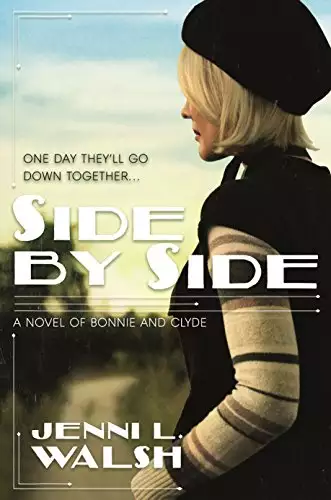
An audiobook about America's most infamous crime spree, told in the raw and honest voice of the woman who lived it, Bonnie Parker.
Texas: 1931. Bonnie Parker's dreams of the limelight and a white picket fence are on hold. She's a waitress in Dallas, endlessly writing letters to the governor pleading for the release of the man she loves: a reckless, quick-smiling boy named Clyde Barrow, sentenced to fourteen years at the notorious Eastham prison farm.
When Clyde is paroled early, Bonnie thinks their life is about to really begin. But Clyde has changed in prison. Distant, damaged, and dogged by the cops, he knows it's only a matter of time before the law tries to lock him up again. That's not something he or Bonnie can bear. When he's fired from his job—and now breaking parole—he decides to make a run for it. Leave Texas. Get enough cash to make a fresh start in a new state. And, of course, he wants his beloved Bonnie to come with him.
It's just one stolen car. One robbed bank. Then, they can have the life they always wanted. Or so they think, as they set out.
Unflinching and yet deeply empathetic, Jenni L. Walsh's Side by Side tells the story of America's most iconic outlaws.
Please note: Side by Side is Book 2 in the "Bonnie" series, but can be listened to as a standalone.
Release date:
June 5, 2018
Publisher:
Tom Doherty Associates
Print pages:
320
* BingeBooks earns revenue from qualifying purchases as an Amazon Associate as well as from other retail partners.
I’m a fool for busting Clyde out of McClelland County jail.
My fingers rest on the typewriter keys. It’s my own fault “Bonnie and Clyde” only exists in my head. That’s the way it’s been for nearly two years, ever since Clyde got caught again.
I breathe in, a cigarette clenched between my teeth, and the tip glows red. The smoke swirls ’round my mouth, escaping between my lips. I can right my wrong. We can be us again, if I can convince the governor of an early parole.
I snuff out my cigarette, glance ’cross the Barrows’ living room at Clyde’s daddy with a newspaper, and get down to business. I jab my fingers into the typewriter keys.
Dear Governor Sterling:
Letters ago, I searched for that colon. It took practice to remember to also hold down the shift key, or else a semicolon would blot onto the paper and I’d have to start again. Now both my pinkies know where to go. I press the carriage-return lever. The paper turns up and the typewriter screeches as it shifts to start a new line.
With my back ramrod straight, I begin.
I am writing on behalf of Clyde Champion Barrow, prisoner number 63527, to ask that his seven, two-year sentences be served concurrently, concluding at two years—
Ding!
I press the carriage-return lever. The paper feeds up. The typewriter screeches.
—as opposed to the mandated fourteen years.
Tears well up in my eyes, and I sniffle. The winter air feels too cold, even indoors, even with the fire crackling beside me. Mr. Barrow sets his newspaper aside to stoke it, a distant look masking his features.
On his behalf, I have secured a paying position.
I don’t feel even a lick of shame over that fib. If ya want a parole, a job is a necessity—and a challenge to find nowadays.
More words fill the page.
Profoundly remorseful.
Even if that’s not particularly true. I’d say Clyde’s more profoundly resourceful, ’specially with his quick hands—on cars, on safes, and on me.
Clyde’s daddy ain’t more than a few feet away, yet I can’t help trailing a finger up my thigh, pretending it’s Clyde’s touch. Eyes closed, through my dress, I cross the seam of my chemise, imagining Clyde working his palm beneath. He’d smirk. That boy is always quick to smirk. My lips quiver, fighting to keep my face from showing the fantasy running through my head.
I open my eyes, and the reality of where I am—and who I’m without—crashes into me. With renewed focus, I keep typing, line after line, trying to persuade the governor to let Clyde come home to me. Then I can start living again. Then Clyde can, after all he’s been through.
V—
I hold down the key, biting my lip, composing myself. I let up, and continue.
Viciously brutalized.
Buck, being Clyde’s older brother, struggled to relay that to me. His teeth grit and his breath held as he explained how guards are swift to beat Clyde. I cringed, imagining the guard patrolling on horseback around the grounds, smacking the butt of his rifle into Clyde’s back. A demand to work harder, faster. Clyde referred to life at the prison farm as slave labor.
“Stay in Dallas, darling,” he wrote to me, the letter typed. “I can’t have you seeing me like this.”
This.
What in God’s name does it mean? I’ve seen Clyde purple and blue, the aftermath of him stepping in when my deadbeat husband came back for me. What makes these bruises different?
I shake the thought from my head and focus on my letter.
I implore you to see Clyde as worthy of reconsideration, compassion, and clemency.
In closing, I add:
Respectfully,
Cumie Barrow
Clyde won’t let me sign my name, not wanting those guards who read our letters to utter it. His letters to me are addressed to Darling. Mine to him are signed Honey. Pardon letters are from his ma. She’s able to read and write just fine, but with both Clyde and Buck locked away, the poor woman’s heart is too heavy to find the right words.
The typewriter whines as I rip the paper free.
In her kitchen, I find Mrs. Barrow elbow-deep in a bird. After a quick wipe on her apron, she scribbles her signature with a pen. Clyde’s mama gives me the letter and a hug, her thick arms pulling me to her. “Thank you, sweet Bonnie.”
Then it’s off to the post office.
I ain’t more than two steps out of the Barrows’ apartment, tacked on to the back of their service shop, when I’m face-to-chest with my much leggier best friend.
“What’re you doing here?” Blanche asks.
By the looks of her, she’s seconds from plopping down her bag, changing from her beauty shop uniform, and crashing into her borrowed bed at her in-laws. Her daddy only lives a few miles away, but Blanche would rather be with Buck’s, being she hasn’t seen her own daddy in months on account of the new lady in his life. And her mama, she’s long gone. Over-a-decade gone.
I hold up the letter.
She nods, understanding. The way from here to the post office practically has a Bonnie path worn into it.
Blanche offers, “My dogs are tired as sin, but I’ll keep ya company if ya want.”
A little white something pops from the bag hung over her shoulder.
A little white head, to be more exact. “I’m more interested in that dog,” I say. “Where’d she come from?”
“He,” Blanche corrects. “I checked. And I named him Snow Ball.”
“Ah, ’cause he’s all white.” For once, Blanche has a perfectly reasonable rationale for one of her decisions.
She scrunches her brows. “No, ’cause this here dog is the start of something good. And more good will stick to him, accumulating more and more. I can feel it. I found him on my way home. No tag or anything, so he’s mine.”
“And Buck’s mama, she going to be all right with you keeping him?”
Blanche shrugs, a typical Blanche response. “Cumie can have some of Snow Ball’s good, too.” She nods to my letter. “Maybe he’ll help get Clyde home.”
’Cross the street, Old Jed whistles from his stoop, saving me from pointing out how that doesn’t make a lick of sense. Both laces of Old Jed’s ratty boots are undone. Really, it looks like Old Jed himself has come undone. But he’s still a permanent fixture in West Dallas. Always there, always hooting at the gals who scoot by.
I shake my head, taking one more peek at Old Jed as we head down the cracked sidewalk toward Elm Street. “Somehow, I bet ya that man outlives us all.”
Blanche loops her arm through mine. “As long as he’s got enough teeth for whistlin’, that’s fine by me.”
We both laugh, but quickly cough away our giggles as we pass a man curled up against a building. A Hoover blanket covers his midsection, leaving feet, arms, and a head exposed. I squirm out of my jacket and lay it over the newspaper that’s doing little to serve as an actual blanket.
Blanche clucks. “Bonn, that heart of yours is going to land you on the streets, too.”
I raise a brow in Snow Ball’s direction, then shrug. Maybe both our hearts are too big, but fortunately, working at the diner’s been kind to me after the stock market crumbled and the bank stole all I entrusted to them. Since, I’ve been squirreling away tips when I can, and I’ve got some clams in my pocket. Not a lot, but enough.
Too many others aren’t as lucky. President Hoover may claim the economy is fundamentally sound, and this depression is merely a passing incident in our national life, but I’m calling his bluff.
There. And there. Blanche and I pass one building after another that’s boarded up.
A pang of sadness hits me as we approach what used to be Victor’s, the soda shop Blanche and I used to frequent after school let out. I swallow, afraid to look ’cross the street from Victor’s to Doc’s. I’ll look at the three-story building, though. I always do, as if pressing on a bruise to make sure it still hurts.
It throbs: setting my eyes on the physician’s office, knowing that Dr. Peterson still practices inside those walls, but beneath the office is nothin’ but empty bathtubs and a dusty bar. Blanche and I used to secretly spend our nights there, serving bootlegs. I stood on the stage, feeling the heat of eyes and lights on me. In those moments, I allowed myself to think I could be somebody. That a somebody would see me up there and put me on a real stage on Broadway. Or maybe in a film, instead of my always watching from the crowd. I’d be somebody who was more than poor, somebody who would’ve made my daddy proud if he were alive to see it.
But no, our country went to hell, Doc’s and Victor’s crashing along with the banks. Everyone’s dreams are stuck in the mud, not just mine. Once in a blue moon, a gal gets discovered at a diner, but none of the fellas I’ve shown my pearly whites to have fancied making me a star. I reckon I should simply be happy to have a regular shift to work. Many can’t say the same thing. Took Blanche a while to find new work, grudgingly charming her way into the Cinderella Beauty Shoppe.
So yes, I’m calling your bluff, Mr. President.
Blanche’s gaze is higher up, on a third-story window where she once lived.
I ask her, “Miss it, don’t ya?”
“I miss him more.”
Buck.
The wind carries the faint sound of a bell and a ping of a coin into a kettle, and blows Blanche’s short hair ’cross her face. She tucks a strand behind her ear. Her wedding band, still shiny and new, catches the sunlight.
Blanche is someone who’ll always surprise me. Selfish yet caring. Impulsive yet levelheaded. She once threw caution to the wind, the one who dragged me into Doc’s in the first place. “But the wind’ll change directions on ya, Bonn,” she told me a few days ago. “It can all come back and hit ya square in the face.”
That’s why she sent her husband off to jail. “Buck,” she told him, “you got to go.”
While she once saw his arrests as scandalous and delicious, she now sees the police’s eyes on him as restrictive. Mostly for herself.
“Do your time,” she told him. “Get rid of those warrants out on you. Then no one will be after us no more.”
Two years ago, I should’ve let Clyde do his time after the law came for him.
But no, I couldn’t stomach him being away for five years, so I taped a gun to my upper thigh and smuggled it into the prison’s visitors’ room. Clyde’s expression was priceless. Astonished would be a word for it. He chuckled, dimples showing. “My God, Bonnie, what am I going to do with you?”
I wanted to beam at impressing my man, but I shrugged, and mostly feigned bravado at what I’d done. “Someone once told me that big things await us. But not in here.”
Goodness me, he did it. He escaped. We were going to run away together, hide out on a plot of farmland. He knows a bit ’bout tending one since he came from one. But Clyde, fresh out of jail, said it was too dangerous for me to go with him right away. He’d come back for me. The law stomped on that promise when they caught him two weeks later. Then there he was, facing fourteen years instead of five. Clyde would’ve been nearly halfway done if it weren’t for me.
I squeeze Blanche’s hand, as much for her as for myself. She jars out of her own memory and drops her gaze from the window of her onetime home.
“I hope you’re right about Buck finishing his time,” I say, “and having that fresh start.”
She says, “When is Blanche ever wrong?” I open my mouth. She adds, “Don’t answer that.” Snow Ball barks sharply. “Would you look at that; Snow Ball agrees.”
Really, I hope the same will apply to Clyde, and no one will be after him once he gets out. Then there won’t be a need to hide out on a big stretch of land. We’ll start anew in Dallas. But fourteen years … That’s a lot different than Buck’s year and a half. I’ll be thirty-five. I ain’t going to think where I’ll be or even who I could be with—’cause this here letter will work. I hug the envelope against my chest.
Clyde and I will have our chance at being free. Even if Clyde doesn’t believe it himself. “I’d leave all the stealing behind for ya, Bonnie,” he told me once. “But ain’t much I can do ’bout the name Clyde Barrow. You know I’m more likely to find a door in my face than a handshake.”
Maybe that’s how it’s gone in the past, but—for our future—I want to believe Blanche—and her dog. I kiss Snow Ball’s furry head, and then set my sights on the post office down the block. Outside, a man from the Salvation Army collects money. I finger a coin in my pocket. I’ll drop it in, for good luck.
This will be the letter to get Clyde pardoned. This letter will breathe life into the word free. He’ll come home to me. My life will no longer be stagnant. I’ll be moving forward, with Clyde.

 Please log in to recommend or discuss...
