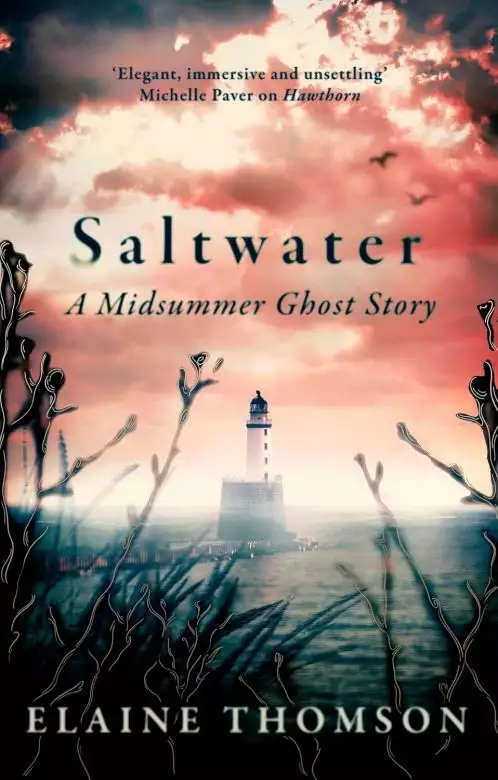
The second in a quartet of exquisitely haunting ghost stories set in the wilds of Scotland.
The Isle of Stroma, 1896. Tom Torrance has been sent to oversee the completion of a new lighthouse, which will guide ships through one of the most dangerous stretches of water in the United Kingdom. The construction so far has been plagued by difficulties, giving rise to superstitious whisperings amongst the men, but Tom is a man of sense and science. He will not be cowed by stories of hauntings and bad omens.
Yet Tom is unprepared for the conditions on the island: the isolation and delirium of the endless summer nights. He soon learns that the real dangers on the island have nothing to do with the wild waves. There are some problems that science cannot answer, and some threats so ancient and strange, that nothing can keep them at bay.
Release date:
June 18, 2026
Publisher:
Little, Brown Book Group
Print pages:
90000
* BingeBooks earns revenue from qualifying purchases as an Amazon Associate as well as from other retail partners.
I had travelled on the railway to the far north of Scotland many times. It passes smoothly over bog and muir, fording rivers and crossing firths, and is a miracle of engineering to which most who travel on it are quite oblivious. Take my brother, for instance. Jamie was travelling with me, the two of us sitting opposite one another in an empty compartment, and yet he was bundled up in his coat, fast asleep. Earlier, from Inverness to Invergordon, he’d had his nose in an anthology of Scottish poetry and had not once remarked upon the wildness of the terrain or the smoothness of the journey.
‘It smells of rotten herrings,’ he’d remarked. ‘Does everything stink of fish where we’re going?’
The train did have a fishy smell to it, occasioned by the cargo of lobsters, salt fish and cured herrings that it transported south from the fishing port of Wick in the far north-east. This, mixed with the sulphurous reek of coal and cinders that permeated the whole train meant that we were smoked and salted, like a pair of kippers, as we travelled north.
‘Yes,’ I said. ‘But one gets used to it.’
‘I will never get used to it,’ he replied. ‘Not even if you cut my nose off.’
I ignored him. Given that he was some twelve years my junior, and barely twenty-one years of age, perhaps such irreverence was to be expected. Besides, we had not yet reached Helmsdale and still had a long way to go. I had no wish to quarrel with him before we had even reached our destination.
We were bound for Huna, to the east of Gills Bay, some two miles west of John O’Groats. From there we would take a boat over to the isle of Stroma, where I was master of works for the completion of the lighthouse for Mr David A. Stevenson. Jamie had been ill, a fever that had threatened his life and taken our mother’s, and he was still weak from it. The sea air would do him good, I reasoned, for there was no health to be had in Edinburgh with its filthy atmosphere and filthier streets. And should he continue to be reluctant to join me in our family’s profession, perhaps some time on Stroma would change his mind.
In my bag I had a copy of the plans for the lighthouse. I had tried to show them to him more than once, but he professed to have a headache, or to be too tired to concentrate on such things. I had not pursued the matter for reasons of my own. Stroma was not the first light I had worked on. There was nothing particularly difficult about it, especially when compared to the Bell Rock, Dubh Artach or Skerry Vore – lights built at the very heart of the most terrifying seas. Nevertheless, it was true to say that my return to Stroma was marked by a deep-seated anxiety.
The build so far had been bothersome. Nothing catastrophic or dramatic had occurred, but we had been beset by small inconveniences that irked the men and caused delay – lost tools, spoiled work, items put in the wrong place, tangled ropes or broken glass. On one occasion our paraffin store had leaked out all over the grass during the night. Even so, the men were working well, determined to follow the somewhat punishing schedule I had set for completion by midsummer. We were due to finish in time for the arrival of the Pharos, the Northern Lighthouse Board’s paddle steamer which toured the lights of Scotland every summer, and upon which Mr Stevenson himself would be travelling. I was determined to be back there to make sure everything was ready for him. And yet, ever since I had left the place to attend my mother’s funeral, I could not think of my return there without feeling something I can only describe as dread.
Perhaps it was because I had left my fiancée Mary behind. A sensible woman with a sensible demeanour, she had consented to marry me some three months earlier, both of us agreeing to the match to please our mothers. My heart surely lay with her, I said to myself, and my travels to the north were therefore filled with melancholy. And yet I knew it was not that. Perhaps, then, it was because I had Jamie with me. I looked at him asleep in his corner of the carriage, noting his waxy cheeks and the slight sheen to his brow – was he feverish still? I cursed myself for fussing over him the way our mother had, for seeing sickness in every flushed cheek and glittering eye. He will manage very well, I said to myself. You have nothing to fear. And yet the feeling remained.
To distract myself I pulled out my account of the work that had been undertaken so far and examined my notes: tons of stone used, payment of wages, cost of shipping men and materials from the mainland, number of days lost to bad weather. Everything had to be accounted for, and the commissioners for the Northern Lighthouse Board were rigorous auditors. And yet the words swam before my eyes as if they had turned into ants and were scuttling across the page. I screwed my eyes shut. How tired I felt! Too tired to concentrate on such matters, but not so tired that I could fall asleep. Besides, sleeping in the daytime was self-indulgent.
I took out my pipe and tobacco and stared out of the window. The sea beyond was grey and flat as a tombstone. A thick mist was creeping in. The east coast is prone to such heavy mists – known as the haar – especially in the summer, when warm moist air condenses as it passes over the cold water of the North Sea.
I have never liked the haar. The way it smothers all things in grey, deadening sound and turning the air damp and cold. Since the start of our work on Stroma, I had come to dislike it even more. Even looking out at it, watching it creep in, stealthy as a thief, filled me with a sense of foreboding. I felt my skin grow cold as a sheen of sweat sprang from it, so that it was as if the sea mist itself seeped from my forehead. I pulled out a handkerchief and swabbed at my face.
I looked over at my brother, but he was still asleep. I was glad to see it, I did not want him to see me so sweaty and fearful over nothing more than a wisp of haar. He knew something was bothering me, though I had not told him what it was. I could never let him know – I was Tom Torrance; I had been the head of our little household since our father had died when I was thirteen years old and Jamie no more than a wee baby, I could not let him see my fears.
I closed my eyes against the sight of the sea and the haar and let the jolt and sway of the carriage lull me. I thought about the work that lay ahead, the days that remained to us, the work nearing completion. I had spent months on Stroma already, the days lengthening from spring to summer, the weather growing warmer. In my mind’s eye I saw the island as it was when I had first laid eyes on it, viewed from my window at the Huna Hotel on a crisp blue Sunday morning. Stroma lay some two miles out in the Pentland Firth, a flat green island studded with squat houses. I had raised my spyglass to my eye and surveyed the place from end to end. There were steep cliffs to the west, perforated with deep fissures into which the sea heaved and slapped. To the east the land tapered downwards towards beaches of sand and shingle.
I recalled the rocking of the boat as I was taken across by one of the Stroma fishermen. I have been out on the most turbulent of seas, but the Pentland Firth’s reputation as the most restless and violent stretch of water in the whole of the kingdom is richly deserved. Even on that calm spring day the wind had pulled us this way and that, the waves rearing before us like a wall of blue-black glass, threatening to break over us but instead disappearing beneath the bow so that our little boat rose and fell, each time causing my stomach to lurch, my hands to grip the sides.
I remembered the feeling of the boat rocking beneath me as I stepped out onto the slippery edge of the Stroma pier, the harsh cry of seabirds overhead – herring gulls, guillemots, skua, fulmar. The wind was sharp against my face, the sun bright in my eyes, the boys from the Uppertown crofts sitting idly on the grass watching me.
That was when I had first seen Flora. She was standing silhouetted against the bright spring sky, tall and slender, her flaming hair escaping from her head covering to blow about her cheeks. I could not see her face, for the sunlight was behind her, but I knew that she was looking at me. I could feel her bright appraising gaze taking in my clothes, my gait, the bag I carried, her green eyes lingering on me for longer than one might expect from a well-bred woman. But Flora was not a well-bred woman, she was a crofter’s daughter from Stroma and I was to discover that she was as capricious and unpredictable as the sea.
I had seen her many times after that. She had brought bread and eggs up to the lighthouse, had taken care of my men when they fell sick, and supplied the foreman and me with cod and lobsters. I had paid her well for these things and, over time, had added small gifts of my own – pencils and notebooks, a small brass compass that I had seen her admiring on my work bench. I had also given her a geode I had found on the beach near the lighthouse – a ball-shaped rock with a crystal-lined hole inside it, and a rare find indeed. She seemed as fascinated by such natural formations as I, and had been delighted to receive this unusual rock, though when I had attempted to give her a hag stone – a small pebble with a hole worn in the middle of it by the action of the waves – she had refused.
‘Oh no, Mr Torrance,’ she had said. ‘This is a gloine nan druidh, a druid’s glass. It belongs to the finder. It’ll protect you from nightmares and ward off evil.’
I had left the hag stone in Edinburgh, I realised now. The thought made me uneasy, though I could not say why. I put it from my mind. As much as my return to the island disquieted me, the prospect of seeing Flora again brought me comfort and filled me with pleasure, and I allowed myself to think of her as we headed north.
I must have fallen into a doze, for the sound of the train, the rattle and clatter of the wheels, the throaty huffer huffer huffer of the engine, merged into my dreams, becoming the sound of the masons’ hammers and joiners’ saws. The images in my mind became jumbled. I saw Flora standing on the stones of the half-built lighthouse, the rough woollen weave of her skirts billowing in the wind. The sun was low to the west but bright, the light sharp and brittle as platinum. I could hear the crash and swirl of the water on the rocks, the suck and roar of the Swilkie whirlpool to the north, and a sudden terror swept over me, cold and dark as the sea. I felt hands upon me, pushing and pulling—
And then all at once I was awake, and the hands that were shaking me belonged to an elderly man with a starched white collar and a dusty black topcoat.
‘My apologies, sir,’ he said, ‘but you were crying out. I could not leave you in the darkness with your nightmares.’
‘What nightmares?’ I said. I did not like the way he was looking at me – as if he pitied me, though I could not think why he should. ‘I was asleep for moments only.’ I looked over at Jamie, who had still not awoken.
The old fellow was sitting forward in his seat, looking at me with sharp blue eyes. ‘I believe you’re going to Stroma.’
It was a statement, not a question. I looked out of the window. We were inland now, just past Altnabreac and there was not a house for miles. Had the fellow boarded there?
‘That’s right,’ I said.
‘You’ll be working on the lighthouse.’
Looking at the books I had scattered on the seat beside me, the plans that had slipped to the floor, it would not take much to work out what my profession might be. ‘Yes, sir,’ I said. ‘Tom Torrance,’ I held out my hand. ‘And you’ll be the minister.’ His dark clothes and upturned collar gave him away.
‘For Stroma, aye.’ He squeezed my hand between his dry bony fingers. ‘My name is Robert Gunn. Of course, Stroma doesn’t have its own minister, any more than it has its own doctor. He and I must come over from Gills Bay, should the weather permit, and should there be a need for either of us.’
I wondered when he had last visited the island. There was a kirk there, certainly, but it had a cold neglected air, and I had not once seen the islanders entering it.
‘Stroma is quite isolated,’ he went on, ‘even though it’s not so far from the mainland. Not two miles of water but what dangerous waters they are. Sometimes weeks pass before anyone can leave, or anyone can arrive. But you’ll know all about that in your line of work.’
‘Indeed, sir,’ I said. ‘Stroma has a population of some three hundred or more, according to the last census returns, so although we are somewhat isolated by the waters of the firth, we are many.’
He smiled and nodded at that. ‘I observe that you’re a man who can see the value in precision and detail. But the islanders keep themselves to themselves, no doubt?’
‘They’re too busy to do otherwise, especially at this time of year. Most of my men are from the mainland. From the south. I’ve found that the Stroma men don’t take well to the work. They have their own livelihoods to attend to. They can’t stop fishing or abandon their crofts for a season’s work on the construction of a light.’
‘A superstitious people,’ he said, ignoring my remarks, ‘wouldn’t ye say?’
‘I suppose so,’ I said. ‘As are so many rural people.’
‘But those who live by the sea,’ he persisted, ‘those who die by it, those who feel its fickleness every day, they’re different to those who live on the land. The Stroma people have their own ways, as you’ll have noticed. The sea has shaped every aspect of their lives for over a thousand years. That, at least, has remained unchanged. Until your lighthouse, of course.’ He fell silent. Something unspoken seemed to hang between us in the dusty air.
‘Well,’ I said, ‘I’m sure they will be grateful for it.’
‘Are you sure?’ he said.
Outside, instead of the endless grey of the North Sea and the creeping blanket of haar, we looked out at the mottled landscape of the Flow Country – the great peat bog that blankets the county of Caithness and much of eastern Sutherland. The sun broke through the low clouds shining golden on the rugged earth. I pulled out my pocket watch, a silver fob watch given to me by Mr Stevenson after I had finished my apprenticeship. It was almost half past nine in the evening, and yet still the sun shone, its leisurely beams illuminating the dust and smoke particles that whirled in the air.
‘We’re approaching the summer solstice,’ said the minister. ‘Will you be done by then? I hear you’re almost finished.’
‘I hope so,’ I replied.
‘And then you’ll leave?’
I shook my head. ‘No, sir. I’ll leave when Mr Stevenson is content that the work is complete.’
‘I see,’ he said.
I saw him looking at me, taking in my black cravat, my dark coat, trousers and waistcoat. ‘Permit me to offer you my condolences,’ he said. I saw him glance at the black armband I wore over my coat sleeve, evaluate my age, the lack of a wedding band upon my finger. ‘A parent?’ he said. ‘Perhaps … your mother?’
‘You are correct, sir.’
He nodded. ‘The Lord in his providence often takes the most blessed souls first. Precious in the sight of the Lord is the death of his saints.’
I shifted in my seat. I did not want his attempts at comfort. He knew nothing about me, nothing about my family, my circumstances.
‘A recent bereavement?’
‘A week,’ I replied stiffly.
‘You find solace in your work, no doubt.’ He gestured to the plans I had unfurled about the seats of the carriage, the books I had pulled out but not opened. ‘The Lord appoints work as a blessing, not a burden.’
All at once I realised that my hands, resting on my knees, were clenched into fists. My face felt cold, as if it had frozen. I had done nothing but work hard, had done right by God all my life, and yet still He had taken from me those I held most dear. As I stood at my mother’s graveside, listening to the words intoned by the minister, I had realised that I felt nothing. Was everything, including my mother’s suffering and death, really God’s will? How cold and unfeeling He must be, to allow such pain to befall someone who had spent her life in His worship. Why had my prayers gone unanswered, done nothing to change the outcome? What recourse did I have to lament, to rage and weep? I had turned my back on my faith as it had turned its back on me.
‘Thank you for your attempts to reassure me, sir,’ I replied. ‘But God no longer offers me the comfort He once did. I would sooner find solace in the motion of the sea, or the cry of the wind.’
‘Aye,’ he said. ‘But God speaks through the wind in the reeds, or the waves on the shore, as much as He speaks to us through the scriptures. What matters is not the sign, but what it points to: that even in sorrow, God is near.’
Here was a strange fellow, I thought. It was a fine line he walked between the teachings of the Kirk and some sort of mystical version of God as an elemental force of nature, whispering truths from the rushes and the waves.
I did not reply.
He hesitated. ‘The people of Stroma,’ he asked, ‘how do ye like them?’
‘They seem hospitable enough,’ I said.
‘But superstitious.’
He seemed determined to discuss the matter, but I had to admit that I had not given it much thought. ‘I’m an engineer,’ I said. ‘A man of science and measurement. I deal in the laws of the natural world, not in the stories people might conjure up to explain what they cannot understand.’
I noticed that Jamie had woken up and was listening to our conversation. ‘You are so prosaic, Tom,’ he said now. ‘You keep your nose stuck in those dry books all day, but there are things in the world that cannot be explained by mathematics and science.’
‘Almost everything can be explained by mathematics and science,’ I said. ‘And, I might add, the books that I’ve kept my nose stuck in year after year have kept our family provided for since our father’s death.’
Jamie held up his hands and grinned. ‘Touché, brother.’
‘You are an anthropologist yourself, sir?’ I said to the minister.
‘A little,’ he replied.
‘And are the people of Stroma any different to the people one might find anywhere else?’
‘Oh indeed,’ he answered.
‘How a man sees the world, how he might understand his relationship with the sea, the stars, the land, will surely vary with every locality,’ said Jamie.
‘Education and the Kirk do much to iron out inconsistencies in outlook,’ I said. Why did I always feel the need to argue with him? To make him see the world as I did? Let him apply his mind to the needs of our project, to the problems of light, structure, wind and wave, then he would see how little use there was in the real world for his pointless musings.
Mr Gunn was looking at me warily, as if he wondered what direction the conversation was about to take. ‘Aye, that’s true enough,’ he said. ‘The Kirk is a powerful force in the lives of the crofters – or so the moderator in Edinburgh would like us to believe. But what’s done when I am not looking or listening, what men believe in their hearts – that cannot be watched. And no matter what book learning and catechising might be forced upon people, their own beliefs, built on generations of feelings and sensibility, their own witnessing of the sea, the seasons, the elements, these things are not easily wiped away.’
‘You’re speaking of superstition,’ I said. ‘Selkies, fairies, sea monsters, ghosts of drowned sailors and lost boats. Folklore and stories. I’ve heard them all.’
‘Have you, Tom?’ Jamie turned curious eyes upon me. ‘You’ve said nothing of this before.’
‘They have no bearing on anything, no use nor purpose,’ I said.
‘But they have some use,’ Jamie replied.
‘The role these things play in places such as Stroma is important, Mr Torrance,’ said Mr Gunn. ‘You would be wise not to dismiss them out of hand.’
‘Society can only benefit when superstitions are banished to the past,’ I said, ‘which is precisely where they belong.’
‘Is it?’ Jamie shook his head. ‘Really, Tom?’
‘You are over-simplifying,’ said the minister.
‘As for Stroma,’ I said, before he could continue, ‘let us take the example of the Swilkie.’
‘Oh, yes.’ Mr Gunn nodded and – to my surprise – rubbed his hands together. ‘An excellent example, sir.’
‘The Swilkie?’ said Jamie.
‘The Swilkie is the name of the whirlpool that lies to the north of Stroma,’ I said. ‘It is caused by sea currents – the Atlantic from the west, and the North Sea from the east – passing between the north of Stroma and the south of the island of Swona. Legend has it that the whirlpool is caused by a giant meal grinder beneath the sea. Inventive, I admit, but what actual use is that information as an explanation of the phenomenon?’
‘But you’re missing out much in the telling,’ said Mr Gunn. ‘If I may, sir, the Swilkie – also known as “the swallower” to the people of the north – has far more meaning than what can be gathered by your bald and unimaginative account.’
Jamie laughed. ‘I think you must have met my brother before, sir, to arrive at so correct a conclusion about his narrative skills.’
The minister ignored him. ‘The story itself is far more detailed and therein lies its use.’
The sun had slipped once more behind a bank of cloud, purplish and twisted like a skein of entrails. The shadows it threw were long and dark, so that our ca. . .
We hope you are enjoying the book so far. To continue reading...

 Please log in to recommend or discuss...
