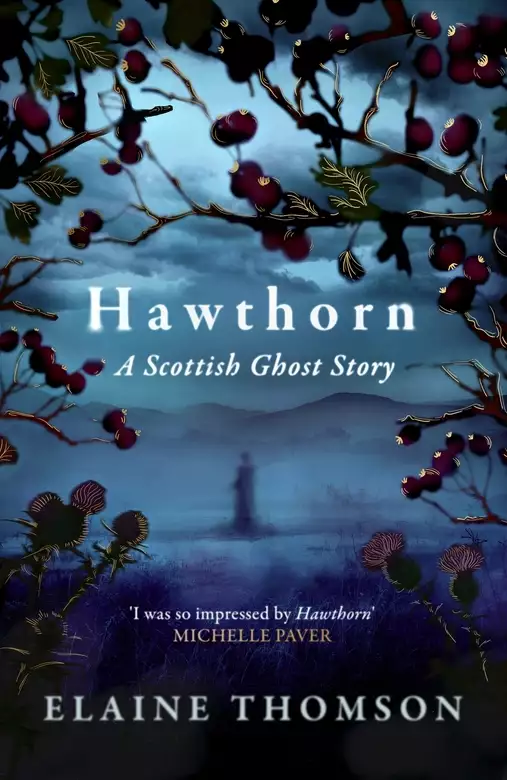
For fans of Michelle Paver and Sarah Waters, the first in a haunting quartet of ghost stories set in the wilds of Scotland.
'I was so impressed by Hawthorn' MICHELLE PAVER, author of Dark Matter
'Delightfully brooding and gloriously gothic, Hawthorn sucked me in like the deepest bog, refusing to let me go' CJ COOKE, author of The Book of Witching
'Reminded me of The Little Stranger . . . a hugely entertaining and evocative treat' BRIDGET COLLINS, author of The Binding
'A new classic' SARA SHERIDAN, author of The Fair Botanists
_________
Caithness, October 1871.
The Ordnance Survey are charting Scotland's most remote north-easterly county, a bleak landscape of endless moorland and lonely crofts. When a strange vision leads cartographer Robert Sutherland out onto the moor, an accident leaves him inches from death. He is taken to Leask House, to recuperate under the care of Mrs Sinclair and her beautiful daughter Isabel.
At first, Robert thinks the dreadful visions that plague him at Leask House are the result of the laudanum he has been prescribed. But as events take ever stranger and more terrifying turns, Robert begins to wonder whether his presence at Leask House is really a coincidence at all.
Someone - or something - has summoned him here.
And they don't intend for him to leave.
Release date:
September 25, 2025
Publisher:
Little, Brown Book Group
Print pages:
90000
* BingeBooks earns revenue from qualifying purchases as an Amazon Associate as well as from other retail partners.
When I consider how I came to be here, in this locked cell, it seems as though my whole life has been predestined; the path that led to me sitting at this desk, with my candle, my pen and ink, my sheaf of paper, has been mapped out since the day of my birth. I am, at present, incarcerated in the Inverness District Asylum – God knows I have had trials over these past weeks that would make any man doubt his reason. And yet I am certain that all I have seen and heard is no figment of my imagination, no fantasy or illusion conjured up by a disordered mind.
To prove this to myself, as much as to those who must act as my judge and jury, I have determined to set everything down as it happened. It will be my own testimony, not as it might be recorded by some foolish clerk who omits the half of it, nor by some self-important medical man who has already determined that I have lost my wits.
And so, herewith follows the true account of the haunting at Leask, set down in his own hand by Robert Sutherland, Surveyor for Her Majesty’s Ordnance during the autumn of 1871, lately of Leask in the parish of Wick, Caithness, but formerly of Edinburgh – and I will claim that fair city as my true home and let the Devil take these wild northern lands, for I swear he is here already.
I was – I am – a geographer. A cartographer, as well as a surveyor, a naturalist, and a man of science whose faith in the ground beneath his feet is as unshakeable as the old red sandstone upon which Caithness stands. I am not a military man, though those with whom I lived and worked are military men – Captain Ashton, Lieutenant Jamieson, Sergeant Walker, sappers Campbell, McAndrews and Doyle.
Our work was slow, painstaking, detailed – as was necessary given the task we had, for we are part of a much grander project to map the British Isles. With every river, bridge, tor, sheep cote and house, every fence, farm, mountain and moss noted and named, the six-inch map, once complete, will be a triumph indeed. England was mapped when the fear of Napoleon nipped at our heels. Ireland was mapped to value its land and buildings for the Crown. But Scotland defies them all, its wild north a place of mystery and secrets that even our instruments cannot unmask.
Of course, surveying the far north is an activity regarded by many in London and Edinburgh as a task whose completion is not worth the time and effort of the men who must undertake it. To what end were we mapping so much empty space? they said. What military purpose would such information serve? Far better to leave the place forever uncharted, the marks left upon it by its savage people ignored and forgotten. And, there were times when we agreed. Trudging over bog and muir, the wind tearing at our pencils as if it wanted to write its own story; the snow – even in May – blown horizontal and stinging like cinders, the rain a whip against our skin. Who amongst us would not rather trip across a lowland hillside, or a gentle Perthshire glen? But map the north we must, and although I have the hands and mind of an engineer, I have the heart and soul of a Caithnessian, for when the weather lets up there is, to me, a serene and savage beauty in those wide skies and watery, barren landscape that is unmatched anywhere.
I remember those days fondly, despite everything that has passed. Indeed, I look back on them now with a longing that surprises me. Wrapped in my coat against the cold, with the endless nights of winter approaching, I crave the long golden days of early autumn, when the heather glowed red and purple, the sky overhead an infinite blue arc, threaded here and there with long skeins of greylag geese. I miss the birds and the flowers, the elegant red-throated diver drifting serenely on the dark surface of Loch Watten, the buzzards hovering overhead, the delicate golden petals of the marsh saxifrage that fringe the black peaty pools of the flows. More than anything, I miss the cold bite of my measuring chain in my hand, the feeling that I am contributing to the creation of something that combines beauty and utility in equal measure. As I write out this testimony, I feel the loneliness of my current situation keenly, and with only my nightmares for company, I long for companionship – Lieutenant Jamieson and his bagpipes, Sergeant Walker’s crude humour, Captain Ashton and his brisk certainties.
We had been in the highlands for months, though September had given us the best conditions for our work. The days were still long, the weather settled, and the flies and midges had gone. We had worked our way north and east, triangulating the land, measuring, sketching, plotting, recording. Amongst other things, I was required to find trustworthy local people – landowners, rather than the impoverished crofters who scratched out a living in the waterlogged moss – who might tell us the names of places and buildings, parts of the landscape and its various topographical features. Hills or crofts, for example, or the name of a sheiling, a broch, a burn or a lochan. These I kept in the Names Book, to be recorded along with their exact position, and later transcribed onto the six-inch sheet. Whatever vagaries of spelling and name existed between neighbours were henceforth eradicated, a single swipe of the pen setting them hard and fast on the map.
‘The place is nothing but bog, Sutherland,’ Captain Ashton said, staring out from our tent at the rain-washed peatlands that stretched east and west, north and south. Only if one looked to the horizon, towards the county that shares my name, did the land rise – low hills rather than the sharp curious peaks of the far west. Their names – Scaraben, Meall a’ Bhuiridh, Ben Griam Beg – sounded harsh on my tongue, harsher still on Ashton’s, who made little effort to hide his loathing for the place, and its people. He sighed as he looked at his calendar, wondering, I knew, how much longer our work would take.
‘You’ll be back in Edinburgh by Samhain,’ I said. ‘If we’re lucky.’
He blinked at me. ‘Can’t you speak English, Sutherland? What in God’s name is Samhain?’ He pronounced it Sow-ayn, a rough approximation of my own pronunciation that I did not bother to correct. Criticising Captain Ashton on his denigration of the Gaelic language was a futile undertaking.
‘All Hallows’ eve to you,’ I replied. ‘The thirty-first of October.’
He shook his head. ‘You bloody lot with your made-up words. No wonder this blasted business is taking ten times as long up here, none of the names for anything or anywhere make sense.’ He seized the Names Book and peered at my writing. ‘Look at this place here. Alt Nam Bree-Ack? Sounds like someone sneezing!’
‘Altnabreac,’ I said, pronouncing it correctly. ‘It means the stream of the trout.’
‘Yes, well, you’d need to be a bloody trout in this weather.’ He thrust the Book back into my hands and pulled out his hipflask. ‘At least there’s one thing your lot are good at. Want a tot before we go out?’
I shook my head. It was all very well for Ashton, he wasn’t the one slipping and sliding out on the bog with the tripod and the theodolite.
‘Go on, Sutherland,’ he urged. ‘Go on, ye wee tim’rous beastie.’ He grinned. ‘You see? I’m as Scots as the next man.’ He tossed me his flask. ‘Take a drink. It’ll warm your bones.’
Although I did not generally enjoy the taste of whisky, I admit that the warmth of it on my tongue and the burn and fume of it in my throat were more pleasant than I had expected. I took another, deeper draught, and handed it back. I was to get a taste for it in the days ahead, and I learned to draw comfort from it. But not then.
Caithness is a county of moods and surprises. The landscape may appear bleak and hostile, but one must be forbearing. One must wait for it to reveal its beauty, for it will not reward impatience. I had been watching the sky as the rain fell. A distinct lightening of the air was occurring, the clouds taking on a shimmering pearlescence as the rain grew softer. And then, as I had known it would, the cascade lessened and stopped.
In the silence we could hear only the sound of earth and water – the chattering of a rivulet hidden in the heather, the throaty gurgle of the moss releasing its moisture into the dark peaty pools – the dubh lochs – that blot the landscape. In the sky, a patch of blue showed where brightness lay. The grey clouds, which not ten minutes earlier had seemed as thick as our coarse woollen army blankets, slipped away to the sea. Even Ashton smiled, for all at once the sun was shining in a washed blue sky, the bog shimmering brown, purple and gold, and sprinkled with diamonds. Before us, against the flat grey skies, a rainbow glowed.
‘Won’t last,’ Ashton said, slipping his hipflask into his overcoat pocket. ‘It never does.’
I breathed in the scent of the wet earth, rich and loamy, yet also fresh and invigorating. It was the smell of moss and water, damp peat, and moist heather stems.
‘Tha turadh ann an-dràsta,’ I said, surveying the retreating clouds.
‘What’s that supposed to mean?’ said Ashton.
‘Turadh,’ I said. ‘There is no word for it in English.’
‘Then why use it?’
‘Because it’s beautiful,’ I replied. ‘Gaelic is beautiful. And it’s well suited to these lands. To this place.’
Ashton grunted.
I waited.
‘Go on then,’ he said. ‘What does it mean?’
‘It’s that silent moment when the air is still after the rain has stopped falling, but before it begins again. That is turadh.’
‘Trust the Scots to invent a special word for when it’s not raining yet,’ he said.
We fell silent again. A hollow gurgling came from somewhere deep in the heather, a few feet east–southeast of where we stood.
‘An caochan,’ I said, pointing to the general direction of the sound. ‘Try it. An caochan. You might find it useful.’
‘Ann coor-chan,’ said Ashton. He rarely attempted to copy my pronunciation, and I hardly managed to conceal my surprise. He sighed. ‘Come along then, man, tell me what it is.’
‘An caochan also has no clear direct translation,’ I said. ‘It’s a stream, but one that’s hidden. Perhaps by the heather, or the bracken. You can hear it, but you can’t see it.’
‘Well, there’s certainly plenty of those,’ said Ashton. ‘Bloody ankle-twisting, foot-soaking things.’ But Ashton had clearly had enough of my Gaelic lessons, for he ducked from the tent and motioned to Sergeant Walker to ready the men. ‘We’ve work to do, damn it all, Walker.’ He shouted, as if the fellow had been shirking. ‘Get those sappers out on that bog!’
I had enrolled with the Ordnance Survey some eighteen months earlier, after a spell teaching geology and natural history at the University of Edinburgh following my graduation. I have always shown a degree of aptitude for understanding the ways in which the natural world could be explained and understood, harnessed for the greater good of mankind. Education has enabled me to become the man I am – logical, rational, and scientific in my approach. To be able to contribute to our knowledge of the world seems to me to be the noblest of undertakings and I have always had a love of the countryside. Growing up in Edinburgh, my guardian, Mr MacKay, had indulged what he termed my ‘newt-collecting pursuits’ – anything that involved being outside, in the Pentland Hills to the south of Edinburgh, or roaming Corstorphine hill to the west. I had spurned Mr MacKay’s dry legal world, though not with any resentment on his part. He had never wanted me for an acolyte, and I was free to choose my own path. So when I told him I was to join the Ordnance Survey and participate in drawing up the six-inch map of Scotland, he nodded and shrugged, barely raising his gaze from his legal papers. ‘As you wish, my boy,’ was all he said. ‘Your life is your own. Your parents always hoped that education would allow you the freedom to choose your own destiny.’
Choose? The word makes me shake my head. For is not our future mapped out for us already, and we are fated to endure it, no matter how we might try to set our own path?
I had thought at first to be sent to Perth and Kinross, counties closer to the Edinburghshire I was used to. But when it came to it, something I could not name pulled me northwards. I chose Caithness, perhaps because it was where my mother had been born and raised. I could remember little about her, and had no recollection at all of my early childhood. No doubt my memories were obliterated by the horror of being sent to an Edinburgh boarding school shortly after her death when I was no more than five years of age. I remember only that I missed her dreadfully, though soon I could no longer recall her face, or her voice. I had but one fragment of her, and I had cultivated it the way one might cultivate a delicate flower, tending it, watching it, frightened in case it died. For she had left me with the memory of her language, her own mother tongue, and when I had first come to Edinburgh I had found solace in being able to recite beneath the bedsheets the Lord’s Prayer in Gaelic, as she had taught me.
When I was aged ten, one of my teachers, a highlander by birth named Mr Oliphant, being from the county of Sutherland himself, had taken a liking to me, and had made it his purpose to school me in the languages of the north. Thus, by the time I matriculated at the University I was passably good at Gaelic and Scots, as well as the Caithnessian dialect itself, something in which Mr Oliphant had a particular interest. I even had a few words and phrases of Norn, the variety of old Norse spoken in the isles of the far north, and once upon a time in Caithness too.
My proficiencies with the languages of Scotland stood me in good stead when surveying the highlands. I could speak to, and understand, anyone. I like to think it gave me a sensitivity for the culture and history of those whose homeland we were recording. And I have never forgotten Mr Oliphant’s version of the Lord’s Prayer in Norn. I can still recite it now, though it no longer brings me the comfort it once did.
After our Gaelic lesson, under instruction from Captain Ashton I went out on to the flow with five men – Lieutenant Jamieson, Sergeant Walker and three sappers. Other groups of men were spread out at intervals across the landscape, whilst the rest of our company was some two miles further to the west. We had not seen them for two days, though now, with the rain stopped at last and the air clearing, if I held my scope to my eye I could see them, tiny black stickmen moving across the bog with their chains in their hands, their brass theodolites catching the sun in a golden blink.
For five days it had rained without pause, and the land was sodden. Walker and I, with the sappers, made our way out on to the wet moorland. I had already made a note of the land in the Names Book. A crofter from Camster had told me that the area ahead of us was known as the Flows of Leanas, Leanas being a swampy plain, with the area in question a sort of rough green pasture that straddled the parish boundary of Wick and Watten. A large tract of marshy moorland, I had written. Similar in every respect to the dubh lochs in other parts of this district, it is extremely dangerous to cross unless one is acquainted with the nature of the ground. Cattle and sheep are very often lost in these dubh lochs.
The land was indeed treacherous. Walker stepped on ground that appeared firm, and immediately found himself up to the waist in black bog water. We hauled him out, only for me to suffer the same some twenty paces further on: startled by the sudden appearance of an otter at my feet, I lost my balance and plunged, along with my compass, notebook and pencil, into the same black peaty pool.
I was dragged out by Walker and two of the sappers, Lieutenant Jamieson being face down in the mud some three yards behind us and unable to offer his assistance. I recall lying side-by-side with Walker and Jamieson, sprawled on the sodden moss that grows in abundance in these wet and boggy places, the three of us staring up at the sky. And then the rain began pouring down upon us once more, so that I felt as if I would take root, the moss curling up around me, consuming me the way it consumes everything – rocks, fence posts, walls – until nothing but my face, upturned to the falling rain, was visible.
Before supper I sat and smoked with Captain Ashton, Lieutenant Jamieson and Sergeant Walker. Fuller, Ashton’s batman, had hung my wet clothes above the stove, and the air was heavy with a steamy miasma of wet tweed, canvas and leather. Out of all of us, Ashton was the only one who had not taken a baptism in the mud that afternoon.
‘You’re too heavy on your feet, gentlemen,’ he said, sitting back and resting his boots upon the stovetop. ‘You see I have dry boots, dry puttees, dry britches. And why do I have these things? Because I watch where I am putting my feet. Have you learned nothing after all these months? You cannot trust what you see, or what you think you see. What looks dry may well be wet. What appears firm will almost certainly be soft. The very land itself is against us, gentlemen.’ He sucked on his pipe and grinned at us through a cloud of blue-grey smoke. ‘And my final piece of advice? Never, ever, trust a pool of black water.’
Walker, Jamieson and I grumbled that we knew all that, that in fact we knew far more about it than he. ‘Besides,’ said Jamieson, ‘I heard you took a full dook only last week. Walker here said he thought you were going for a swim.’
‘Is that stink coming from your socks, Sutherland?’ said Ashton, pointedly changing the subject. He addressed his batman. ‘Fuller, do you have a ripe French cheese in your pocket, or is the smell actually coming from Mr Sutherland’s socks?’
‘It’s the socks, sir,’ said Fuller, his face serious. ‘I don’t think any cheese, even a French one, can hold a candle to Mr Sutherland’s socks.’
‘I imagine the gas they’re giving off might cause an explosion if a candle went anywhere near them,’ retorted Ashton. ‘Good grief, Sutherland, can’t you do something about it? I consider it an honour to share quarters with you, sir, even if they are no more than this squalid tent, but I really can’t say the same about your footwear.’
‘They’ve not been dry for about a month,’ I said. ‘Socks and boots both. I think they’re starting to rot.’ I stared pointedly at Fuller. It was his job to dry my things after a day on the bog, not mine. But the fellow had turned away and pretended not to notice.
The evenings were still light, for it was early in the month of October, and after supper I set out my camera. I had suggested the camera to Captain Ashton when we were in Edinburgh and planning to leave for the north – would it not be useful, I said, where drawing failed, to ensure accuracy and speed up our work? Ashton was happy to approve anything that might hasten our job, and my equipment and I had been loaded on to the train without further question. But the truth of it was that the camera was heavier and bulkier and less useful than I had hoped. Rather than using it to enhance the survey, therefore, I employed it for recreational purposes.
I still have the picture I took that evening, a calotype developed and fixed in my portable dark tent. It shows everyone but myself – I was the one behind the camera – and I have it before me now, as I write. It was the last warm evening of the year, and the men were sated from a supper of salt beef and potatoes, smoking in the evening sun and warmed by the generous ration of whisky that Captain Ashton allowed. There is Walker with his upright posture and walrus moustache. Ashton, tall and slender, his handsome face caught in a rare smile, his stick in one hand, a canteen of whisky in the other. There too is Jamieson, a small man dwarfed by the bagpipes which he insisted on playing whilst I took the picture. The evening light was surprisingly good – a pale gold – and the image came out well. We were up later than usual, for the weather was unseasonably warm, and after so many days of rain we were glad to be able to sit outside. Something unusual occurred that October evening, and I will record it now though I thought nothing of it at the time. One of the sappers, Campbell, returned from the latrine said that he had seen a woman out amongst the dubh lochs. ‘Just standing there, looking over at us.’
‘Probably a crofter’s wife,’ I said, for I had seen a group of crofts far to the north, the smoke from their black houses a faint smudge on the far side of the bog.
‘Probably nothing at all!’ Walker gave a guffaw. ‘That’s how desperate you are, Campbell. Seeing women everywhere you look!’
But Campbell looked serious. ‘She was an old woman, sir,’ he said. ‘With grey hair. Too old to be out in the gloaming in a place like this. When I looked again she’d gone, sir. D’you think she’s fallen in? Should we go and look for her?’
‘The last place you want to be is out on that bog in the half-dark, Campbell,’ said Captain Ashton. ‘It’ll be a crofter woman. The locals know these bogs the way you know the tenement stair back in Leith! Either that or it’ll be that woman you were telling me about yesterday, Sutherland. The mythical hag.’ He laughed.
‘You mean the Cailleach?’ I said. ‘The veiled one?’
The men stared at me. Campbell looked nervous, for the shadows were growing longer and a chill had set in. Behind him, far out on the bog, a pale light quivered. Marsh gas, no doubt. ‘Don’t worry, Campbell,’ I said, ‘the Cailleach doesn’t want the likes of you. Just don’t try to follow her – especially if she transforms herself into a deer.’
‘Why’s that?’ said Campbell, who was forever watching the deer through his spyglass and meditating on the delights of venison.
‘Because she’ll lure you away and you’ll end up drawn down into the underworld, that’s why,’ I said. ‘So the legend says, at any rate.’
‘I know! Why don’t you tell us a little bedtime story, Sutherland?’ said Ashton. ‘Tell us about the Cailleach. The old woman of the hills. It’ll be like being back in the dorm!’
It was evident to me that the sappers had no idea what it might be like ‘in the dorm’, but I proceeded anyway.
My telling was prosaic. I am not a man to embellish, as this account will testify. Besides, my version of it came from Mr Oliphant, and I did not have his gift for narrative.
‘The Cailleach can be many things, Campbell,’ I said, ‘and she changes into a deer only when she is feeling threatened. Usually, she takes the form of a hag of great age, leaning on a stick.’
‘Yes!’ cried Campbell. ‘Yes, that’s exactly what I saw!’
‘As crabbed and bent as a lonely hawthorn on a blasted heath.’
‘Yes!’
‘My dear Campbell,’ I said. ‘You do know that there is a lonely hawthorn on the blasted heath over by the latrine?’
The men laughed. Campbell turned red. He glowered, and muttered, ‘It was not a hawthorn tree that I saw, sir.’
‘Carry on, Mr Sutherland,’ cried Ashton. ‘The crabbed hag on the blasted health luring Campbell into the latrine. Or was it the underworld? Both pr. . .
We hope you are enjoying the book so far. To continue reading...

 Please log in to recommend or discuss...
