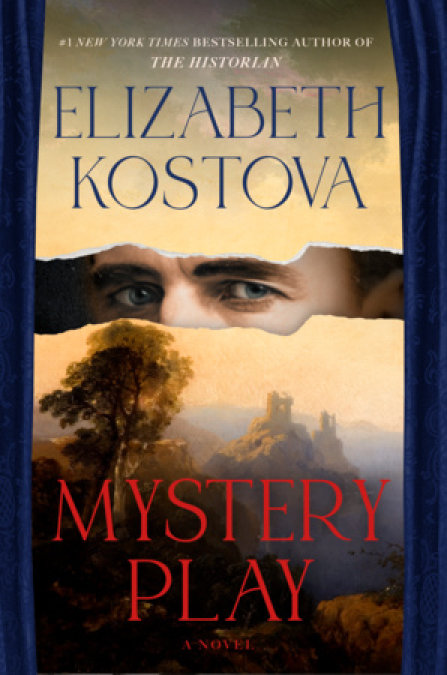
The last living member of a family of historians who has been hunted by dark forces associated with Dracula finds himself in peril at the hands of a new threat in this thrilling novel from the #1 bestselling author of The Historian.
After his beloved mother passes away suddenly, Jay Turner finds himself at a crossroads. She was always secretive, and when he returns to their Boston home to clear out her possessions, he finds an unusual item: a partially burned scrap of newspaper bearing the name “Gael Brogan.” Soon after, a deliveryman leaves behind a package containing a small antique volume bound in leather—and two bloody footprints.
The sight of the volume is chilling. As a young scholar, his mother had been given the medieval book—one of a set commissioned by Vlad Țepeș, otherwise known as Dracula, just before his death in 1477. She'd always warned Jay of the dangers associated with it, and had donated it to a museum before she died . . . yet here it is, back in his possession.
Jay sets out to learn more about Gael Brogan, a prominent nineteenth-century actor whose last and most famous role was based on Bram Stoker’s Dracula. As Jay begins to dig deeper—with the help of a mysterious woman named Rhiannon—he uncovers the frightening story of a young actress who fell under Brogan's sway long ago. Before long, Jay and Rhiannon realize that something similarly implacable is pursuing them.
In this epic and riveting tale, Elizabeth Kostova takes us deep into the Gilded Age of the theater and across the Atlantic in pursuit of an ancient evil and its dramatic followers.
Release date:
October 13, 2026
Publisher:
Ballantine Books
Print pages:
592
* BingeBooks earns revenue from qualifying purchases as an Amazon Associate as well as from other retail partners.
The traffic into Boston that morning was insane—and the March day as raw as any had been all winter—but I hardly cared. I could think only of the dismal task that lay ahead of me. I had no siblings to share it with, and for months I'd been keeping my friends at arm's length. In fact, the head of the school where I'd taught for six years had suggested I take a "break" the following semester, without putting the words mental health in front of that proposition.
My mother had left me everything; at first that hadn't been much, but when I decided to sell her South End apartment, it suddenly amounted to quite a bit more. She'd bought into the once-elegant building before I was born, and before it had become expensive again; she was fond of pointing out the date carved on a rectangular stone above the front door: 1887. The height of the Gilded Age, she liked to say, as if relishing the contrast between that phrase and our rather seedy surroundings. My key got stuck for a moment, as it always had.
That spring, I was twenty-nine—old to be so much in the dark about what I wanted to do with my life, but too young, I felt, to begin settling down in earnest. This is the conundrum of those raised with just enough shelter to drift a little but not the means for full-scale wandering. I'd always known that my post-college job as a history instructor at Kitterly, a boarding school in western Massachusetts, was a waystation. Long before I'd been invited to take a semester off, my work there had begun to chafe me with a sense of bigger things undone, of my separation from something important.
Above all, my mother's death the year before had left me empty. Or perhaps I'd simply become quiet—way too quiet. Even my funny, smart colleagues inviting me to play hockey on the flooded tennis court couldn't wake me up. I could see them exchanging glances across the tables of the Kitterly town pub. But I couldn't explain to them, or anyone, the shadow I felt reaching over me on even the most brilliant New England days. I'd had a girlfriend there for a year or so—an interesting and lively woman who worked at an art museum in the next town. She'd broken up with me several months after the funeral. She was frustrated, kind, apologetic, but I couldn't even feel the misery of being dumped. My teaching wasn't going well, either. I found it especially difficult to concentrate on the usual parade of student essays: the assassination of Lincoln in my American History class, or the horrors of colonialism in the course my students always called "Euro."
In fact, the more I grieved my personal loss, the more history itself seemed to me one long collective sorrow; I began to wonder why we were all so eager to pass it on to the unsuspecting young, who might still have time to daydream about their heroic futures. The winter Friday evenings when we had cocoa and visiting speakers by the common-room fire—an English businessman with eyebrows like tropical caterpillars discussing his career in Singapore, or an acrobat describing his early days with Cirque du Soleil—none of this seemed to break the long school weeks or lighten the hollow weekends. And when I'd fallen silent one time too many at the whiteboard in my classroom, word reached the head of school about what I could have told him myself: Social, cheerful, "fun" Jay Turner had gone dark.
I can see now that part of the problem was my general lack of family. My mother had raised me alone and had given me all the best of herself—the kind of gift we tend to understand too late. She'd taught history for many years at one of the country's most august universities, and the two of us lived in our own small world of books, music, conversation, summer vacations in a comfortably run-down cottage in Maine. By the time I was a scrawny boy of eleven, I was better suited to sit through an opera than to converse with other children at recess; and by the time I was a regrettably awkward fifteen, my mother and I had read all of Dickens aloud to each other.
At this point, I'd like to be frank about the other half of my parentage. My mother had wanted a child without wanting a husband, and I was born while she was busy building her academic career. I wondered as a young adult why she hadn't carried out this project while her father, Paul, was still there to enjoy a grandchild; I appeared fifteen months after he died on his last diplomatic mission to Bosnia.
My own father had been an old friend of my mother's, unnamed by her and long deceased by the time I was aware of the world. He'd served as her "donor," she'd informed me once, and she wanted to respect his privacy. I suspected it had been a medical arrangement, something involving a clinic and a refrigerator. And I knew she'd given me my own last name, after one of her favorite painters, so I could be completely and independently myself, she said.
Before she died, I didn't want to know more, or perhaps I'd simply chosen not to disrupt our companionship with questions. My mother was parent, friend, and teacher, and her death from a rapid and rare condition when I was twenty-eight was the greatest loss I could imagine. An only child raised by a single person experiences desolation that is nearly impossible to describe, on being left alone—she'd known this all too well herself.
When she died, I was more than orphaned.
We hope you are enjoying the book so far. To continue reading...

 Please log in to recommend or discuss...
